
BESSIE DULLER (1896 – 1981)
(formerly HYAMS and later NIGHTINGALL)
RACING MOTORIST (and many other things)
Bessie Grace Hyams was born on 13 December 1896, the daughter of racehorse trainer George Godfrey Hyams and his wife Grace Helen (née Wood, and a sister of the music hall star Marie Lloyd).
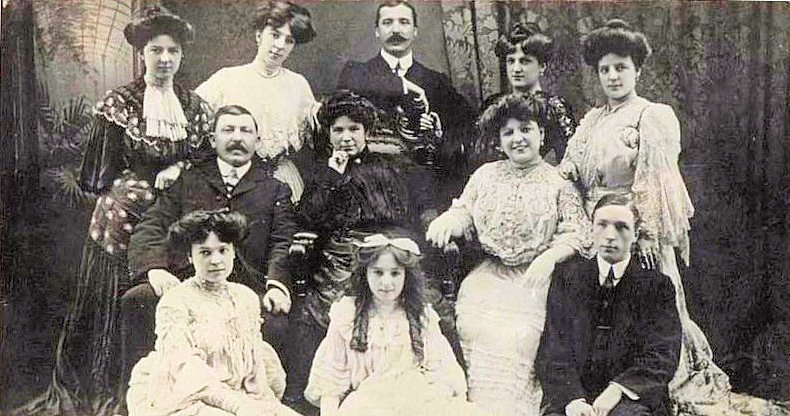 The Wood family c.1900. Grace Helen (Mrs Hyams) is second right
in the back row and Marie (Lloyd) is centre row right.
Image source: Wikimedia Commons.
In 1918 Bessie married champion National Hunt jockey, and subsequently trainer, George Edward Duller, who became heavily involved in racing cars, and she too developed a keen interest in the sport, as well as her existing involvement with horses and a love of Alsatian dogs. During the inter-war years the British car racing fraternity was centred on the Brooklands track at Weybridge – the museum and site make a great day out, if you’ve never been. Anyone with even a peripheral interest in old motors may well be aware of the fabulous cars of that era and household names such as Malcolm Campbell, but perhaps we don’t know much, if anything, about ladies who raced: they had actually been doing it since 1897, believe it or not, when the first ladies’ motorised tricycle event took place.
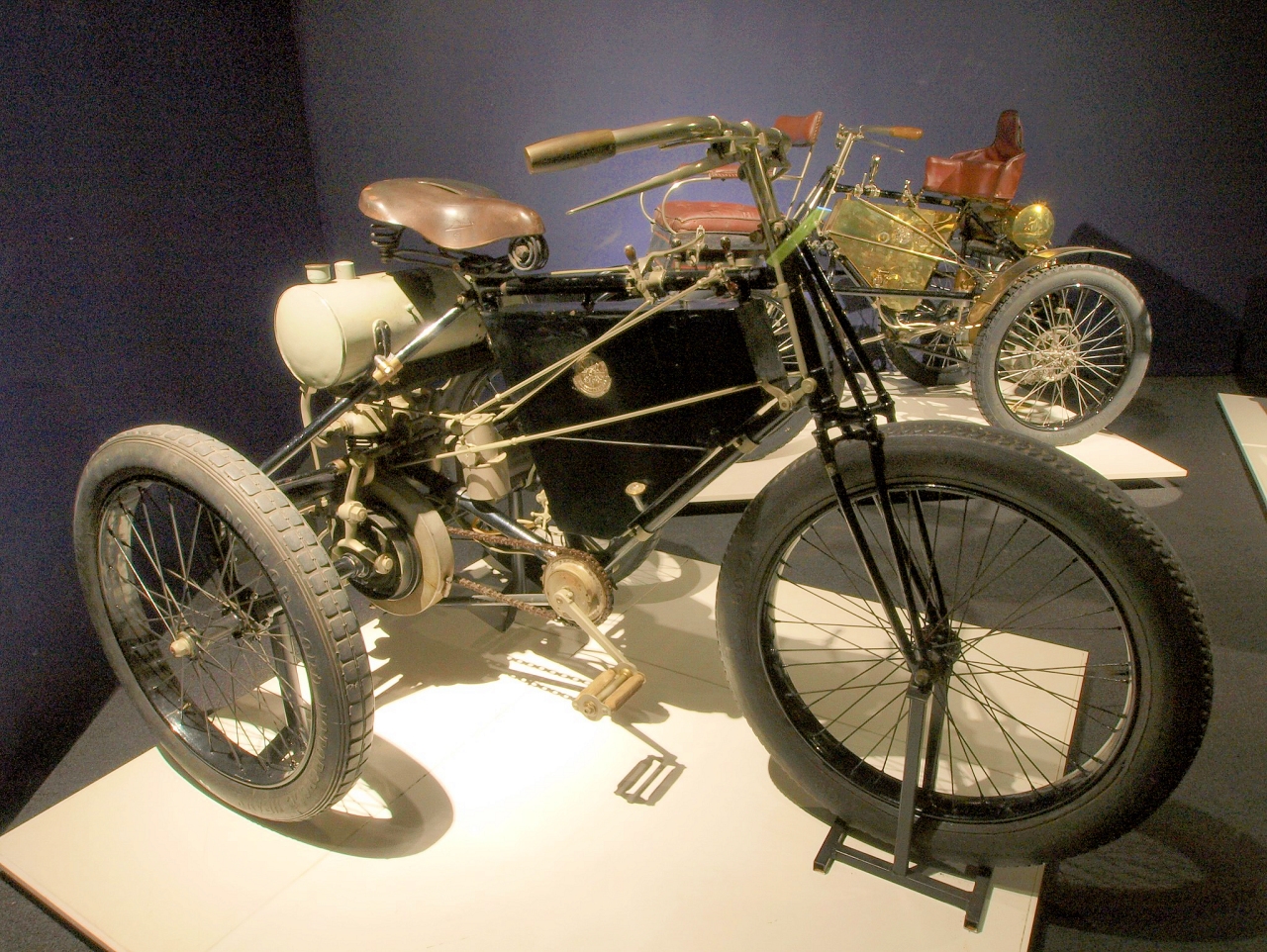 1900 De Dion-Bouton tricycle in the Louwman Museum, Netherlands.
Photo by Alfvan Beem via Wikimedia Commons
The lady racers
Up to about 1910 there were few races for ladies but one person who made an international reputation for herself was Frenchwoman Camille Du Gast, who came 30th in the 1911 Paris-Berlin race driving a 20hp Panhard. When she had to stop racing cars, because of legal restrictions in France, she took up speedboats. Camille was an amazing and colourful woman, who was almost murdered for her money by her own daughter, and her biography on Wikipedia is well worth a few minutes of your time.
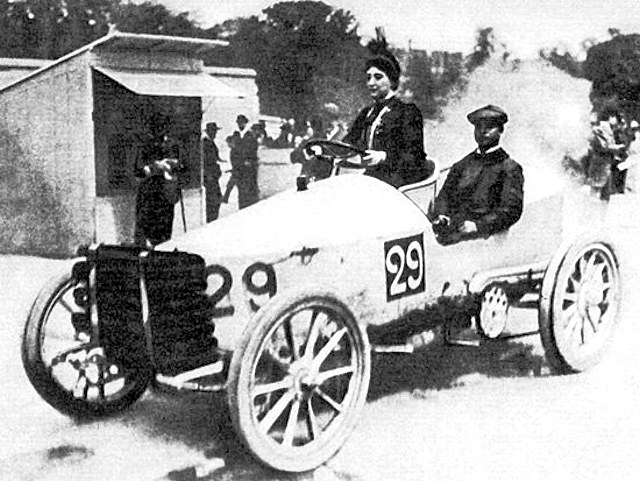 Camille du Gast in the 1903 Paris-Madrid race driving her 30hp De Dietrich
(her ramrod posture was apparently due to the unyielding nature of contemporary corsetry).
Image source: Wikimedia Commons.
The top Englishwoman of that era was Dorothy Levitt, who began her career in motor boats and in 1903 set the first water speed record, in a craft with a Napier engine. The dress fashions might be worthy of an article in themselves!
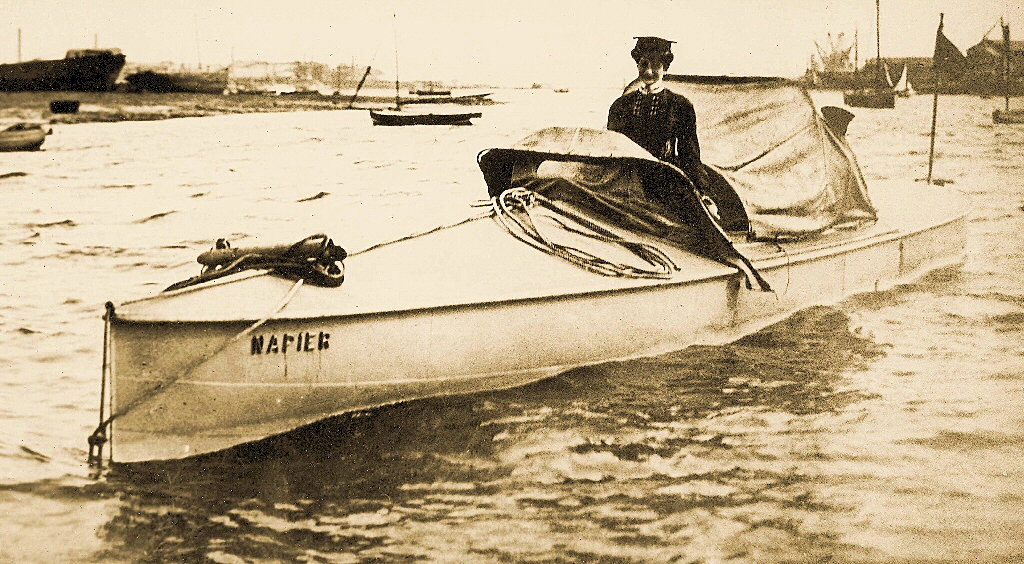 Dorothy Levitt steering the Napier 1903
Image source: Wikimedia Commons.
Dorothy was not active in car racing for very long but made a success of it, one notable victory being in the inaugural Brighton Speed Trials of 1904.
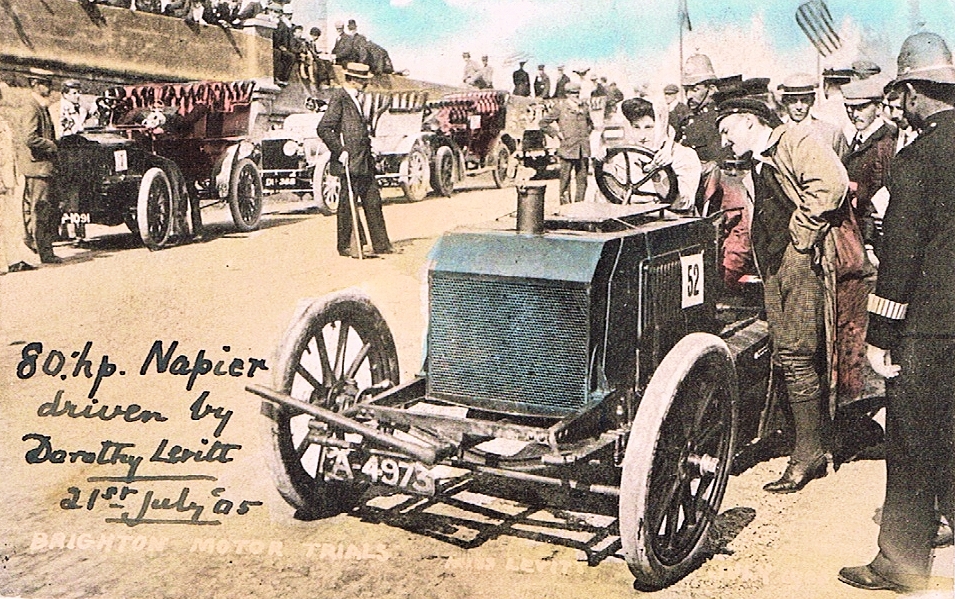 Dorothy Levitt in a Napier at Brighton, July 1905.
Image source: Wikimedia Commons.
In 1906 she broke the Women’s Land Speed record in a Napier, with a speed of about 91mph: this was achieved over a flying kilometre at the Blackpool motor carnival and the mark stood until 1913.
Nothing much happened in ladies’ racing during the First World War years but, as we know, many women drove ambulances and other essential vehicles on the Front, including Gwenda Glubb/Janson/Stewart/Hawkes (she had several husbands – see later). Gwenda was the sister of John Bagot Glubb, known as ‘Glubb Pasha’, commander of the Arab Legion throughout the Second World War.
Note: The Derby car company, based in France, existed from 1921 to 1936. In 1930 the racing driver Douglas Hawkes bought in to the company and worked on Gwenda’s cars, which, to cut a long story short, is how another Gwenda divorce occurred and she became Mrs Hawkes. All of Gwenda’s husbands were connected with motoring in some way.
Gwenda broke the one-hour speed record several times and had an ongoing rivalry with the Canadian driver Kay Petre, who was a big star at Brooklands. Just 4 feet 10 inches in height, Kay drove massive cars like the one pictured below.
 Kay Petre, pictured in 1934
by Unknown photographer
4 3/4 x 3 1/2 inch glass negative, 1934
NPG x138931 © National Portrait Gallery, London
Incidentally, Gwenda sometimes drove in races with both George Duller and his younger brother Jack.
Bessie and the cars
Fortunately, a few years before her death, Bessie, then Mrs Nightingall and a widow, gave a long interview to Jonathan Wood of ‘Thoroughbred and Classic Cars’ magazine (December 1976 edition), so we know a great deal about her racing career. Almost all of it was wound up with the exploits of her then husband, George Duller, and their mutual circle at the time, but she gave a fascinating insight into the life they led and the big names they knew.
Soon after George got into motor racing and was part of the Brooklands scene, Bessie decided to try it herself and acquired an Amilcar, followed by an Austin 7 that she obtained from Captain Arthur Waite, son-in-law of Herbert Austin, founder of the Austin Car Company: these were fairly light and small for racing cars, but they could pack a punch in their day.
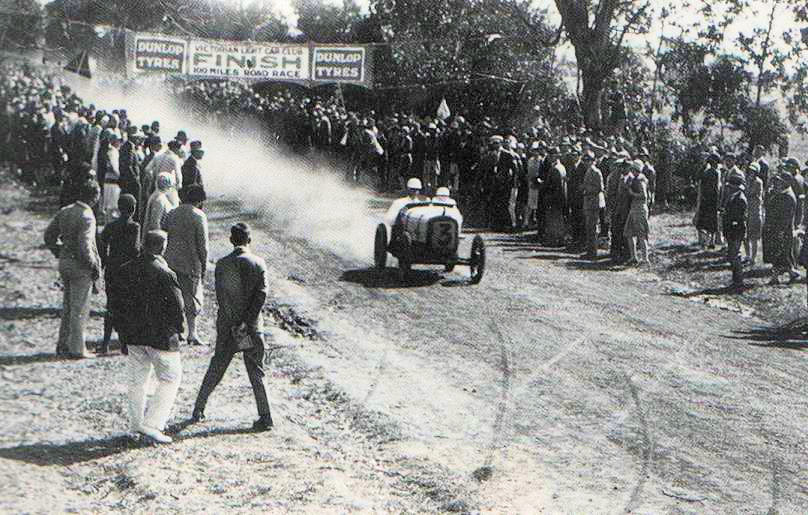 The Austin 7 of Arthur Waite contesting the 1928 100 Miles Road Race at the Phillip Island road circuit in Victoria, Australia. The race, which was later to be recognised as the
first Australian Grand Prix, was won by this entry.
Image source: Wikipedia
Bessie had some success in the Amilcar and in 1923 was ‘spotted’ by Parry Thomas (John Godfrey Parry-Thomas) who had designed the Leyland Eight.
Parry Thomas had left Leyland by then and set up his own operation; he lived at the Brooklands circuit. And one day he said Bessie could try out his car if she wanted. In the magazine interview she recalled her response as ‘what, me drive that, but I’ve only been used to these silly little things’. Nevertheless she gave it a whirl, with Parry Thomas beside her, and found it a far different proposition from what she was used to. However, according to an advertisement which appeared in various newspapers in the 1920s, she had some medicinal assistance from Phosferine, a popular tonic wine which purported to ‘soothe frazzled nerves’.
Later in 1923 Bessie attempted to break the ladies’ unofficial 100 mile speed record (which roughly equated to 37 laps at Brooklands) in Parry Thomas’s car, with George Duller in the passenger seat. The record up to then was an average speed of 75 mph. Bessie did an average of 90 mph and blithely said, in effect, that once she had got to the appropriate pace she kept an eye on the speedometer and then it was just a matter of going round and round the track 37 times. If you haven’t seen the track ‘in the flesh’, it is very steeply banked in places and is hardly just a matter of ‘going round and round’ in a big, heavy car at that kind of speed.
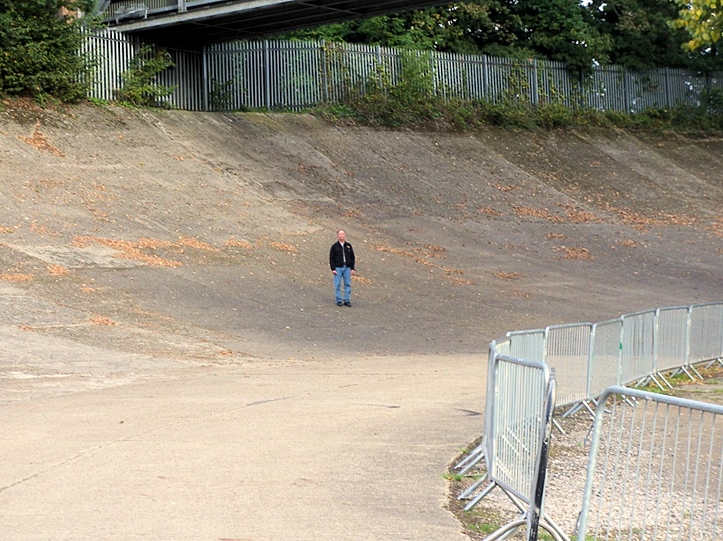 Part of the Brooklands banking, photographed in 2010 (note the scale of the man to the track).
Image ©Linda Jackson 2021
Sadly, Parry Thomas was killed at Pendine Sands, on the shore of Carmarthen Bay, in 1927, whilst trying to regain his world land speed record from Malcolm Campbell, and he was recalled very fondly by Bessie, who had given him one of her Alsatian pups, which he named Bess.
Another great friend of Bessie and George was Sir Henry Segrave, who lived with his wife, Doris, on Kingston Hill. On 13 June 1930 Segrave broke the world water speed record with his first two runs on Lake Windermere and then tried one run too many. The boat, ‘Miss England II’, capsized at full speed, killing Segrave, aged only 33, and his chief engineer.
The Dullers spent many weekends at house parties in the home of Woolf Barnato, which was a mansion at Lingfield called ‘Ardenrun’. However, despite the fact that Woolf was so heavily involved in motor racing, Bessie said that most of the guests were people from showbusiness, including Fred Astaire on occasion.
Bessie’s motor racing career petered out in the late 1920s when George went to ride in the USA for a while and, after their return, they moved to Wantage in Berkshire, but then went back to Epsom in the 1930s and were eventually divorced. In 1951 Bessie married Epsom trainer Walter Nightingall (died 1968).
Asked what car she liked driving best, Bessie plumped for George’s Bugatti. She ended the interview by saying that ‘the marvellous thing about Brooklands was that it never seemed to shut, there was always something going on there. They were wonderful days’.
Bessie died on 17 May 1981, her final address being 58 Longdown Lane North, Epsom.
Linda Jackson 2021