
James Lucett (c. 1771 – 1851),
self styled ‘Professor for the cure of insane persons’.
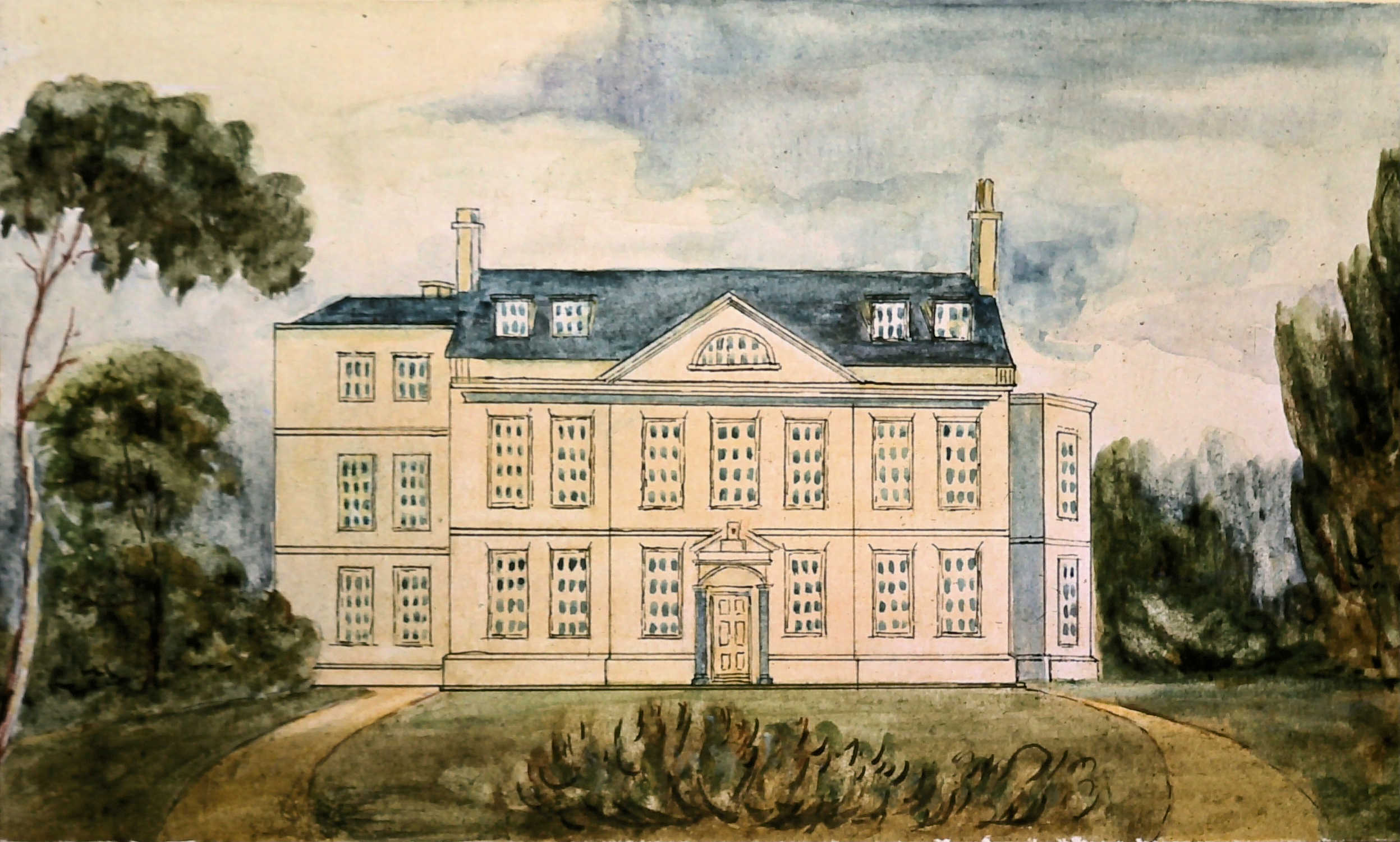 Ewell Parsonage House, formerly on the site of Glyn House Church Street Ewell.
Image courtesy of Epsom & Ewell Local & Family History Centre
According to the Medical and Physical Journal (1814), Lucett’s first patient, treated conjointly with E Tardy, surgeon, of Marchmont Street, Russell Square, London, was Mr Morgan, Editor of the Dublin Correspondent newspaper, in September 1811. The ‘process’ then involved ‘warm immersion and warm affusions on the head, conducted in such a manner, by a considerable column of water, as to produce a slight concussion upon the shaven vertex [highest point of the head]’. Temperature of the water could be varied in relation to the ‘exigency’ of each case.
The Monthly Magazine of 1 June 1813 reported that Messrs. Delahoyde and Lucett of Sion Vale, Brentford, had been successful in the treatment of some cases of insanity. It was said that Mr Lucett, who for many years had been a clerk in the Bank of England, received details of a secret process from a German physician on his death bed and became associated with Dr Charles Delahoyde, a regularly trained Surgeon, to provide this treatment for patients. Details were provided of the ‘rapid cure’ of particular individuals and patronage sought from the Duke of York.
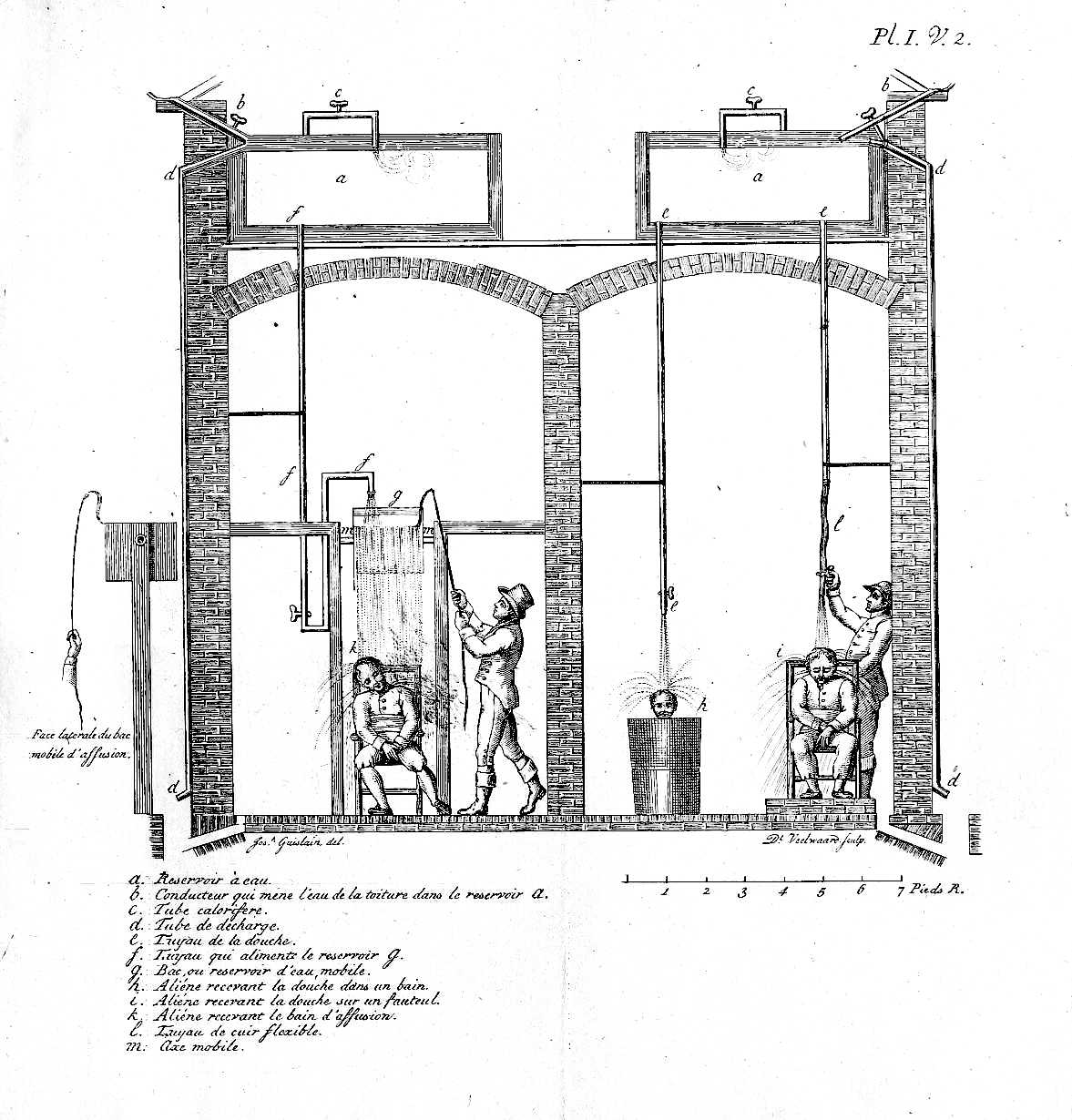 Drawing showing use of hydotherapy equipment in the treatment of mental illness
Click Image to enlarge
Image source: Traité sur l’alienation mentale et sur les hospices des aliénés 1826
Subsequently
‘a committee, consisting of several royal personages, and many noblemen and gentlemen, [undertook] to make inquiry into, and to ascertain the extent of the means employed by Messrs Delahoyde and Lucett for the cure of insanity; and they…selected four incurable patients from the Government receiving-house at Hoxton, in order to put the process to the severest possible test. Dr Harness (the Commissioner of his Majesty’s navy) [was] one of the present committee, and he, very judiciously, suggested the selection of the most confirmed lunatics from the government asylums’.
Following the Committee’s first report, Messrs Delahoyde and Lucett, ‘under a pledge upon honour of secrecy, communicated to their Royal Highnesses the Dukes of Kent and Sussex, and to Dr Harness, their process for restoring insane persons to sanity’. On 19 February 1814, however, Dr John Harkness wrote to William Wentworth-Fitzwilliam, 4th Earl Fitzwilliam: he enclosed a report on Delahoyde and Lucett’s patients. lamenting that although much temporary relief was obtained they had relapsed to remain highly deranged.
The partnership relocated from Brentford to Ealing during 1813. In the following year this relationship was terminated and Delahoyde removed himself to Dublin. On18 May 1814, Mrs Olivia Lucett, the wife of James Lucett wrote to to Fitzwilliam, on behalf of herself and children, complaining that her husband was in the King’s Bench for Delahoyde’s debts.
Lucett resumed business from a house at Datchet, near Windsor, but within twelve months moved again, to Weston House , Chertsey, accommodating 3 female patients, There, in 1815, he published a book explaining why there had been no extension of his curative methods ‘for relieving and curing Idiocy and Lunacy and Every Species of Insanity’.
The Morning Post from 14 February 1820 contained an advertisement:-
“INSANITY CURED, Weston House, Chertsey, Surrey. The success which has been attendant upon Mr. LUCETT’S ESTABLISHMENTS theseTen years past, in the various shades of MENTA L DERANGEMENT and the restoration to health of so many persons who had, previously to their being placed under his care, been certified incurable by the most reputed eminent men in ihis particular line of practice, are proofs so strong, that to say more on the subject of this important discovery would be superfluous.”
Another followed in The Times:-
October 12th 1822
UNDER the Patronage of the Right Hon. the Earl of Liverpool &c., – INSANITY CURED – Mr LUCETT has the satisfaction to announce to the public his unprecedented success in the restoration of ladies and gentlemen after every advice, for years, that money could procure, had been obtained without any beneficial effect; and further, to prove the importance of this discovery, he has taken out of Bethelem, St. Luke’s, and various other, private mad houses, persons, all of whom had been pronounced by their physicians to be incurable, which certificates may be inspected, who have been restored by him to their respective families. Mr. Lucett may be consulted, in all cases of insanity, personally, or by letter, post paid, at his residence, Rectory House, Ewell, Surrey, (late of Chertsey,) and limits the number to six, and which he receives upon the principle of cure only. The use of a carriage if required.”
There had been objections to a licence being granted for keeping insane persons in the house lately occupied by Lady Glyn by Ewell Church Vestry but Mr Lucett had previously obtained a licence for the stated purpose at the Reigate adjourned Sessions on the 18th day of May 1821. Having re-invented himself as a ‘Professor for the cure of insane persons’, however, Lucett entered insolvency proceedings during 1822.
By 1825 he is found in Mitcham a partner with William Antonio Rocher and others at The Recovery (formerly The Retreat) private asylum on The Green. This business also became insolvent by 1828.
James Lucett had moved on to Brompton Villa, Old Brompton where he became involved in the tragic suicide of Rev Brackley Charles Kennett, as reported in The Times 17 December 1830: –
“On Sunday his insanity icreased to such a degree that his family applied to Professor Lucett, of Brompton Villa,…who immediately attended the deceased, and remained with him on Sunday, Monday, and Tuesday. On Wednesday the deceased was again visited by Dr. Johnson, who advised that he should be placed under restraint. Lucett, however, disapproved of this mode of treatment, observing, that he had attended a great number of persons labouring under insanity of the same character, and never resorted to coercion, finding that he could effect more by soothing and gentle means. Dr. Johnson then waited upon the wife of the deceased, and remonstrated with her on the removal of the deceased from his care, and Lady Sheffield was prevailed upon to interpose her influence for the purpose of removing him from the house of Mr. Lucett. She accordingly drove to that gentleman’s house, bringing with her a keeper, seated on the box of her carriage, intending to remove her brother, and again place him under Dr. Johnson’s care. The deceased, however, preferred remaining with Mr. Lucett, and, suspecting the purpose for which the carriage had been brought, implored her, in the most forcible terms, not to remove him, at the same time declaring that if such a step were taken, he would terminate his existence. Lady Sheffield, however, preferred acting under the advice of Dr. Johnson, and having, with great difficulty prevailed on the deceased to enter her carriage on Friday, Mr. Lucett, at his eamest request, joined him, and they proceeded to Mr. Kennett’s house, at Kensington. In the afternoon, when the deceased quitted Mr. Lucett’s company for a few moments, that gentleman left the house, cautioning Lady Sheffield to keep a strict watch upon the deceased, and expressed his opinion that as soon as he found he (Mr. Lucett) had quitted the house he would destroy himself. Shortly after, the deceased went into one of the upper rooms, where his mother then was, and catching up a pair of scissors which lay on the table, plunged them into the jugular vein, and continued extending the wound, until he sunk to the ground exhausted from the loss of blood. Mr. Lucett, who gave evidence before the jury, said that when the deceased was at home on Thursday night, he conducted himself in a very rational manner, and joined in a game at whist, playing with the science and judgment of an experienced hand. He considered it highly improper to remove the deceased fom his care, particularly as he had stated that he had experienced great benefit and comfort while under his (Mr. Lucett’s) protection. The jury, after a short consultation, returned a verdict, that the deceased was insane when he committed the act”.
Dr Johnson wrote a letter to the newspaper disputing the account and concluding:-
“Such, Sir, are the facts, from which a puffing tale has been made out by Mr. Lucett. It is fortunate that lunatics are under the protection of the law, and that fools only are exposed to quackery. The Commissioners are taking effectual measures to prevent the public being gulled by the ‘system’ and the secret nostrums for the care of insanity, whilst ‘Professor’ Lucett is puffing off through the medium of the newspapers”.
A scathing criticism of Lucett, under ‘Quacks and quackery’, followed in the 25 December 1830 edition of The London Medical Gaxzette .
With his reputation in tatters Mr Lucett seems to have retired: he was living in Camberwell during 1841 to expire there ten years later. Mrs Olivia Lucett survived him until 1864.
Brian Bouchard April 2021