
The Right Honourable
Sir Harry Braustyn Hylton Hylton-Foster MP (1905-1965)
Speaker of the House of Commons (1959-65)
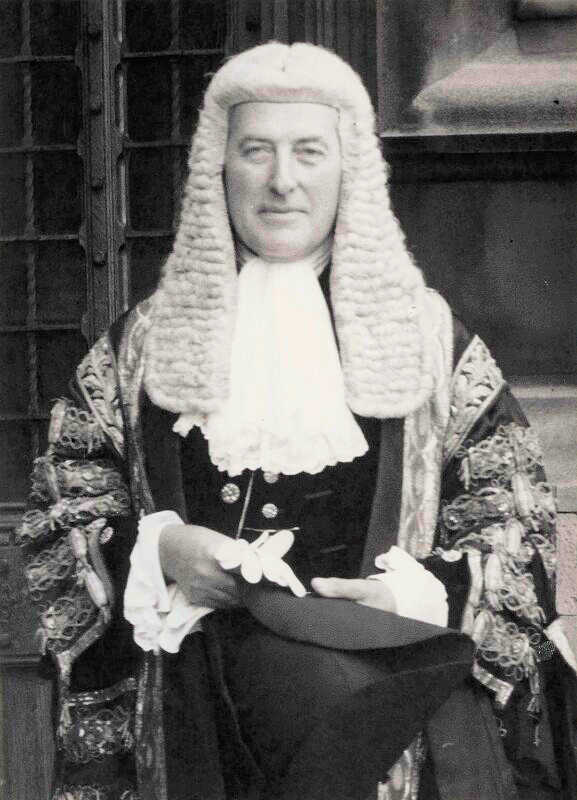 Sir Harry Braustyn Hylton Hylton-Foster in his Speaker’s regalia.
Bromide print by Elliott & Fry, 25 November 1960
National Portrait Gallery image x89912 (CC BY-NC-ND 3.0)
Harry was born in Ewell on 10 April 1905, the first child of the identically named Harry Braustyn Hylton Hylton-Foster and Margaret Isobel (née Hammond-Smith). The parents had married in Q4 1903 (registered in Kensington) and set up home at Woodgate in London Road, just SW of its crossing the Ewell Bypass. (As set out in the Appendix, this identically named father and son is not the only source of potential confusion in this family’s history.)
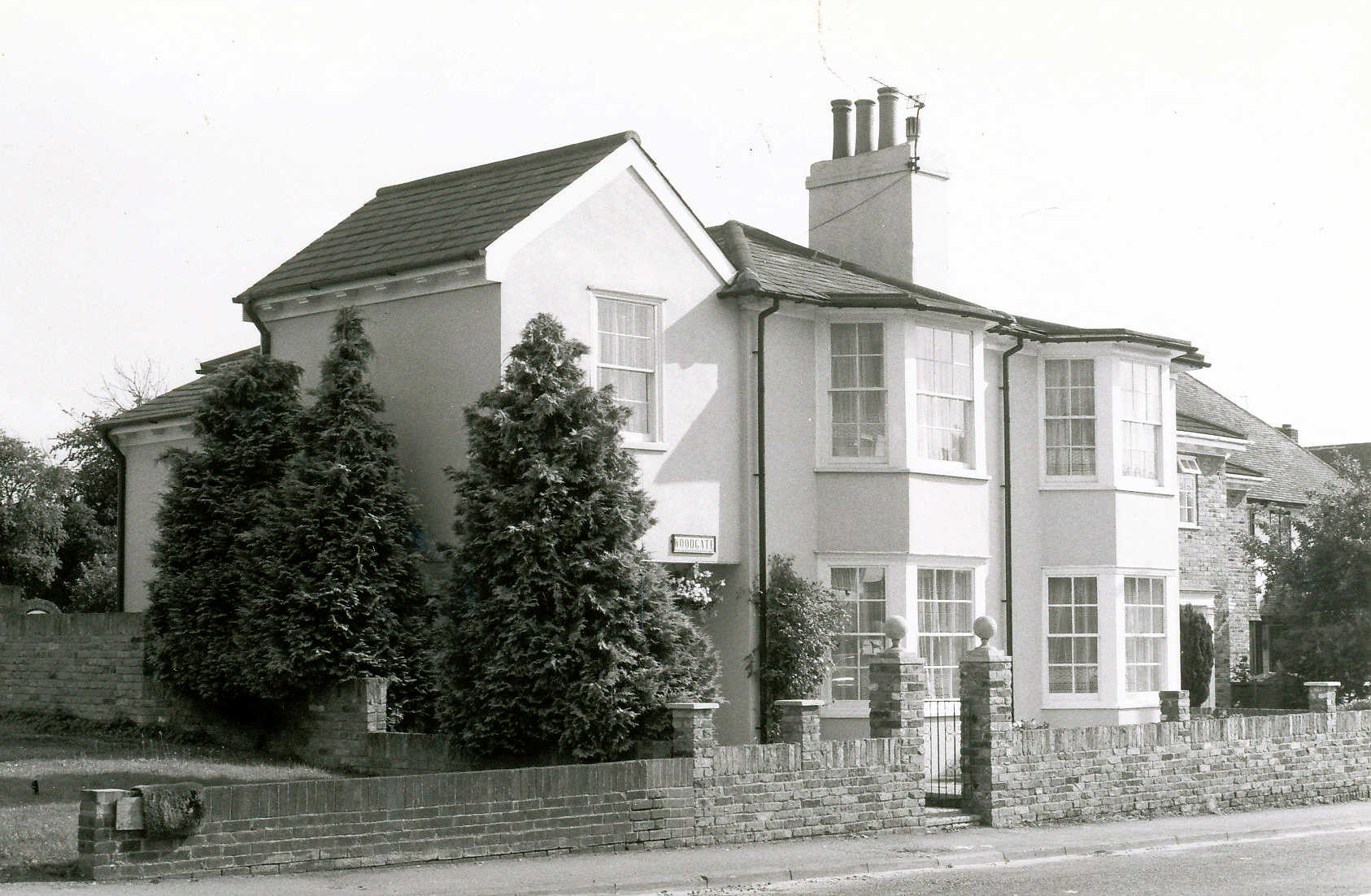 Woodgate, London Road, Ewell
Image courtesy of Bourne Hall Museum
The earliest parts of this now Grade II listed property date from the late 1700s. Its name is likely to stem from the nearby tollgate on the then London to Horsham turnpike. It is probably not a coincidence that the house was only a couple of miles south of the now lost Tolworth Hall (on the Tolworth/Worcester Park border) where Harry senior’s parents lived.
As shown on the Register entry of Harry junior’s 9 June 1905 baptism in the local church of St Mary’s Ewell, his father was a Barrister.
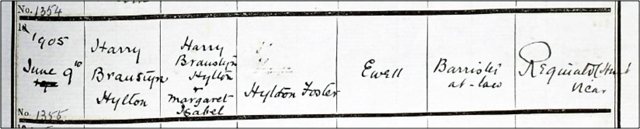 The Register entry for Harry’s baptism in St Mary’s, Ewell.
By the time of the 1911 Census, the parents and Harry Junior (supported by five domestic servants) had moved away to the isolated Old Dene on Chapel Lane to the north of Ranmore Common – about midway between the village of Westhumble and the Polesden Lacey estate. More significantly, the Census records that Harry senior (of whom there is a 1920-ish caricature at the end of in the Appendix below) had by now left the legal profession, being listed as a “Manufacturer and Merchant, Leather / Employer”. It seems likely that this was in the long-standing family firm of Bevingtons which ran the major tannery and leather works at the Neckinger Mills in Bermondsey.
The parents had one other child, Elizabeth Margaret, born on 12 August 1912. Her birth, like young Harry’s was registered in the then Epsom District. However, that District extended to the Bookhams, just to the north of Old Dene.
Young Harry was educated at Eton College. Then, following his father’s initial career interests, he studied jurisprudence at Magdalen College, Oxford, where he obtained a first-class degree. He entered the Inner Temple as a pupil where, in due course, he worked as a legal secretary for Robert Finlay, (1st Viscount Finlay – a title he had been given on retiring from the post of Lord High Chancellor in January 1919). Harry was “called to the bar” in 1928.
On 22 December 1931, in St Michael’s Church Pimlico, the 26 year old Harry married the 23 year old Audrey Pellew Clifton Brown. She was the daughter of Douglas Clifton Brown and Violet Cicely Kathleen (née Wollaston). She had been born on 19 May 1908 in Simla, India, where her father (an officer in the 1st Dragoon Guards) was serving at the time. On leaving the Army, her father turned to politics and, at the time of her marriage, was the Conservative MP for Hexham. (From 1943 he also served as Speaker of the House of Commons. On retiring from that position in 1951, he was created 1st Viscount Ruffside.)
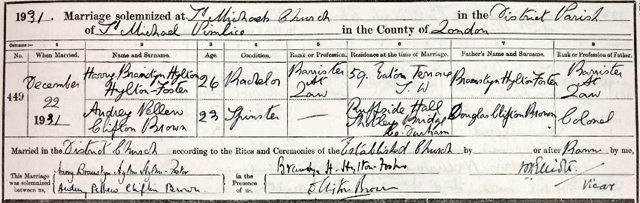
The Register entry for Harry’s and Audrey’s marriage.
(Note that, contrary to the 1911 Census and 1939 Register entries that record Harry senior’s occupation in leather manufacturing, this cites him as a “Barrister at Law”.)
The Register entry for their marriage gives Harry’s address as 59 Eaton Terrace, London SW. However, the September 1939 Register records the couple (who never had any children) at Harry’s parents’ previously mentioned home of Old Dene. 60 year old Harry senior’s occupation is listed as “Leather Manufacturer” and Harry junior’s as “Barrister at Law, Travelling”. Their wives are both listed with the conventional “Unpaid Domestic Duties”. Also there were Harry junior’s 27 year old and unmarried sister, Elizabeth, and his 82 year old widowed mother in law, Ethel Hammond-Smith – both listed as having Private means”. The household was supported by six domestic servants and a Private Secretary.
During WW2, Harry served as an intelligence officer in the Royal Air Force Volunteer Reserve. Later he served as a deputy judge advocate (a military judge) in North Africa and in Italy. His wife, Audrey, had developed a close interest in the work of the British Red Cross (which continued for the rest of her life, during which she held various senior positions in the organisation). During the War, she was a nurse at St Luke’s Hospital, Chelsea.
Perhaps inspired by his father in law, Harry had developed political ambitions. In the 1945 General Election, he was selected as the Conservative candidate for Shipley, in Yorkshire. However, he did not win the seat and continued his career at the bar. In 1947, he not only “took silk” to become a Kings Counsel but also took up the office of Chancellor (the independent judge of the Consistory Court, overseeing various legal issues) of the Diocese of Ripon. In 1948, he accepted the same appointment in the Diocese of Durham.
For the 1950 General Election, he was selected as the Conservative candidate for York. He won the seat and, with an increased majority, retained it in the 1951 General Election. He continued his legal career alongside service as an MP, perhaps most notably in (unsuccessfully) defending Michael Pitt-Rivers in the early 1954 “Montagu trial” which is seen as a key step in the eventual decriminalisation of homosexuality in the UK.
In October 1954, Harry was appointed Solicitor General for England and Wales – an appointment which brought the customary knighthood and meant he had to stand down from his Chancellorships of Durham and Ripon. In 1955, he held his York parliamentary seat with another increased majority and, continuing as Solicitor General, was appointed a member of the Privy Council in 1957.
For the 1959 General Election, Harry was selected for and won the far safer Conservative seat of the Cities of London and Westminster. The Speaker of the House of Commons (William Morrison, who had succeeded Harry’s father in law) had just stood down after eight years in post. Harry was elected as his successor – among some controversy, generally that he was an office holder rather than the traditional backbencher and, from the Labour Opposition, about insufficient consultation. However, the controversy soon waned, and Harry proved to be a popular and well-respected Speaker. He and Audrey (who has the unique distinction of being both the daughter of a Speaker of the House of Commons and married to another) moved into Speaker’s House attached to the Commons.
On 2 September 1965, the 60 year old Sir Harry Hylton-Foster was walking down Duke Street in the St James’s district of London when he dropped dead from a heart attack. Warm tributes were given to his memory by a shocked House of Commons. Leaving an estate of £26,285, he was buried near his parents in the churchyard of St Barnabas Church, Ranmore Common – the local church for their long-term home at Old Dene.
Retiring Speakers are normally given a life peerage. In this unusual case Harry’s widow, Audrey, was instead given a life peerage as Baroness Hylton-Foster – and, under the Honourable Lady Hylton-Foster’s Annuity Act 1965, was granted a life annuity. Rather to her surprise, she became an active member of the House of Lords, for many years serving as Convenor of the Crossbench peers. She was appointed a Dame Commander of the Order of the British Empire (DBE) in the 1990 Birthday Honours.
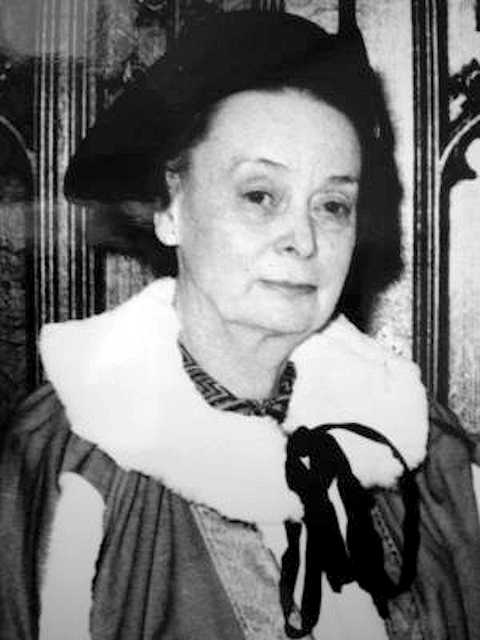 Baroness Audrey Hylton Foster DBE
Source not known.
The widowed Audrey had moved to a converted Coach House on Leith Hill, a few miles south from where her husband was buried. She was a passionate gardener in her later years and her Garden Open Day raised funds for a number of good causes, including the British Red Cross, Cancer Research and local schools.
She would be out in her garden in all weathers right up until her death on 31 October 2002 at the age of 94. She was then buried with her husband in the churchyard of St Barnabas Church, Ranmore Common.
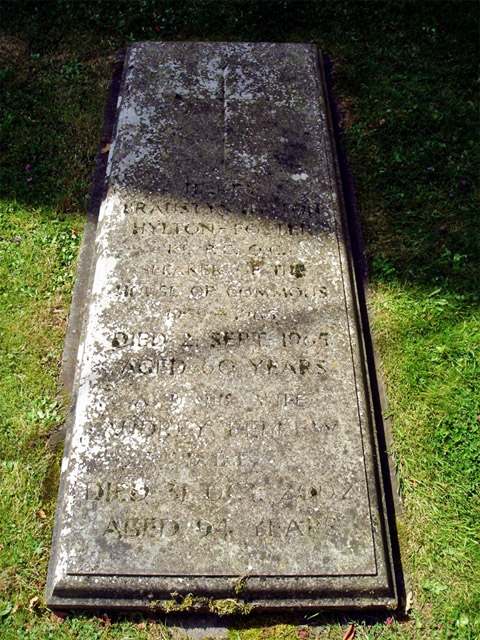
Harry’s & Audrey’s joint grave at St Barnabas, Ranmore Common.
Image with thanks to EdwardX via Wikimedia Commons (CC BY-SA 3.0)
Roger Morgan, Peter Reed & Ian Parker 2021
with special thanks to Hazel Ballan
Appendix: The Hylton-Foster family history
When, in 1905, Harry Braustyn Hylton Hylton-Foster (then a barrister) chose to call his only son (who went on to be a barrister) Harry Braustyn Hylton Hylton-Foster, he created an elephant trap for unwary genealogists. There are other traps for researchers in the way the family name evolved over time. We navigated our way through all this in more detail than was needed for the main article above, but felt it useful to summarise our results here for the general record.
As will be seen below, the double-barrelling of the surname comes fairly late in the (Hylton-)Foster story which, using the readily-available records, we have been able to trace back as far as the mid-1700s couple Robert and Ann Foster of Rushwick in Worcestershire.
We know of this Robert and Ann Foster from the record of the 15 October 1794 wedding (by when both had died) of their son Thomas. He had been born in Worcestershire in about 1760 but, by the time of the wedding, was of “Bromley in the County of Middlesex” nowadays known as Bromley-by-Bow (and, occasionally, Bromley St Leonard) in the London Borough of Tower Hamlets.
In 1794, the now 34 year old Thomas Foster’s bride was the 22 year old Elizabeth King, daughter of Erasmus and Mary King. That family was of the Cotswold village of Upper Guiting, Gloucestershire. (Elizabeth’s 31 May 1772 baptism in the records of nearby St Mary’s, Temple Guiting note that she was born on 16 April that year.) By the time of Elizabeth’s marriage, her father had died and it seems that the widowed Mary – with Elizabeth – had moved Alcester in Warwickshire, which is where Thomas and Elizabeth’s 1794 wedding was conducted in their Quaker tradition.
The couple lived in Bromley-by-Bow/St Leonard where records have been found of their having three children: Thomas Nelson in 1799; Erasmus Robert in 1801; and Emma in 1806. (Emma’s birth on 19 May 1806 seems likely to have led to her mother’s death just ten days later.) The line we are pursuing flows though their second child, Erasmus. The Quaker records of his birth on 20 May 1801, tell us that the family home was the Tudor period Bromley Hall (thought to be the oldest surviving brick house in London) and that the occupation of his father, Thomas, was “Calico printer”. Joining up various dots shows that Thomas was part of the long-standing Quaker firm of Talwin & Foster, famous for their use of the “English blue” indigo-printing technique.
On 17 May 1832 (three days short of his 31st birthday), the Erasmus we are following married the 26 year old Eliza Bevington. The record of the Quaker wedding in Peckham records Erasmus as a “Commission Merchant” of Birchin Lane in the City of London and Eliza as the daughter of Samuel Bevington and his wife, also an Eliza. Young Eliza was their second of their three children. While the precise date of her birth is currently unknown, it is likely to have been only a few weeks before her baptism on 2 October 1805.
It is important for our story to note that the wedding record describes Erasmus’s father in law, Samuel Bevington, as being “of Neckinger Mills, Bermondsey, Leather Dresser”. He was not, however, a mere worker there. The Neckinger Mills (named after the small river by which it stood, a tributary of the Thames) was built in 1801 as the home for the tannery with the business name of Bevingtons & Sons. Samuel was part of the family management that can be traced back to Richard Bevington (1763-1840).
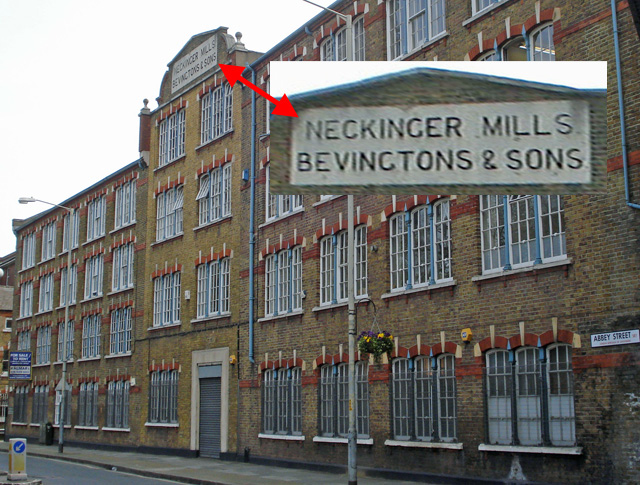
The Neckinger Mills building – which dates from the early 1800s) in 2010.
(After the Mills’ closure in 1980, it has been converted to offices and studios.)
Photograph by “Diamond Geezer” via Flikr (CC BY-NC-ND 2.0)
To return to Erasmus and his bride, Eliza, the first national Census of 1841 records them living in Adelphi Place (off Coldharbour Lane), Lambeth with their first two children. They went on to have a total of six children, and the whole family (supported by two domestic servants) were recorded in the 1851 Census still at 3 Adelphi Place with Erasmus listed as “Resident Director of the Britannia Life Office”.
Our particular interest in all this continues through the couple’s fourth child, Henry. We don’t have an exact birth date, but the birth was registered in the Lambeth District in Q4 1845. None of the family has yet been found (perhaps because of transcription errors) in the 1861 Census but, by the time of the 1871 Census, the 25 year old Henry and a younger brother are found living with their widowed mother (their father, Erasmus, died in 1857) at 149 Camberwell Grove – a mile or so south of their 1851 Lambeth address). The family is supported by two domestic servants, and Henry is listed as “Leather Manuf” – from his later Census entries doubtless in the Neckinger Mills of his mother’s family, the Bevingtons, and on the management side.
In Q4 1875 and registered in the Lewisham district, the 29 year old Henry married 23 year old Katherine Susan Schroeder. She appears to be the last of twelve children born to Frederick Augustus Schroeder and his wife Friederike Mathilde (née Popert). This couple were originally from Hamburg (and had probably married there). It is not clear when they came to England, but these 30 year olds (with Frederick listed as a “Merchant”) are recorded in the 1841 Census living in Loughborough Road North Brixton with their first three children supported by three servants . By the time of the 1851 Census, the family had grown to ten children and had moved to the late-Georgian Halnaker Lodge in Coldharbour Lane, Brixton where they were supported by four servants. Frederick is now listed as a “Fur Merchant”.
Katherine was born in Brixton in about 1852. By the time of the 1871 Census, the Schroeder family had moved east to the grand Mottingham House, south of Eltham. Father Frederick is now listed as “Merchant and Landowner” – his 29 year old son, John, having now become a “Fur Merchant”. Could this trade have involved some contact with the Bevingtons’ tannery, perhaps leading to Henry’s first meeting with Katherine?
Henry and Katherine made their home at 17 The Cedars, Putney. The 1881 Census records them there (with Henry listed as “Merchant – Factor”) with their first three children (aged 4, 3 & 2) and supported by a butler, cook, housemaid and two nurses. Our particular interest is in their third child (and only son), born on 10 March 1879 and given the Christian names Harry Braustyn Hylton. All their children (including their fourth, born in 1882) were given the last Christian name of “Hylton”, and it is understood that Henry was seeking to establish a link to the Hylton family who, shortly after the 1066 Norman Conquest, erected Hylton Castle near Sunderland in NE England. And Harry’s most unusual second name of “Braustyn” could have come from the same regional thinking: a Northumbrian history notes “Brustan” as a knight of old.
By the time of the 1891 Census, the family (parents and four children) had moved to the grand (and now-lost) Tolworth Hall on the border with Worcester Park. The 45 year old Henry is now listed as a “Tanner” and an “Employer”. The family were supported by six domestic servants and a coachman in the adjacent Hall stables. The 22 year old Harry (our focus at this stage of the story) has not yet been found in the 1901 Census, probably because of transcription errors). However, we know that he had been training as a barrister: The Times of 2 November 1900 reported that he – of the Inner Temple – had gained Class II in Constitutional Law & Legal History. That report calls him “Harry B H Hylton-Foster” – the first time that the double barrelled surname has appeared. (But it is not a usual double barrelling since Hylton was retained as the third Christian name. There are echoes here of the case of local Solicitor Auriol Auriol-Barker.)
The 1901 Census records the parents and their youngest daughter still at Tolworth Hall, but the parents (previously plain Henry and Katherine Susan Foster) now styled themselves as “Harry H Foster” and “Katherine S H Foster”. The “H” was for the “Hylton” they had given to all their children. Indeed, a London Gazette entry of 7 June 1904 about a retirement from the partnership behind Bevingtons lists one of the continuing partners as “Harry Hylton-Foster”. In the 1911 Census (when Henry/Harry and Susan were still at Tolworth Hall), they gave their names as “Harry Hylton-Foster “and Katherine Susan Hylton-Foster”. Still at home with them was their 33 year old unmarried daughter, Beryl, and she is now named as “Beryl Hylton Hylton-Foster”.
As noted in the main article above, Henry/Harry’s son Harry had, by 1911, not only moved from Ewell to the isolated Old Dene to the north of Dorking but also left the legal profession, recorded himself in that year’s Census as a “Manufacturer and Merchant, Leather (Employer)”. The obvious assumption is that this was alongside his father in the management of Bevingtons at Neckinger Mills. (But how does that square with a 3 May 1940 announcement in the London Gazette that “the Partnership which has for some time past been carried on by Harry Braustyn Hylton Hylton-Foster, Water George Goodson and Harold William Gaul under the respective styles of GEORGE & CO. and THOMAS CUNDALL at 21A Noel Street, Soho, W1, and Black Swan Yard, Bermondsey, SE, in the trade or business of Leather Merchants and Manufacturers” was dissolved and would be “carried on by the said Harry Braustyn Hylton Hylton-Foster and Harold William Gaul in partnership”?)
Anyway, Henry/Harry and his wife later moved from Tolworth Hall to Foxbury Shaw in the village of Westhumble only a mile or so from son Harry’s home at Old Dene. He died there on 23 November 1923 and, as noted in the Probate records, son Harry (described as “Leather Manufacturer”) was one of the executors of his £160,243 estate. The widowed Katherine was also of Foxbury Shaw when she died on 14 November 1933.
Son Harry (and father of the Harry in our main article) was still of Old Dene in September 1939 (when the national Register listed him as a “Leather Manufacturer”) and when he died on 10 February 1957 – as was the widowed Margaret when she died on 18 July 1974. Margaret will have witnessed the 1965 burial of her son ,Commons Speaker Harry, near his father in the churchyard of St Barnabas, Ranmore Common – where she (and, in due course, her widowed daughter in law, Audrey) later joined them.
Notwithstanding the clear evidence of Speaker Harry’s father having moved into leather manufacture, he is still listed as a barrister the Dictionary of National Biography and by the National Portrait Gallery. In the latter case, this is in connection with the following 1920-ish caricature.
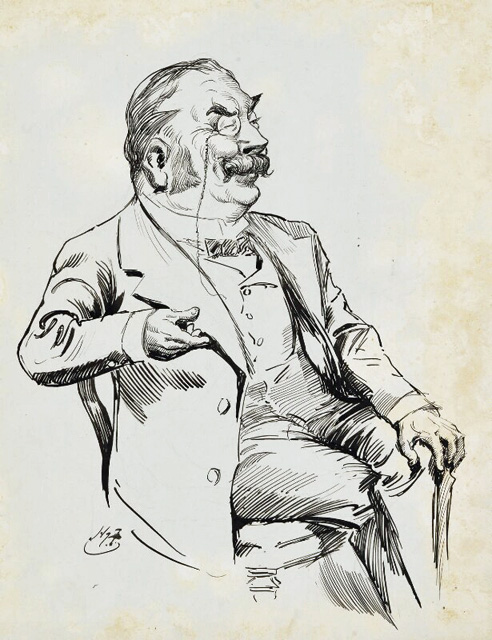
Harry Braustyn Hylton Hylton-Foster senior in around 1920.
Pen and ink caricature by Harry Furniss (1854-1925) – NPG 6251(27)
© National Portrait Gallery, London – CC-BY-NC-ND 3.0
Hazel Ballan and Roger Morgan © 2021