
Missionaries at the Derby
 The Open-Air Mission at the Derby in, it is understood, about 1905.
Image courtesy of Bourne Hall Museum (OP 2862)
For over 160 years, visitors to the Epsom Derby have seen a group of people taking the Christian message to those who would not normally attend church services. The group is The Open-Air Mission, a religious society founded in 1853 by a 28 year-old barrister, sportsman and artist John MacGregor (nicknamed ‘Rob Roy’ after a renowned relative).
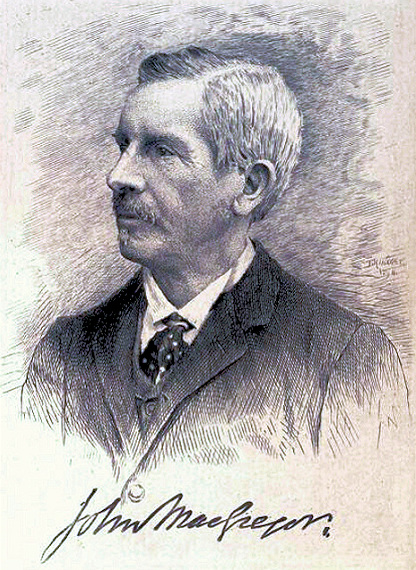 John MacGregor (1825-92)
Etched portrait by H. Manesse from an 1894 biography, via Archive.org
Just 5 years after it was formed, the Society was in attendance on Derby Day 1858 – and it has been at the event every year since.
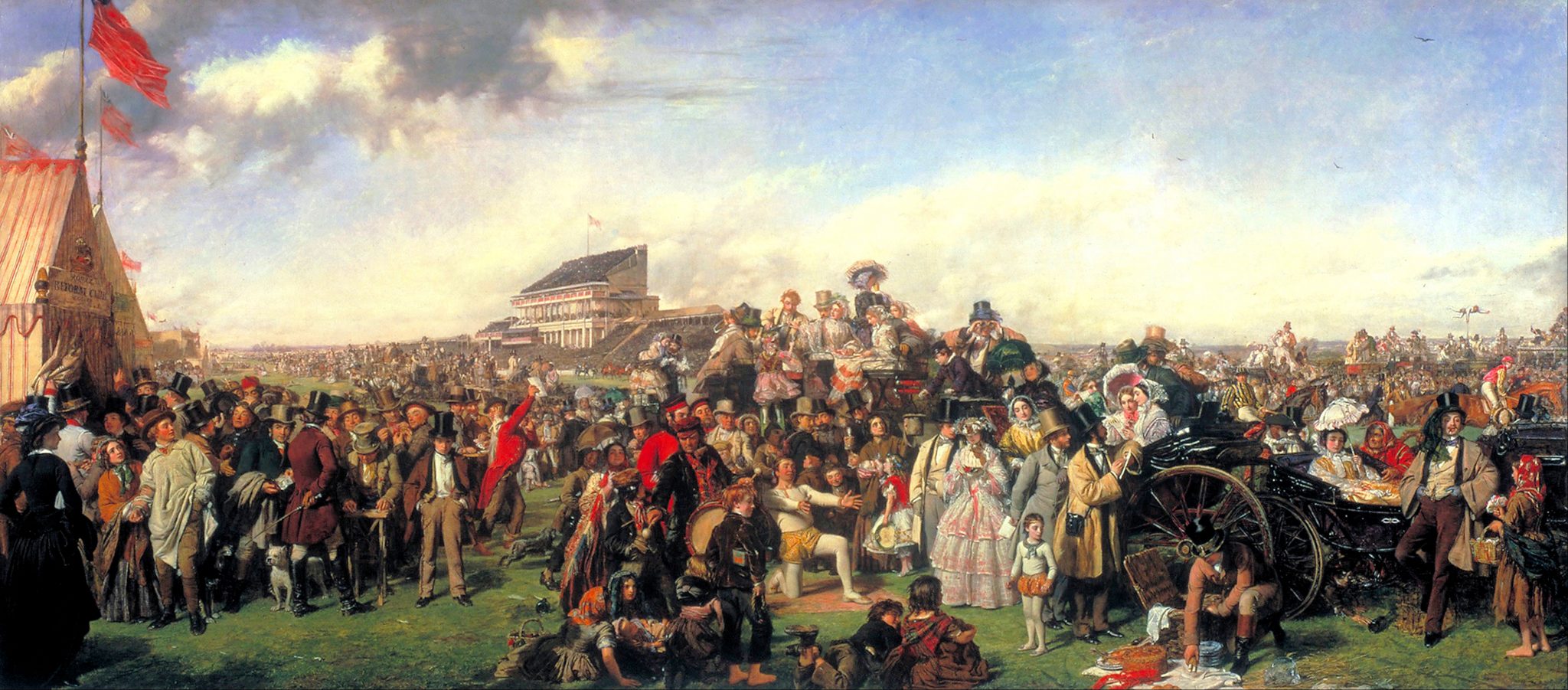 The Derby Day 1856-8 by William Powell Frith R.A
One imagines that it could not have been easy ‘selling God’ at the Derby depicted in Frith’s The Derby Day painting, and this is just what is recorded in the society’s history of its first 150 years ‘This is the Lord’s Doing’ by Alan Greenbank.
It is always a challenging day with gambling and drinking going on all around the witness. In that first year, the work consisted largely of tract distribution to the crowds as they arrived and many noteworthy conversations took place, as illustrated by these accounts:
“Tracts were given to parties walking to and from the course. Also to scores of ostlers, coachmen, cabbies and drivers who were lounging about on the Downs. These were generally well received and conversations of an interesting and, we trust, a profitable nature, were entered into. Tracts were given to very many gypsies, with whom conversations were held; and to some few the Word was read and prayer offered up in their tents.”
“On coming to one tent, I found a poor gypsy woman confined to a bed of straw, suffering severely from ague and general debility. I said, “I hope you won’t be offended but you appear to be very ill.” I opened my Bible and read the parable of the lost sheep and the piece of money that was lost. It was most interesting to watch the eager expression upon her countenance as the various truths that were such glad tidings were read.”
The opposers used exactly the same tactics that we still see today.
“On the course there were many insulting remarks made as we gave out tracts – “Get away with tracts!” “Go to church and give them away!” “We don’t want God here,” said one and many repeated it. One gentleman said it was thoroughly disgusting.”
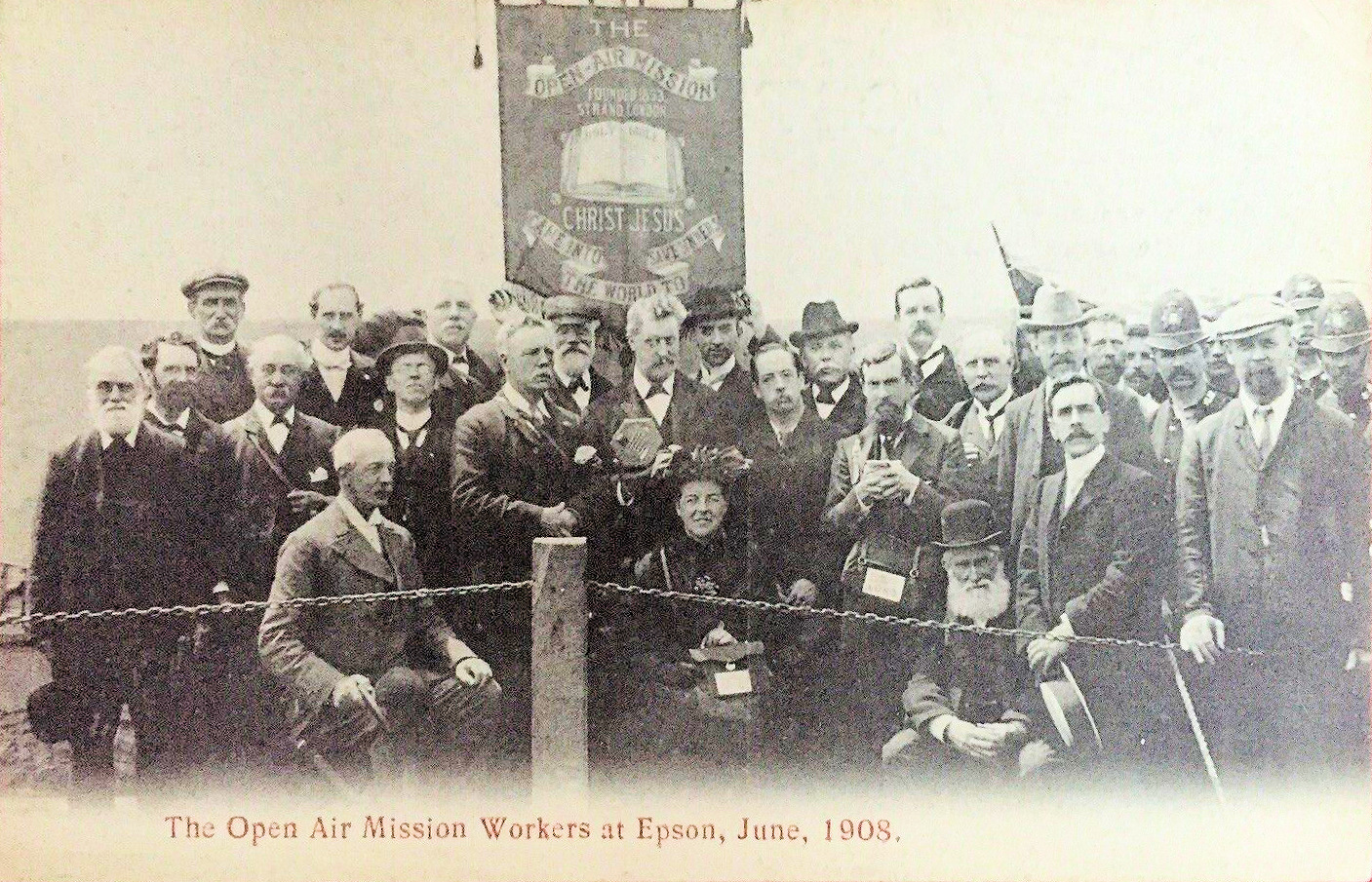 Image courtesy of Bourne Hall Museum
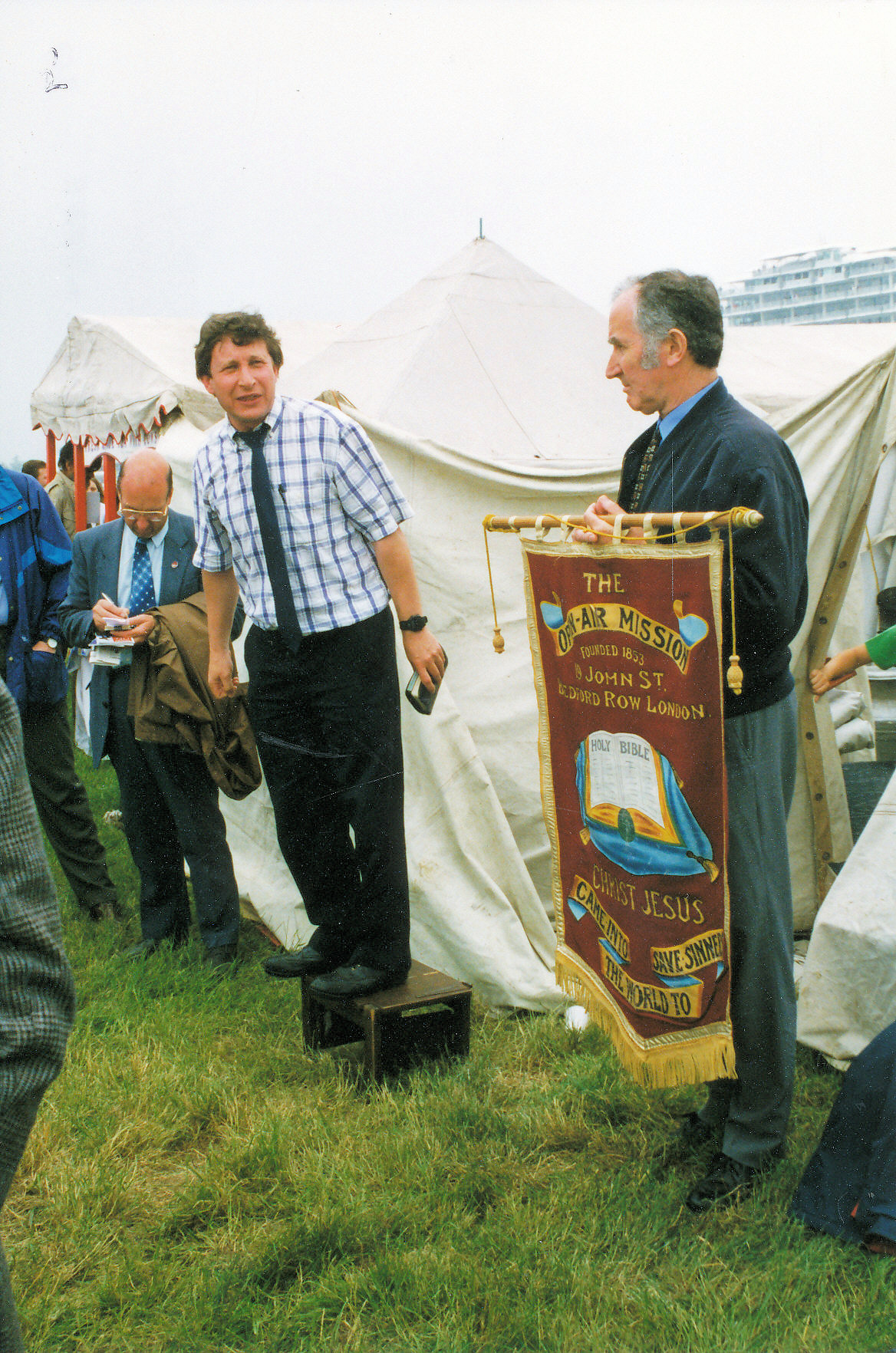 The Open-Air Mission in the 1990s
Image courtesy of Bourne Hall Museum
Researched and written by Peter Reed 2020
With grateful thanks to The Open-Air Mission for use of their text.
Appendix
Extract from the
LONDON CITY MISSION MAGAZINE, JULY 1, 1869.
We have before us reports of the visits of several missionaries to Epsom during the late race week. We select one of them, from which we give a few extracts :—
“Epsom is a small town in Surrey. It is pleasantly situated, and has a number of opulent people residing in and near it. It was once celebrated for its mineral waters and salts. Its distance is about fifteen miles S.S.W. of London. For centuries past it has been notorious as a place for horse training and• for horse racing. In the great week of the races, in which the Derby ‘is ‘run, it is computed that about 400,000 assemble on the Downs, the majority of whom come from the metropolis, and others from different parts of the country, all anxious to be present at this carnival, which constitutes the elysium of the sporting world.
At such a time Jack is as good as his master, and lords and vagrants, aristocrats and scoundrels, rub shoulders as a matter of course. Perhaps the largest encampment of gipsies the supposed descendants of the mixed multitude’ which accompanied the Israelites who came out of Egypt, is to be met with here, plying their games at three throws a penny, ‘‘Aunt Salo,’ and Dusty Bobs,’ and who’ll ride!’ Some give their attention to afford means for the special ackemmadation ‘ of the public, while mingling among the crowd, and passing the hedge-lined lanes, might be seen a few feminine bronzed countenances, with red hoods and variegated coloured frocks, archly inquiring, Shall I tell you your fortune, my lady?’
The Sunday preceding the races Epsom Downs present a scene similar to what transpired some years ago in Battersea-fields during the palmy days of the Old Red House, where excess ran riot, and the lawless had all their own way. Well do I remember on one occasion the respected Vicar of Epsom telling me that the races neutralised all the good he had done the previous twelve months. Were it not for the self-denying and devoted Christian efforts of that excellent lady, Miss Alexander, Dr. Graham, and a few other friends who are the salt of the place, Epsom, I fear, would be still more corrupted at such times.
It was in the year 1857, at the earnest request of Dr. Graham for one of the Society’s missionaries to work at Epsom during the race week, that I was deputed to visit Epsom with the view of counteracting in some measure the evils of the races. That year I worked single-handed, and distributed thousands of religious tracts. Not another agent was present that I am aware of from any other Society; but God was with me, and He armed His unworthy servant with strength to witness for Christ amidst scenes of abounding ungodliness. Since then, year after year, the labourers have increased, and Christian brethren, in connexion with the Open Air Mission, have joined our ranks. Public-houses, booth-keepers, and gipsies, have been visited. Meetings have been held, and preaching has taken place on the race-course opposite the Grand Stand and in the town. Copies of the Holy Scriptures have been given away; tracts and religious books have been circulated with such titles as A Saviour for You,’ Heaven, and How to Get There,’ with a variety of other useful publications besides, as the British Messenger,’ the British Workman,’ the Gospel Trumpet,’ the ‘Band of Hope, &c. Every morning we met for prayer with Christian brethren in the Lord in the old Wesleyan chapel now used by the town missionary for his meetings.
It has been the custom for several years for the Christian ladies of Epsom to give a free tea to the gipsies on the Monday evening preceding the races in a barn on Epsom Common. Bread and butter and plum-cake have always been most liberally and generously supplied, to which the gipsies have done ample justice, not forgetting to cram their pockets, and at the same time telling, without a blush, those who were waiting upon them, that they had ‘not had any.’ Advantage is taken after tea to instruct the gipsies in the way to heaven, telling them how hateful a thing sin is in God’s eyes, and how, out of sovereign love- to a lost world, God sent His only begotten Son to die for them; that those who believe in His Son, Jesus Christ, might not perish, but have everlasting life. The Dean of Ripon, and several other speakers, took part in the meeting, which was concluded with prayer.
On the Downs some friends from Kingston erected a booth for the sale of Bibles. Congregated inside, as well as outside, the booth many listened to the Word of life, and some of the starving, homeless poor, who had come hither either to beg or to get a job, were fed with the bread that perisheth.
The London and Brighton Company’s line from Victoria Station offers peculiar facilities to those who wish to be conveyed to the Downs as quietly and as quickly as possible. Since the opening of the Downs Station’ I have observed that the traffic on the London road and chalk lanes has not been so great as formerly, but though the number of vehicles, such as carts, vans, omnibuses, shanclrydans, and barouches, have been less, yet the living mass of human beings who swarm on the Downs have been greater.
On the Derby day,’ special trains arrived in addition to the ordinary ones, freighted with human beings, who quickly influxed the town, and then issued in a direction towards the Downs. For hours, the surging crowd kept moving on. Beggars practised all kinds of deceitful arts with the view of exciting sympathy; large numbers of these were Irish tramps, who prefer getting a living in this way to that of honest toil in our cities and towns. Card-sharpers and thieves were hard at work. Their Royal Highnesses the Prince and Princess of Wales, in company with the Crown Prince of Denmark, Prince Edward of Saxe-Weimar, and Prince Teck, arrived at Epsom at half-past one P.M. They were hailed with a warm greeting. The great Derby race was run about half-past three.
Though I and several of my brethren had opportunities to see this and other races, yet we did not; for, thank God, we were engaged in a nobler race—the race that is set before us in the Gospel, looking unto Jesus, the author and the finisher Of our faith. As opportunities offered, we spoke to the passers by,’ some of whom confessed that they were backsliders, and who told us that they dare not repeat their history. Sunday-school teachers were met here, and others also who had come to see the races for the first time.’
Thousands of persons received tracts, but many refused, and uttered oaths and curses as they passed by; one man went so far as to blasphemously assert that the Bible God was a ‘monster’ for allowing suffering in this world to exist. Others moved along as though they saw us not. A few took tracts, read the titles, and then threw them away; some accepting tracts for luck,’ others called out that they could not mix the two,’ and thought that religion on such an occasion was quite out of place. Others thanked us, told us that we should do more good than the races, . and that we were on the safest side,’ and solicited tracts to take home to their friends.’I’ve four children,’ said a ni..er singer, ‘who belong to the Band of Hope, and I like for them to have good instruction.’ A man who accepted a tract entitled ‘What will be the end?’ paused, and then inquired, ‘What will be the end?’ His conscience was evidently awakened, and I could see that he trembled at his state. Four years ago,’ said he, ‘I lost my wife, who died suddenly. She left me to go to Yorkshire on a Monday, and she was a corpse on the Thursday.’ I remarked that the way of transgressors was hard, that there was no peace to the wicked, and that if the righteous scarcely be saved, where would the ungodly and the sinner appear? One man, who had been working as a dock labourer in Liverpool, gratefully accepted a copy of the New Testament, and told me that he would read it. May it be, under the Holy Spirit’s teaching, a lamp to his feet, and a light unto his path.
We could not preach in the town without some interruption from a resident, a petty tailor, who sought to turn away the people from hearing us. Having the rabble at his back, he belched forth volleys of abuse, calling us hypocrites,’ raving parsons,’ fornicators,’ &c.
As I perceived that the rabble contemplated doing me serious bodily harm I made a start to get away from them; the ruffians overtook me and so bonneted ‘ my hat out of shape as quite to disfigure it for wear. Having sought shelter in the railway station, the station-master very kindly ordered one of his officials to accompany me across the line to the back part of his house, where, after waiting awhile, I was conducted to the front door facing the road, and was thus enabled to make my escape.
On another occasion a man, who had the appearance of a thimble-rigger, and who had got the ‘gift of the gab,’ began scrambling pence among the ‘ roughs ‘ to annoy the preachers. He was evidently acquainted with the letter of Scripture, for he quoted such texts as He that giveth unto the poor lendeth unto the Lord, and that which he giveth will He pay him again,’ ‘Go ye out into the highways and hedges, &c.,’ ‘Believe on the Lord Jesus Christ and thou shalt be saved.’
On the whole we were thankful to the Lord for enabling us to bear testimony, and to witness for Jesus, esteeming it an honour that we were counted worthy to suffer shame for His dear name
…