
STAGECOACH ACCIDENT 1826
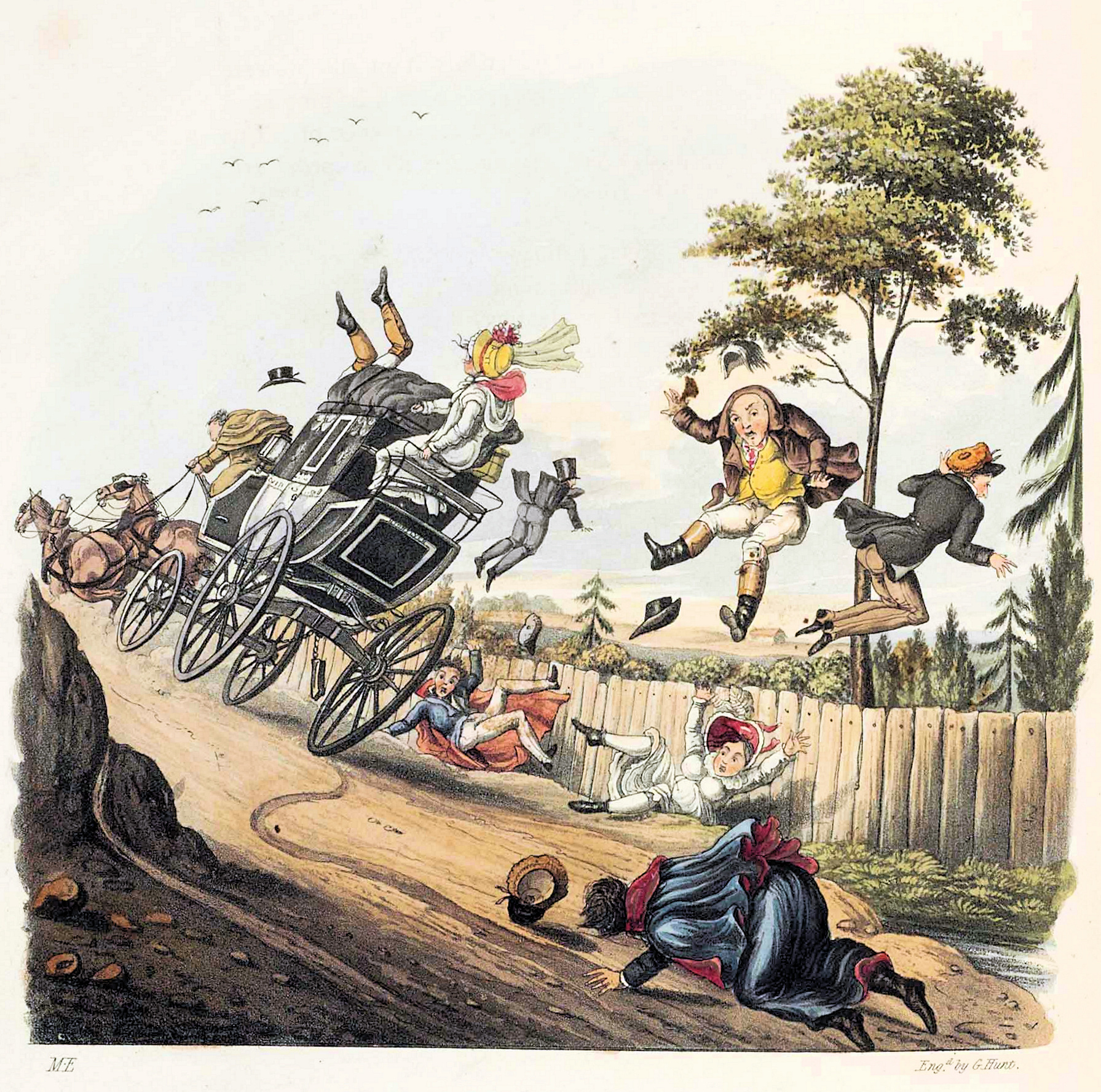
In the September 2017 edition of Lives & Times appeared the following article:
All-Fool’s Day Tragedy
Close to the Old Tower (in St Mary’s Churchyard) stands a well-preserved gravestone with the words “Here lies a sad memorial of the uncertainty of life –
Catherine, wife of James Bailey, who in consequence of the overturning of the Dorking Coach – April 1st 1826, met with her death in the 22nd year of her age.”
On that day Walker’s Coach, full of passengers was standing outside the King’s Head in Church Street. This inn is now a private house (No. 11) at the entrance to Glyn House. The coachman had the habitof starting the horses by stamping on the footboard. In his absence a boy stamped on the board, the horses started and ran away.
As the coach took the corner into High Street it overturned onto iron railings, which were then outside No. 32 – now William’s newsagents. Catherine Bailey was one of the passengers thrown off the coach and killed, others were injured.
Unfortunately the messenger sent to Epsom for the surgeons was disbelieved as it was All-Fool’s day and considerable delay ensued before medical help, such as it was, was available for the dying and injured.
A.W.L
The Times
April 12th 1826
STAGE-COACH ACCIDENTS – The late melancholy accident at Ewell to the Dorking coach, induces a correspondent to offer a few observations both on coaches and roads, that may be of service if attended to; but all that can be said, written, or legislated on the subject, without good judgment on the part of the coachman, will be useless. Should he have occasion to leave the box, a man should be placed at the wheeler’s head, holding them with one hand, and having the leaders reins in the other, this is, supposing all the horses to be quiet; if otherwise, the passengers are never safe, unless there be two men, on with the wheel horses, and the other with the leaders. Neither females nor boys should ever be allowed to sit on the box, both being alike incapable of tendering assistance; and as to the former, they certainly add nothing either to their own respectability, or to that of the coachman, by being there. The passenger taking that situation should never be incumbered with umbrella or stick, but have his hands perfectly at liberty to take the reins when asked. As much as possible passengers should be taken up, and set down, at the houses where the coach usually stops, there being, with very few if any exceptions, men there in waiting whose duty and business it is to attend to the horses in case the coachman be forced to alight. The overturning of a coach in consequence of a wheel coming off, (you lately mentioned an accident of the kind), can never occur but from the most culpable negligence. There are, or ought to be, two linchpins to each wheel, and each linch-pin fastened on with a strap and buckle, one going perpendicularly through the notch-washer and arm, and the other transversely through the arm only, either being in itself sufficient to keep the wheel on; but both linch-pins ought to have straps and buckles, which is not always the case. The trustees of roads are no longer permitted to have the stones broken on the roads, and the same act should have made it unlawful for the scrapings to be left there after dark; as either in hot or frosty weather, they soon become hard, and render a road exceeding dangerous; though, as the law now stands, in case of an accident occasioned by the scrapings being so placed, the trustees would perhaps be liable for the damage. Neither waggons nor carts should be allowed to load beyond their own respective widths. The manner in which timber carriages are loaded is particularly dangerous of a night; they very frequently carrying a tree, an arm of which projects five or six feet on the road, and that at a distance of twenty feet from the hind wheel. It might perhaps be advisable to let turnpikes charge for over width as well as for over weight. Two-wheel carriers’ carts, having long iron rods, or bars should be compelled to load them on the near side only, as their attempting to pull out of the way while a coach or other carriage be passing, would have the effect of putting the iron bars, if loaded on the off side, among the spokes of the coach wheels, and not improbably upsetting it. However, a coachman is, or ought to be on his guard against all these, and many more obstructions; he is in a very responsible situation with the lives of so many under his charge, and the proprietors should be thoroughly satisfied of his talent and experience ere they place him on the box.

Grave of Catherine Bailey in St Mary’s Church Ewell
Photo by LR James 1967
“Here lies a sad memorial of the uncertainty of Life
Catharine wife of James Bailey
Who in consequence of the overturning of the
Dorking Coach April 1 1826 met with
Her Death in the 22nd year of her age
Gape holy earth take all that I adore,
Forever take what I must know no more,
The friend and partner I so greatly priz’d,
Forever’s lost unto my aching eyes,
Lord shall a wretch like me dictate to thee,
Dispute thy rights or what thy will decree,
No! let me bow submissive to my God,
And kiss the avenging hand that dealt Rod”
With thanks to Angela Clifford