
A Terrier Tank Engine called Ewell
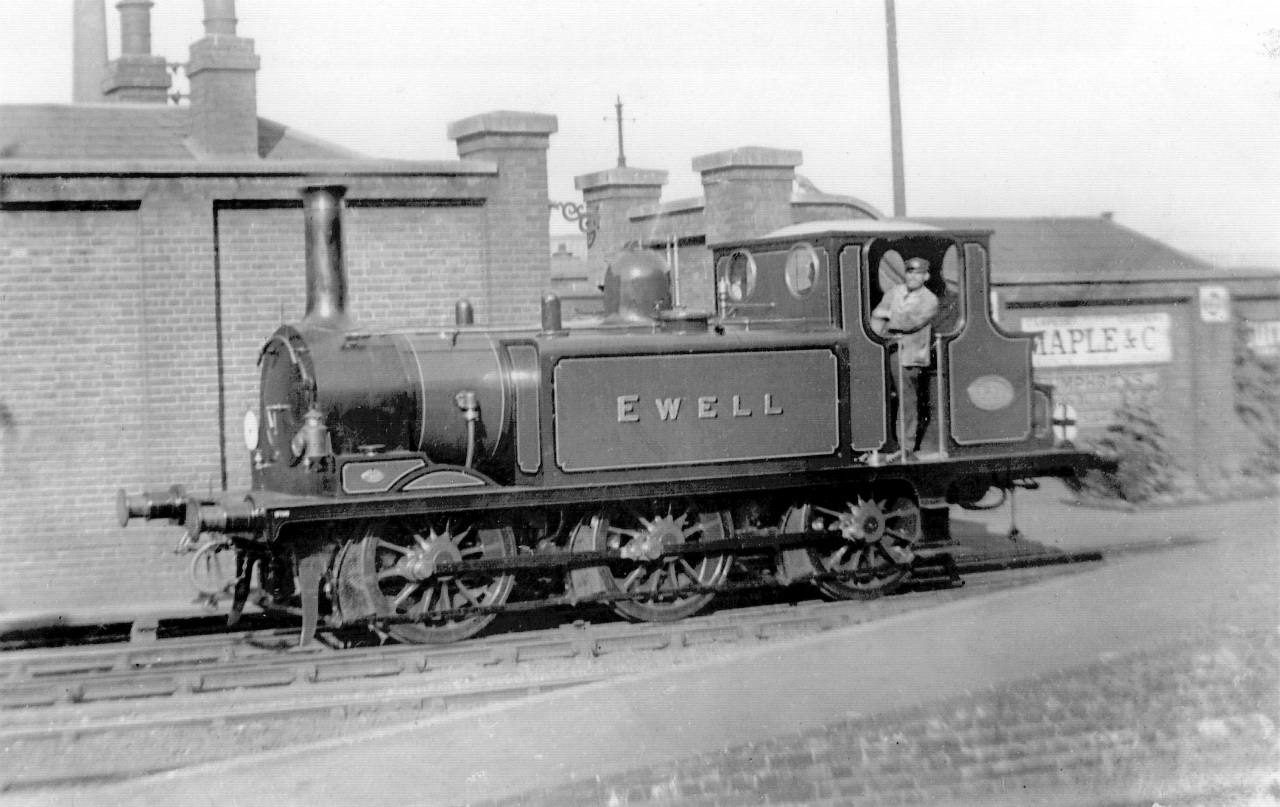
The locomotive Ewell
Image courtesy of the Dave Searle Collection ©
Introduction
As I have said in the companion piece to this one, which is about Two Locomotives called Epsom, I am not scientific or technical, and all I knew about tank engines until now was that there are a lot of children’s books etc about Thomas and friends and that tank engines carry their water and coal on the engine chassis, so there is no tender coupled to the locomotive.
However, just as there were two locos specifically named after Epsom, albeit that there was around an 80-year gap between their respective births, so there was one named after Ewell, which was a tank engine – or, to give it its proper title, a London, Brighton & South Coast Railway (LBSCR) Class A1 locomotive.
The Terrier Tanks
There has apparently been some confusion about the colour of these Terriers. It’s said that their designer, William Stroudley, believed they were green, but he was allegedly colour-blind and restorers have had a stab at the colour-matching, ranging from yellow ochre to shades of brown. Here is a very nice yellow one, belonging to the National Railway Museum at York.
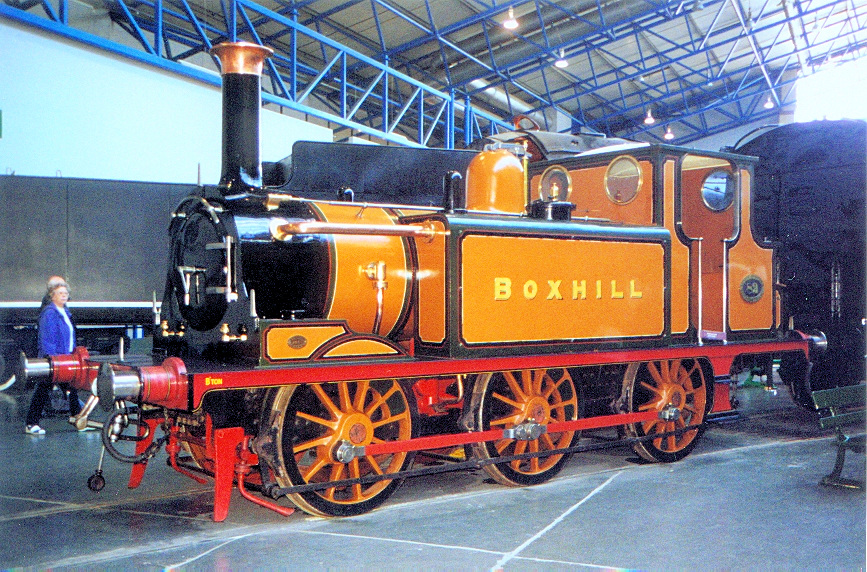
Photo courtesy of Les Chatfield (CC by 2.0)
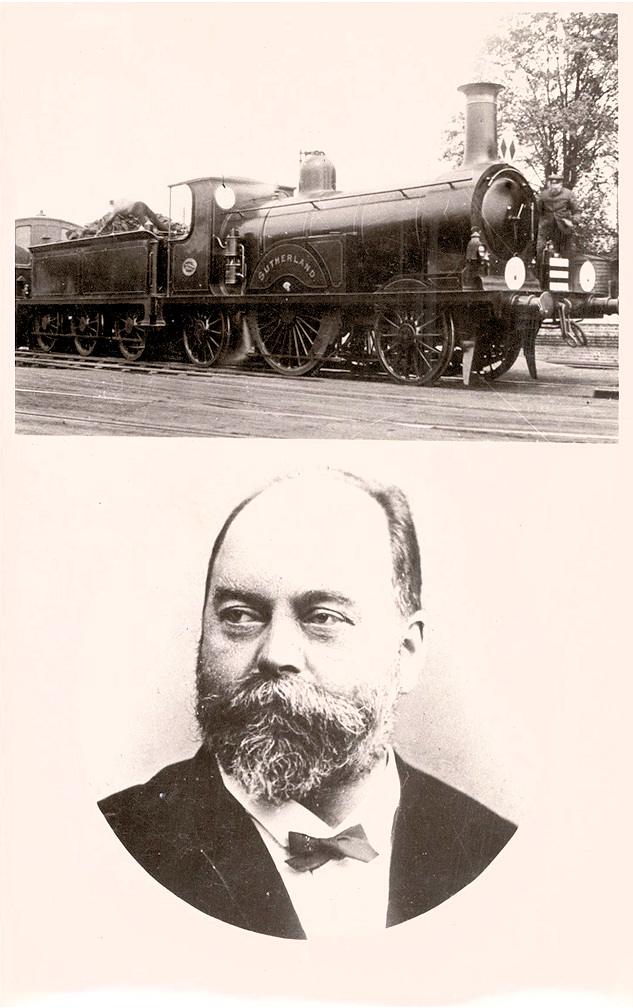
Double-image postcard of the G Class locomotive Sutherland and its designer, William Stroudley
Image courtesy of Royal Pavilion & Museums, Brighton & Hove CC-BY-SA
Although I had never heard of this gentleman until very recently, there was something vaguely familiar about the name – you know, seen it somewhere, and more than once, but where? The answer is on the front of a Brighton & Hove bus. His vehicle has been, amongst many other numbers, a 12, a 14 and a 27, which are routes I have used often. About 20 years ago B & H Buses started naming their vehicles for people who had made a significant local contribution, but you need to be dead to have the honour. Stroudley must be revered in the city to have his name on a bus still, as other people, including Lord Dickie Attenborough, have been consigned to the bin when their bus was sold or scrapped.
I mentioned in the companion article that Brighton Railway Works was no longer there and had been replaced by a development called the New England Quarter. One of the streets in the Quarter is Stroudley Road. I am not sure that William would feel particularly honoured if he saw it. Here he is as a Number 21, actually on Stroudley Road in 2010.
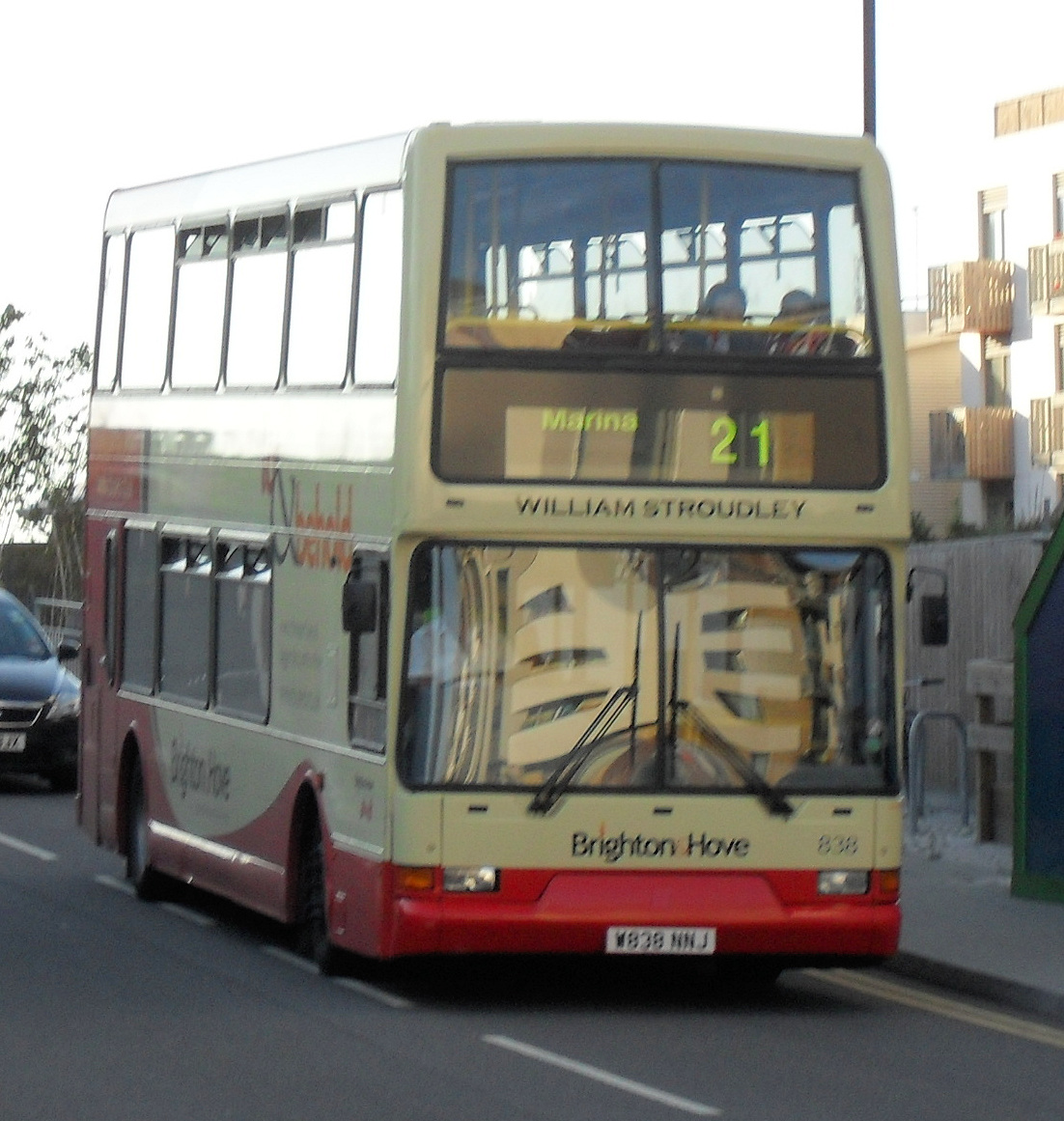 W838 NNJ at Stroudley Road
Photo by Matt Davis via Wikimedia
Bus digression over, we shall return to the Terriers. The idea was to build a compact, lightweight little loco which was sufficiently strong and nippy (like a terrier?) to haul commuter trains between the many stations in the south and south-east London suburbs and they were named after the various places they served, so we had, for example, Morden, Sutton, Tulse Hill, Ashtead, Cheam and, of course, Ewell, to name just a few of them. Six were built to begin with, in 1872, and they were so successful at their particular task that another 44 followed and the concept was expanded further afield.
This next picture is Piccadilly, built in 1877.
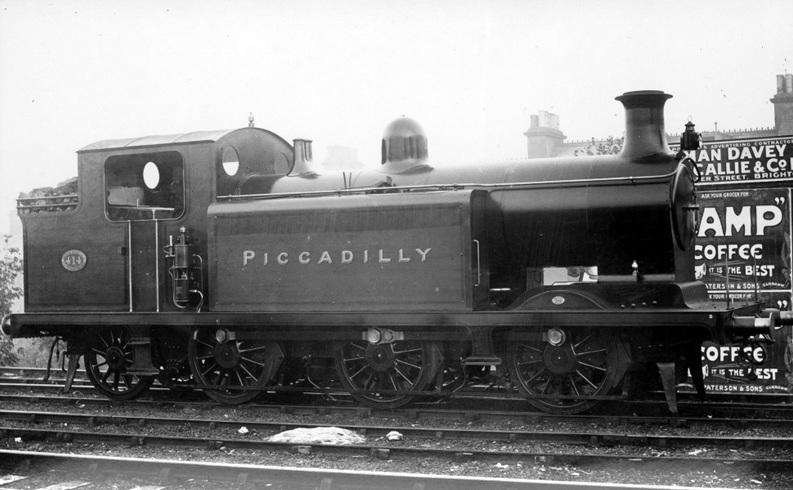
Locomotive Piccadilly
Image courtesy of Royal Pavilion & Museums, Brighton & Hove CC-BY-SA
Ewell entered service in 1875, originally numbered 60 and later 660. You will recall that there were only 50 of these in total, but the numbering of the Terriers started at 35, which disposes of that conundrum. Some of them, but not Ewell, were subsequently modified to become Class A1X.
As the suburbs became more densely populated and ‘joined-up’ towards the end of the 19th century, a heavier loco was required on the main busy routes, so Stroudley came up with the Class D1 tank, most of which were built at Brighton over the period from 1873 to 1887. The last survivor of this class was withdrawn from service in 1951 and none have been preserved. (I don’t want to get bogged down in the D1s, but again they were named after suburban stations and there was a Dorking in the batch. D1 Ranmore was based at Epsom Shed.)
However, the Terriers were not obsolete and could still operate on branch lines, haul freight, or be used for shunting, but over the years many were sold and/or scrapped. Ewell was withdrawn from service in December 1902 and sold for £125 (roughly £150k in today’s terms) to George Cohen, Sons & Co, as were other Terriers. It would be nice to say that the Cohens used the locos for their intended purpose, but sadly they operated a scrapyard: Ewell was broken up and the bits were sold off for what we would now call recycling.
On a happier note, some of the Terriers found a new lease of life as the ‘Hayling Billys’ and remained in service until 1963. This is of particular interest to me, as I’m reasonably familiar with the relevant area, and it is all to do with a bridge.
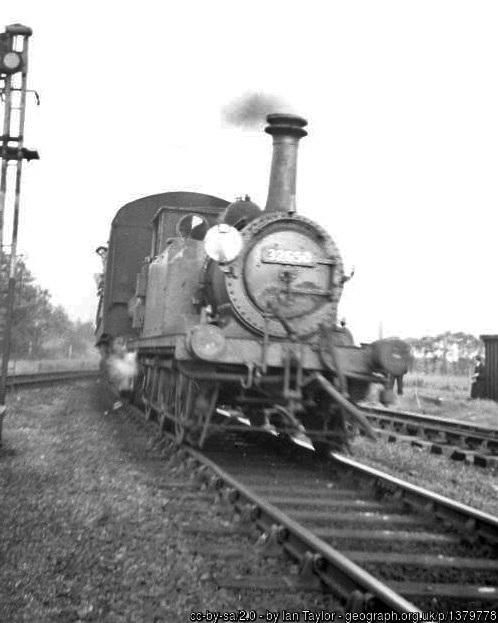 The Hayling Billy
cc-by-sa/2.0 – © Ian Taylor – geograph.org.uk/p/1379778
As the name heavily suggests, Hayling Island is surrounded by water and used to be very popular with summer trippers. Still is, for that matter, but it’s accessible via a road bridge now. I had an unreasonable aversion to it years ago, without even seeing it, because there were some relatives who spent their holidays on the island – indeed, they may well have ridden on a Hayling Billy – and brought me back very tacky presents, such as a large pink hairbrush with synthetic bristles and ‘a present from Hayling Island’ inscribed on the back. Anyway, there used to be a wooden rail bridge from Langstone (just along from Havant) on the mainland over to the island and LBSCR hadn’t bargained for the behaviour of the mud flats. To cut a long story short, the official inspector refused to certify it as fit to carry passengers, so the company came up with the idea of using the lightweight Terriers.
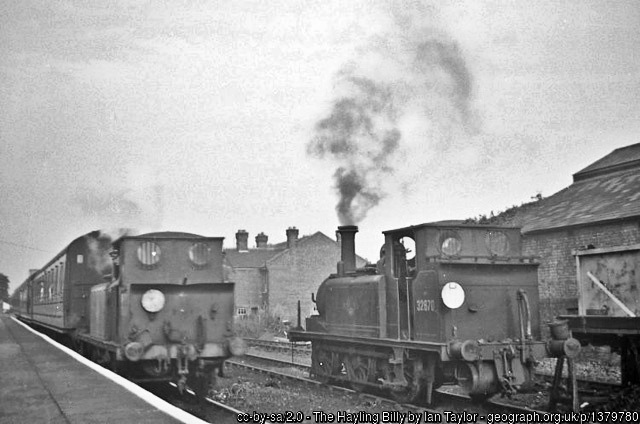
The Hayling Billy
cc-by-sa/2.0 – © Ian Taylor – geograph.org.uk/p/1379780
The remains of the railway bridge are still there, as this next photo shows.
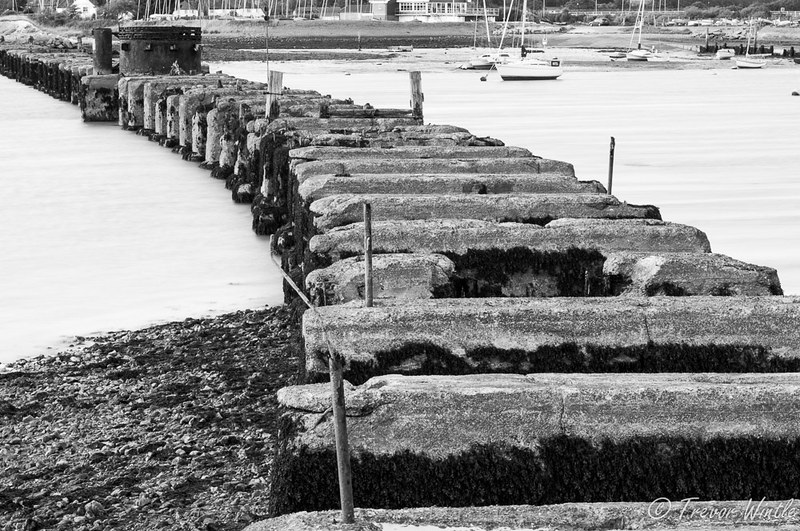
This is all that’s left of the old Hayling Billy bridge that use to span across Langstone Harbour.
Photo courtesy of Spinnakertog (CC BY-NC-ND 2.0)
Footnotes
I mentioned Thomas the Tank Engine at the beginning, and there is a connection between him and the LBSCR. According to Wikipedia, the Reverend Awdry’s publisher hired an illustrator for the first of the books to feature Thomas and Awdry gave him a photo to use as a guide. The photo featured an LBSCR E2 tank engine, designed by L B Billinton, the last Locomotive Engineer of the company before it became part of Southern Railways.
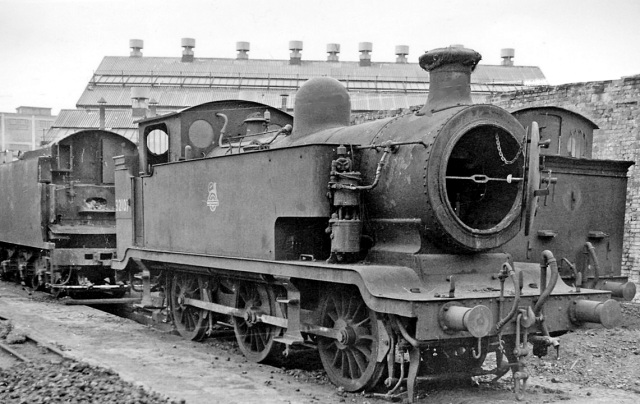
Abandoned ex-LB&SC 0-6-0T at Bricklayer’s Arms Depot. L. Billinton class E2 0-6-0T No. 32107
Photo courtesy of Ben Brooksbank (CC BY-SA 2.0)
If you have an interest in old LBSCR trains, you might like to look at Dave Searle’s website http://lbscr.org/, which has photos of many of them and further information.
Linda Jackson 2019