
Two locomotives called Epsom
Introduction
The locomotive called Epsom which I originally had in mind belonged to the ‘Schools Class’ (formally known as the Southern Railway V ‘Schools’ Class), which comprised 40 units named after public schools. Epsom was Number 37 of the batch. The idea was that, as far as possible, the unit would visit the station nearest to the relevant school and the pupils would go along for a naming ceremony and an exploration of the cab. The Schools Class units were built at Eastleigh, Hampshire to a design by Richard Maunsell over the early to mid-1930s.
Before I continue, please note that I am not a scientific or technical expert in anything at all, so this is not an article for ‘railway anoraks’. I love old trains for their aesthetic qualities and this is merely an atmosphere/nostalgia piece. When I was a kid we would go for a local walk on a Sunday and sometimes pass over the railway bridge, where the parents and I paused and leaned on the parapet. If we were lucky (unlucky in hygiene terms, but nobody worried about that in an era of yellow pea-soup fogs), a steam train appeared and enveloped us in smoke. At that point I had never actually been on a proper train.
Locomotive Epsom 1
 Locomotive Epsom 1
Postcard view of Epsom No. 464
As the research developed, I soon found that there was a much earlier locomotive called Epsom, operated by the London, Brighton and South Coast Railway (LBSCR). Epsom 1 (originally Craven No. 40) was designed by John Chester Craven – Locomotive, Carriage and Wagon Superintendent of the LBSCR – and built at Brighton in 1854 by Sharp, Stewart & Company.
John Chester Craven.
Designer of Epsom Locomotive 1
Source not known
Epsom 1 was almost or even absolutely unique in its original incarnation as Craven No. 40, which was not exactly as it appears in the later image above. Craven did not generally design whole classes of locomotives, but ones or twos, to carry out specific tasks. He was responsible for the vast expansion of the Brighton Railway Works, which began as a single engine shed in 1840. Back in the day Brighton must have been a paradise for the steam train enthusiast and, even after electrification of the main lines, steam was still in use for freight, as this impressive photo from 1954 shows.
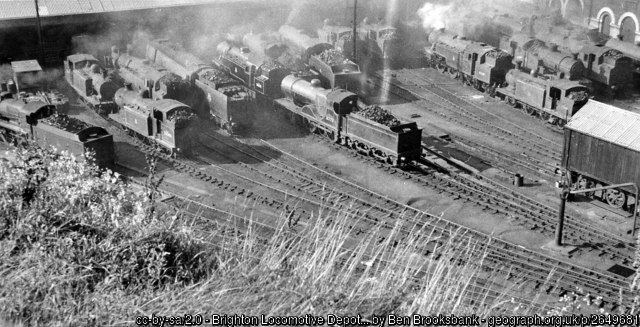
Brighton Locomotive Depot seen from above
© Copyright Ben Brooksbank and licensed for reuse under this Creative Commons Licence.
This next image shows the Works on the top of the hill to the right, fronted by the viaduct (known as the London Road Viaduct), as they were when first built.
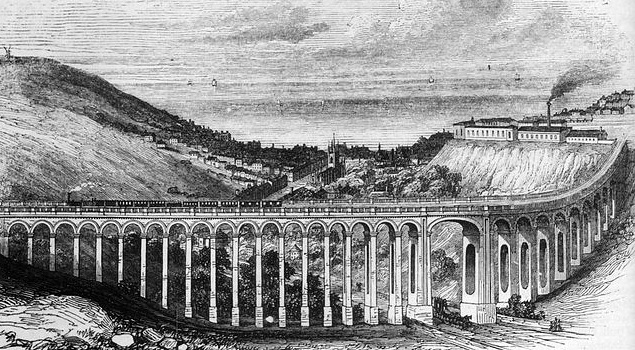
London Road Viaduct and the Railway Works, mid-1800s
Image source: Wikimedia
The Works has gone, although the viaduct remains and is still in use between the main Brighton Station and London Road Station, which isn’t actually in London Road, but never mind. The site of the Works is now home to a modern development called the New England Quarter, which you either love or hate, but I will remain neutral (no, I won’t, it’s horrible). The Works had a massive footprint and, for example, it covered 9 acres in 1952.
Craven No. 40 was rebuilt by William Stroudley, who became Locomotive Superintendent of the LBSCR in 1870, and became Epsom No. 464. As I mentioned, Craven had had a penchant for one-offs, which translated into a cumbersome stock of different spares and considerable extra work on maintenance and repair. Stroudley changed all that and introduced standardisation. According to one source, Epsom 1 was indeed used on the Epsom/London line initially and I understand from another source that it was completely withdrawn from service in 1891.

Locomotive Epsom 1
Source not known
Locomotive Epsom 2

A replica of the name plate presented to Epsom College in 1962
Image courtesy of © Epsom College
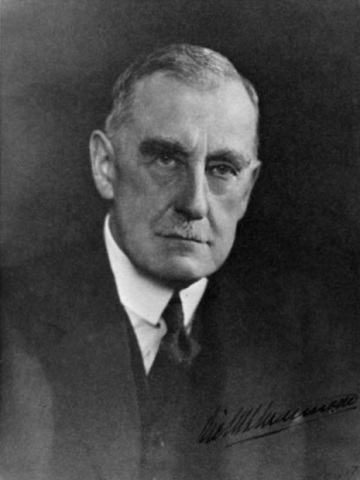
Richard Maunsell
Designer of Epsom Locomotive 2
Source not known
 Epsom 937 (pre-1948) at Southampton
Photograph courtesy the Linda Jackson Collection

Epsom 30937 post-1948
Source not known
Epsom 2 is much better documented than its predecessor, because the Schools Class locos were regarded as classics. Although it has long since been broken up, together with most of the other units in the Class, three still survive. Number 26 of the batch (officially numbered 926 and then 30926 when British Railways was formed in 1948), called Repton, is operational on the North Yorkshire Moors Railway and 925/30925 Cheltenham runs on the Watercress Line (Mid Hants Railway). 928/30928 Stowe is at the Bluebell Railway in Sussex, undergoing overhaul. Here’s a fine picture of Repton in steam.

Schools Class Locomotive at Castlecroft
© Copyright David Dixon and licensed for reuse under this Creative Commons Licence

Engine No 30926 at Tattenham Corner Station in June 1962
Image source: Epsom & Ewell Local & Family History Centre
See what I mean about being enveloped in filthy smoke if you stand on a bridge when the train passes underneath! The photo, though, shows beautifully what the loco looked like before BR took it over, as it has been sympathetically restored with its original number and livery.

Another photo of Epsom 30937 post–1948
Image source not known
Maunsell’s purpose with the Schools Class was to produce an express passenger loco which was capable of negotiating the tricky bends and gauge restrictions on the Hastings Line. He achieved this so well that it was used much more widely. All of the Schools Class locos were withdrawn from service by 1962 and the era of steam trains finished for general use in 1968. Epsom 30937 ended life where it began and was cut up at Eastleigh on 30 June 1963.
 Epsom 30937, possibly awaiting break-up at Eastleigh 1962/3
Photograph courtesy of the Linda Jackson Collection
Epilogue
As I said at the outset, this is an atmosphere/nostalgia piece. There are many good reasons why we moved over to diesel and electric trains, but the nostalgia and love for steam persists; legions of volunteers, old and young, spend their free time restoring, repairing, maintaining and running what we call heritage railways. The Bluebell Railway now has four operational stations, covering 11 miles of track, and kids who would never have seen a real steam train in service still like to ride in them and climb up in the cab, as this last picture proves.
 9017 Earl of Berkeley (ex- GWR)* on the Bluebell Railway, March 2005.
Image © Linda Jackson 2019
* This particular loco is a ‘Dukedog’, so-called because it was made by amalgamating parts from the Duke Class and the Bulldog Class.
But nostalgic preservation is not confined to steam trains. For some years now a project has been underway to restore the Brighton Belle, which was Southern Railway’s flagship electric Pullman service, dating from the 1930s. There were howls of outrage when it was withdrawn in 1972, particularly from Lord Laurence Olivier, who used it regularly and enjoyed the kippers, and Dora Bryan, both of whom had abodes in Brighton at the time. Happily, the component units of the train were never destroyed, although they became scattered and pretty derelict – apart from anything else, they needed to be modified and adapted to meet today’s standards and regulations and still look like the 1930s version as much as possible. Current thinking is that the restored train could be up and running in 2020 and might well be based at … Eastleigh.
Linda Jackson 2019
If you have enjoyed this article you might like to read A Terrier Tank Engine called Ewell and Five ships called Epsom