
Dr Francis (Frank) Nicholls (1699 – 1778)
Physician to King George II
Resident in Epsom from 1766 until his death.
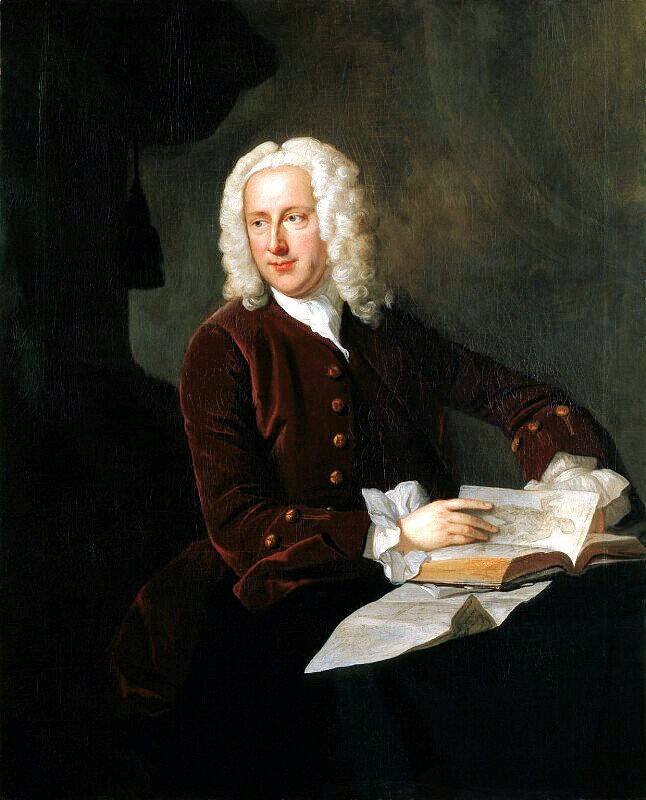
Frank Nicholls attributed to Thomas Hudson oil on canvas, circa 1745-1748
Image source : National Portrait Gallery (NPG 6144) (CC BY-NC-ND 3.0)
Francis Nicholls was the second son of John Nicholls of Trereife House, near Penzance, Cornwall, who became a successful Middle Temple barrister in the late 17th century. A memorial to Francis’ father is to be found at Madron Church [The First Book of the Parish Registers of Madron, in the County of Cornwall]: –
“Black and white marble—the latter richly carved and relieved with gilding—are blended in a harmonious design, finished in detail and unobtrusive in effect. Slender columns of highly polished black marble support a handsome cornice, on which rests a shield—festooned with flowers, and flanked by two flaming urns—bearing the arms of Nicholls,—Arg. Three pheons sa. An exquisite piece of Italian workmanship is empannelled in the lower part of the monument; it is composed of rare and brilliantly coloured stones, lapis-lazuli, jasper, &c., inlaid so as to represent flowers and fruit, advantage having been taken of the natural tints to give force to the form and shading of the group. With such skill has this been done, that at a little distance it is difficult to believe the fact that the flowers and fruit are not in relief, so real and rounded do they appear. On the entablature, forming the middle of the monument, the following inscription is engraved –
Near this place in the grave of his Fathers
Whom he honour’d lyes interr’d the body of
JOHN NICHOLLS of Trereife esquire
Who being born in the year of our Lord 1663
As sent to London in the year 1680
And having served in a laborious Clerkship
Was in 1688 sworn one of the Clerks
Of the High Court of Chancery
And having with great industry and integrity
Encreased the paternal estates of his family
And was in the year 1705 call’d to the Bar
By the Society of the Middle Temple
Where having for some years
Practiced with success
He retired to the seat of his ancestors
And having made many improvements
Departed this life the 3rd day of August 1714
In the 53rd year of his life
Leaving three sons and one daughter
Of whom IKEL HIS DAUGHTER
AND Samuel is youngest
(by whose order this monument is erected)
Lye here likewise interr’d.”
The monument is said to have been decorated subsequently with the inlaid fruit, at the instruction of The Reverend C. V. Le Grice. According to The Civil and Military History of Cornwall; with Illustrations from Devonshire, by Richard Polwhele, 1806, ‘ A group of tulips that adorn the monument, are composed of variously coloured marbles, which were purchased at Florence by Dr. Francis Nicholls, when he made the tour of Europe with Sir Charles Price, Bart. of the island of Jamaica’.
In A Topographical History of Surrey by Edward Wedlake Brayley, 1841, it is remarked with regard to the Manor of Ockley:-
“…in 1751, it was sold (under the provisions of an act of parliament) to Dr. Frank Nicholls, an eminent physician, and lecturer on anatomy and physiology, who succeeded Sir Hans Sloane as one of the king’s physicians, but was superseded in that office after the accession of George the Third, to make way for the appointment of Sir William Duncan. He died, at an advanced age, in 1778; and his son and heir, John Nicholls, esq., M.P. for Blechingley, sold this manorial estate, in 1784…”
This was followed by a memoir:-
“DR. FRANK NICHOLLs,who had a country seat at Ockley, was the son of a barrister, and was born in London, in 1699. He was educated at Westminster school, and Exeter college, Oxford, where he attached himself especially to the study of Natural Philosophy. Being appointed Reader on Anatomy in the University, he treated the subject in a popular manner; and by the knowledge and ability which he displayed, he gained great reputation. At this time he resided in London, and visited Oxford only for the purpose of delivering his lectures. He afterwards engaged in practice as a physician in Cornwall, where his family had property; but ere long he returned to the metropolis. After having visited France and Italy, he settled in London as a medical practitioner, and Lecturer on Anatomy and Physiology. In 1728, he was chosen a Fellow of the Royal Society; and he became a contributor to the Philosophical Transactions. In 1729, he took the degree of M.D.; and in 1732, being a Fellow of the College of Physicians, he was appointed to read the Gulstonian Lecture, and in 1739, to deliver the Harveian Oration. For many years Dr. Nicholls seems to have lived in harmony with his professional brethren; but about 1748, being disappointed in his expectation of the office of an Elect of the College of Physicians, vacant through the death of Dr. John Coningham, he was so much offended that he resigned the lectureship, and afterwards absented himself from all meetings of the Fellows except on the most important occasions. In 1751, he further manifested his displeasure for the alleged affront by an anonymous publication intitled —’The Petition of the Unborn Babes to the Censors of the College of Physicians’. About this time Dr. Nicholls purchased the estate at Ockley, where he occasionally resided in the summer season. On the death of Sir Hans Sloane, in 1752, he was appointed one of the king’s physicians; and he held that office during the remainder of the reign of George the Second. The decease of that prince, which took place very suddenly, was owing to a rupture of the right ventricle of the heart, of which Dr. Nicholls gave an account in a Letter addressed to the Royal Society. For some time he resided at Oxford, in order that he might superintend the education of his son, who was a student in the University, and was intended for the legal profession; and on the removal of that gentleman to the Inns of Court in London, his father bought a house at Epsom, where he spent the remainder of his life. He died in January, 1778. By his wife Elizabeth, the youngest daughter of the celebrated Dr. Mead, he had five children; two of whom died young.”
Further biographical details appear in The Gentleman’s Magazine, Volume 55, Part 1, 1785, & The Roll of the Royal College of Physicians of London, William Munk, 1878
The death of King George II, 25 October 1760: a royal autopsy
After the King’s morning cup of hot chocolate, his valet heard a loud crash and discovered him on the floor of his room in Kensington Palace and his personal physican, Frank Nicholls, observed that he ‘appeared to have come from his necessary-stool, and as if going to open his escritoire’.
Post-mortem examination revealed that ‘in the trunk of the aorta, we found a transverse fissure on its inner side, about an inch and a half long, through which some blood had recently passed, under its external coat, and formed an elevated ecchymosis. This appearance showed the true state of an incipient aneurysm of the aorta’. An image of the damaged heart may be found at https://www.sciencephoto.com
Residence in Epsom from 1766
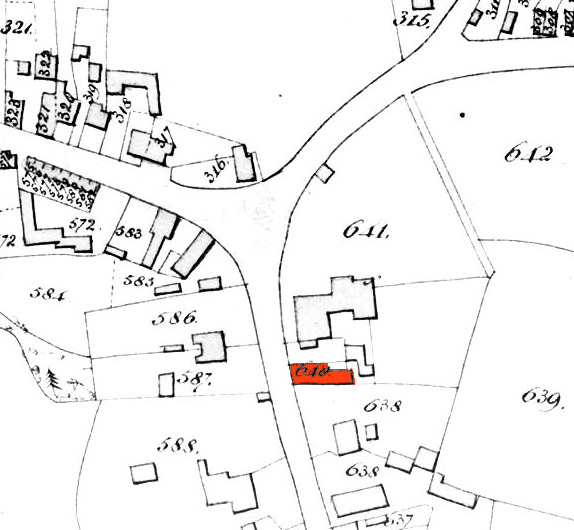 Plot 640 from 1843 Tithe Map.
A reference to the burial of ‘Dr Nicholl’s servant’ in St Martin’s churchyard may imply residence in Epsom by April 1766
The Residential Copyholds of Epsom,from the Records of the Manor of Ebbisham 1663 to 1925, compiled by H.L. Lehmann, published Epsom & Ewell Borough Council, 1987, mentions at 9C19:-
‘On 19 May 1766 Jane Holden and John Jolliffe and Mary his wife sold the properties to John Nicholls of Lincoln’s Inn Middx. Esq. On 15 Oct. 1804 John Nicholls, late of Felbridge Park, Sussex, but now of Verdun within the French Republic Esq appointed his eldest son Frank Nicholls of Westcombe House, Somerset, now residing at Felbridge Park, his attorney, to sell the messuage on the east side of Church Street, lately in the occupation of Mrs. Elizabeth Nicholls widow decd. to Andrew Burt of Gould Square in the City of London.’
John Nicholls (1744 -1832) [LINK ] was Frank’s son, called to the bar in 1767. Evidently he purchased the house in Epsom in which his parents came to live for the rest of their lives. It stood where Church Street turned the corner into East Street. The messuage and buildings were rebuilt by Thomas Clayton after 1839: on 5 August 1848 the land and premises were sold to the London Brighton and South Coast Railway Company, incorporated by an Act 97, 10 Vic. For the Act, to consolidate and unite the London Brighton and the London & Croydon Railway Companies, the properties were numbered. 97 and 98 on their plan and became enfranchised on 12 July 1862. Their location is now indicated by the railway bridge crossing East Street.
Here Dr Nicholls devoted himself to the study of botany and agriculture –
‘he passed the remainder of his life in a literary retirement, not inattentive to natural philosophy, especially the cultivation of grain, and the improvement of barren soils, and contemplating also with admiration the internal nature of plants, as taught by Linnæus’.
Illustrations Of The Literary History Of The Eighteenth Century by John Nichols, 1822 contains an exchange of letters:-
To Dr. Francis Nicholls at Epsom in Surrey.
“State House, King’s Bench, Jan.3, 1770.
Sir,
In its due time I received your much-esteemed letter, which honors me with an invitation to your house at Epsom, to review some fine minerals you have lately collected in Cornwall.
The being known to Dr. Nicholls is an honour I shall always esteem, but I am so unfortunate at present as not to be able to embrace the much-desired and respected offer you make me; as 1 am under confinement in this King’s Bench, which really is the reason I did not anwer your kind letter before. However, the Almighty who has afflicted me with the confinement, has through his mercies granted me the call of my reason, and I apply myself as much as ever, and assiduously to my studies.
With this recollection I am capacitated to wear away the hours of affliction and idleness usually attendant on such places, and by the patronage of several eminent physicians and other gentlemen, as Dr. Mackenzie, Dr. Hunter, Dr. Fothergill, Mr. Foster, &c. I have read some Lectures on the Fossil Kingdom with applause and success, the plan of which I presume herein to transmit you.
Therefore, Sir, though I cannot have the honour of paying my respects personally to you, yet I will strive to demonstrate how ready I am to obey any of your commands by presuming to propose to you, that if you will send to me any part or the whole of the Minerals you mention (for I have a very handsome and commodious apartment in the State House, with a small Library, my papers, and some collection of natural history), I will arrange them, and give you all the information I am capable of in writing. Your specimens shall be kept with all care, and returned you with all honour. This way is the only one at present by which I can shew the respect I acknowledge to Dr. Nicholls, to whom I with pleasure subscribe myself.
Your very obliged servant, E. M. Da Costa.”
Reply to Mr Da Costa
“Epsom, Dec.27, 1774.
“It is with pleasure I hear you are restored to liberty and philosophy; and, as my son tells me, that you should like to see my Collection of Cornish Fossils, I am to assure you of a sincere welcome and a warm bed whenever you shall think proper to indulge your curiosity.
My son will come down again next Sunday morning; so, if you will be at his house in Lincoln’s Inn-fields by nine, he will bring you down, and render your journey less tedious. If you have an hydrostatical balance, I wish you to bring it in your pocket.
I am your humble servant,Fran Nicholls”
Demise in Epsom
Frank’s constitution never was robust and he had attacks of fever at intervals throughout his life sometimes accompanied by the formation of abscesses. ‘In his youth, at Oxford, he was recovered from a dangerous fever by the skill of Doctors Frampton and Frewen; and afterwards at London he had often been afflicted with a catarrh, and an inveterate asthmatic cough’. Of this disorder, probably tuberculosis, which, returned ‘with great violence at the beginning of the year 1778, [to deprive] the world of this valuable man on January 7, in the eightieth year’of his age’.
He was buried at Goring on 26 January 1778, Will, Doctor of Physic of Ockley, proved the same day.
The Lady’s Magazine Or Entertaining Companion for the Fair Sex, Volume 34, announced the death:-
‘6 October 1803, At Epsom, Surrey, aged 98, Mrs Nicholls, relict of Dr Nicholls, mother of John Nicholls, Esq. late M. P. and daughter of the celebrated Dr. Mead’.
Elizabeth Nicholls is presumed to have followed her late husband to the grave in Goring.
Elizabeth Nicholls/ Mrs Trinder, their daughter
Elizabeth born c. 1749 would have been a teenager when the family arrived in Epsom. On 12 March 1770 at St Martin’s church she married, by licence, Rev.William Martin Trinder from Walton upon Thames. The witnesses were her father, Frank, and brother, John.
Trinder, a son of David Trinder, of Shadwell, in Middlesex, esquire, was born in 1747. He matriculated at Exeter College, Oxford, on 31st October 1763, at the age of 16, and after-ward proceeded to the University of Leyden, where he took the degree of M.D. On the 31st October 1770, he took the degree of B.C.L. at Oxford, afterwards proceeding to that of LL.B. For some time, he appears to have resided at Romford but about 1800, he appears to have removed to Barnet, in Hertfordshire, where he took up his residence at Rowley Lodge. There he died on 18 December 1818, aged 73, Memorial in St Botolph’s Shenley; Will proved 2 January 1819 [PROB 11/1612/20].
John Nicholls, their son

John Nicholls by James Sayers, published by Hannah Humphrey etching, published 15 December 1797
Image source : National Portrait Gallery (NPG D9876) (CC BY-NC-ND 3.0)
John Nicholls is found with his Mother both described as ‘of Epsom’ in the list of subscribers to Delineations of the heart, published in 1792, which indicates his residence with her for a period when she was a widow.
Before 1801, however, he had taken a lease on Fellbridge Park, [listed in 1805 late Sir G. A. Shuckburgh Evelyn, Bart.]which extended until circa 1808.
John had remained MP for Tregony up to 1802 but, before 15 October 1804, left Felbridge Park, Sussex, to be found in Verdun , France.
Mr Nicholls had in fact been caught up in the Napoleonic War and the location of an internment centre may be found explained in A Picture of Vedun, or the English detainees in France, by James Lawrence, 1810.
On 2 September 1805, ‘two English magistates then prisoners at Verdun, Mr. Nicholls,a justice of the peace for the county of Oxford, and Mr. Clive, a justice of the peace for the county of Hereford, administered the oath’ in the case of Lovibond v Sir John Morshead, Bart. [a fellow captive].
John is listed,amongst Napoleon’s British Visitors and Captives, 1801-1815, by John Goldsworth Alger, 1904, as ‘Nicholl’ [LINK]. There he is reported to have been allowed to ‘repair to’ Lyons. ‘Nicholl’s son was also allowed to go to a neighbouring town to marry a Miss Mount. [John Frank Nicholl, the younger son married Frances, eldest daughter of Henry Mount in November 1806 before dying in Barbados at the end of 1807. He had been admitted to the bar 25 November 1800 and accompanied his sick sister to the South of France where she was to recover but he was arrested in May 1803, writing to Lincoln’s Inn from Toulouse to say that he had been detained as a prisoner of war and so was not able to keep his terms nor able to pay for the rent on his chambers which were in Dial Court]. The second son of John Nicholls from Felbridge, Godstone, Surrey, Esq. was called to the bar, Mich., 1806.
When John Nicholls made his last Will on 24 September 1821 he was residing at Holland Street, Kensington; it appears he and his daughter had been there from 1816. on 15 April 1817, Lucy, daughter of John Nicholls, esq. of Kensington, married the Rev. Theophilus Abauzit, D.D. , a Huguenot Minister.
John died in France during the spring of 1832, aged 87, mentioned as from Goring, Oxfordshire. The Goring estate, acquired by Dr Frank Nicholls in 1752, had been inherited by his son and augmented before the latter broke up the holding during 1819. John Nicholls retained Goring Grove left to his surviving elder son Francis/Frank, with a financial settlement on his married daughter Mrs Lucy Abauzit.
Francis Nicholls, grandson of Dr Frank Nicholls
Born in 1774, Master Francis Nicholls matriculated at Christ Church, Oxford, on 3 November 1790 and became a barrister at law of Lincoln’s Inn during 1799, his father described ‘of Whitchurch, Oxon’. He is thought to be Gainsborough’s Pink Boy. [LINK]
In 1799, Frank, ‘eldest son of J. Nicholls of Mitcham’ married Ann Katencamp, daughter of Herman Katencamp. In Family Memorials, compiled by Anna W Merivale, 1884. it is remarked: –
‘[The Katencamp’s] daughter, whose delicate state of health had never allowed them to send her from them for the advantages of education, was married about the year 1799 to Mr. Frank Nicholls, in union with whom, having fallen into a deep decline, she dragged through two years of hopeless suffering, and having buried an infant of about three months old,she died soon after at Madeira, whither she went at her own request accompanied by her Mother and Husband’.
A mortgage on the Manor of Chellows for £8,000 to finance their Marriage Settlement, dated 4 December 1799, is documented at the Surrey History Centre [SHC 204/3/42 & 326/35]. John Nicholls, esq, son and heir of Frank Nicholls of Epsom, Doctor of Physic was then described ‘of Mitcham’: his eldest son, Frank, was at Lincoln’s Inn. A Lease and Release of Chellows Farm, 15/16 January 1811 involved, amongst others, John Nicholls of Kensington and Frank Nicholls of Penryn, Cornwall [SHC 204/3/49-50].
In 1808 a licence had been obtained at Quarter Sessions under the Gunpowder Act to build gunpowder mills and magazines at Cosawes Wood in St. Gluvias, Cornwall On 15 May 1910 there was an agreement conveying to Frank Nicholls of Kensington half the gunpowder mills on formation of a partnership with Henry Gill of Penryn, to be called Gill & Co. [Archives and Cornish Studies Service CF/1/1294 ]. Frank withdrew from this business in 1813.
In 1811, by licence at St Gluvias Church, Cornwall, Frank Nicholls, widower, married Charlotte Thomas, both ‘of Penryn’.
There were three children from this union – Frank, John, and Charlotte.
Charlotte Skinner Nicholls (reputedly born 13 December 1817 at Trereife, Cornwall) was brought for baptism to St Mary Abbots Church, Kensington, on 6 January 1818. The residence of her parents Frank Nicholls, Esq. & Charlotte is recorded as ‘Holland Street’. On 20 May 1841 Charlotte Skinner, only daughter of Frank Nicholls of Trereife, Cornwall, barrister at law, married William Rogers Coxwell [later Coxwell–Rogers (b 1809, d 16 February 1899, rector of Dowdswell] at Sevenhampton.
The Will of Frank Nicholls, Upper Grove, Tollington Park, Hornsey, made 28 November 1843 with a codicil at Boulogne sur mer, 7 March 1853, was proved by the sole Executrix, Charlotte Nicholls, widow, his relict, on 25 June 1855.
The codicil had become necessary because Frank had been left Lady’s Bower Cottage, and other land at Rowley Green, Shenley, Herts., under the Will of Mrs Honor Trinder [daughter in law of Elizabeth Trinder, nee Nicholls] his late cousin John Trinder’s widow. This real estate was devised to sons Frank & John Nicholls, and daughter Charlotte Coxwell as tenants in common.
Brian Bouchard © 2019