
Henry Whistler and the Webster family
– their connection to Epsom
The Whistlers were a prominent family in Oxfordshire and many of them became mixed up in the Civil War on opposing sides. One Hugh, possibly from Goring, had four sons, John, Ralph, Henry and Hugh, but for the purposes of this article attention will be confined to the youngest. Hugh, junior, (1594 – 1661) who graduated from Lincoln College, Oxford, became the rector of Faccombe cum Combe in 1618. By his second wife, Sarah, he had a son Henry who was christened at Flaccombe on 11 March 1635. Sometime after 1642, however, he was dispossessed from the living because of his royalist sympathies and died before the Restoration.
Henry Whistler, son of Hugh of Flaccombe, became apprenticed to Edward Layte, clothworker, for 7 years from 10 January 1649/50. Henry Whistler is also reported to have received a commission from Oliver Cromwell as a captain in Colonel Lewis Morris’ Regiment of Foot. He pops up in 1660 in partnership with John Young their firm having gained appointment as flag makers to the navy. Messrs Young and Whistler are mentioned several times in Samuel Pepys Diary. Pepys seems to have regarded their activities with suspicion; he wrote: –
6 October 1664 ‘Up and to the office where busy all the morning, among other things about this of the flags and my bringing in of callicos to oppose Young and Whistler’.
26 October 1664 ‘I stepped aside and found out Nellson, he that Whistler buys his bewpers [bunting] of, and did there buy 5 pieces at their price, and am in hopes thereby to bring them down or buy ourselves all we spend of Nellson at the first hand’.
31 October 1664 ‘Thence home, and there came presently to me Mr Young and Whistler, who find that I have quite overcome them in their business of flags, and now they come to intreat my favour, but I will be even with them’.
5 February 1667 ‘This morning, before I went to the office, there come to me Mr Young and Whistler, flaggmakers, and with mighty earnestness did present me with, and press me to take a box, wherein I could not guess there was less than 100l. in gold: but I do wholly refuse it, and did not at last take it. The truth is, not thinking them safe men to receive such a gratuity from, nor knowing any considerable courtesy that ever I did do them, but desirous to keep myself free from their reports, and to have it in my power to say I had refused their offer’.
During 1677, Whistler appears in a list of London Merchants in business at Sheerbon (Sherborne) Lane but on 24 June of that year he was granted a lease for 60 years of the rebuilt parsonage of St Mary Abchurch. His activities as a supplier of provisions, woollen goods etc. to the Admiralty extending over about 40 years generated great wealth. Investment in London real estate comprised Whistler’s Court, Canon Street, near Salters Hall, Wallbrook, (described in Strype’s Survey as ‘pretty large, well built and inhabited’), and premises in Lombard Street, St Katherines, Ratcliffe, Stepney, Wapping, etc. including wharfs and warehouses on the Thames. In addition to Epsom, he maintained a country retreat at Bengeo Farm, Ware, Hertfordshire.
A petition (in the Journal of the House of Commons, 22 March 1698) reveals that the Trustees of Richard Starling, nephew of Sir Samuel Starling, had conveyed land at Epsom to Henry Whistler, Esq., and Henry Griffith, Merchant, sometime after 1673. Having acquired the property for 100 years at full consideration the petitioners ‘built and laid out several thousand pounds thereon’. This begs a question as to where the land was situated: from Henry Whistler’s will it is known to have been a freehold estate which explains why his name cannot be found in The residential copyholds of Epsom. Dr Lehmann records, however, that most of the land on the south side of Clay Hill, west of South Street and north of the Dorking Road was freehold and notes copyhold plots in the area held by Sir Samuel Starling which were passed down to his nephew, Richard Starling [1B2].
In John Toland’s Letter to Eudoxa, about Epsom, dated 30 May 1711 we are told: –
“The form of our village, as seen from the downs, is exactly semicircular, beginning with a church, and ending with a palace. Mr. Whistler’s far conspicuous grove, makes, as it were, a beautiful knot in the middle, and the road from thence to Woodcote Green, may be called midway street.”
Henry Pownall writing some Particulars relating to the history of Epsom in 1825 identified Mr Whistler’s house with Garlands but, with regard to Mount Diston, confessed ‘We cannot even trace this once beautiful place, but conclude it to have been the mansion, which stood on the hill behind the house, now occupied by Mrs. Pugh.’ The ‘mansion’ would have been above South Street east of Abele Grove but the home of Diston and Garland was one and the same and otherwise known as Woodcote Grove. Henry Whistler’s residence seems to have been a place built on Mounthill (although no substantial house was marked in that area on the 1843 Tithe map), near the road to Woodcote Green, in what Toland described as a ‘far conspicuous grove’. The property actually called Mounthill does not appear until the 1866 OS map was produced.
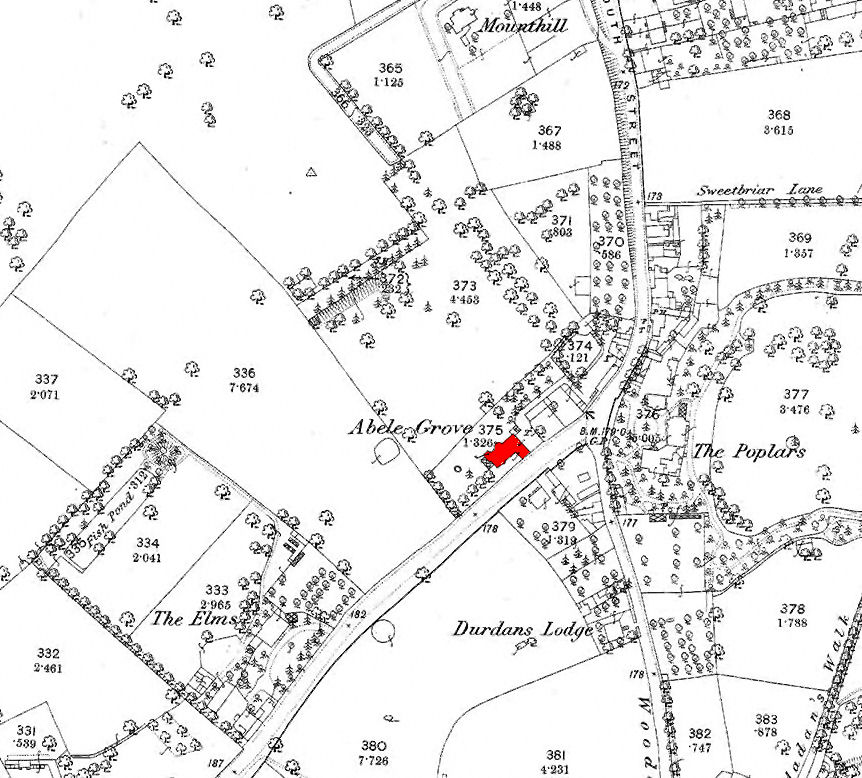 Extract from the 1866 OS map showing Abele Grove and Mounthill – Click to enlarge
During 1678, by licence with the consent of her father Henry Whistler, Gent., Mary Whistler, 18 years old, married Edward Cheek(e) of St Botolph, Bishopsgate, Citizen and Soapmaker, who was a batchelor of 29, at St Mary Abchurch, London. The Marriage Settlement agreed on 3 April 1678 provided a dowry of £15,000. Cheek(e) was required to provide his new wife with a brick messuage or tenement within 40 miles of London of £100 yearly value, with a freehold or copyhold inheritance should she outlive Edward. The Cheekes also held a manor at Sampford Orcas, Somerset, bequeathed by Edward’s father, Francis Cheeke, Attorney of Lyons Inn.
The baptism of a daughter, Jane Cheek(e), took place at St Botolph’s Bishopsgate on 29 January 1682. Her father had died about five years later for his will, as Soapmaker of St Bartholomew without Bishopsgate, to be proved on 1 June 1687. During 1701 Jane Cheeke married Sir Thomas Webster (1st Baronet, bap. 12 November 1676 – died 26 October 1751) of Copthall or Copped Hall, Essex. [There would have been connections with Henry Whistler because Sir Thomas became Master of Clothworkers in 1704 and, with his father, speculated in the supply of hemp to the navy!]
On 17 September 1716, the Nag’s Head in Epsom High Street [Lehmann 2B15] had been mortgaged to Maria (sic) Cheeke of Epsom and following her demise Jane, her daughter and wife of Sir Thomas Webster, was admitted to the copyhold. Dame Jane Webster’s widowed mother Mary Cheeke had lived until 1720, when buried at Waltham Cross. A Certificate from the Heralds’ College for her funeral records that she had died at Copt Hall, and was buried in Waltham Abbey. (Officers who directed the said Funeral: – Piers Mauduit, Windsor, Deputy to John Vanbrugh, Esq., Clarencieux King of Arms, and John Heskett, Portcullis.)
East Sussex Record Office, writing about Sir Thomas Webster (1676 – 1751) and Battle Abbey observe: –
‘In 1719 his wife Jane, daughter of a merchant Edward Cheke of London and Sandford Orcas, Somerset, inherited her father’s property as well as the vast estates of her maternal grandfather Henry Whistler. . These included property at Epsom and Nonsuch Park in Surrey, at Ware in Hertfordshire and Combe in Hampshire, in the City of London and Middlesex, in Londonderry and the water works at York. A year later Thomas inherited his own father’s estate and set about purchasing further properties, some in London and another in St James’ Street but most in Sussex where he showed a partiality for historic buildings. In 1721 he acquired from Viscount Montague the Battle Abbey estate including the Manors of Battle, Barnhorne, Agmerhurst and Swineham, the advowsons of Battle, Hastings, Hooe, Wartling and Bayham and some 8,000 acres in Battle, Bexhill, Ashburnham, Hastings, Hooe and Ninfield. Sir Thomas paid £56,000 for the estate which was particularly rich in timber. In 1723 he added to this the Ewhurst estate of Sir Christopher Powell which included the Manor and advowson of Ewhurst, the Manor and castle of Bodiam and over 800 acres of land. For this he paid £8,500. In 1726 Lord De Lisle and Dudley sold him the Robertsbridge Abbey estate with its ironworks and timber resources and some 1,100 acres extending into Salehurst, Ewhurst, Mountfield, Whatlington and Fairlight at a cost of some £30,000. Finally in 1733 he bought at a cost of £2,150 the Fairlight property of William Acton, including Franks Farm and some 486 acres adjoining his Robertsbridge estate in that parish’
On his death, in 1719, Henry Whistler’s body had been interred at Walthamstow but his remains were brought following the Webster’s acquisition of Battle Abbey to lie in a vault there. (Source: Rose Fuller Whistler’s The Annals of an English Family published in the Sussex Archaeological Collections, vol 35, pp 61-88 in 1887.)
How Henry and Jane ‘s bodies ended up in St Martin’s Graveyard in Epsom is not known possibly because the burial records for the period 27th June 1705 to 11th December 1719 are missing.
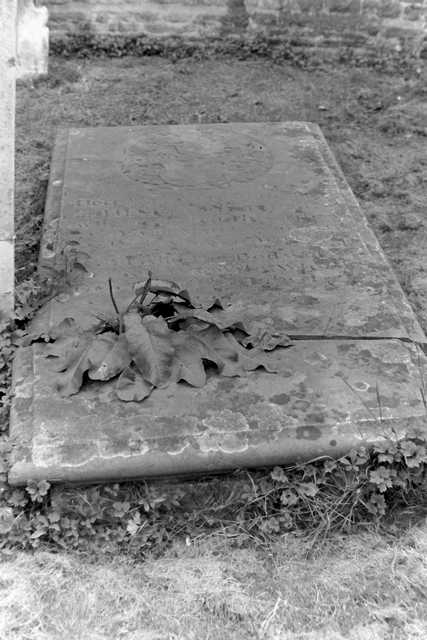 Henry Whistler’s tomb in St Martin’s Gaveyaerd, Epsom
“Here Lyeth interd the Body
of HENRY WHISTLER Esqr.
who departed this Life ye
15th day of March 1719 Aged
Eighty seven Years.
And Also the Body of
JEANE his Wife who
departed this Life the 18th
of February 1688.”
Sir Thomas Webster died on 26 October 1751 to be succeeded by his son Sir Whistler Webster of Battle Abbey. The will, dated 13 November 1753, of Dame Jane Webster, widow, of Battle Abbey was proved 26 March 1760 [PROB 11/854].
The Northey papers at the Surrey History Centre include a Bargain and sale of a freehold messuage or mansion house fronting to the east the street leading to Woodcote Green, by Elisha Biscoe of the Inner Temple, London, and Sir Whistler Webster of Battle Abbey, Sussex, on 10 May 1755.
In Epsom on 10 December 1722 Thomas Webster of Copthall, Essex, baronet, had bought Josiah Diston’s copyhold 4 acres called Readings Mead (now part of Rosebery Park). This land lies over South Street from Mounthill. Sir Whistler Webster surrendered this property on 28 December 1761 and, probably, the family’s local associations were brought to a close [Lehmann 3B14/3C14].
Further particulars of the Websters may be found in the Oxford Dictionary of National Biography accessible through the Surrey Libraries website.
Brian Bouchard
Updated 01 January 2020