
Frith’s Derby Day
By William Powell Frith R.A.
(19 January 1819 – 9 November 1909)
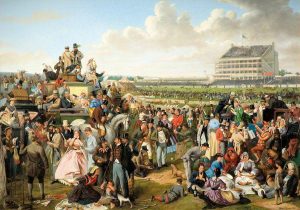
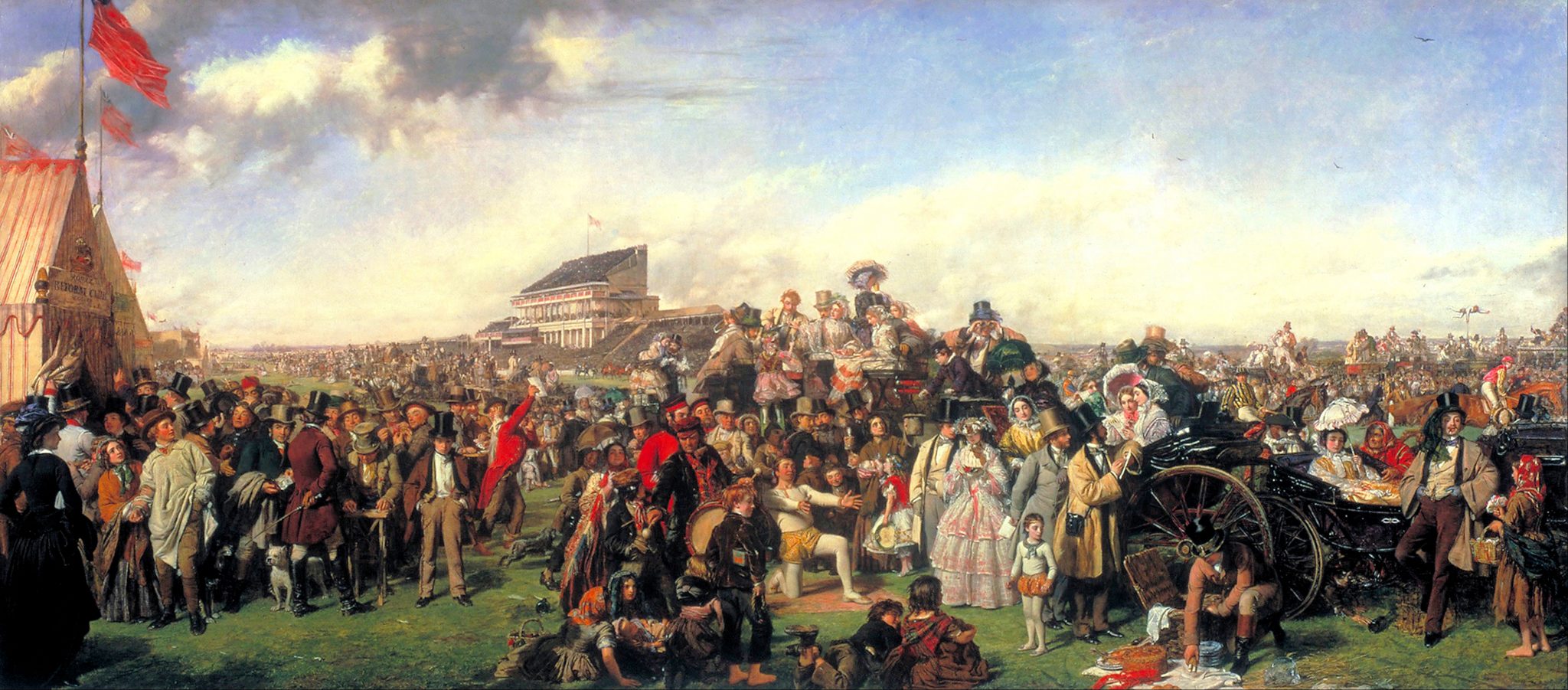 The Derby Day 1856-8 – click image to enlarge
Image courtesy of © The Tate N00615 (Licenced CC-BY-NC-ND 3.0 (Unported))

William Powell Frith c.1860.
Engraved by D.J. Pound. Source not known.
The artist William Powell Frith (1819-1909) first visited the Derby in 1856 and made a rough drawing when he returned home, followed by an oil sketch. While he was on holiday in Folkestone, he showed this sketch to his friend Jacob Bell, who commissioned a painting “5 or 6 feet long” [about 150 to 180cm] based on the sketch for the price of £1500, the highest fee ever paid to that date for a painting by a living artist. Later he made two larger oil sketches, including only the central part of the final picture, one of which is now in the Victoria & Albert Museum. Frith worked on the final version throughout 1857 and produced a painting which was even larger than requested (40 inches high and 88 inches wide)[about 102 x 224cm]. It was first exhibited at the Royal Academy in May 1858 and proved so popular that a rail had to be put up to protect it from the public, the first time this had happened since 1822. The picture was then sent on a world tour that lasted four and a half years. Jacob Bell died in 1859 and left the picture to the National Gallery, where it finally arrived in 1865; it is now in Tate Britain. There is another version dated 1893-4 in the Manchester Art Gallery.
 Queen Victoria, Prince Albert and the Queen of Portugal viewing The Derby Day painting.
(Note the rail protecting the picture)
Image source Illustrated London News 22 May 1858, Vol 32, page 501.
The original title for the picture was “The Humours of a Race-Course” but this was changed at the suggestion of Henry Dorling, General Manager and Clerk of the Course at Epsom (Mrs. Beeton‘s stepfather). The Derby Day is an example of a narrative painting, a type that was popular in the 19th century, designed to tell a story. It can be “read” from left to right. There are 88 foreground figures, intended by Frith to represent the various social types to be seen at the racecourse. At the extreme left in the background is the gambling tent of the Reform Club. Various young men are being lured in, while others attempt to restrain them. In the foreground, the group on the left hand side of the picture centres on a thimble-rigger, with three thimbles and a pea on a portable table. To the right is a young man with a desolate expression, who has just been cleaned out by betting on which thimble contains the pea and to the left is an agricultural worker who is tempted to play, but is being dissuaded by his wife. This mirrors Frith’s own experience in 1856, when he was prevented from losing money in this way by his companion, the artist Augustus Egg. To the right of this group is a man in a red tail coat who is selling Dorling’s race cards.
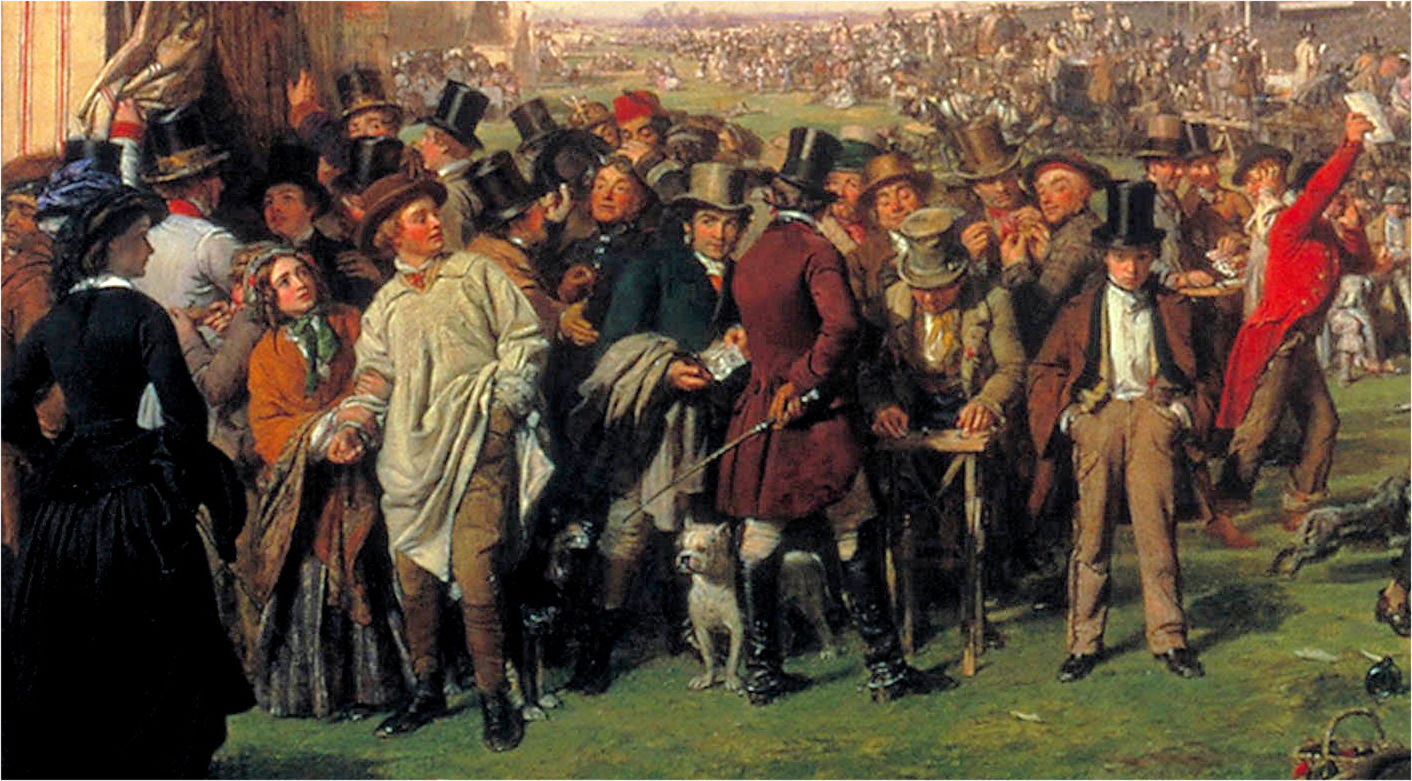
Detail showing agricultural worker who is tempted to play, but is being dissuaded by his wife
the thimble-rigger and the young man who has just been cleaned out.
In the centre of the picture is a boy selling cigars from the box under his arm. In his hand is a piece of smouldering tarred rope for him to give the customer a light. To the right of this boy is an acrobat, encouraging his son to leap into his arms. The son is not paying attention but staring at the luxurious picnic being unpacked from a wicker hamper by a rich family’s footman. There is a large pie and a whole lobster, among other delicacies. Straw packaging from the hamper and a large lump of ice are also on the ground. Frith found the acrobat and his son in a pantomime at Drury Lane but they were not able to sit still for long periods, so Frith bought their costumes from them for professional artists’ models to wear. A preliminary rough sketch of the acrobat’s pose is in the British Museum (Museum number 1932,0611.19).
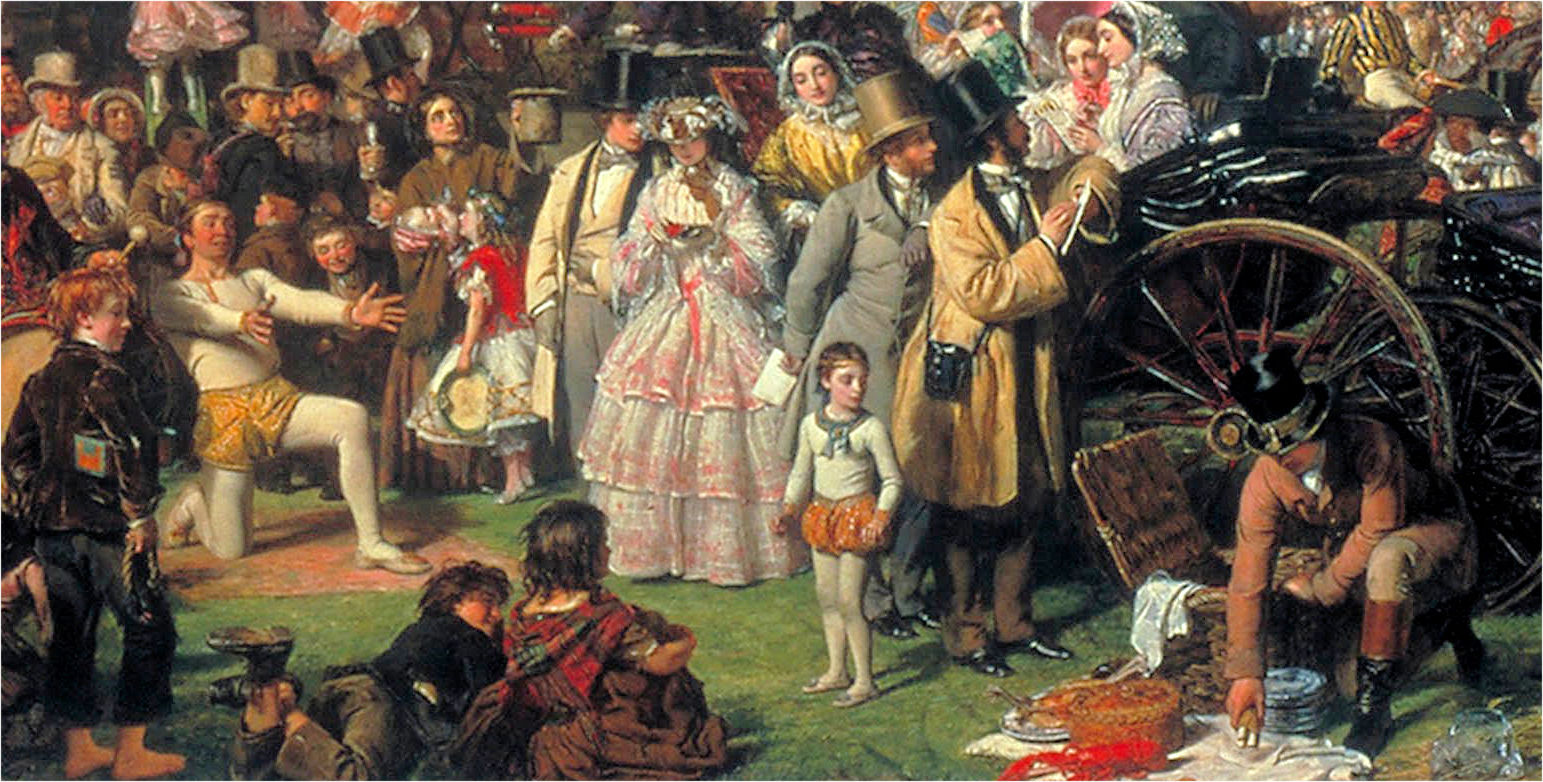
Detail showing boy selling cigars and acrobat holding out arms to his son.
On the right hand side of the picture there are two carriages. In the first carriage are three aristocratic ladies; two aristocratic gentlemen are standing in front of the carriage. In the second carriage sits a ‘kept woman’ refusing the attentions of the fortune teller standing behind the carriage. In front of the carriage stands her dissipated lover, refusing to buy flowers from a barefoot girl. Around his top hat he wears a puggaree, a light scarf worn to protect his face from the dust when on the road. Below this carriage, a boy reaches out to steal a wine bottle.
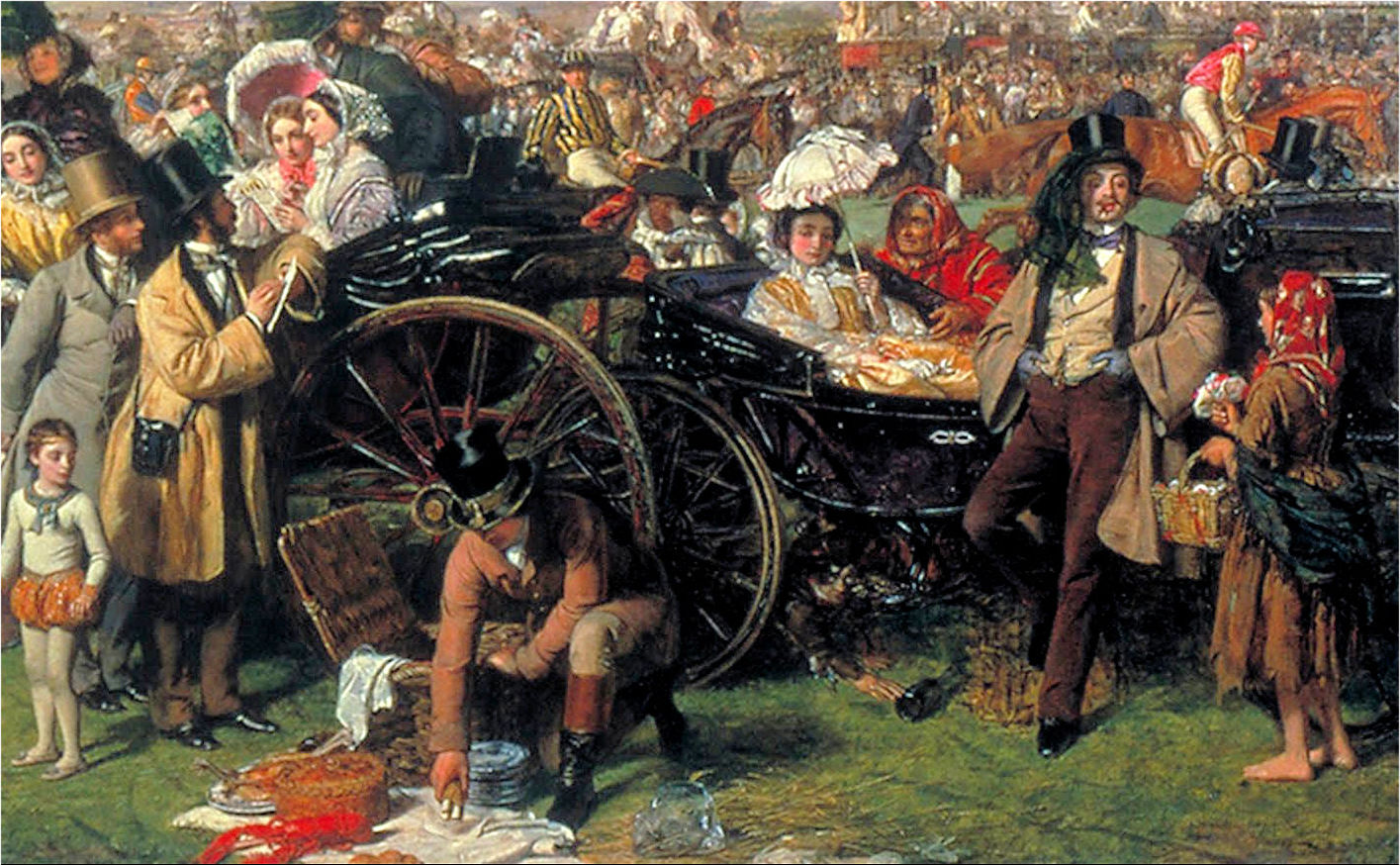
Detail showing ‘kept woman’, fortune tellers and the dissipated lover
Frith had some help when painting the picture. A drawing of the two horses and the jockey on the right of the picture was made by John Frederick Herring (1795-1865) as mentioned by Frith in his autobiography. He wrote, “I am indebted to Herring, one of the best painters of the racehorse I have ever known, for great assistance in the very small share the high-mettled racer has in my work.” Herring’s drawing is now in the British Museum. A professional jockey called Bundy was the model for the jockeys in the picture, sitting on a wooden horse in the studio. He did not enjoy the experience and said to Frith that “he would rather ride the wildest horse that ever lived than mount the wooden one any more.” Frith did not mention his other source of help. He commissioned his friend Richard Howlett (1831-1858) to photograph crowd scenes at the 1856 Derby from the roof of a cab for use as preliminary studies for the picture. It is not clear exactly how Frith used these photographs, but at a meeting of the Photographic Society of Scotland in 1863, it was reported that he, “… got many useful studies, not to introduce literally into his picture… but to work up in his own mind and then reproduce with the true stamp of genius upon them.” One of these photographs survives, showing the crowd with the grandstand in the distance. This is said to be the first time that the camera was used in the creation of a great painting. Today Howlett is perhaps best known for his photograph of Isambard Kingdom Brunel standing in front of the launching chains of the Great Eastern.
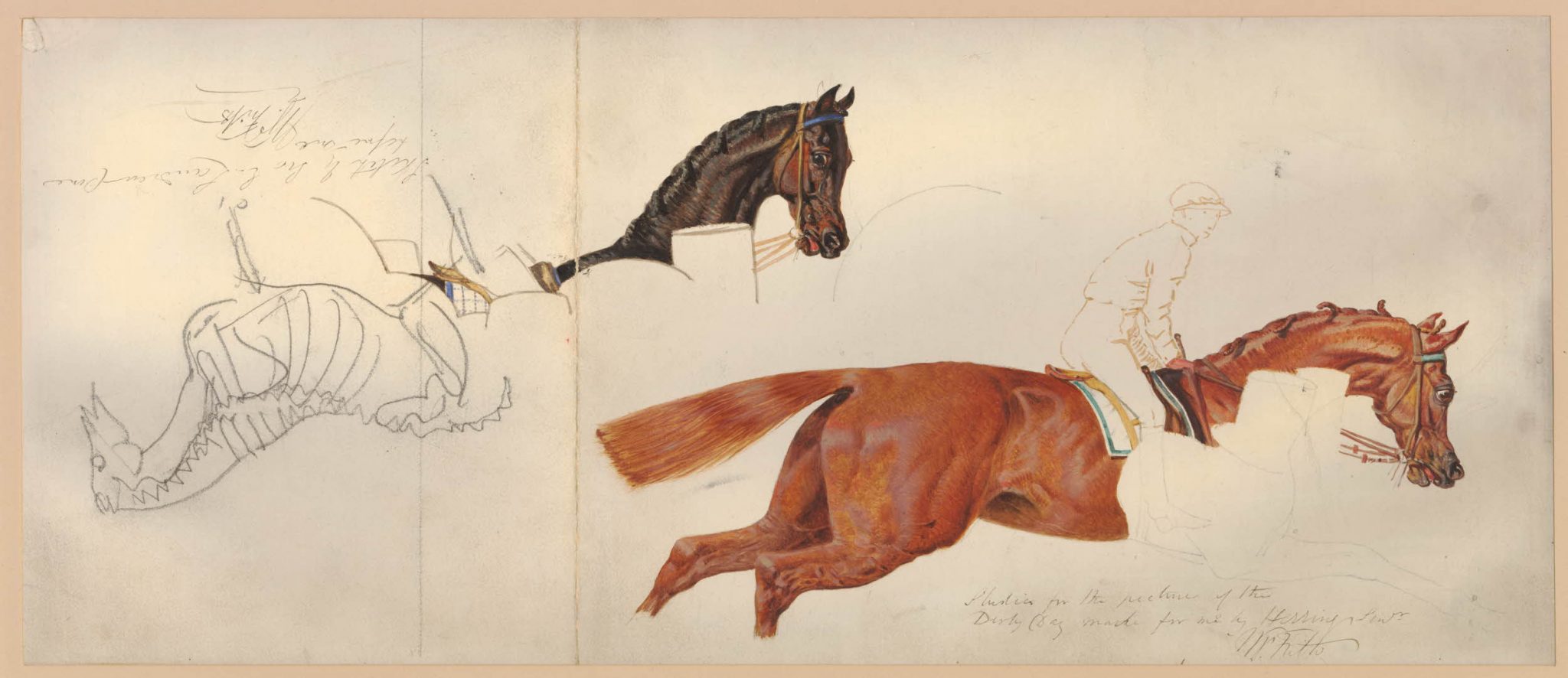
Studies of racehorses – used by W P Frith in his ‘Derby Day’ – click image to enlarge
Drawn by: John Frederick Herring and Edwin Landseer
Image courtesy of © Trustees of the British Museum 1935,0413.1 (Licenced CC BY-NC-SA 4.0)
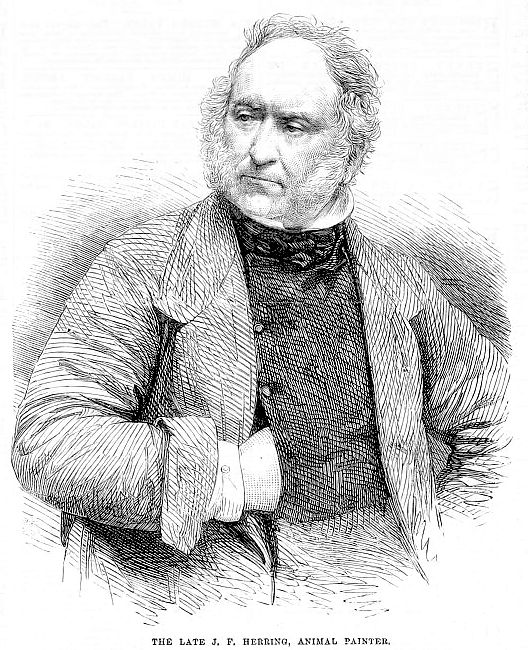
Artist John Frederick Herring (Senior)
Image Source:Illustrated London News. 14 October 1865
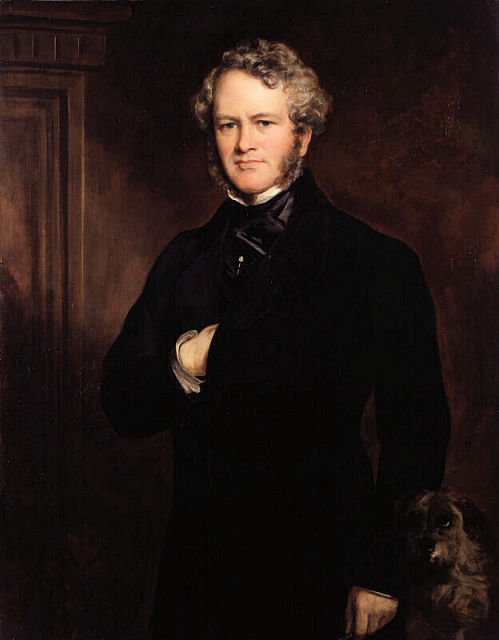
Artist Edwin Landseer by Sir Francis Grant 1852
Image courtesy of © National Portrait Gallery NPG 834 (3.0 Unported CC BY-NC-ND 3.0)
 A ‘snapshot’ taken in 1856 for use of W.P. Frith R.A.
Photograph by Robert Howlett.
Image source Illustrated London News 09 Jun 1934, Vol 184, page 924.
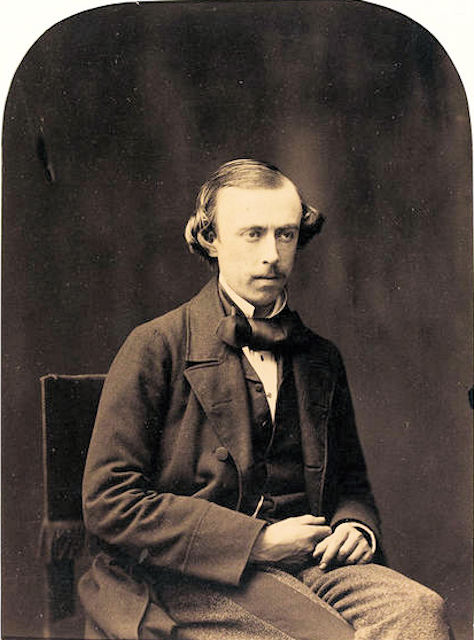 Portrait of Photographer Robert Howlett
Photograph by Benjamin Brecknell Turner
Image courtesy of © Victoria and Albert Museum, London. E.2-2009
There is a similar painting entitled Epsom Downs, now known from the copy by Aaron Green after the original by Alfred Hunt, in the Potteries Museum & Art Gallery in Stoke on Trent. (See also The Dirty Derby.)
Epsom Downs 1863 by Aaron Green (1820-1898)
Image source: The Potteries Museum & Art Gallery
 William Powell Frith
Source: Vanity Fair “The Derby Day” Men of the Day No. 63.
Sources:
- Thomas Sutton. Of some of the uses and abuses of photography. Journal of the Royal Society of Photography 1863;8:202-206.
- Christopher Wood. William Powell Frith: a painter and his world. Stroud: Sutton Publishing, 2006.
- William Powell Frith. Autobiography and reminiscences. Volume 1. London: Richard Bentley, 1887.
- Lionel Lambourne. Victorian painting. London: Phaidon, 1999.
- Mary Cowling. Victorian figurative painting: domestic life and the contemporary social scene. London: Andreas Papadakis Publisher, 2000.
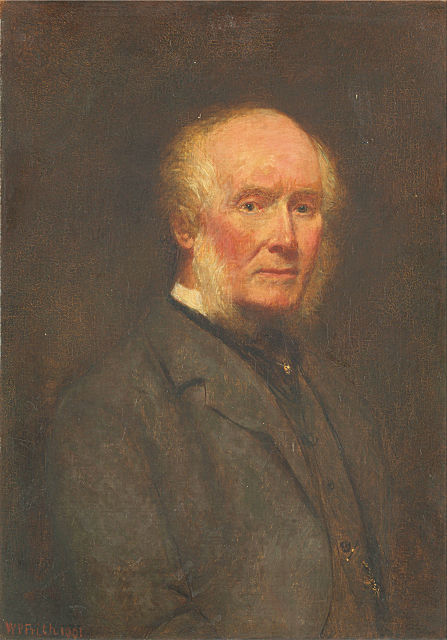 William Powell Frith.
A Self Portrait at age 83 and dated 1901.
Image Source Yale Center for British Art B2009.9.7
Clive Vaisey © October 2017
Key to the Victorian Era Stereotypes shown in The Derby Day painting
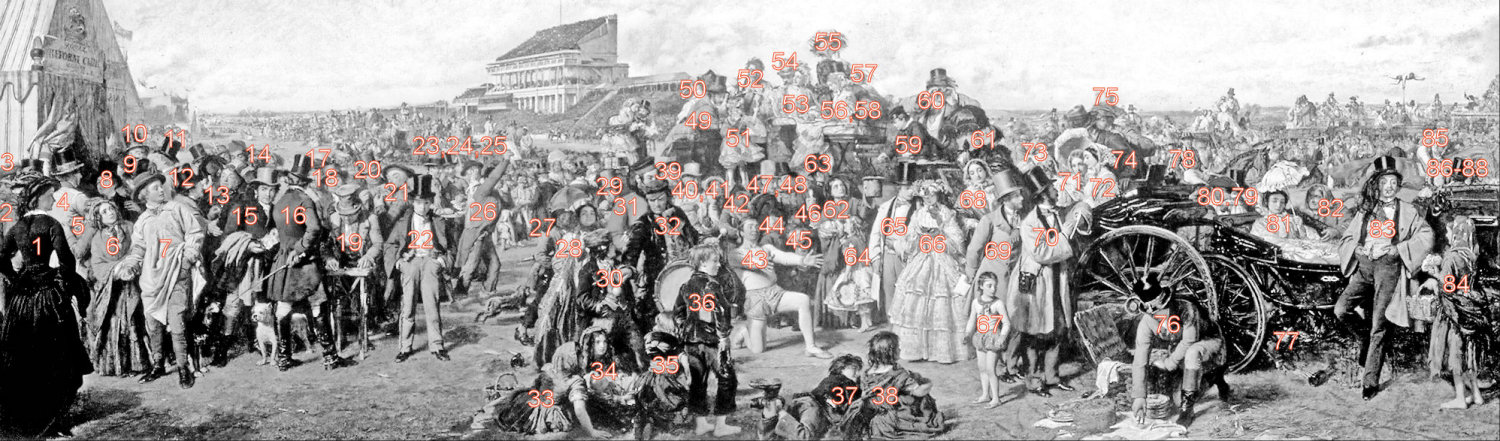 Victorian Era Stereotypes shown in The Derby Day painting
Click image to enlarge.
Key to the Victorian Era Stereotypes shown in The Derby Day painting
- Lady in Riding Habit
- Her gentleman companion
- Low-class type (possibly a coster monger)
- Gambling tent official
- Low-class boy firing at a target
- Country Bumpkin and Wife
- Country Bumpkin and Wife
- Upper-class university student entering gambling tent
- A ‘man about town’ attempting to restrain him
- Gambling tent official
- Foolish young aristocrat, also tempted
- Fussy Gentleman protesting against the fraudulent thimble-riggers
- Policeman, admitting that he cannot interfere
- Man in Fez (This is a portrait of Richard Dadd, artist friend of Frith)
- Murderous type
- Fake country squire
- Morally outraged gentleman
- Fake Quaker
- Thimbler operating with a ‘pea’
- Swindler
- Swindler
- Young city gent, cleaned out by thimble-riggers
- Card sharper
- Card sharper
- Duped country bumpkin
- Man selling Dorling’s Race Cards
- Urchin
- Cook
- Bookmaker
- Urban youth
- Sergeant
- Drummer – low-class urban type attached to acrobat group
- Gypsy girl
- Gypsy girl with baby
- Poor girl – urban type
- Urchin with lighted rope, selling cigars
- Urchin
- Gypsy girl
- Soldier
- Respectable middle-class country farmer and his wife, outraged by the pick-pocketing gang
- Respectable middle-class country farmer and his wife, outraged by the pick-pocketing gang
- Pickpocket
- Acrobat
- Pickpocket
- Urchin possibly working with pick-pocketing gang
- Pickpocket
- Tourist
- Tourist
- Raffish gentlemen getting drunk
- Raffish gentlemen getting drunk
- Girl on stilts, member of acrobat troop
- Raffish gentleman offering her champagne
- His female companion (of doubtful social standing and morality) restraining him
- Members of the same decadent party
- Members of the same decadent party
- Members of the same decadent party
- Members of the same decadent party
- Members of the same decadent party
- Respectable gentleman, boy and lady
- Respectable gentleman, boy and lady
- Respectable gentleman, boy and lady
- Acrobat’s wife
- Policeman
- Acrobat’s daughter neglecting her dancing to kiss the baby
- Charming young couple
- Charming young couple
- Acrobat’s boy
- Aristocratic lady
- Aristocratic Officers
- Aristocratic Officers
- Aristocratic ladies
- Aristocratic ladies
- Lady consulting two gentlemen about the race
- Gentleman consulting her race card
- Gentleman consulting her race card
- Manservant to aristocratic party
- Urchin stealing a bottle
- Jockey
- Serenader
- Gypsy
- Fallen woman – soon to be abandoned
- Gypsy fortune teller
- Aristocratic roué
- Flower seller
- Jockey
- pectators
- Spectators
- Spectators