
Flying Officer (later Group Captain) Peter James SIMPSON (41875), DSO DFC
Battle of Britain pilot (and WW2 survivor) who made
a forced landing at Woodcote Park on 18 August 1940
 Peter James Simpson
Image courtesy of Royal Air Force Museum, Hendon
Peter was born in Hove on 5 March 1921, the sixth and last child of Peter John and Minnie Christina (née Carder) Simpson. His “Retail Chemist” father and “Dressmaker” mother had married in August 1906. The 1911 Census recorded them at 114 Addison Road, Hove with their first two children and a live-in domestic servant. (The family later moved within Hove, to 6 Wilbury Crescent.)
In January 1939 – shortly before his nineteenth birthday – Peter joined the RAF on a short service commission. After completing his pilot training he arrived at 11 Group Pool, St Athan (in the Vale of Glamorgan) on 24 October, where he converted to Hurricanes. On 20 November 1939, he began active service with 111 Squadron at RAF Acklington in Northumberland. The squadron was brought south for duty during the 26 May – 4 June 1940 evacuation of the British Expeditionary Force from Dunkirk during which, on 2 June, Peter was credited with his first “kill”.
The Battle of Britain began on 10 July 1940, and Peter had continued success in the thick of the action, and was fortunate to get home when his aircraft was severely damaged by cannon fire in a dogfight on 13 August. On 18 August – now called the “Hardest Day” of the Battle – Peter was among those scrambled from RAF Debden in Essex to engage enemy bombers. He was credited with a probable destruction of a Dornier 17, but was damaged in the engagement necessitating a forced landing. His Squadron Leader (J M Thompson) recorded:
“111 squadron took off at 1315 on 18 August to engage enemy bombers which were approaching RAF Kenley and Croydon. P/O Simpson was flying P3399 as number 2 in Blue section. At approx. 1330 the squadron engaged these aircraft and as a result P/O Simpson’s aircraft was damaged by gunfire and he was forced to land on Woodcote Park golf course, Epsom Downs. He was slightly injured but returned to his unit at once.”
(The authors of the generally authoritative Aces High Vol. II mistakenly listed the forced landing as being on “Epsom Downs Golf Course”.)
Peter brought his Hurricane down close to the clubhouse on the RAC Golf Course. In the 1990s, the RAC commissioned a painting of this event (see below). In the absence of any photographs, the artist was helped by the eyewitness report of Edwin Jobling, shown in the right background of the painting. Edwin was aged 14 at the time and it is understood that Peter signed part of the Hurricane’s broken propeller for him as a souvenir.

The RAC’s painting of Peter Simpson’s forced landing in Woodcote Park.
(Photograph by Roger Morgan © 2020)
The painting is displayed in the Clubhouse’s “Hurricane Bar” opened on the occasion of a Hawker Hurricane flypast of Woodcote Park in recognition of the clubhouse Centenary on 3 July 2013. The text of the frame’s label is
“HAWKER HURRICANE / Mark Postlethwaite 1997 / This painting was commissioned by the Royal Automobile Club to commemorate the emergency landing at Woodcote Park of an RAF Hawker Hurricane, on 18 August 1940, the “Hardest Day” of the Battle of Britain. The plane was flown by nineteen year old Pilot Officer Peter Simpson, of No. 111 “Treble One” Squadron.”
Peter had continued success and, on 17 December 1940, was awarded the Distinguished Flying Cross. The citation reads:
“This officer has taken part in numerous engagements against the enemy over a long and intensive period of operations both in France and in England. He has shown exceptional keenness and skill and has destroyed at least five hostile aircraft.”
Peter rose through the ranks and, now as an Acting Wing Commander, in June 1944 led the Portreath Wing over Normandy for the D-Day landings and their aftermath. On 29 August 1944, he was awarded the Distinguished Service Order
In Q4 1946, registered in Hailsham, Peter married Cynthia Shallow. No record has been found of their having any children. He retired from the RAF on 5 March 1968 as a Wing Commander, retaining the rank of Group Captain The couple made their home in Tunbridge Wells, where, aged 66 Peter died on 17 November 1987. The widowed Cynthia remained in Tunbridge Wells, dying there on 7 March 1991, aged 71.
Bert Barnhurst & Roger Morgan 2021
(An update of Bert’s 2005 article in the light of information
now on the Battle of Britain Memorial website.)
Spotlight on the Hawker Hurricane
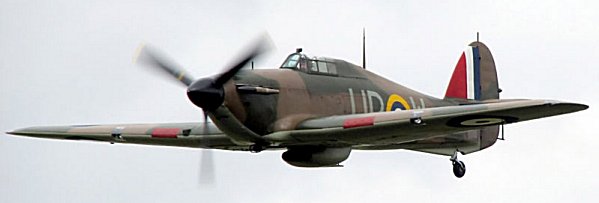 Hawker Hurricane
Image source Wikipedia (opens in a new window)
The Hurricane was initially developed by Hawker to meet an the Air Ministry specification for a fighter aircraft built around the new Rolls-Royce Merlin engines. The original design was started in 1934 and was the work of Sidney Camm but it was rejected by the Ministry so Hawker decided to proceed with it as a private venture. The plane was designed for traditional construction with fabric stretched over a metal frame and utilised many of Hawker’s existing parts, tools and jigs. The Hurricane was very durable and proved far more resistant to exploding cannon shells than the metal-skinned Spitfire. The simplicity of its design meant that remarkable repairs could be improvised in Squadron workshops.
The Hurricane was ordered into production in 1936 mainly by virtue of its relatively simple construction and ease of manufacture. At the time it was unclear if the much more advanced Spitfire would be able to enter production smoothly, whereas Hurricane production was a well understood manufacturing process. This was true for service squadrons as well, who were experienced in working on and repairing aircraft constructed like the Hurricane. With its ease of maintenance, widely set landing gear and benign flying characteristics, the Hurricane remained in use in theatres of operations where reliability was more important than performance, long after it was obsolete as a fighter aircraft. In all, some 14,000 Hurricanes and Sea Hurricanes were produced.
Hurricane Mk I
Deliveries of the Mark I production planes started in October 1937. These early aircraft were simple, with fabric-covered wings, a wooden two-bladed, fixed-pitch propeller, and lacking armour or self-sealing tanks. Powered by the 1,030 hp (768 kW) Rolls-Royce Merlin Mk II or III engine, the Mk I was armed with eight .303 inch Browning machine guns. Although the use of this number of guns sounds impressive, the fact is that this relatively small calibre armament was more suited to shooting down the wood/canvas machines of the First World War. It was relatively common during the Battle of Britain for the (metal) German planes to be struck by a surprisingly high numbers of .303 bullets but still return safely to base. The use of a smaller number of larger calibre guns would have been far more effective and this was rectified in later versions of the Hurricane.
In 1939, a revised Mk I series was introduced which included metal-covered wings, armour and other improvements and about 500 of this later design formed the backbone of the fighter squadrons during the Battle of France and into the Battle of Britain. During the Battle of Britain, the Hurricane shot down the majority of the planes claimed by the RAF (1,593 out of 2,739 total claimed). By late 1940 the Huricane was becoming outclassed as a pure fighter and the higher specification Spitfire could be produced faster. However the general design went through marks II to V and was modified for many other tasks including a fighter bomber and the succesful Sea Hurricane modified for launching from carriers.
Specifications (Hurricane IIC) General characteristics
- Crew: One
- Length: 32 ft 3 in (9.84 m)
- Wingspan: 40 ft 0 in (12.19 m)
- Height: 13 ft 1½ in (4.0 m)
- Wing area: 257.5 ft² (23.92 m²)
- Empty weight: 5,745 lb (2,605 kg)
- Loaded weight: 7,670 lb (3,480 kg)
- Max takeoff weight: 8,710 lb (3,950 kg)
- Powerplant: 1× Rolls-Royce Merlin XX liquid-cooled V-12, 1,185 hp at 21,000 ft (883 kW at 6,400 m)
- Maximum speed: 334 mph at 21,500 ft (505 km/h at 5,400 m)
- Range: 600 mi (965 km)
- Service ceiling: 36,000 ft (10,970 m)
- Rate of climb: 2,780 ft/min (14.1 m/s)
- Wing loading: 29.8 lb/ft² (kg/m²)
- Power/mass: 6.47 lb/hp (kg/kW)
Armament – Guns
- IIA: 8× 0.303 in (7.7 mm) Browning machine guns
- IIB: 12× 0.303 in (7.7 mm) Browning machine guns
- IIC: 4× 20 mm Hispano Mk II cannon
- IID: 2× 40 mm Vickers Type S cannon, 2× 0.303 in (7.7 mm) Browning machine guns
Armament – Bombs (IIC & IID):
- 2× 250 lb bombs, or
- 2× 500 lb bombs
Text Source based on text in Wikipedia (opens in a new window)
If you have enjoyed reading this article you many also like to read the following pages: