
Hearth Tax returns of 1664
Sources for Epsom and Ewell History
 A Woman Peeling Apples by Pieter de Hooch
What Was The Hearth Tax?
In 1662 Parliament needed money to pay for the Royal Household of Charles II, which was estimated to cost £1,200,000 per year. Since the existing customs and excise revenue was not enough, it was to be supplemented by a new Hearth Tax, assessed by counting the number of fireplaces in every house and charging two shillings a year for each of them.
The bill received Royal assent on 19th May 1662, with the first instalment due on Michaelmas Day (29th September) in the same year. It was a tax on property, which (from the tax-gatherers’ point of view) made it easier and cheaper to manage than a poll tax or income tax, since hearths and buildings cannot move about the country as people can. Rich people lived in larger houses, where there were more rooms needing more fireplaces, so the tax also had an element of fairness.
Unfortunately the first Hearth Tax Act was badly drafted and did not consider some of the practical problems that should have been obvious; for example, there were no exemptions for hospitals or almshouses. It was not originally clear who would be responsible for payment – the landlords who owned houses, or the occupants who lived in them. One of the first amendments to the Act specified that it would be the occupants who paid. In this way the politicians shifted the tax burden onto the poorer middle classes and away from wealthy property owners – many of whom just happened to be politicians!
The Hearth Tax failed to raise the expected revenue despite numerous amendments. Originally collected by local government, the tax was placed in the hands of contractors after 1664. It was still resented by many in the middle classes, not just because of the payment but because they had to allow inspection of their homes by petty officials. In 1689 the tax was repealed by William and Mary, probably in a bid for popularity after their accession to the throne.
For a fuller explanation of the Hearth Tax see the excellent www.hearthtax.org.uk website.
Who Organised The Hearth Tax?
 Woman hands money over to her servant by Pieter de Hooch
From 1662 to 1664, collection of the Hearth Tax was managed by local government. This is the period which is of most interest to historians, since detailed records were kept and these give us an insight into the workings of community life, from the village constables who collected the money to the county administration which transferred it to the central authorities.
Seventeenth-century local government was a complex system with a long history. Counties were divided into Hundreds, and there were 14 of these in Surrey, which meant that they were about the same in size and number as the modern Districts or Boroughs. Unlike a modern local authority, the Hundred had no staff or headquarters. Instead, its business was handled by two constables, elected annually from the class of yeomen or farmers. They usually reported to magistrates, who were drawn from the ranks of the gentry, although for some county business they were directly responsible to the Lord Lieutenant or the county Sheriff. Inquiries about administration and law in the Hundred were addressed to a jury, consisting again of local farmers and freeholders.
Each Hundred was divided into tithings. Ewell was a tithing in Copthorne Hundred, as was Cuddington; sometimes Epsom appears as a single tithing, but sometimes Horton or Woodcote are treated as separate ones. At the same time, in parallel to the system of counties, Hundreds and tithings (the civil administration), there was also a framework of dioceses, rural deaneries and parishes (the ecclesiastical administration). A tithing had its own headborough or parish constable, responsible to the Hundred court, and it would send members to the Hundred jury to deal with local government issues, although these might also include laws about the church like those that enforced Sunday attendance. At the same time, a parish would have two churchwardens and a vestry of local freeholders, who dealt with matters not immediately related to the church such as highway maintenance and poor relief. As in Ewell, most parishes covered exactly the same area as the corresponding tithing, and much the same people were elected to run both, so it was easy to get confused. In the 1660s, most people thought of parish and tithing as two ways of describing the same village.
How Was The Hearth Tax Collected?
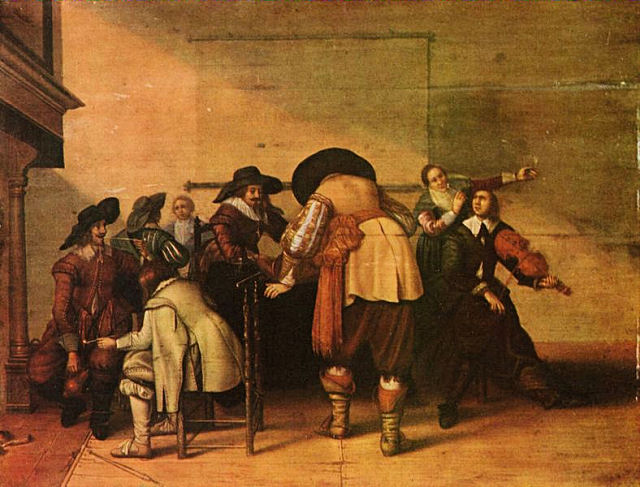 Fröhliche Gesellschaft (Happy Company) by Jan Olis
In 1664, the last year when the Hearth Tax was collected by local government, the constables for Ewell were John Bancks and John Tayler. Epsom was organised by Robert Maynard and Thomas Rogers, with Thomas Michell as the sole constable for Horton. The parish or tithing of Cuddington, which had disappeared into Nonsuch Park, did not feature in the Hearth Tax – not because nobody lived there (Worcester House was a large mansion with farm buildings nearby) but because it was Crown property and therefore exempt.
Constables like Bancks and Tayler had to collect the annual 2s per hearth from their village and send it to the Hundred, from which it would be collected for the whole of Surrey. The tax was payable in two equal instalments, one on Lady Day (25th March) and the other at Michaelmas (29th September). Everyone had to pay except the poor. Bancks and Tayler probably did not count the real paupers – those who were already discounted from paying rates to support the church and poor relief, and who were often on relief themselves. The constables, who had probably sat on the church vestry themselves, knew who these people were and did not mention them specifically, although in one of their returns they explain that they have disregarded ‘divers others poore that Receiue almes’. But there were also borderline cases, defined by the Act as those who occupied a house worth less than £1 a year in rental value, and who were below an monetary threshold on two other counts – they had no other property worth more than £1 a year rent, and their income was less than £10 a year. Someone who met all of these criteria was exempt from having to pay, but as this was an obvious loophole for getting out of the tax, constables were expected to produce a certificate of their low income which had been signed by the vicar, churchwardens and Overseers of the Poor, with counter-signatures from magistrates.
What Does The Hearth Tax Say About Epsom And Ewell?
The Exchequer Duplicate Hearth Tax Roll for Lady Day 1664 lists 88 houses in Epsom – including 12 which were in Horton – and 99 in Ewell. Making allowance for 25 exempt properties in Ewell and 14 in Epsom, this meant that 74 houses in Ewell were due to pay their 2s a year on a total of 262 hearths, while in Epsom the same number of houses, 74, were paying for the greater total of 367 hearths. In other words, the tax income from Ewell in 1664 (supposing that everyone had paid up promptly) would have been £26/4/-, while that from Epsom would have been £36/14/-. How do these figures compare with other Surrey communities?
In 1664 both Epsom and Ewell were villages, with Ewell slightly the larger of the two; since the Middle Ages it had been marked out by a regular layout based on a market place. In this it was very much like Leatherhead, another agricultural village with a trading centre on an old road, and in fact Leatherhead paid for 262 hearths in the tax returns – exactly the same as Ewell. There were only six other villages in rural Surrey assessed for this or a greater number of hearths, and they were Godstone, Lingfield, Weybridge, Chobham, Wonersh and Chiddingfold. Each of them seems to have functioned as a market centre for the smaller villages and hamlets round about, and the same was doubtless true for Ewell. Its hinterland consisted of places like Banstead (paying 65% of the sum that Ewell returned) and Cheam (contributing only 53% as much).
The exception to this pattern was Epsom. Up until the early modern period, most indices of wealth for wealth show Epsom close to the level of Ewell. In the taxation of 1545, it paid 86% of what Ewell did (13s 5d as against 15s 7d). In the lay subsidy of 1593, Epsom is in the lead with 114% of Ewell’s contribution (£14/16/- as against £12/19/4, though to be fair, £4 of the Epsom assessment was levied on the lands of Nicholas Saunder of Ewell). But no assessment before 1664 shows Epsom quite so prosperous in relation to Ewell. The change was due, of course, to Epsom Spa. Discovered, according to later tradition, in about 1618, the spa waters were certainly attracting visitors by the 1620s and under the Commonwealth the village had become a social centre. When Pepys visited in July 1663 – only four months after the Hearth Tax assessment was made – ‘the road being full of citizens going and coming towards Epsum… we could hear of no lodging, the town so full’.
That explains why the return of 367 hearths for Epsom is greater than that for any other Surrey village, if we discount those that lay inside the belt of metropolitan influence around Southwark and along the Thames. In some ways, Epsom was itself an extension of London – a holiday home for Pepys’ ‘citizens’. But it still fell a long way short of being a town. The old boroughs of Surrey – Croydon, Reigate, Farnham, Godalming, or Dorking – typically returned twice as many paying hearths. Even Chertsey, a town in decline after the loss of its monastery, could report 651 hearths, while Guildford had 1299, 3½ times as many as Epsom.
What Does The Hearth Tax Say About Population?
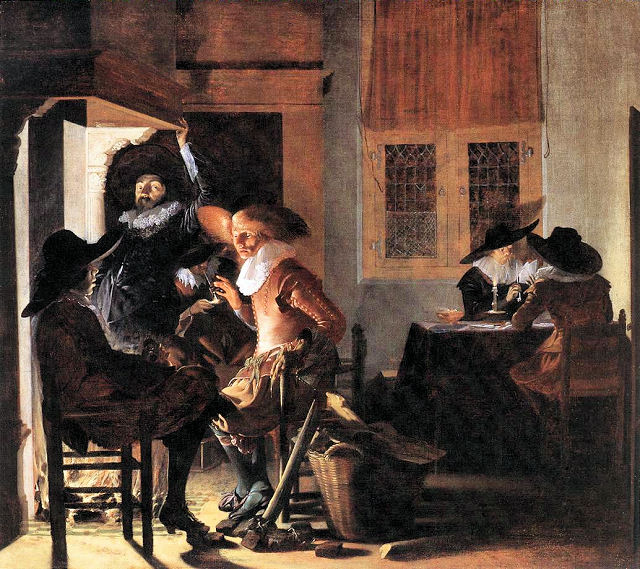 Soldiers beside a Fireplace by Duyster Willem Cornelisz
The constables of 1664 – Bancks, Tayler, Maynard, Rogers and Michell – were conscientious men. They had good reason to be, since the fine for not inspecting a house and reporting its number of hearths was £5 for each week that the job was left undone, with no upper limit. The fact that the Hearth Tax was levied on occupiers rather than landowners helped to simplify their task and ours, since each entry should represent one person in one house. Nevertheless, the tax was not a census. The numbers of the extreme poor, who were in receipt of parish relief rather than paying towards it, cannot be known, and the size of households obviously varied enormously. The 29 hearths registered for Lord Berkeley at Durdans represent an entire nobleman’s retinue, while Widow Pierce and Widow Saunders, to be found (apparently) next to each other in Ewell, had houses with only one hearth and were presumably living alone.
Demographers have agreed on a national multiplier of 4.3 for converting Hearth Tax returns to real population figures. Using this generally accepted figure, it appears that Epsom had a population of some 380 people (330 excluding Horton) while Ewell had about 430. This must surely be an underestimate. William Schellinks, visiting Epsom in 1662, was told that ‘the village… is fairly large and can spread 300 beds’ and allowing for a certain local boastfulness, it seems unlikely that the number of beds supplied for visitors could have been almost equal to those needed for the inhabitants. C.A.F. Meekings suggests that in the metropolitan periphery, Hearth Tax lists of names should be converted to actual population by a multiplier of 6. That would give us 530 for Epsom (450 without Horton) and 595 for Ewell. In the 1720s, the population of Ewell was reported at 583, a figure which sounds like the result of accurate computation, while the return for Epsom says vaguely ‘there are supposed to be 1500 souls’. Much later, in 1788, the more methodical Jonathan Boucher found the population of Epsom at 900. The figures, vague as they are, compare with the evidence of new building in the manorial records to suggest that Epsom enjoyed a population boom in the days of the Spa, followed by a slump when it fell from fashion, while Ewell continued village life at much the same size as before.
What Does The Hearth Tax Say About Wealth?
 Interior with Two Gentleman and a Woman Beside a Fire by Pieter de Hooch
All communities have a gradient, more or less marked, of wealth and social importance. In pre-modern societies, this takes the form of a pyramid; at the bottom, there is a large workforce of peasants or labourers, with smaller numbers of people enjoying a larger share of resources at each successive stage, until at the top you come to the governing elite. Modern societies, by contrast, have a few people who are very poor and a few who are very rich, with most people occupying a middle status.
Epsom and Ewell are no exception to this rule. A manorial survey of Ewell in 1408 – compiled at a time when ownership of land was the most reliable criterion of wealth – found that 57% of the villagers had 5 acres or less of ploughland, a holding below the level of self-sufficiency. 11% had an acreage between 6 and 11, 6% between 12 and 17, 3% between 18 and 23, and 2% between 24 and 29. Above them were the few very rich farmers or landowners of the village. This kind of society, where the majority of people belong to the poorest sector, stands in marked contrast to our own times. For modern figures, we can take the eight bands of the Council Tax valuation, which, being based on the size and cost of houses, offer the closest contemporary analogy to the Hearth Tax. Council tax bands run from A at the bottom to H at the top, and in 2010 most houses in Epsom and Ewell (52%) were rated to the middle bands D and E. The lowest rate (for houses worth below £40,000) and the highest (for those worth more than £320,000) each constituted only 0.5% of the total. This is the wealth pattern of a modern society, and it is very different from the steady gradient from mass poverty to elite wealth which characterised the pre-industrial world.
What do the Hearth Tax returns tell us about wealth and its allocation in 1664? Surprisingly, the two settlements of Epsom and Ewell have very different patterns of distribution. In Ewell, the evidence for wealth, as reflected by house size, is very similar to the picture afforded by land distribution back in 1408. 56% of the named villagers had 1 or 2 hearths, 23% had 3 or 4, 11% had 5 or 6, and 7% had 7 or 8; there is a steady decrease in numbers as you go up the scale of prosperity. This is fairly typical of the situation elsewhere in the neighbourhood. Banstead and Ashtead both had about 60% of the village population at the level of 1 or 2 hearths. Leatherhead, as we have seen, was returning the same amount of tax as Ewell, although the population was larger, with 122 houses. Here the poorest stratum constituted 70% of the total.
But Epsom bucks this trend. In Epsom itself (excluding Horton) the people reported with 1 or 2 hearths make up 36% of the total list. 27% had 3 or 4, 18% had 5 or 6, and 8% had 7 or 8. It’s true that the lowest sector of wealth was still the largest – there were more people with 1 or 2 hearths than in any other sector – but their number was relatively less than in Ewell or, apparently, any other Surrey community. The middle band, from 3 to 8 hearths, constituted an overall majority in Epsom, which it did not do in Ewell, or in Ashtead, Banstead or Leatherhead. In other words, Epsom was becoming more like a modern community, where most people occupy a middle point of wealth, and less like a medieval one, where most people are poor. And this must be the result of the developing Spa, which supported the traditional returns of agriculture with the new opportunities of a service economy.
What Does The Hearth Tax Say About Town Layout?
It is not easy to conceal a chimney. That was the whole rationale of the Hearth Tax; unlike movable wealth, fireplaces with flues could not easily be concealed, since it only took a walk down the street to spot the tell-tale plumes of smoke. The transcript of Epsom, Horton and Ewell Hearth Tax returns show the sequence in which the entries were made, as shown in the column marked ‘number’, and we might hope to follow the original assessors as they noted down their neighbours’ tax duty, house by house. Unfortunately it is not as simple as that.
Firstly, the constables had a strong sense of hierarchy. Knights shouldn’t be mixed up with pawns – at least that is the logic of the Ewell return, which opens with Sir Thomas Sands and then runs through five individuals styled Mr. and two called Mrs. before getting down to Robert Rogers at no. 10 on the list. Epsom, apparently a more egalitarian community, listed gentlemen in order along with everyone else, but Lord Berkeley and Richard Evelyn, Esquire, took the position that their status required at the head of the list.
It must be remembered that the constables were a cross-section of their community. In Epsom, Robert Maynard had a property with 16 hearths, and some years later in 1684 he himself was styled ‘gentleman’, while Thomas Rogers, with a 5-hearth property, was a yeoman. In Ewell, by contrast, John Bancks had 4 hearths in his house and John Tayler only 2. In a society which was very conscious of rank, they would have been diffident about demanding to be shown the inside of other men’s houses, and in fact much of the opposition to the Hearth Tax was based on resentment at the idea of common parish officers infringing people’s publicity. Instead, under the terms of the original Act, householders were given six days within which to supply a statement of their own hearths, with a £2 penalty for false reporting. Only if they had failed to meet this deadline were the constables entitled to enter their houses and make an independent statement – something which they would probably have avoided doing until absolutely necessary.
Thus the sequence of the Hearth Tax entries as we have them may not be geographical; it may simply reflect the order in which statements were handed to the constables by the householders concerned. In Ewell it is very difficult to test this against contemporary evidence; though an abstract of court rolls for the manor of Ewell survives from 1592, the identification of properties at any given moment in time is not easy to extract from this. (For a reconstruction of the descent of copyhold properties in Ewell, see our Ewell Copyholds Individual Plots page). At Epsom, however, a survey of the whole manor was carried out in 1680 and this can be matched against the situation as reported in the Hearth Tax. There must have been changes in the intervening years, since the 1680 survey enumerates some 107 houses, where the return of 1664 listed only 76. Some of this may be accounted for by under-reporting in the Hearth Tax, perhaps for cottages occupied by those too poor to pay church rates, but it should also be borne in mind that Epsom was a growing town. People also moved around a lot more in the seventeenth century than they would in later times, and the expectation of life was shorter, so that the passage of 16 years would have made a significant difference in the population.
With allowance for these factors, it is still possible to follow in the footsteps of Robert Maynard and Thomas Rogers as they walked through Epsom on a spring morning, knocking at doors and reminding neighbours that it really was time to hand over those signed statements of their hearths. The sequence of entries from 22 to 45 runs in the order of properties as they appear in the 1680 survey. Maynard and Rogers presumably started at St. Martin’s Church, where vestry business was carried on. They stopped on the corner of Church Street and Worple Road for the return from William Boys (‘Mr. Boyce’ to them). This was one of the larger properties on their route, with 9 hearths; the return would have been signed by Eleanor Boys, who occupied the house of her late husband Thomas, although her brother-in-law William was the technical owner. Today, after many extensions and rebuildings, the house is still there as the Cedars.
Jeremy Harte© 2010
If you are looking for a particular surname try the Search: function at the top right of the table below.
Hearth Tax returns of 1664
| Tithing | No. | Name | Hearths | Chargeable? |
|---|---|---|---|---|
| Ewell | 25 | Adams; Mr. | 6 | Chargeable |
| Epsom | 35 | Adison; Thomas | 1 | Chargeable |
| Epsom | 60 | Adkins; Thomas | 2 | Chargeable |
| Ewell | 4 | Alder; Mr. | 5 | Chargeable |
| Ewell | 29 | Allingham; Thomas | 2 | Chargeable |
| Epsom | 53 | Amos; John | 13 | Chargeable |
| Ewell | 70 | Anderson; Humphrey | 2 | Chargeable |
| Epsom | 75 | Andrews; Edward | 4 | Not chargeable |
| Horton | 11 | Arnoll; William | 6 | Chargeable |
| Ewell | 5 | Bagnall; Mrs. | 5 | Chargeable |
| Ewell | 89 | Baker; John | 2 | Not chargeable |
| Ewell | 90 | Baker; Nicholas | 2 | Not chargeable |
| Ewell | 72 | Ballard; Mr. | 6 | Chargeable |
| Ewell | 21 | Bancks; John | 4 | Chargeable |
| Epsom | 24 | Barnes; Francis | 3 | Chargeable |
| Epsom | 46 | Barrat; Mr. | 6 | Chargeable |
| Epsom | 1 | Bartlet; The Lord | 29 | Chargeable |
| Epsom | 63 | Bartlett; John | 1 | Not chargeable |
| Horton | 6 | Bartlett; Thomas | 4 | Chargeable |
| Ewell | 67 | Basmore; Peter | 2 | Chargeable |
| Ewell | 92 | Basmore; Widdow | 1 | Not chargeable |
| Ewell | 58 | Bauldin; Thomas | 1 | Chargeable |
| Ewell | 68 | Bayes; Thomas | 3 | Chargeable |
| Horton | 5 | Bird; William | 2 | Chargeable |
| Ewell | 33 | Blake; Thomas | 4 | Chargeable |
| Ewell | 18 | Boorne; Thomas | 5 | Chargeable |
| Epsom | 42 | Borne; Edmond | 7 | Chargeable |
| Epsom | 47 | Box; Robert | 5 | Chargeable |
| Epsom | 22 | Boyce; Mr. | 9 | Chargeable |
| Ewell | 93 | Briglan; Widdow | 1 | Not chargeable |
| Ewell | 76 | Brigland; Allin | 1 | Not chargeable |
| Epsom | 44 | Brigstocke; Widdow | 5 | Chargeable |
| Ewell | 83 | Broadwater; Thomas | 1 | Not chargeable |
| Ewell | 94 | Burd; James | 1 | Not chargeable |
| Epsom | 7 | Burd; Robert; Junior | 7 | Chargeable |
| Epsom | 26 | Burd; Robert; Senior | 3 | Chargeable |
| Epsom | 36 | Butcher; Thomas | 4 | Chargeable |
| Ewell | 30 | Calante; George | 5 | Chargeable |
| Ewell | 42 | Caleway; Widdow | 5 | Chargeable |
| Epsom | 54 | Challiner; James | 5 | Chargeable |
| Epsom | 71 | Charlwood; John | 1 | Not chargeable |
| Ewell | 79 | Chasmor; George | 1 | Not chargeable |
| Ewell | 88 | Chasmor; John | 1 | Not chargeable |
| Epsom | 66 | Chasmore; Henry | 2 | Not chargeable |
| Ewell | 81 | Chelsum; John | 1 | Not chargeable |
| Ewell | 84 | Chelsum; Thomas | 1 | Not chargeable |
| Ewell | 32 | Childe; Thomas | 1 | Chargeable |
| Ewell | 78 | Chyld; Henry | 1 | Not chargeable |
| Epsom | 15 | Clayton; Thomas | 4 | Chargeable |
| Ewell | 59 | Cooper; Ralph | 3 | Chargeable |
| Epsom | 76 | Cooper; Thomas | 4 | Not chargeable |
| Ewell | 96 | Cooper; Widdow | 1 | Not chargeable |
| Horton | 9 | Cowheele; Thomas | 2 | Chargeable |
| Ewell | 24 | Cuddington; Edward | 7 | Chargeable |
| Ewell | 22 | Cudington; John | 3 | Chargeable |
| Ewell | 49 | Cudington; Widdow | 2 | Chargeable |
| Ewell | 14 | Cutler; Timothy | 13 | Chargeable |
| Epsom | 65 | Day; Henry | 1 | Not chargeable |
| Epsom | 20 | Day; Thomas | 5 | Chargeable |
| Epsom | 31 | Dewlay; John | 2 | Chargeable |
| Ewell | 34 | Dowce; George | 3 | Chargeable |
| Ewell | 44 | Downing; Fardin | 3 | Chargeable |
| Horton | 4 | Eastford; Henry | 4 | Chargeable |
| Epsom | 45 | Ellyott; Nicholas | 4 | Chargeable |
| Ewell | 53 | Ellyott; Thomas | 2 | Chargeable |
| Ewell | 15 | Evans; John | 7 | Chargeable |
| Epsom | 2 | Evelyn; Richard; Esqr. | 28 | Chargeable |
| Ewell | 6 | Fendall; Mr. | 7 | Chargeable |
| Epsom | 50 | Fenn; Henry | 2 | Chargeable |
| Epsom | 59 | Fowke; Thomas | 2 | Chargeable |
| Ewell | 71 | Fowle; Robert | 1 | Chargeable |
| Ewell | 95 | Fowler; Widdow | 1 | Not chargeable |
| Ewell | 65 | Fox; William | 2 | Chargeable |
| Epsom | 34 | Foxe; Thomas | 3 | Chargeable |
| Ewell | 61 | Franck; William | 2 | Chargeable |
| Epsom | 37 | Franke; George | 2 | Chargeable |
| Ewell | 54 | Fuler; Thomas | 1 | Chargeable |
| Ewell | 56 | Furnis; Richard | 2 | Chargeable |
| Ewell | 8 | Gittins; Mrs. | 4 | Chargeable |
| Epsom | 73 | Grout; William | 2 | Not chargeable |
| Epsom | 4 | Grove; Thomas | 2 | Chargeable |
| Ewell | 62 | Gunn; Robert | 2 | Chargeable |
| Ewell | 11 | Gunn; William | 4 | Chargeable |
| Ewell | 69 | Hawkins; John | 1 | Chargeable |
| Ewell | 12 | Hawkins; Samuel | 4 | Chargeable |
| Ewell | 40 | Hawkins; Thomas | 2 | Chargeable |
| Ewell | 37 | Heyhurst; Mr. | 5 | Chargeable |
| Ewell | 13 | Hoard; Mr. | 4 | Chargeable |
| Ewell | 80 | Hodgkins; Edward | 1 | Not chargeable |
| Ewell | 38 | Hoord; Edmund | 4 | Chargeable |
| Ewell | 23 | Hoord; Thomas | 7 | Chargeable |
| Epsom | 64 | Howard; William | 2 | Not chargeable |
| Ewell | 3 | Hulme; Mrs. | 7 | Chargeable |
| Epsom | 72 | Humphrey; Edward | 1 | Not chargeable |
| Epsom | 41 | Ireland; Mr. | 8 | Chargeable |
| Ewell | 28 | Isted; Thomas | 4 | Chargeable |
| Epsom | 57 | Jones; John | 5 | Chargeable |
| Epsom | 27 | King; Emanuell; Junior | 1 | Chargeable |
| Epsom | 61 | King; Emanuell; Senior | 1 | Chargeable |
| Epsom | 40 | King; John | 4 | Chargeable |
| Epsom | 74 | King; Widdow | 1 | Not chargeable |
| Ewell | 2 | Knap; Mr. | 6 | Chargeable |
| Epsom | 16 | Lankashere; Widdow | 3 | Chargeable |
| Horton | 7 | Ledwell; Anthony | 4 | Chargeable |
| Epsom | 49 | Legg; Francis | 2 | Chargeable |
| Epsom | 39 | Letts; John | 4 | Chargeable |
| Epsom | 6 | Lewis; John | 13 | Chargeable |
| Epsom | 38 | Lin; Mr. | 11 | Chargeable |
| Ewell | 47 | Loveday; Edmund | 3 | Chargeable |
| Ewell | 86 | Lucock; John | 1 | Not chargeable |
| Epsom | 55 | Maynard; Robert; Junior | 16 | Chargeable |
| Epsom | 52 | Maynard; Robert; Senior | 12 | Chargeable |
| Epsom | 19 | Merret; Widdow | 8 | Chargeable |
| Ewell | 64 | Michell; John | 3 | Chargeable |
| Horton | 2 | Michell; Widdow | 2 | Chargeable |
| Epsom | 8 | Michill; John | 4 | Chargeable |
| Epsom | 67 | Morris; Robert | 2 | Not chargeable |
| Ewell | 55 | Myls; Matthew | 2 | Chargeable |
| Ewell | 82 | Myls; Widdow | 1 | Not chargeable |
| Ewell | 7 | Mynors; Mr. | 4 | Chargeable |
| Ewell | 45 | Newman; Thomas | 2 | Chargeable |
| Ewell | 85 | Niblett; John | 1 | Not chargeable |
| Ewell | 50 | Nickolls; Richard | 2 | Chargeable |
| Epsom | 21 | North; John | 2 | Chargeable |
| Epsom | 23 | Pallmer; Robert | 2 | Chargeable |
| Ewell | 99 | Parish; John | 2 | Not chargeable |
| Epsom | 30 | Parker; John | 5 | Chargeable |
| Epsom | 68 | Parker; Nicholas | 4 | Not chargeable |
| Horton | 12 | Parker; Nicholas | 2 | Chargeable |
| Epsom | 70 | Parker; Ralph | 2 | Not chargeable |
| Epsom | 69 | Parker; Thomas | 2 | Not chargeable |
| Epsom | 13 | Parker; William | 3 | Chargeable |
| Epsom | 9 | Parkes; William; and Rogers; John | 5 | Chargeable |
| Ewell | 66 | Parkhurst; Thomas | 2 | Chargeable |
| Ewell | 27 | Parkis; William; Maltman | 4 | Chargeable |
| Ewell | 26 | Parkis; William; Smith | 3 | Chargeable |
| Epsom | 18 | Parnell; Richard | 5 | Chargeable |
| Epsom | 5 | Parsons; George | 2 | Chargeable |
| Ewell | 73 | Peirce; Widdow | 1 | Chargeable |
| Epsom | 12 | Pike; Mr. | 7 | Chargeable |
| Ewell | 63 | Pingh; Thomas | 3 | Chargeable |
| Epsom | 28 | Ramsey; Mr. | 2 | Chargeable |
| Ewell | 91 | Renolls; John | 2 | Not chargeable |
| Epsom | 51 | Richbell; George | 5 | Chargeable |
| Epsom | 58 | Robert; John | 7 | Chargeable |
| Ewell | 36 | Rogers; John | 6 | Chargeable |
| Ewell | 10 | Rogers; Robert | 7 | Chargeable |
| Epsom | 14 | Rogers; Roger | 3 | Chargeable |
| Epsom | 11 | Rogers; Thomas | 5 | Chargeable |
| Ewell | 35 | Rogers; Widdow | 2 | Chargeable |
| Epsom | 10 | Rogers; William | 5 | Chargeable |
| Horton | 10 | Sander; Leonard | 2 | Chargeable |
| Epsom | 3 | Sanders; Mr. | 5 | Chargeable |
| Ewell | 1 | Sands; Sir Thomas | 7 | Chargeable |
| Ewell | 74 | Saunders; Widdow | 1 | Chargeable |
| Epsom | 62 | Shore; Edward | 3 | Chargeable |
| Epsom | 32 | Sims; Christopher | 2 | Chargeable |
| Epsom | 25 | Sims; John | 3 | Chargeable |
| Ewell | 31 | Skeete; Widdow | 4 | Chargeable |
| Horton | 1 | Spurlin; Robert | 6 | Chargeable |
| Horton | 3 | Sta-; Robert | 4 | Chargeable |
| Epsom | 43 | Start; Lawrence | 3 | Chargeable |
| Ewell | 57 | Start; William | 1 | Chargeable |
| Epsom | 29 | Steevens; John | 4 | Chargeable |
| Epsom | 56 | Sterre; John | 3 | Chargeable |
| Ewell | 17 | Surpland; Thomas | 3 | Chargeable |
| Ewell | 46 | Tayler; John | 2 | Chargeable |
| Ewell | 51 | Tayler; Peter | 2 | Chargeable |
| Ewell | 98 | Taylor; Widdow | 1 | Not chargeable |
| Ewell | 52 | Teg; John | 1 | Chargeable |
| Ewell | 77 | Tegg; Widdow | 1 | Not chargeable |
| Ewell | 43 | Tegg; William | 1 | Chargeable |
| Ewell | 20 | Terrill; Thomas | 2 | Chargeable |
| Ewell | 9 | Tully; Mr. | 6 | Chargeable |
| Ewell | 75 | Umphry; John | 4 | Not chargeable |
| Epsom | 33 | Ward; John | 5 | Chargeable |
| Ewell | 48 | Waterer; James | 2 | Chargeable |
| Ewell | 19 | Waterer; John; Junior | 9 | Chargeable |
| Ewell | 16 | Waterer; John; Senior | 3 | Chargeable |
| Ewell | 41 | Wells; Thomas | 2 | Chargeable |
| Epsom | 48 | Wheeler; William | 3 | Chargeable |
| Ewell | 97 | White; Roger | 1 | Not chargeable |
| Ewell | 39 | Wilkins; Francis | 2 | Chargeable |
| Ewell | 60 | Willmott; Adam | 2 | Chargeable |
| Horton | 8 | Wood; Christopher | 3 | Chargeable |
| Ewell | 87 | Woodman; James | 1 | Not chargeable |
| Epsom | 17 | Woodman; William; Senior | 1 | Chargeable |