
EDWIN HARROWELL – the ‘orphan’ of the South Seas
The Harrowell family background
The Harrowell family first appeared in Epsom at the end of the 1830s. James Harrowell was born in about 1798 in Whipsnade, Bedfordshire. He had moved to Brighton at some stage, where his first child was born in about 1834, and he then became a butler to Justice of the Peace, Henry Gosse, in Church Street, Epsom, a position he held from at least 1841 to 1861. His wife Mary (born in about 1812) lived at various addresses in the town with their growing family, which eventually numbered at least eleven children, and at one stage she was keeping a lodging house in the High Street.
James died in 1867. His eldest son, also James (born in about 1837), was a solicitor’s managing clerk and married Anne Lucock, daughter of Epsom poulterer, William Lucock. James Junior died in 1868, leaving Anne with four very young sons.
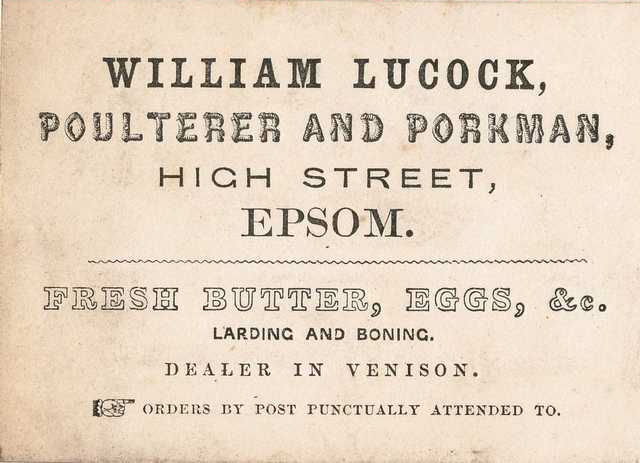 William Lucock’s Business Card
Image courtesy of Bourne Hall Museum
Anne initially took the children to Dorking, where she appears to have been a schoolteacher (her niece, Lissie Barnard, was with her – see below), but by the 1881 census the family was scattered. Anne was working as a domestic housekeeper in Suffolk and the eldest son, James William, born in 1861, was an invoice clerk in a biscuit factory, living in Reading (he died in 1889). The next son, William Lucock, a court clerk, was with his aunt Mary Ann back in Epsom (Mary Ann Harrowell ran a small private school). William Lucock Harrowell died in 1928 and was buried in Epsom Cemetery. Ernest, born in 1864, was with his uncle and aunt, William and Elizabeth Barnard, also in Epsom. He died in 1931. None of them seems to have married.
Elizabeth Barnard was Anne Harrowell’s sister and for many years the Barnards had an assortment of Elizabeth’s nieces and nephews with them, helping in their bakery and confectionery business. When William and Elizabeth Barnard died (Elizabeth in 1888 and William in 1898) their daughter Lissie, Ernest Harrowell and various Kitchens (who were children of Hannah, sister of Anne and Elizabeth) stayed together, first in Epsom (1901 census) and then Croydon (1911 census), and probably until the last one of them died in the mid 1930s. Indeed, it seems that William Lucock Harrowell joined them in Croydon at some stage, as he had the same address when he died in 1928.
The youngest son was Edwin, born in Epsom in 1867, and he was just an infant when his father died. It does look as if Anne fell on progressively harder times after that, given that she was an employed, live-in housekeeper by 1881. The three older children were accommodated elsewhere, but presumably she could not find a home for Edwin and in the 1881 census he was in an orphanage in Wanstead, Essex, aged 14.
Edwin’s story
The orphanage
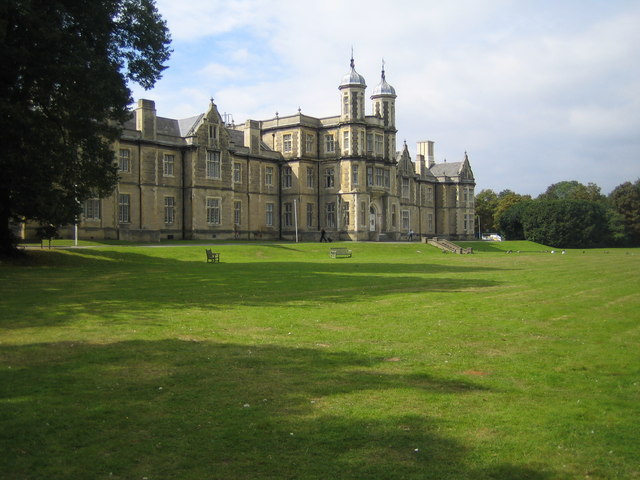 Snaresbrook Crown Court (formerly the Infant Orphan Asylum).
Image: © Copyright Nigel Cox and licensed for reuse under this Creative Commons Licence
Placing Edwin in an orphanage was not as straightforward as one might suppose. During the 19th century most orphanages were for children of working-class families, but there was nowhere for young middle-class children to go, albeit that they might have been left just as destitute and homeless as an apparently poorer child. The Infant Orphan Asylum at Wanstead (the building is now Snaresbrook Crown Court), on the edge of Epping Forest, was founded by the Reverend Andrew Reed in 1843 precisely for this purpose. However, admission was not simply a case of applying. The institution had subscribers who, in return for their money, were entitled to vote on which children were admitted. This led to surviving parents and relatives ‘lobbying’ for votes, whereby they paraded with placards or distributed printed leaflets stating the child’s case. A leaflet was issued in the case of Edwin Harrowell and was successful. He was admitted to the Asylum in about 1873.1 In 1881 the institution had over 600 children from all over the UK in its care, ranging in age from one year to 14 years. Since Edwin was 14 in that year, it is likely that he was cast out into the world quite soon afterwards. What happened to him between 1881 and 1891 is not known, but in the 1891 census he was a commercial clerk in lodgings in Reading (possibly he had gone there to join his brother, James William, but, as mentioned previously, James William had died in 1889).
Emigration
In September 1895 Edwin, then aged about 28, sailed from London to Wellington, New Zealand on the steamship ‘Tokomaru’2 and on arrival took up farming. His emigration may well have been connected with the fact that another Epsom Harrowell, his uncle Henry (see http://oa.anu.edu.au/obituary/harrowell-henry-463 ), had gone to Australia in about 1892 and was running a prestigious Sydney company that manufactured equipment for the then new enterprise of mechanised sheep-dipping. Henry opened another branch of the company in New Zealand in 1894 and lived there for many years afterwards.
The Boer War
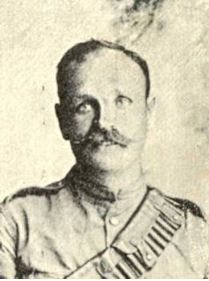
Edwin in the Boer War
In 1899 Edwin was farming at a place called Papatoetoe, now a suburb of Auckland, where he enlisted in the infantry and was shipped off to South Africa with a New Zealand Contingent, to help the British fight the Second Boer War. He was originally a sergeant in the New Zealand Mounted Rifles.
During the South African campaign he was awarded the Queen’s South Africa Medal and the King’s South Africa Medal (South Africa 1901 and South Africa 1902 Clasps).3
In 1900 Edwin, now a captain, had joined the Provisional Transvaal Constabulary. Little is known about this unit but it was apparently made up of a collection of recruits from various Army units and the Natal Police and was established after the siege and capture of Pretoria in June of that year. He then returned to New Zealand, but was back in South Africa in 1901 with the New Zealand 7th Contingent as a sergeant. He soon became a captain once more.
It is worth mentioning at this point that he probably did not bear his mother any grudge for placing him in the orphanage, as he habitually listed her as next of kin on his military records.
Subsequently Edwin went to Queensland, Australia and joined the Mounted Constabulary.
The New Hebrides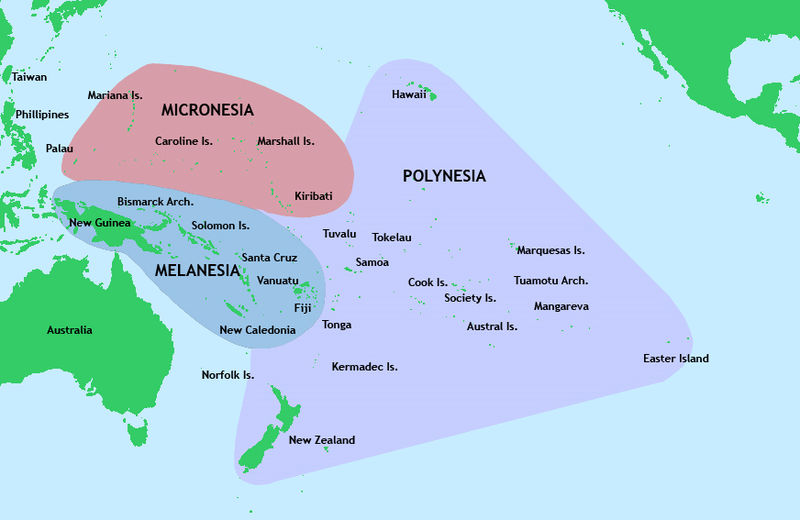
Map of the Southern Pacific.
Image: Wikipedia
Soon afterwards Edwin was appointed to take charge of the rifle associations in Fiji and then became Police Commissioner in the New Hebrides in the South Pacific (now called Vanuatu). In the early 1900s he was responsible for training the first Colonial native police force there.
In 1907 the author Jack London and his wife, Charmian, were in their ketch, ‘The Snark’, sailing the South Seas. Edwin was at that time in Port Vila, the capital of the New Hebrides, and Charmian wrote in her book ‘The Log of the Snark’.
‘We called upon the Acting English Resident, Mr. Jacomb, an Oxford man, and upon the French Resident, Charles Noufflard. They returned our calls next day, also Captain Harrowell, English chief of the native constabulary, and we were entertained by them ashore. Captain Harrowell seized Jack’s hand in both his and cried: “And this is Jack London! Why, he’s a household word in England!” We dined with him and Mr. Jacomb, all in faultless evening dress, with noiseless Chinese servants, and a white silk punkah waving overhead.’
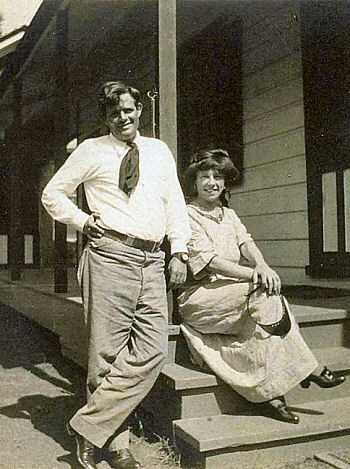 Jack and Charmian London c. 1911
Image Source: http://thenostalgialeague.com/olmag/london-the-scarlet-plague/ via Wikipedia
Lest one might think that life in the New Hebrides was one long social round amidst beach scenes out of ‘South Pacific’, the reality was very different for the colonials, both officials and settlers. It was not uncommon for settlers to be slaughtered by bush natives and much of the terrain was inhospitable or impenetrable.
Professor Margaret Critchlow Rodman writes in her paper ‘My only weapon being a pencil’.4
‘On 29 May 1908 Edward Jacomb, a tall lean lawyer in his early 30s who was serving as Assistant to the British Resident Commissioner (BRC) in the New Hebrides, wrote to his mother describing a `most interesting trip’ he had just made to the island of Ambrym to apprehend an alleged murderer named Berk. The trip was long: two days on a packet-boat from the capital, Port Vila, to the island of Paama; a weekend with the Rev. Maurice Frater, a Presbyterian missionary who had reported the murder; an abortive trip to the wrong part of Ambrym; and finally four-and-a-half hours rowing a whaleboat across a glassy sea to the accused man’s village. Jacomb went on:
On entering the village I found the object of my search without the slightest difficulty. My arrival seemed to astonish the inhabitants pretty considerably. The village is about as primitive as it is possible for a village to be; the huts are low and can only be entered on hands and knees; the natives are practically naked, and most of them were strolling about smoking clay pipes charged with black plug [tobacco], and with Sneider rifles at full cock over their shoulders. There were a number of piccaninnies [children], pigs and fowls roaming about in the mud. I must confess I did not care for the environment, my only weapon being a pencil. However I made the best of it and sat down on a tree trunk and spent half an hour questioning Berk as to the alleged shooting of his wife. He made no effort to deny it, but I failed to discover his motive.
Jacomb arrested Berk, travelled with the confessed murderer back to Port Vila, and handed him over to Captain Edwin Harrowell, who was in the process of training the first British colonial police force. Once again, Jacomb asked Berk why he had killed his wife. The Melanesian `wrinkled his face, and the wrinkling soon turned to an engaging smile: “Mi no savvy”, he said.’
Professor Rodman goes on to say:-
‘The production of the prison and of the police was closely linked in the colonial New Hebrides. Neither existed on the British side prior to 1907 when Captain Harrowell was appointed Commandant of the British Division of the New Hebrides Constabulary. He lived with Jacomb and the Resident Commissioner, Merton King, in the British Residency on Iririki Island in Port Vila harbour. Jacomb, who never liked Harrowell, described him as `a fine figure of a man, with a magnificent moustache but, unfortunately, a balding head’. In 1907, Harrowell was about 38 years old, `a bachelor, a teetotaller, a heavy smoker of pipes and cigars, a non-reader even of newspapers, and devoid of any interests outside his as yet non-existent police force’. The first policeman was a West Indian named Alcide, whom Jacomb `found derelict in Vila and handed to Harrowell as the nucleus of his future police force’. By the end of the year, Jacomb had recruited nine more policemen; the Resident Commissioner found another four, and by 7 May 1908 there was a total of 16 British policemen. Harrowell set to training them and within a month had `worked wonders with the very raw material available’. A large grass house was built to accommodate the police on Iririki Island near the British Residency.’
The New Zealand Free Lance newspaper of 11 July 19085 wrote the following about Edwin:-
‘The average New Zealander is a born wanderer. Take Captain Edwin Harrowell, Commandant of Native Constabulary at Vila, New Hebrides. He has been there for the past four or five months, knocking the [word deleted] armed police into shape, and although he writes to a Wellington friend to say that the New Hebridean native is by no means a bright person, his regiment of police now drill a great deal better than the average New Zealand volunteer corps! But it will be admitted that New Zealand volunteers are not great on drill, won’t it, and that the infantryman in this particular town is (for show purposes) the most shambling soldier possible.
To revert to Edwin Harrowell. In, a remote part of his career he was a Berkshire Mounted Rifleman. Then, he took a notion to go to Queensland, and there became a mounted policeman, and got the beautiful dark mahogany complexion that suits him so well. Edwin got tired of police work in Sugarland, and drifted to Auckland (or back to Auckland). Then he took to farming, and joined the Auckland Mounted Rifles. Then he rushed off with the first batch of New Zealand warriors to Africa and glory. Was a sergeant in that Contingent and won a commission in subsequent corps. Went home to Berkshire, and had a great time. Rushed back to New Zealand, and became adjutant of the Auckland District, or something of the kind.
Then Edwin, feeling cold in Auckland, went to Fiji, and became organising officer for defence rifle clubs. He was such a good hand at the game that when he had organised everything handy he was asked to go to the New Hebrides to tackle the Darktown police job. These Hebridean police are a quaint business apparently. There are two sections of them- one lot under British officers and another lot under French. They are a united force, living in the same barracks, and would combine in case of hostilities. This is “l’entente cordiale” again.’
In 1911 there was a rebellion in Santo (Espiritu Santo), New Hebrides. Edwin and a combined contingent of French and native police mounted an operation to capture the principal chief, Thingaroo, involving many hours of marching through dense bush. The enterprise was a disaster. The guides deserted, the police were ambushed, several native auxiliaries were wounded and a civilian accompanying the party was shot twice. Thingaroo escaped and the attempts to capture him were abandoned. It was conceded that, given the nature of the terrain (mountains and tropical rainforests), the natives held the upper hand, especially if they were armed with guns, as in this instance.6
The First World War
Edwin does not seem to have returned to New Zealand for any length of time during his stay in the New Hebrides, but on the outbreak of the First World War he became a Captain and then a Major with the New Zealand Expeditionary Force. In 1915 he was Second in Command of the Auckland Infantry Battalion, but was wounded in both arms at Gallipoli and invalided home via England, and eventually recovered. By 1917 he was Assistant Military Secretary to the Commissioner of the garrison in Samoa.
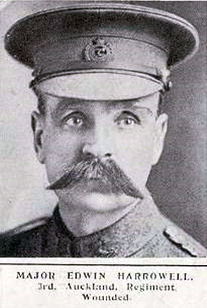
Edwin’s family
Edwin married fairly late in life, in Samoa in about 1917. His wife was (Florence) Camilla Steele, a nursing sister at a hospital there.7 She had served on a hospital ship during the First World War. Edwin and Camilla had a son, Dudley Steele Harrowell, born in 1919 in Auckland. Edwin remained in the Colonial Service, occupying administrative positions at Ocean Island and Fanning Island (two islands in the central Pacific which are now part of the republic of Kiribati).
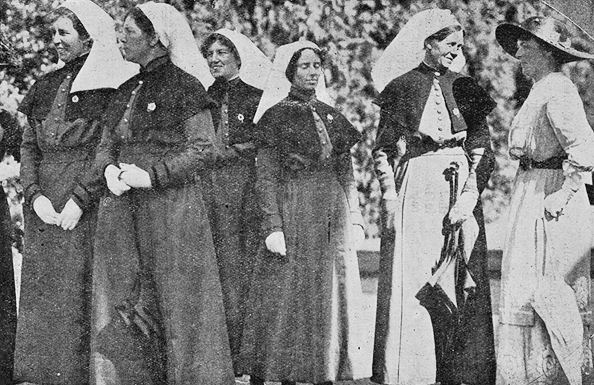 Group at the garden party given by Her Excellency Lady Liverpool to the staff of the
Hospital Ship Maheno in 1917. Camilla Steele is on the left.
Dudley was educated at King’s College, Auckland and Edwin retired to Auckland with his wife in the late 1930s. Dudley enlisted in the New Zealand Army as a gunner in February 1939 and that same year he was sent to the Royal Military College of Australia in Duntroon, Canberra, Australia for officer training. He passed out as a Lieutenant in the New Zealand Staff Corps. Edwin died in Auckland on 7 August 1941. His final address, oddly enough, was in the suburb of Epsom in Auckland.8 He was buried in O’Neill’s Point Cemetery, Bayswater, Auckland.
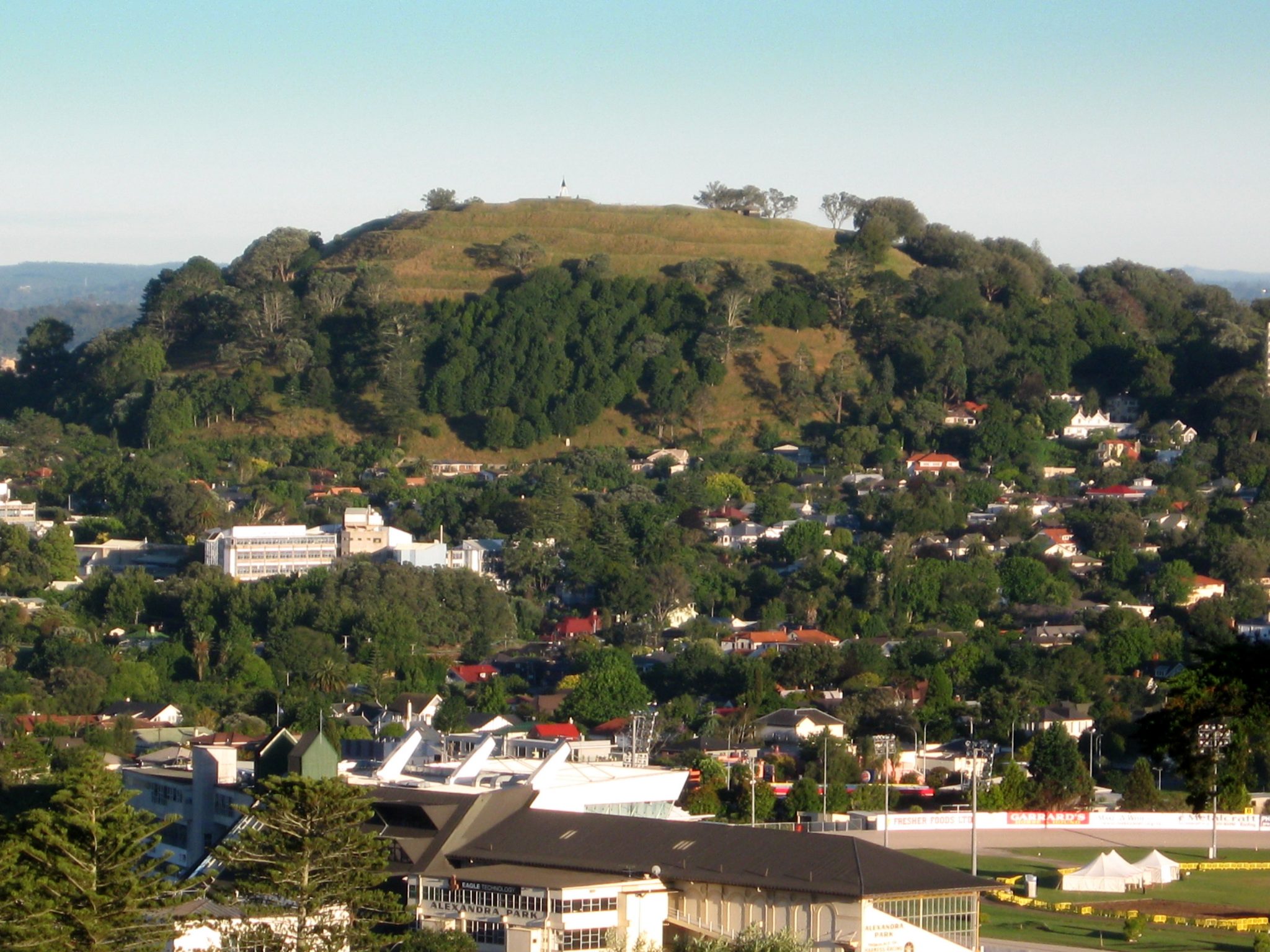 Epsom, Auckland, with Mount Eden in the background.
Image author: Follash, source Wikipedia
Dudley, having served regimental postings in New Zealand and Fiji, was sent to the Middle East, arriving in Egypt on 5 January 1943. He was killed before he could even fire a shot, shortly after the second battle of El Alamein, during the Allies’ final push to drive the Axis powers out of North Africa, at Tebega Gap, Tunisia, on 26 March 1943. He was buried in the Sfax9 War Cemetery, Tunisia.

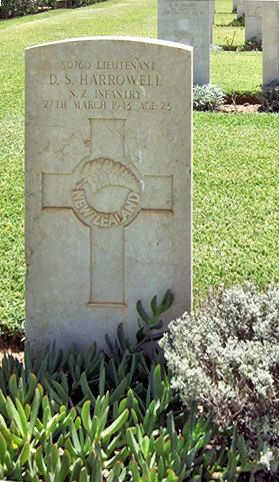 Dudley Harrowell’s grave
Camilla died on 26 December 1961, aged 80, and was also buried at O’Neill’s Point Cemetery.
Linda Jackson © October 2011
ADDENDUM
Firstly, I must thank Alison Cratchley for contacting us and digging out a significant amount of material concerning Edwin Harrowell from her personal archives. The reason she has this material is that her Great Grandfather and Great Uncle, respectively John Henry George and James William George, played for Reading FC in its early years and were team-mates of Edwin’s. The Club has an online list of Heritage Numbers, ordered by the date on which each player made their debut, so, for example, it says that Johnny H George (Number 103) debuted in 1891 and played against Newbury Town in the FA Cup. Edwin Harrowell is Number 66 and made his first appearance on 12 November 1887 in the Berks and Bucks FA Senior Cup, so we have proof of his whereabouts between 1881 and 1891. We also now know that, after leaving the Infant Orphan Asylum, Wanstead in 1881, he attended Kendrick School in Reading, which was then a charitable institution.
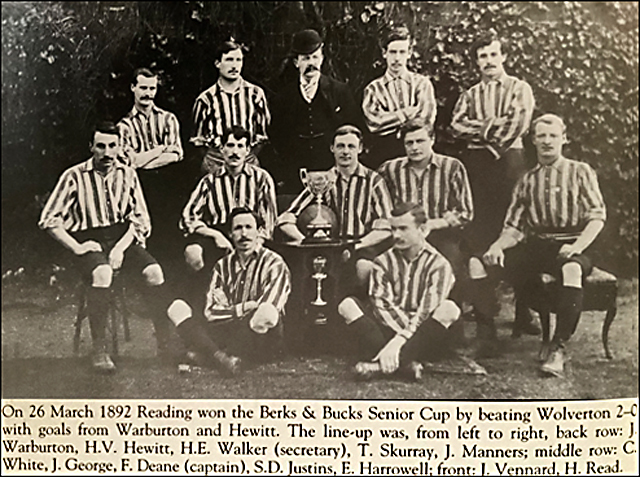
1892 Newspaper cutting showing the Berks and Bucks Senior Cup winners. Edwin Harrowell (goalkeeper) is on the far right.
John Henry George is the man with the impressive hair and moustache in the middle row, immediately left of the Cup.
Image courtesy of Alison Cratchley
Although both of us have studied this next picture, we remain unconvinced that the man at back left is Edwin: however, the caption claims it is, so we’ll include it but with a strong caveat. The photo is worth a look anyway for the player wearing tartan socks in the front row (Harry H Read- Number 98 in the Heritage Numbers). John Henry George is front left.
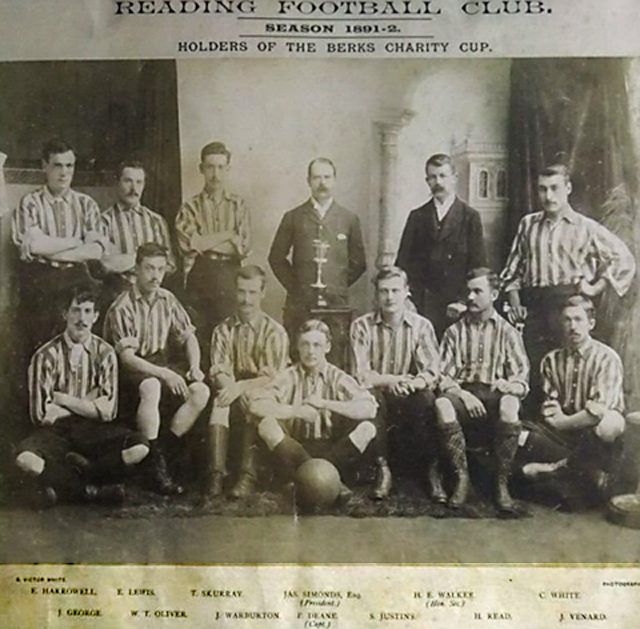
Newspaper cutting showing the team that won the Berks Charity Cup in the 1891-2 season. Edwin is allegedly back left.
Image courtesy of Alison Cratchley
Edwin clearly had considerable affection for Reading, which was probably the only real home he had ever known, given his background. As mentioned in the main article, he was with his brother, James William Harrowell, who died in 1889, and an electoral register for that year shows that the young men were hardly living a life of luxury: they were in lodgings, consisting of one furnished bedroom each, with use of a sitting room, costing 15 shillings a week, which, according to an interesting converter , was roughly two days’ wages for a skilled tradesman.
The ‘Reading Standard’ of February 22nd 1895 reported that Edwin had performed in an entertainment put on by the Kendrick ‘Old Boys’ Football Club. This was probably his swan song, since he emigrated to New Zealand in September of that year.
Edwin joined the New Zealand military in 1899 and was shipped to South Africa to fight in the Second Boer War, but until now we hadn’t known any more: however, various pages of the ‘Berkshire Chronicle’ for that period reveal that he was writing home to the Editor describing his experiences. I’m impressed by the speed of the post, since the letters were reasonably ‘fresh’ when published, but they reveal an expedition which must have seemed like an exciting adventure at first and then swiftly became deadly serious. Whatever the experiences and expectations of the soldiery might have been, they eventually encountered guerrilla warfare which bogged them down until 1902.
Here’s the first letter (published in the ‘Berkshire Chronicle’ of 20 January 1900), when Edwin had first arrived in South Africa by sea, along with just over 200 New Zealanders.
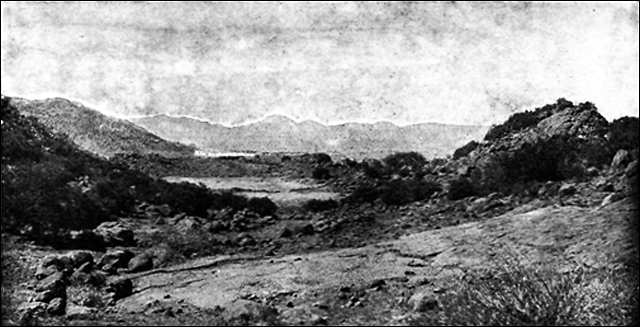
Arundel Camp from the hills to the north
From “With the flag to Pretoria” by H W Wilson via Project Gutenberg
Arundel Camp, South Africa, December 23rd, 1899
Sir, – As an old Readingite, serving with the New Zealanders on General French’s column, it has occurred to me that possibly it may interest your readers a little to have a few details of our life here.
New Zealand was the first colony to despatch troops, and we anticipated a great race with the Australians, who, though starting a week after us, had a much faster boat. However, we got to Capetown several days ahead of the Cornstalks [slang for Australians, particularly from New South Wales – often used as a derogatory term], much to our satisfaction. After camping in the vicinity of the city we started on the fourth day for the front, reaching Naauwport [or Naauwpoort] after a journey of 48 hours, which latter took more condition out of our horses than the five weeks’ sea trip. We landed in South Africa fully equipped in every way, our total strength being 203.
During a week’s stay at Naauwport we made several reconnaissances, once 18 miles out and back -36 miles in all. On the eighth day we left camp on a reconnaissance in this direction, driving the Boer patrols back beyond this point, and bivouacking for three days when our tents came up. This place is one of the most dangerous at the seat of war, and it may be likened to a triangle, the base at Naauwport (from which all supplies and troops are drawn) and the point here at Arundel, pushed right forward into the enemy’s country. We are thus surrounded, except at base, by Boers to the number of some thousands. Twice they have attempted to get between us and our base, only to have their plans frustrated, though on one occasion their “advance guard” got through. We have had plenty of rough work to negotiate, turning out at two and three a.m., and saddle up ready for emergencies, and several mornings turning out at one a.m., and going out for daybreak attacks or reconnaissances.
Several times we have been under fire and, so far, I can honestly say I have not felt that attack of “funk” one is supposed to have during the first few shots. Last Monday we made a reconnaissance, escorting seven guns of the Royal Horse Artillery, our contingent being the only troops with the guns, and we eventually had as hot a time as it is possible to get. Our guns shelled the farm occupied by the enemy for half an hour and then our company (No.1) fixed swords and went for the place, only to find it empty, of course, for you never catch a Boer in a place from which he cannot “modestly” retire by the back door. After carefully examining the place, during which we noticed Boers in plenty on a ridge some quarter of a mile in front, we retired, only again to be ordered by General French to re-occupy the farm, as the Boers were advancing to seize it, having found our numbers were so small. Only our company (No.1) was available, our other company (no.2) acting as support to our guns some three-quarters of a mile to our left. After occupying the farm, my division (no.2) was ordered to take possession of a kopje (hill) about 800 yards on the right front of the farm, which was, however, commanded by another kopje in possession of the enemy, their position enabling them to fire on our front and right flank. The ground we had to ride over to reach our kopje was simply awful, big rocks, holes and finally a deep, wide water-course, all of which we negotiated safely, and then began one of those “lovely” climbs which one acquainted with this part will understand, these kopjes consisting of ironstone with enormous rocks and loose boulders, making very tiring going. But we soon scaled up to the top, and immediately the Boers opened fire on us – pat-pat-pat came the bullets all around us on the rocks just as though it was a hailstorm, interspersed with the ping-ping-ping of bullets that, missing the rocks, whizzed by one in all directions, many of them being only hair-breadths off one’s head or body. Meanwhile we were not idle, firing steadily. Our lieutenant aimed at a Boer (who was making a stone breastwork for himself in a very “cheeky” manner, as though he thought very little of our marksmanship) and changing the range each time knocked him over third shot. Another Boer rode his horse (a white one) in full view of us along the ridge and one of our fellows coolly aimed at him and knocked him off also. Then for half an hour an incessant fire was kept up and finally the Boers, trying to get between our party and the farm to cut us off, the General ordered us to retire. Now began the perilous part of our “picnic”, for though on the kopje we were exposed to rifle fire from front and on right flank and were shelled in rear, we still had the shelter of rocks, but our retirement meant exposure for about 1,500 yards to the enemy’s full fire. As the Boers were computed at between 200 and 400, you can gather an idea what “magazine fire” would mean as a body of twenty men, who had to run the gauntlet from within 250 to 300 yards from the Boers’ position. After mounting our horses off we went, one at a time, this formation being the best under the circumstances, and our horses seemed to be as conscious of their danger as their riders and went like lightning, clearing water-course and rocks and holes in a wonderful manner, and carried us with one exception out of danger. One man’s horse was shot dead, but another picked him up, and they rode out “double-banked”. Another man was shot and fell off his horse and after examination was reported dead, but apparently he must have been unconscious, for on the ambulance going out afterwards to bury the body, the owner of the farm stated that our man had been carried away by the Boers and was wounded. The fire through which we went was simply awful, and yet only these two casualties occurred, a truly marvellous thing, and in which a right-thinking man would clearly observe the sheltering hand of Providence. General French’s remark explains the matter in a nutshell; he said: “No man need ever wish for a hotter corner,” and the remark was true, for though in the future we may get into all sorts of “scrums”, I am sure we shall never get into a hotter fire. Whilst forming up to retire we were “shelled” and one exploded very near us, a great piece hurling along a few yards in front of me and between our divisions and the one in front. Had we been in closer formation some of us would have been hit. Since Monday we have had a much needed rest, and until the other columns come up I expect we shall be quiet, and then will advance on Colesberg.
If anything should eventually occur worth writing upon, you may rely upon my sending details. – I am, Sir, yours faithfully, Edwin Harrowell, Sergt. No.1 Co. N.Z.Contingent.
The rest and quiet didn’t last for long. On February 3rd 1900 the newspaper published a further letter, from Kolskop (or Colescop/Coles Kop, a hill above Colesberg), dated 3rd January 1900.
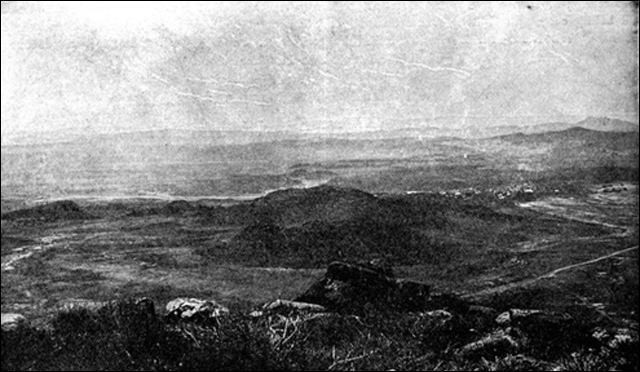 Colesberg from Coles Kop
Photo by R C E Nisson from “With the flag to Pretoria” by H W Wilson via Project Gutenberg
Since my last of a few days since, in which I anticipated a quiet time for at least two weeks, we have been exceptionally busy, for the Boers suddenly vacated their positions 29th December and retired with their guns to this place, a 15 mile journey. Information reached camp late at night and I was called out of bed at 11.30 p.m. to draw forage rations for my division and from thence until two a.m. I had quite enough to do. We started out at 2.30, a pitch dark morning, over the usual treacherous ground. About six miles out we found the railway line torn up, in one place for about a chain’s length, the rails standing up as though a team of oxen had been fixed on to one rail and the affair pulled right over. However, our engineers repaired the line in far less time than it must have taken the Boers to upset it and trains were running in an incredibly short space of time. At about twelve o’clock (mid-day) we located the Boer position and the General decided to shift camp. At 1.30 the order was received at camp and at 6.30 the camp was pitched at Rensburg, three miles from here. Horse lines and everything ready, a smart thing considering that a road journey of 15 miles had to be made and that most of the men were out with the reconnaissance. Our party had two guns against the Boer battery of six quick firing guns and one of ours had soon to retire disabled; the other pluckily engaged the whole, the lieutenant in charge coolly looking through his glasses at the Boer battery the whole time, though the place was simply alive with shells. Eventually they retired this gun, with one man wounded. Really one cannot express properly in mere words one’s admiration for the cleverness and coolness of the Royal Horse Artillery. They are simply perfection itself.
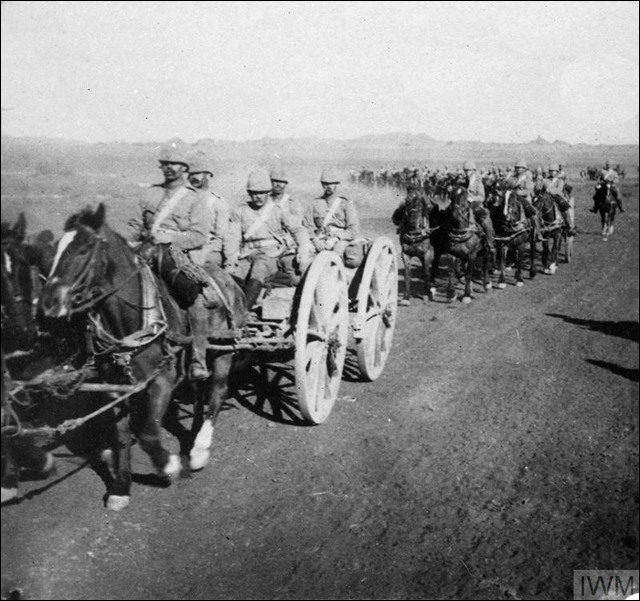
Royal Horse Artillery during the Second Boer War ©IWM (Q71945)
On December 31st we were on outpost all day and all night (my sleep for the three nights totalling eight hours all told) and on New Year’s Day were astir long before daybreak. The previous night the Berks regiment and ten guns came out here, also another Infantry Battalion, so we guessed something was afoot. At two a.m. on the 1st the guns were in position and before break of dawn began shelling the Boers’ position. They responded with quick firers and a Hotchkiss gun, which latter throws out several shells in succession, but our guns at the fourth shot completely silenced this and after an artillery duel of about an hour and a half’s duration all the Boer guns were silenced. Then the Cavalry (Carabiniers) worked round their right flank and the Regular Mounted Cavalry round left, our contingent advancing dismounted in the centre, but the rifle fire was too hot and we had to retire our line to former position. I am told there are several casualties amongst the Berks, who worked round Colesburg, but as we have not seen them since I cannot vouch for this statement. None of our fellows were hit but many had narrow escapes. Though neither side gained any immediate advantage in this our first engagement of importance, we have decidedly gained a success, as we now have them completely surrounded, though our force is not strong enough to successfully carry out such work until the reinforcements wired for arrive here, then I expect the Boers will be starved out.
In February 1900 General French and a vast contingent of cavalry relieved the siege of Kimberley, albeit that by then the Kimberley opposition was fairly light. French had driven a large part of his force to the point of exhaustion in the mad rush to Kimberley, but nevertheless it was a victory of sorts and went down well with the public at home. The Boer commander, Piet Cronjé, was subsequently captured and sent to St Helena as a prisoner (but only until the end of the war).
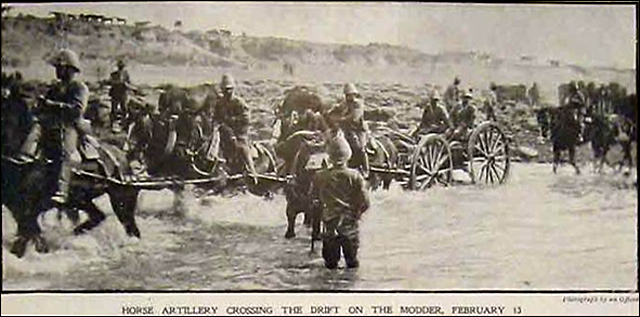
French’s cavalry at Klip Drift on their way to Kimberley
Image source: Wikimedia Commons

Edwin seems to have been present at most of the engagements around that time as, in a long missive from various dates in March 1900, he talked of Kimberley and Bloemfontein, both of which had been under siege and were relieved by the British and their allies, although he rued not being in the forefront of the action.
The ‘Reading Mercury’ of 20 September 1902 (the 2nd Boer War was finally over by 31st May of that year) reported that Captain Harrowell of the New Zealand Mounted Rifles had been entertained to dinner by his old friends in Reading.
Captain Harrowell has just returned home after seven years’ absence from the old country. Before he left England he was prominently connected with athletics, being a member of the old Reading Football Club [they played as amateurs until 1895] and captain of the Old Kendricks FC. For ten years he was in the Berks Volunteer Mounted Infantry [this seeming contradiction in terms refers to infantrymen who rode to the scene of an engagement and then dismounted to fight – i.e. not cavalry], gaining the highest non-commissioned rank of Colour Sergeant in the Company. Captain Harrowell went out to New Zealand and engaged in farming there. He also served in the Queensland Mounted Police. When the South African war broke out he joined the first contingent of the New Zealanders as Troop- Sergt. He saw much service under General French and was at the relief of Kimberley, the capture of Cronje and of Bloemfontein. He returned to New Zealand and was offered a Lieutenant’s commission but declined it. Eventually, however, he joined the seventh contingent of the New Zealanders and was given a Captain’s commission. With them he served up to the end of the war and when he came home his friends invited him to be their guest at a dinner to his honour. At the same time it was decided to present him with a souvenir of the occasion.
There followed a list of the dignitaries present, including the Mayor and various others (the newspaper ran out of space listing them and ended up with an ‘etc’ so that they could get to the point before they needed to go to press). The souvenir was a ‘handsome’ illuminated address, inscribed as follows:-
‘To Captain Edwin Harrowell of the New Zealand Mounted Rifles – We the undersigned, old friends of yours in Reading and district, desire to take the opportunity of your presence in the old country of showing you how highly we esteem you for your many admirable qualities and for your true personal worth, which has caused us to keep a warm place in our hearts for you during your long absence. We also desire to express our appreciation at the loyalty, courage and devotion of the New Zealanders during the recent war in South Africa and especially to refer to the great services rendered by the 1st and 7th contingents with which you gained so much distinction. We note with pleasure the admirable spirit you always displayed in connection with football and athletics generally in Reading and during your many years’ service with the Berkshire Volunteer Mounted Infantry, which has not only been retained but intensified during the recent campaign. As a token of our regard we ask your acceptance of the accompanying gift and we trust you may enjoy many years of health, happiness and prosperity’
Edwin obviously kept in touch with his old friends even after he had gone ‘home’, although I’m not that convinced he really had a home in the generally accepted sense, as his activities after Reading tend to suggest (see main article). The ‘Berkshire Daily Chronicle’ of June 18th 1912 had this to say.
‘Mr H J Matthews, the secretary-manager of the Reading Football Club, has received an interesting letter from Mr Edwin Harrowell, the Old Kendrick and for some seasons goalkeeper for the Reading Football Club. Mr Harrowell, who resides in the New Hebrides, after congratulating the Reading Football Club on its cup-tie successes, writes – “As you know, I command a native constabulary force here (South Sea Islanders) and I have always encouraged them to participate in sport. I have taught them ‘Soccer’ and we have a decent team, enough to play the men-o’-war when a cruiser is on this station. I had rather a contract to teach them the game and rules at first. Last season we played about a dozen matches against men-o’-war teams and only won one. The natives are very keen and play ‘Footer’ all the year round, even in the hot season – and we are in the tropics. They play with bare feet and it is wonderful how well and strong they can kick. They are also keen on cricket and boxing. I may be home later in the year, on leave, and, if so, I shall hope to witness some of the performances of my old club at Elm Park.”
Linda Jackson © 2025
With thanks to Alison Cratchley
Unless otherwise stated all photographs and information concerning the careers of Edwin and Dudley Harrowell courtesy and copyright of Auckland War Memorial Museum 2011. from their Cenotaph Database
Footnotes
1. Source: Catalogues of the National Archives and University of Nottingham
2.This ship was torpedoed and sunk by a German submarine in 1915 whilst anchored in the roads off Le Havre. It was carrying cargo only. No lives were lost.
3.These were normal campaign medals at the time, but conditions were hard and it was fairly unusual to have both. Few people served throughout the whole war, which took place from October 1899 to May 1902, spanning the end of Queen Victoria’s reign and the accession of King Edward V11, but Edwin did, apart from a brief return to Auckland in 1901.
4.The Journal of Pacific History. Issue: June 1998. Quoted by permission of Professor Rodman
5.http://paperspast.natlib.govt.nz/cgi-bin/paperspast?a=d&d=NZFL19080711.2.2&cl=&srpos=0&e=——-10–1—-0–
6.Source: National Library of Australia http://nla.gov.au/nla.news-article15229989
7.Source: Kai Tiaki, the journal of the nurses of New Zealand, 3 July 1917 – website of the National Library of New Zealand
8.Source: The Evening Post, 11 August 1941 – website of the National Library of New Zealand
9.Sfax is a city about 168 miles south-east of Tunis