
SMITH Henry John, Sergeant. 65914.
24th Battalion (Victoria Rifles) Canadian Expeditionary Force.
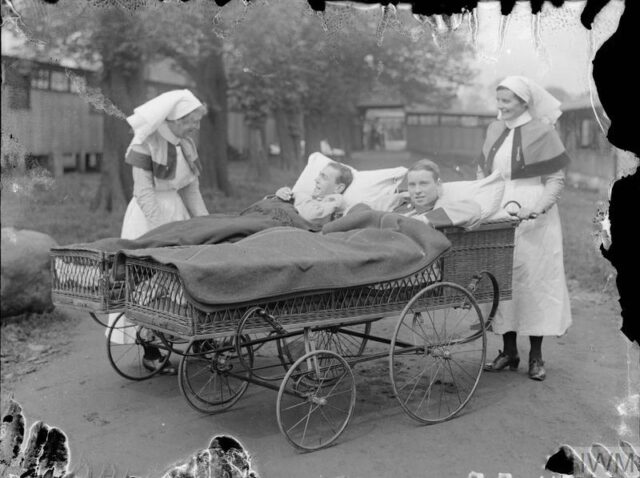 Wounded WW1 soldiers in invalid chairs being taken round the grounds of
No. 4 London General Hospital. © IWM. Q 27814
Henry John Smith was born in Bristol on 5 March 1893 (GRO reference: Jun 1893 Bedminster 5c 648) the son of Samuel and Ada Lucy Smith née Loxton. Henry’s parents were married in the Methodist Victoria Chapel, Whiteladies Road, Bristol on 25 November 1890. Aged 26 bachelor Samuel was a ‘Letter Carrier’. Spinster Ada Lucy was aged 25.
In 1891 Henry’s parents were living in 24 Ambra Vale East, Bristol. Henry’s father was a ‘Packer Parcel Post GPO’.
By 1901 the family had moved to 37 Merioneth Street, Bristol. Henry’s 36 year old father was ‘Postman’. Henry aged eight had a sister Annie aged nine.
Henry’s mother Ada Lucy Smith died in the March quarter of 1903 aged 37. Henry’s father married Ana Pratt in York during the September quarter of 1904.
By 1911 the family lived at 24 Wick Road, Brislington, Bristol. Henry’s father aged 46 was now a ‘Rail Guard GPO). His step mother aged 45 recorded that she had been married for 6 years and her three children were all living. Henry aged 18 was a ‘Merchants Clerk’ for ‘Youngs Paraffin and Mineral Oil Company’. His five year old brother Cyril Samuel was also recorded.
It is not known when Henry went to Canada but on 23 October 1914 he attested into the 24th Battalion of the Canadian army in Montréal on 23 October 1914. His next-of-kin was his father Samuel of 9 Stanbury Road, Victoria Park, Bristol, England. He stated that he was not married and that he worked as a ‘Storekeeper‘. Henry’s ‘Apparent Age’ on enlistment was 21 years 8 months. He was 5feet 6½ inches tall, weighed 140 lbs, had a fully expanded chest measurement of 36 inches, a fair complexion, brown eyes and brown hair. Distinctive marks recorded were, a mole on right upper arm and a cut on first finger of left hand. His religion was ‘Congregationalist‘.
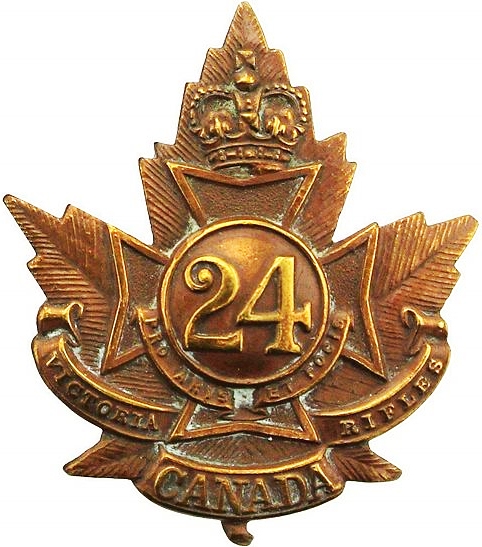 24th Battalion Canadian Cap Badge
Aboard the SS Cameronia, Henry sailed from Canada on 10 May 1915 and arrived in England on 20 May. After about 5 months he embarked from Folkestone on 15 September 1915 arriving in Boulogne, France the next day. Between 5 December 1915 and 16 February 1916 Henry was ill with influenza.
On Monday 27 March 1916 the 24th Canadian Battalion was in trenches at R.E. Farm near Kemmel, about 4 miles south of Ypres, Belgium. During the early hours of the 27th March patrols of the 24th Battalion were sent out to place ‘torpedoes‘ under the enemy barbed wire. The patrols were spotted, and prompted the enemy to respond by shelling. It is not known if Henry was involved with the patrols, but he received a shrapnel wound to his left foot on the 27th. Even when no great battles were being fought shelling and sniping made the trenches very dangerous.
Henry progressed through the well organised casualty evacuation route; Casualty Clearing Station, Ambulance Train and two days later, on 29 March, he was admitted to No.20 General Hospital, Camiers, France suffering from a ‘Gunshot wound left foot’. He was then evacuated to England aboard HS Dieppe and on 10 April 1916 was admitted to Willesden V.A.D (Voluntary Aid Detachment) Hospital, St. Mary’s Road, Willesden.
On 19 June 1916 he was admitted to Woodcote Park Convalescent hospital, Epsom. His ankle was very weak and was to have ‘4 weeks massage’.
Henry’s ‘fighting’ days were over, he spent the rest of the war in England, initially with the 1st Quebec Regimental Depot at Shoreham then he was employed at the ‘Canadian Paymasters Office’ in Epsom.
On 28 February 1918 Henry, having been granted permission, married Beatrice May Young (GRO marriage reference: Mar 1918 Keynsham 5c 1025). On 1 May he assigned part of his pay to his wife Mrs Beatrice May Smith of 3 Hayden’s Park Road, Wimbledon.
Henry was the victim of a motoring accident. The following is a transcription from his service papers:
When riding bicycle along Monger’s lane, Ewell, on 17-6-19 was run into by a Private touring Car approaching a side road. He states that no warning was given till collision was about to occur. No Court of Inquiry has been held.
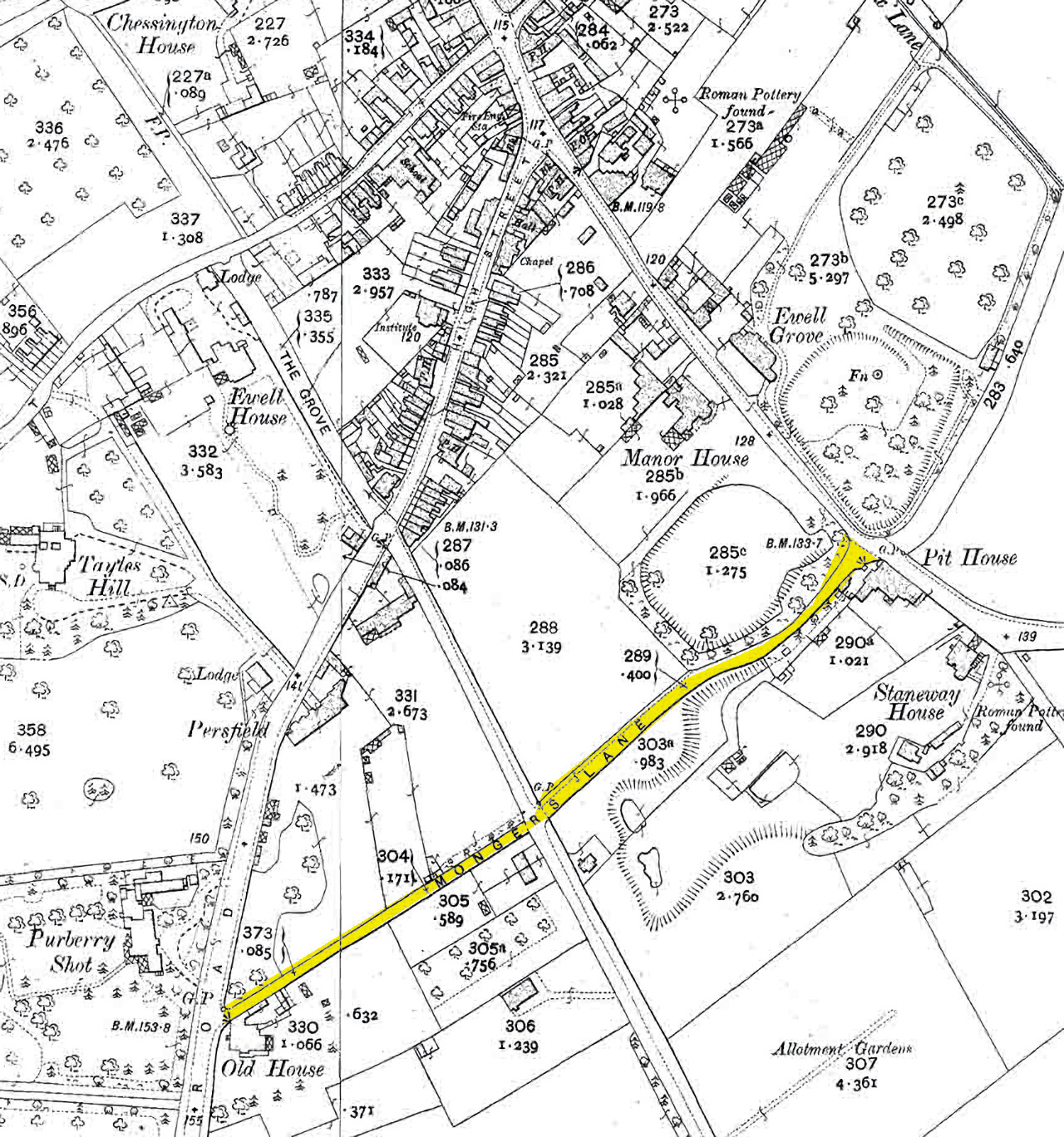 Mongers Lane Ewell on 1913 OS Map
Henry was admitted to Horton War Hospital having fractured his spine at ‘Cervical Vertebrae 5 & 6’. These are in the neck region and resulted in the complete loss of function below that level. The injury was permanent and meant that Henry would need active nursing in a Convalescent Hospital for the remainder of his life. A medical board was held at Horton War Hospital on 2 September 1919. It confirmed that Sergeant Henry John Smith was a clerk worked for the Canadian Pay Corps, that his home address was 32 Rockmount Road, Upper Norwood, London S.E.19 and that his next-of-kin was his wife Beatrice May. The Board recommended that he be discharged from the army.
Henry was duly discharged from the Canadian Army on 15 December 1919; his place of residence after discharge was 14 Sandgate Road, Brislington, Bristol. On the discharge form, in the space for Henry to sign were written the words ‘Unable to sign’.
Just over three years later on 23 September 1922 there was a fatal accident in Monger’s Lane involving a soldier John William Brown, a Private in the Norfolk Regiment.
Clive Gilbert 2022
 A Spinal Carriage Advert from 1914