
THE HANDS FAMILY – PART 2
(including the Wonhams)
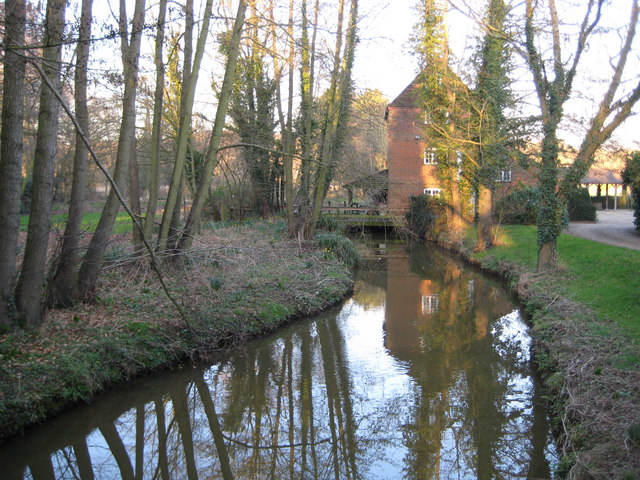 Rickford Mill, Worplesdon (now a private residence)*
Photo © Copyright Nigel Cox and licensed for reuse under this Creative Commons Licence.
*Trust me again, this will become relevant.
The Wonhams
Ordinarily you wouldn’t be seeing the Wonhams on this website. They were millers and bakers, which is unremarkable, but you could say the same about Moses and Johnson Hands: however, something happened between the two families that links them together in this narrative.
When Johnson Hands abandoned baking and dived into brick kilns (not literally), the brothers John and George Wonham, originally from Ockley/Capel, took over, round about the mid-1850s. John, the elder of the two by about a year, was at the Ewell Windmill operation and George was baking at the old Hands premises in South Street. It seems that Johnson had been ‘buying’ bread and other items from George Wonham without paying for them, as, after Johnson’s death, George went to court to get his money. £7.12s.11d (approx. £7.65) may sound a pittance now, but in 2021 money it’s about £614, which is a lot of bread. Incidentally, the court case was how we discovered that Eliza Hands had left her husband in the 1850s.
This is from the Surrey Gazette of 20 January 1863.
|
THE WIFE NOT LIABLE George Wonham v. the Executors of W.J. Hands* Mr W. Drummond** appeared for the defence. It appeared that the plaintiff succeeded the late Mr. Johnson Hands, in business at Epsom as a baker, and the present claim was principally for bread. Mr Drummond said the action ought never to have been brought, as Mrs. Hands was not the executrix of her late husband, at whose death no property belonging to him was left. He therefore argued that it would be wrong to come upon what belonged to the poor widow, who had not in the least interfered in the effects of her late husband. Mrs. Eliza Hands was then sworn and confirmed the statement of Mr. Drummond, that she had not derived any property from her late husband, whom she had left some years before his death, and had since been supported by her father. Her late husband died at Croydon a year ago, leaving no property behind him. His Honour told the plaintiff he must make out that the husband was aware of the bread being supplied. Mrs. Hands was at the time a married woman and as such could not be sued. There must be judgment for the defendant. Costs for defendant’s attorney allowed |
* This should be J.Hands
** This was William Drummond, a Croydon attorney and solicitor, who also seems to have been involved in the paltry 1867 estate of Edward Daniel and the 1880 minor leavings of Mrs Daniel. It looks as if Mr Drummond didn’t come cheap, since he left an estate of £13,103 (well over £1m in 2021 terms) when he died in 1884. So George not only lost out on his claim, which was probably ill-advised if he could afford any advice, but he had to pay Drummond too. And, with hindsight, I wonder if some, or even all, of the bread acquired by Johnson Hands had ended up in the mouths of the Daniel family.
Whether or not this was a killer financial blow to George Wonham I can’t know, but on 5 May 1869 he died, leaving effects of under £1500, which presumably represented his interest in the bakery/mill. Even worse than that, his wife, Elizabeth (née Weller), expired just four months later (6 September 1869), also leaving effects of under £1500. Both of them were barely 40 years old. And they left a whole brood of young children without parents. Fortunately, the Wonhams and the Wellers, mostly farming folk, were extensive families in Surrey – a George Weller and his wife, Ann, who lived in the Reigate area, took all of the kids in together.
(I’ll stick my neck out and suggest that the South Street bakery was taken over by Henry Joseph Bone from Leatherhead, who was in the right place in the 1871 and 1881 censuses, but we’re not going there.)
George’s untimely death seems to have tipped John into instant bankruptcy and the following notice appeared in the Croydon Chronicle and East Surrey Advertiser on 12 June 1869.
|
Ewell, Surrey Have received instructions from the Assignees of Mr. John Wonham to Sell by Auction, upon the premises, at the Windmill, Ewell Fields, on Tuesday, June 15th, 1869 at (time unreadable) THE HOUSEHOLD FURNITURE, live and dead stock, implements and stock-in-trade of a miller, a 5-horse power portable steam engine, by Tuxford and Sons, and other effects. May be viewed on the morning of the sale; catalogues obtained at the principal inns in the neighbourhood, and of Messrs. Butcher, Estate Agents, Epsom. |
The Tuxford portable steam engine is interesting, because this was a fairly recent engineering invention and it was presumably quite valuable. The Musée des Arts et Métiers in Paris has a preserved example of an 1852 model, which was probably the same thing that John Wonham had at the mill.
 The Tuxford Portable Steam Engine 1851/2
Source : Musée des Arts et Métiers via Wikimedia
By 1872 John had begun paying out dividends to his creditors and in the meantime he had been working as a dairyman at Epsom Common, so he seemed determined to extricate himself from the mess he had been landed in. He also had a wife and son to support. By 1881 he was in Worplesdon, milling and being a dairyman at Rickford Mill, which is where the picture at the beginning of this article comes in. His son, Ewell-born Thomas, was the assistant miller. And Thomas was still at Rickford in 1911, described as the miller in charge.
Mrs Eliza Hands
We left Eliza denying George Wonham his bread money. As mentioned, she had abandoned Johnson Hands and taken the children to Leatherhead at some point in the 1850s, living on money provided by her father, wheelwright William Streater. In 1861 four of the six Hands offspring were with Mrs Hands in Leatherhead. The two eldest girls were with their widowed step-grandmother, Mrs Mary Streater (Eliza’s mother, Elizabeth Streater, had died in 1822). In 1871, Eliza, described as an annuitant, was still in Leatherhead with just three of the children, all now grown-up; she died in 1885 and was buried with her parents in St Mary and St Nicholas Churchyard, Leatherhead.
The Hands children
Just to recap, these are the children of Johnson and Eliza Hands, all born in Epsom or Ewell, and they had diverse experiences in later life.
| Name | Born | Died |
| Elizabeth | 1842 | Possibly 1891 |
| Ellen | 1844 | 1921 |
| William Johnson | 1846 | 1881 |
| Eliza | 1851 | 1902 |
| Arthur | 1852 | 1929 |
| Edward | 1856 | 1896 |
Elizabeth Hands, the eldest child, married John Summers Cousens, a grocer from Sussex, at St Dunstan in the West, London City, on 30 June 1873. I have no real idea what went on with this family, but in the 1881 census they were keeping a lodging house in High Street, South Bersted, a village in the Bognor area, and there were children – Kate May (1877) and Henry (1878). The eldest child, Clara Elizabeth (1874), was with grandmother Eliza Hands in Leatherhead; there had also been a Frederick John, who died in 1876, aged 11 weeks. John’s father, Charles Cousens (died 1877), was a grocer, so it would seem that he had just been following in dad’s footsteps. My question is, where did Elizabeth Cousens go after 1881? In the 1891 census John, described as married, was with his sister Mary Ann (formerly Rush, now Richards) in North Bersted, but there was no Elizabeth and the children were missing. Family trees on Ancestry seem convinced that Elizabeth died in Melbourne, Australia in 1891 and there is a death entry of sorts on Victoria BDM which fits. Was it the case, therefore, that the family emigrated to Australia, Elizabeth suddenly died and John returned to England? And did Henry die too? Kate and Clara were not permanently missing, by the way – they soon popped up again. John Cousens next appeared as a UK probate entry, reading as follows:
John Summers Cousens of 1933 Dean Street, Brooklyn died 24 May 1907 at King’s City Hospital, Brooklyn. Probate to Sarah Summers Chilman*, wife of William Chilman. Effects £505.23s.11d
*Sarah Summers Chilman was John’s sister.
I am leaving Ellen Hands for the moment, as she might be regarded as the only genuine success story in the whole Johnson Hands saga and, through her, we shall finally come home to Epsom.
William Johnson Hands seemed to start out reasonably well, as a draper’s assistant at a fairly prestigious shop in Snargate Street, Dover (1871 census). On 11 May 1872 at St John, Horsleydown, Southwark, by then a grocer, he married builder’s daughter Sarah Ann Bills and next became a hotelier/publican in Maidstone. The hotel, which closed for good in 2011, has recently been demolished, to accommodate an extension to Maidstone East Railway Station.
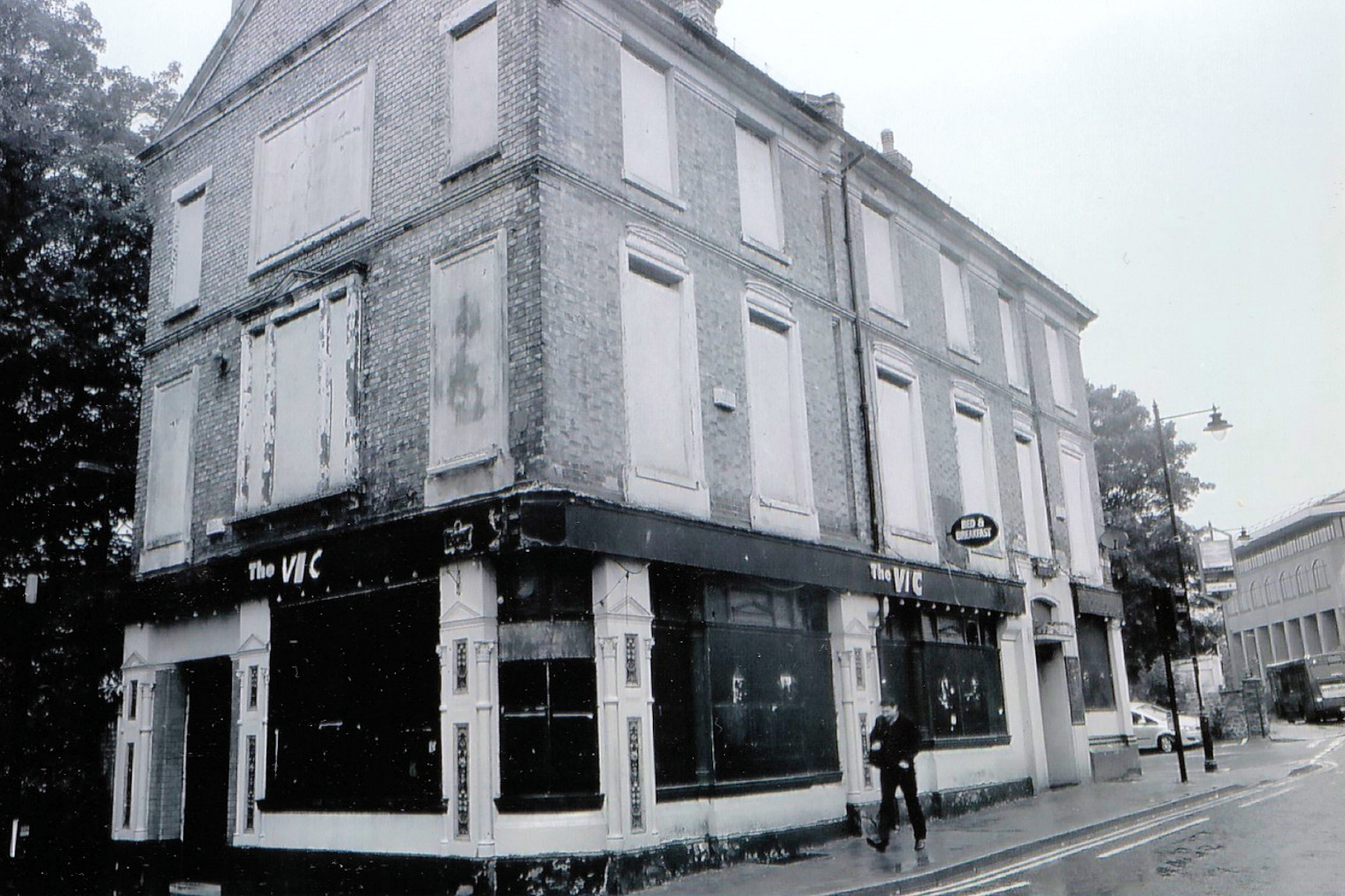 The Victoria Hotel, Week Street, Maidstone c.2015
From the author’s own collection
If you’re squeamish, please skip the next abridged newspaper report from the Kent Times (via the Maidstone Herald) of 10 September 1881.
|
DETERMINED SUICIDE OF A Early on Thursday morning Mr William Johnson Hands, the proprietor of the Victoria Hotel in Week Street, Maidstone, committed suicide in a most determined manner. The deceased, who was of habitual intemperate habits, retired to his bedroom shortly after twelve on Monday night, and nothing was seen of him till the following morning at about seven o’clock, when his dead body was found lying in his beer cellar. A double-barrelled gun was lying beside the body, and with this weapon the deceased had blown his brains out. An inquest was held at the Victoria Hotel on Tuesday afternoon before Mr J.B. Stephens (the borough coroner) and a jury of which Mr. T.W. Wallond was foreman. Prior to viewing the body the Coroner told the jury that he had thought it advisable to do in this case as he was always desirous of doing in others – having the body made somewhat presentable for the jury; and the spot upon which the unfortunate occurrence had taken place had also, for judicious reasons, been made fit for the jury to inspect. The jury then viewed the body which was laid forth in a lower room of the house. The head, although it had been washed and sewn up, presented a disgusting sight; whilst the deceased’s brains, the whole of which had been blown out, were lying upon a plate near the body. The following evidence was then taken: – Sarah Admans, wife of Thomas John Admans, deposed that she lived at the Victoria Hotel and occupied the position of waitress. She knew the deceased well; he was proprietor of the hotel. She had been at the hotel about eighteen months. Deceased, she believed, was 34 years of age. She last saw him alive a little after twelve o’clock on the previous night. He came out of his bedroom and called out, “Turn the gas out”. She told him the gas was all out and that the light he could see was only her candle. Witness went into her room and had been there about a quarter of an hour when she came out to see that everything was all right; and, seeing that all the lights were out, she returned to her room and went to bed. During the night she heard no noise in the house. She came downstairs at ten minutes to seven this morning. It was usual for the deceased to be up at that hour but she did not see anybody about when she got down. She accordingly looked for the deceased, concluding that he was up by seeing the bar door open. Finding he was not in the bar she went into the kitchen and other rooms but could not see him. She then went into the bar for the keys of the cellar and seeing they were gone she went down the cellar in company with William Underdown, the cellarman. They went through the wine cellar and then into the beer cellar and, on looking round, she saw the deceased on the ground with a gun between his legs. She said, “Go and see if he is dead,” and Underdown said, “Yes; go upstairs; don’t see it; he has shot himself.” She called a policeman in. Since last Christmas the deceased has been under the doctor’s hands, off and on, suffering from bleeding at the nose and mouth. She did not think that affected his spirits; although since June last she had noticed that he was low-spirited at times. They had heard the deceased say on more than one occasion before the bleeding commenced that he wished he was dead. She had never heard him threaten to destroy himself. He was a man of intemperate habits – habitually so. The witness, in answer to the coroner, said from the appearance of the deceased’s bed it was evident that he had not slept in it but merely sat on the side of the bed. Deceased kept his gun in the kitchen. He was not going out shooting that day and she did not think it was probable that he went into the cellar to clean his gun. He had not been out shooting lately. Police Constable C. Gulvin deposed to being called to the Victoria Hotel at seven o’clock, having been told that Mr Hands had shot himself. He went down the cellar with Police Constable Burrows and on reaching the beer cellar he found the door leading to a small square at the bottom of some steps leading from the Station Road open. The deceased was lying with his legs towards the door and the gun was lying by his side. There was a large quantity of blood by his head and his brains were scattered about on the ground, wall and door. There were two pieces of his skull on the ground. Deceased had his slippers, trousers, vest and shirt on. He searched him and in one of his trousers pockets he found the cartridge produced, which corresponded with an empty one found in one barrel of the gun. The stock of the gun produced witness found near to where the deceased was lying. By a juror: There was no string on the trigger of the gun, nor was there any on the deceased’s feet. He thought it quite possible for a man to discharge a gun into his mouth. He was not aware that any report had been heard during the night. Dr Meredith said he was called to see the deceased about twenty minutes past seven that morning. He went at once and found him dead. He had been dead some hours. The cause of death was a gunshot wound which had completely blown out his brains. In his opinion the wound was suicidal and was caused by the deceased putting the muzzle of the gun in his mouth and pressing the trigger with his hand, the butt of the gun resting on the ground between his legs. The Coroner having summed up, the jury returned a verdict to the effect that deceased committed suicide during a fit of temporary insanity. |
Albeit that witnesses didn’t agree where the gun ended up after the event, the jury probably reached the right verdict, but CSI or Silent Witness it wasn’t. And where was Mrs Hands in all this? Not at home by the sounds of it. There were two young children of the Hands marriage, who seem to have been staying with relatives around the time of the Victoria Hotel tragedy (this was not an upmarket hotel, the 1881 guests consisting of members of the militia and people in the manure trade, so it’s entirely possible that it wasn’t considered a suitable environment for children, or perhaps Mrs H didn’t want them around Mr H). In the 1891 census Mrs Hands, now using the forename of Annie, was a domestic cook at a Margate hotel. I really would like to say that she had a happy ending, but I fear she didn’t. She died in her home town of Folkestone in 1896, aged 48, leaving very little in the way of effects. The children survived her.
Eliza Hands married schoolmaster David Frederick Pritchard in 1890. However, by 1891 he was out of work and had become a market gardener in his home ‘town’ of Wribbenhall, Worcestershire (near to Kidderminster and Bewdley). Eliza decided to shed a decade off her age, which porkie made her about the same age as her husband. There was a son, Frederick Edward, born in Wribbenhall 1892. Eliza died in November 1902, leaving nothing worth mentioning in monetary terms. Mr Pritchard remarried a year later and by 1911 he and his new wife had produced three young children. As for young Frederick, he emigrated to Australia, married, and died in 1971: he was at the time a retired gardener, living at Dee Why, which is a pleasant coastal suburb of northern Sydney.
In 1891 Arthur Hands was a boarder in Newington, described as a restaurant keeper. By 1901 he had become an insurance agent in Walthamstow, married since 1900 to Alice Emily (née Morgan). In 1911 he was living in North Leyton, apparently co-habiting with 61 year old widow Amelia S Nickels, and he was still an insurance agent. Mrs Nickels was a crochet worker – I think it says crochet – at home. Previously she had worked with her late husband in shirt manufacturing. Alice was in Lewisham with a nine year old son called Stanley Herbert Frank Hands and a couple of lodgers. Alice was incredibly durable and lasted until 1956, then living in Whitstable. Mrs Nickels died in about 1920. Stanley became a Police Constable in the Met and died in 1984 and Arthur had checked out in 1929; I have no evidence that he ever reconciled with his wife.
Edward Hands is an odd one. In 1891 he was a lodger in Leatherhead, aged 35, and the job description was ‘London Stock Exchange’, which made him sound promising. As far as I can see he never married, but he died in 1896, with the probate record stating that he lived and died in Loughton (Essex) and he also had an address as a member of the Stock Exchange at 16 Tokenhouse Yard, London. Probate was granted to his sister, Eliza Pritchard, and his effects amounted to just £19. I can’t find any further information about Edward so we’ll move on, at long last, to Ellen Hands.
I saved Ellen Hands until last because, not only did she seem to have a better life than most of the others, but she will finally bring us back to Epsom, where we began. Ellen married William Harriott, a butcher, on 12 November 1867. William’s father, James, had been a butcher in Leatherhead High Street and then Clapham; his mother, Elizabeth, was the sister of Mrs Johnson Hands, originally Eliza Streater, which made Ellen and William first cousins. By 1871 daughter Ellen had arrived, then aged two, and William was butchering at 4-5 Church Street, Chiswick. (Church Street was and is in the older part of Chiswick near the river and still has some fine buildings, so I would guess that the business did well, especially as the Harriotts were still there ten years later, by which time two more daughters and a five week old son – who sadly died in that same year – had been added to the brood.)
The 1891 census saw the family in Amity Grove, Wimbledon and William had become a farmer. Apparently, he was a tenant at Moat Farm and you can read all about the property on the website of Merton Historical Society (and do take a look at the wonderful names of some of the fields in the right hand column). At the time the area was called West Barns or West Barnes, then it was part of New Malden, but is now largely Raynes Park.
By 1894 William Harriott had purchased an estate of more than 300 acres and Moat Farm became known as Harriott’s Farm.
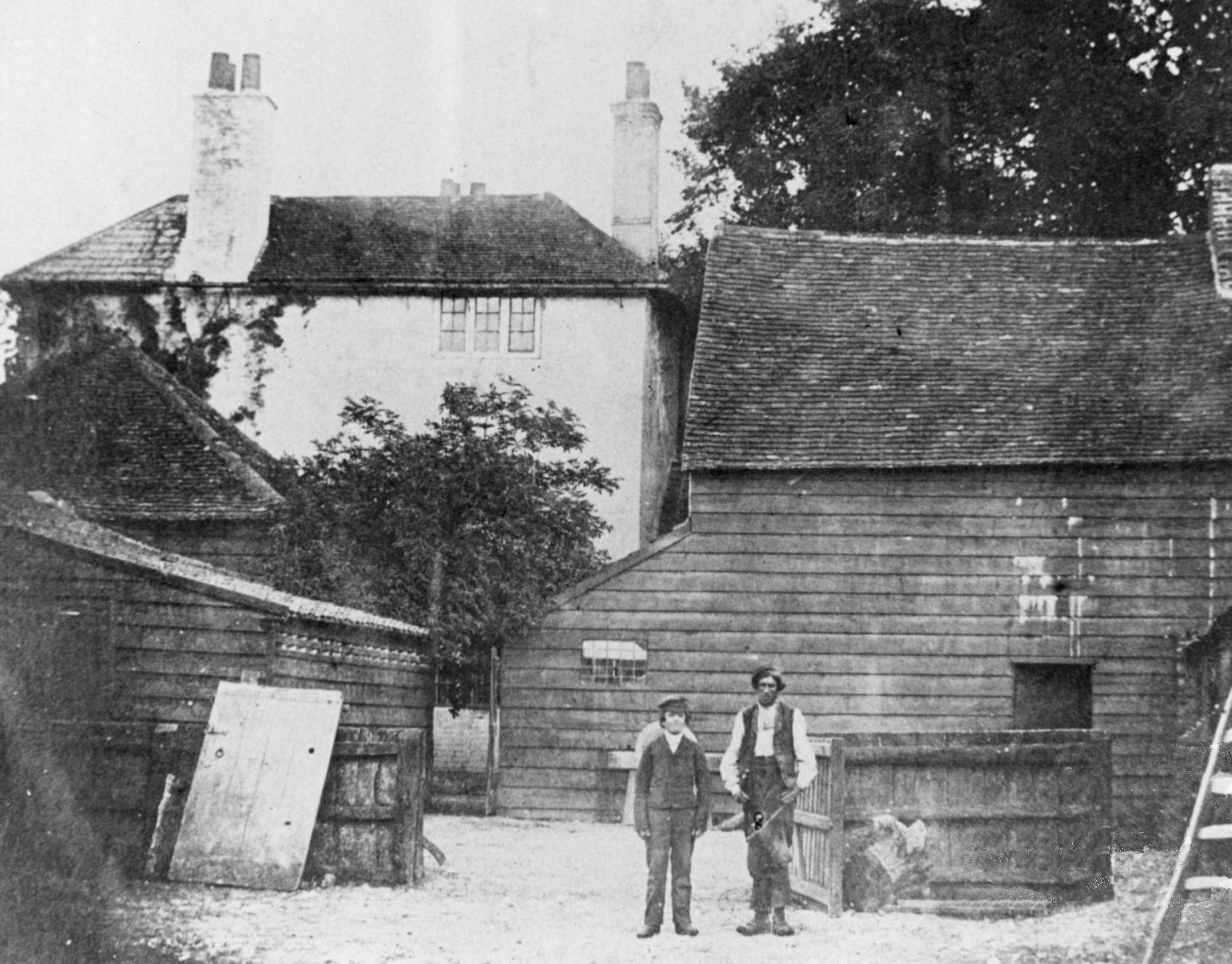 Harriott’s Farm, West Barnes, date unknown
I would guess that the man on the right is William Harriott and the lad on the left is his surviving son, James Gordon Harriott, and, if so, that would date the photo at around 1900.
William also had built a rather fine ‘farmhouse’, known as West Barnes House.
 West Barnes House, date unknown
In 1911 the Harriotts were still at West Barnes House and remained there. Ellen died in 1921, aged 77, and was buried in St Mary’s Churchyard, Merton. William soldiered on until 1935; he left effects of nearly £100,000 (roughly £5m in 2021 terms). Both of them, however, lived to see their daughter Ellen get married at Wimbledon on 27 April 1907. Ellen became the second wife of Epsom man Edwin Burberry Jay and, given that Edwin was heavily into farming, it seems likely that they met in farming circles.

In 1908 Edwin and Ellen Junior produced a daughter, Edwina Harriott Jay, and at St Martin’s on 18 April 1936 she married Yorkshire solicitor Henry Maurice Loncaster. Edwin had died in 1921, but Ellen Jay survived until 1948, then living at 5 Worple Road, Epsom.
 1934 photograph of Edwina Harriott Jay from the Leeds Mercury,
on her engagement to Henry Loncaster (with thanks to
Janine Heggie for sharing this with us)
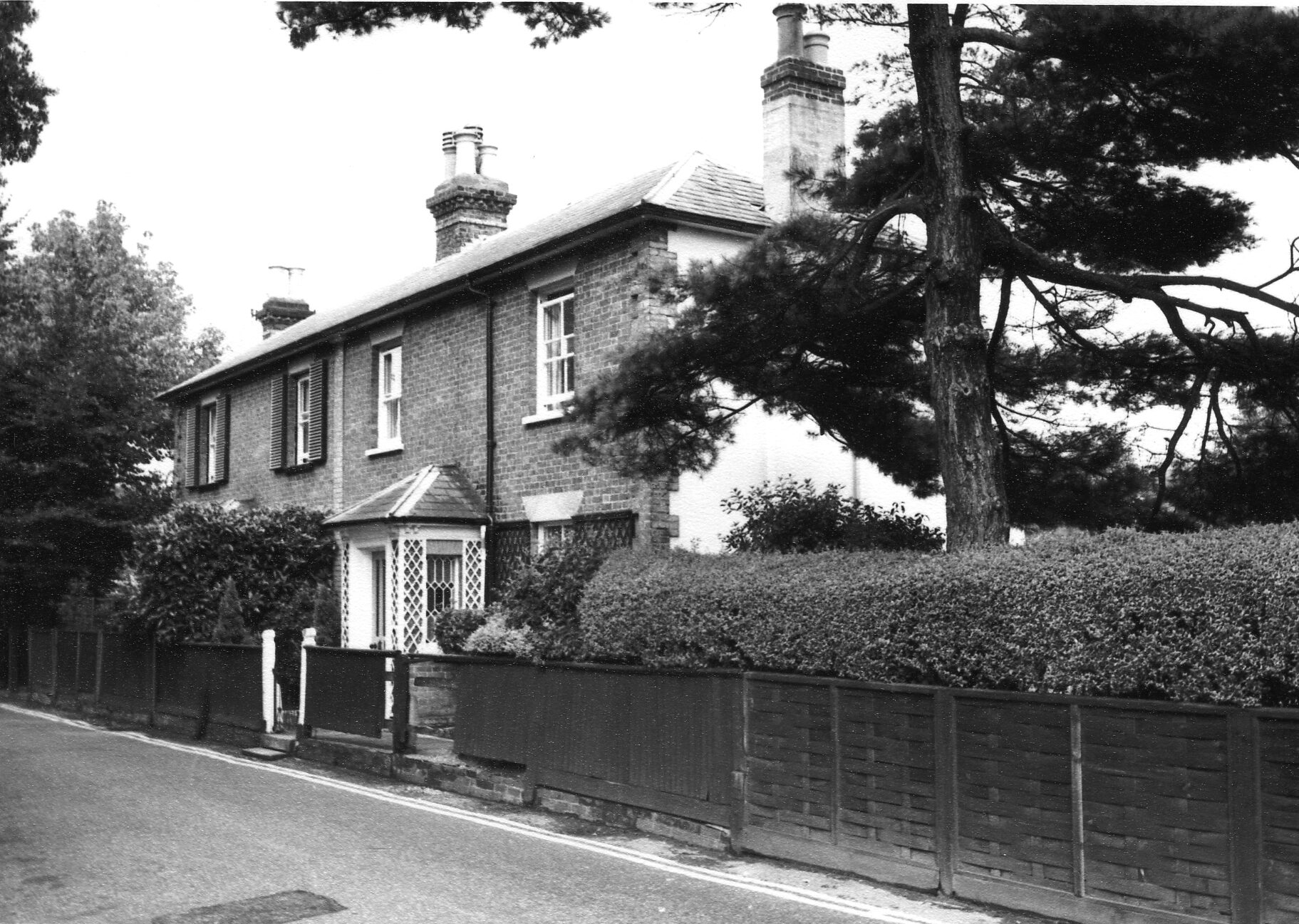 5-7 Worple Road (Number 5 being the final residence of Mrs Ellen Jay), photographed in 1971 by L R James
Image courtesy of Epsom & Ewell Local History Centre
Author’s note: So there we have a round trip from Epsom and back in more words than I care to count. I was only supposed to be doing something with Johnson Hands and his patent, but once you tentatively insert a miniature trowel into something you gradually find out that it’s a can of worms and you need a mechanical digger.
Linda Jackson 2022