
THE HANDS FAMILY – PART 1
(with a liberal dollop of the Daniels)
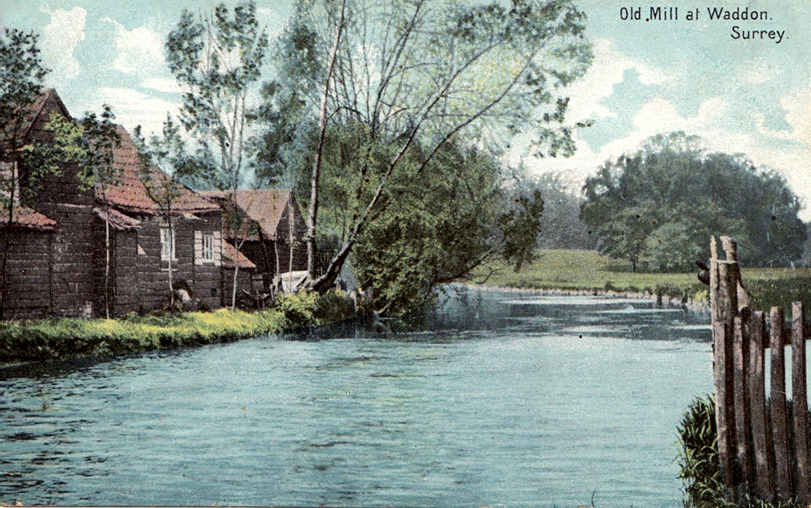 Postcard view of Waddon Mill, Croydon c.1905*
From the author’s own collection
*You’ll just have to trust me, won’t you, but Waddon Mill is relevant to this article (see the Daniels below).
Introduction
This was supposed to be about a 19th century patented brick kiln with eco credentials – and it will be at some point– but the man who invented the process, and his family, turned out to be even more complicated than the kiln. You need to wait if you are interested in brick kilns, as we must first talk about mills and bread.
Beyond the fact that the Hands family seems to have appeared in Epsom during the 1780s, in the shape of John Hands and his wife, Mary, I am struggling to find their origins. You might think that Hands is a reasonably uncommon surname, but it isn’t, and there are Johns and Marys galore all over the place, so I don’t know who these two were or where they went. There is a Mr J Hands in the local Land Tax records and another Mr Hands (initial not given), occupying stables/houses around the 1820s, but, as it gives no real clue where these premises were, we’ll move on to what we know for sure. John and Mary Hands had two children that I can find – these were Mary (christened 23 September 1784 Epsom) and Moses (born about 1788). I decline to search for Mary Junior, but we can proceed with Moses, who lived locally all his life.
Moses Hands
Advisory note: You ’google’ Moses Hands, even in quotation marks, at your own risk, as it mostly turns up results about the hands of Moses the prophet.
Moses seems to have been the man who built up the family money and assets, although he might have inherited some of it. We know that he had property, including premises in Burgh Heath, but I’m not sure how many properties there were. Suffice it to say that he was a man of local substance.
Moses married Mary Daniel, widow of Epsom, at Christ Church, Southwark on 8 September 1814 (as Mary Roffey, minor, she had been wed to John Daniel, minor, on 2 September 1806 at St John the Baptist, Croydon). Four children of Moses and Mary died as infants. Mary Hands herself expired in June 1825, aged just 38; her first husband, John Daniel, who died in 1813, aged 28, is buried in St Martin’s Churchyard on his own (location 345). The couple’s son, also John Daniel, was born in September 1808 and died in June 1825, aged 16: he is buried with his mother and step-father in grave 359. There was another Daniel son, Edward, born in 1807, but, as he didn’t stay in Epsom long-term, we shall skip him just for now. Johnson Hands is the child of Moses and Mary that we want, christened April 1817 at St Martin’s. The other children were Eliza (1815), Emma (1818), George (1819-21), William Moses (1820-21), Ellen (1822-24) and Mary Ann (1823-26). I will deal with Eliza and Emma shortly, but most of the people mentioned are buried in Grave 359 at St Martin’s. Please note that the ‘John’ mentioned on the inscription is Mary’s son, John Daniel.
Following the death of his first wife, Moses married Elizabeth Sowersby, originally from Yorkshire, at Stepney in 1827. They had just the one child, Elizabeth, born 1828, who married local personage Charles Langlands and you can read all about them here.
In the 1841 census Moses was listed as a baker in New Inn Lane, Epsom (see our article on The New Inn). New Inn Lane was the road that unsurprisingly led to the New Inn, which was at 77 Dorking Road, and is currently South Street, plus parts of Dorking Road. Assuming that the census enumerator was following logical progression and not nipping into hostelries for ad hoc refreshment breaks, the bakery was in the South Street portion, in or next to the Folly (a row of cottages, now demolished, which stood behind the shops on the western side of the road at the High Street end). And, in fact, the will of Moses Hands confirmed that he had premises at ‘the Folley’ (sic).
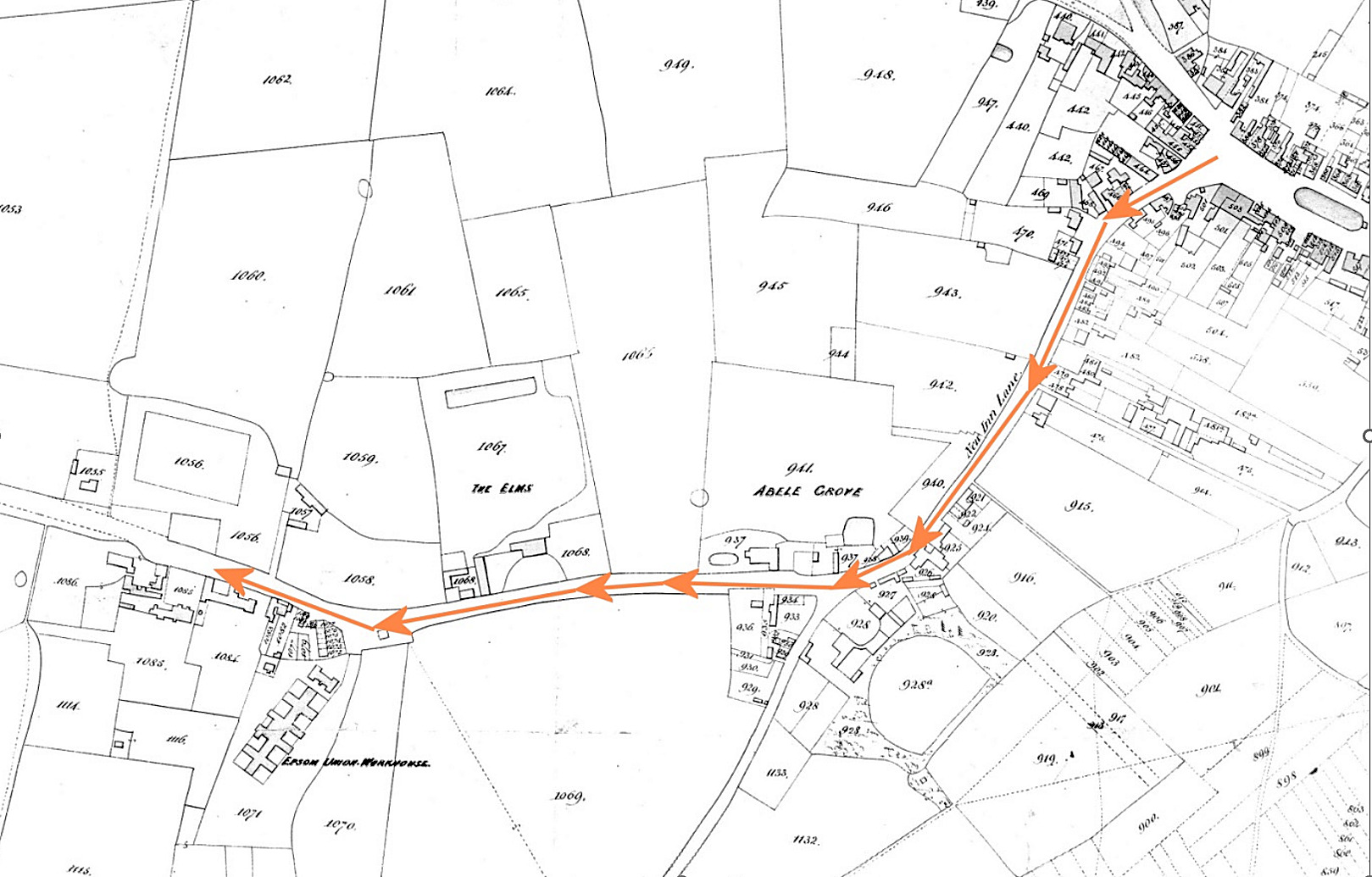 1842 tithe map with New Inn Lane arrowed
At the time we are describing, many of the occupants of New Inn Lane were tradespeople and the census read rather like the ‘Happy Families’ card game – Mr Buggs the grocer, Mr Miles the gardener etc. However, people like Buggs (who later changed his surname to Barton) and Miles – this was Richard Miles, market gardener, of the local Miles greengrocery dynasty – were the bedrock of Epsom’s basic supply chain, who grew/produced many of the staples locally and sold them likewise. This is an apparently novel(!) idea that some places are coming round to again, nearly two centuries on, but, of course, we no longer have so much spare land that it can happen everywhere on a viable scale. Many of the New Inn Lane people ended up as South Street inhabitants by 1861, including one George Wonham, baker, who took over the Hands bakery – he will re-emerge in due course.
It’s slightly misleading to present Moses as a baker, since he obviously needed to obtain the flour from somewhere, and this is where a mill comes in; his son, Johnson, was running the milling operation. Fortunately, we already have an article about flour mills and, although the information and pictures therein are generally later than the period we’re now dealing with, it does save me from having to tackle the topic.
The 1841 census had young Johnson Hands in charge of the milling at the Union Mill, Ewell. My indispensable local guru, the webmaster, tells me that this was Ewell Mill/Windmill and it seems certain that the ‘Union’ handle derived from the fact that it was located in Windmill Lane (off East Street, Epsom) at the junction of the two civil parishes of Epsom and Ewell.
 Extract from 1866 OS map showing Ewell Windmill
(Union Mill) off Windmill Lane
Before we leave Moses, let me deal with the surviving daughters from his first marriage – Eliza and Ellen. Eliza had married Thomas Williams in 1840, at which point Thomas was a warehouseman; he was originally from Melton Mowbray, but by the 1851 census he had become a linen draper in Church Street, Epsom, albeit that the family seems to have been in several other places between those two dates. In 1861 they were still in Church Street and they had a visitor – Edward Daniel, step-son of Moses -, so it’s clear that Edward was still engaged with his wider family, which will become relevant later. Edward was described as a proprietor of houses, so clearly not on his beam ends at that point. By 1871 Eliza had died and Thomas Williams had moved to Fetcham. I don’t know when or where Eliza passed away, but it could have been as early as 1861. Thomas eventually gravitated to a big house called Uplands in Ashtead and died in 1899, aged 93. He was buried in St Giles Churchyard, Ashtead.
There were quite a number of Williams children and most of them seem to have adopted the surname of Hue Williams (or Hue-Williams), but Ashtead is not in our catchment area so I shall turn briefly to Emma Hands. Emma married Cornishman William Reginald Bluett at St Martin’s in 1850. William was a chemist with premises in Sloane Street, Chelsea. By 1861 the family, now including several young children, was in Reading and they then moved to Tetbury in Gloucestershire, but by 1881 they were in Hackney, which seems somewhat odd. Why would you move from Tetbury to Hackney? I don’t know, but the Emma Bluett in Hackney was not our Emma Hands, who had died in Tetbury in 1873, but Mr Bluett’s second wife, formerly Emma Hughes Tanner of Tetbury, whom he had married in 1874. There is nothing more to say about them – Mr Bluett died in 1903 in Wimbledon, followed by his second wife in 1917. There were several Bluett children from his marriage to Emma Hands, none of whom need concern us here.
Johnson Hands
After Moses died in 1846, leaving an annuity to his wife, Elizabeth (died 1854), Johnson took over the milling and baking altogether, although he had been thinking deeply about/pontificating on bricks in learned publications for some time. I thought I should mention the bricks, just to keep you interested if you’re a brickophile. On 26 August 1841, at St Mary’s, Ewell, he married Eliza, daughter of Leatherhead wheelwright William Streater. We shall list the children now, all born locally, just to be clear who they were (more about them in Part 2).
| Name | Born |
| Elizabeth | 1842 |
| Ellen | 1844 |
| William Johnson | 1846 |
| Eliza | 1851 |
| Arthur | 1852 |
| Edward | 1856 |
As you see there are some significant gaps in the table above – no children between 1846 and 1851 and none between 1852 and 1856, which may be explained by miscarriages, but there is a likely explanation for the fact that there weren’t any after 1856; we shall get to that soon.
By the time of Edward’s birth in January 1856, Johnson’s occupation was given as brickmaker. The best place to read about local bricks, and pottery, on this website is our article entitled Pottery and Brickworks’, which has some very nice illustrations, even though it doesn’t mention the Hands family. Since that article has left me nothing much to say about bricks, I will now tell you about Johnson’s revolutionary kiln.
Johnson’s big idea
The advertising etc for Johnson’s revolutionary brick kiln took off in about 1857, which may well be when Eliza reached the end of her tether and moved out, taking the children with her. There is no evidence whatsoever that this kiln was a raving success, despite reams of ‘puff’ from impressed customers.
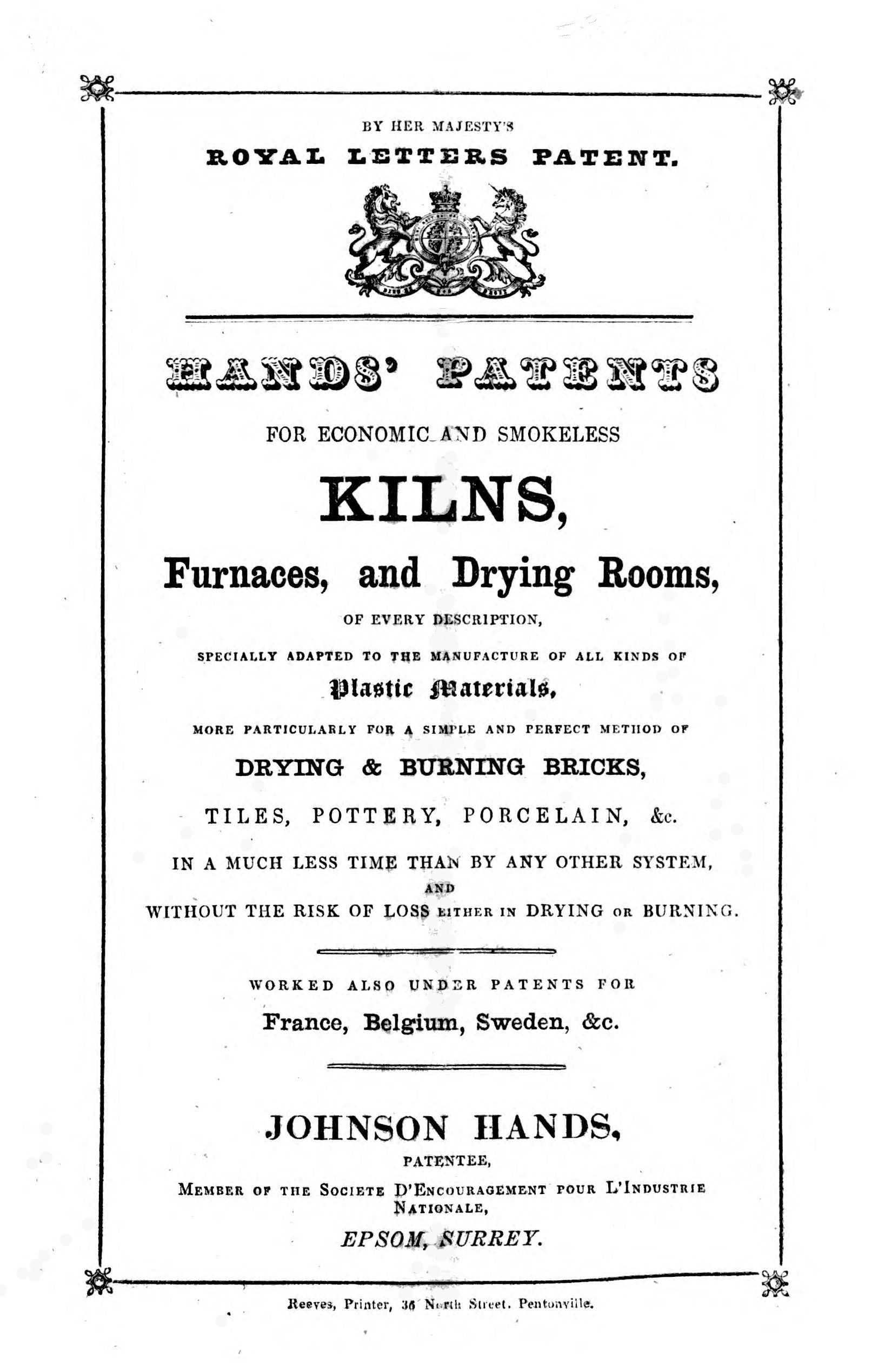
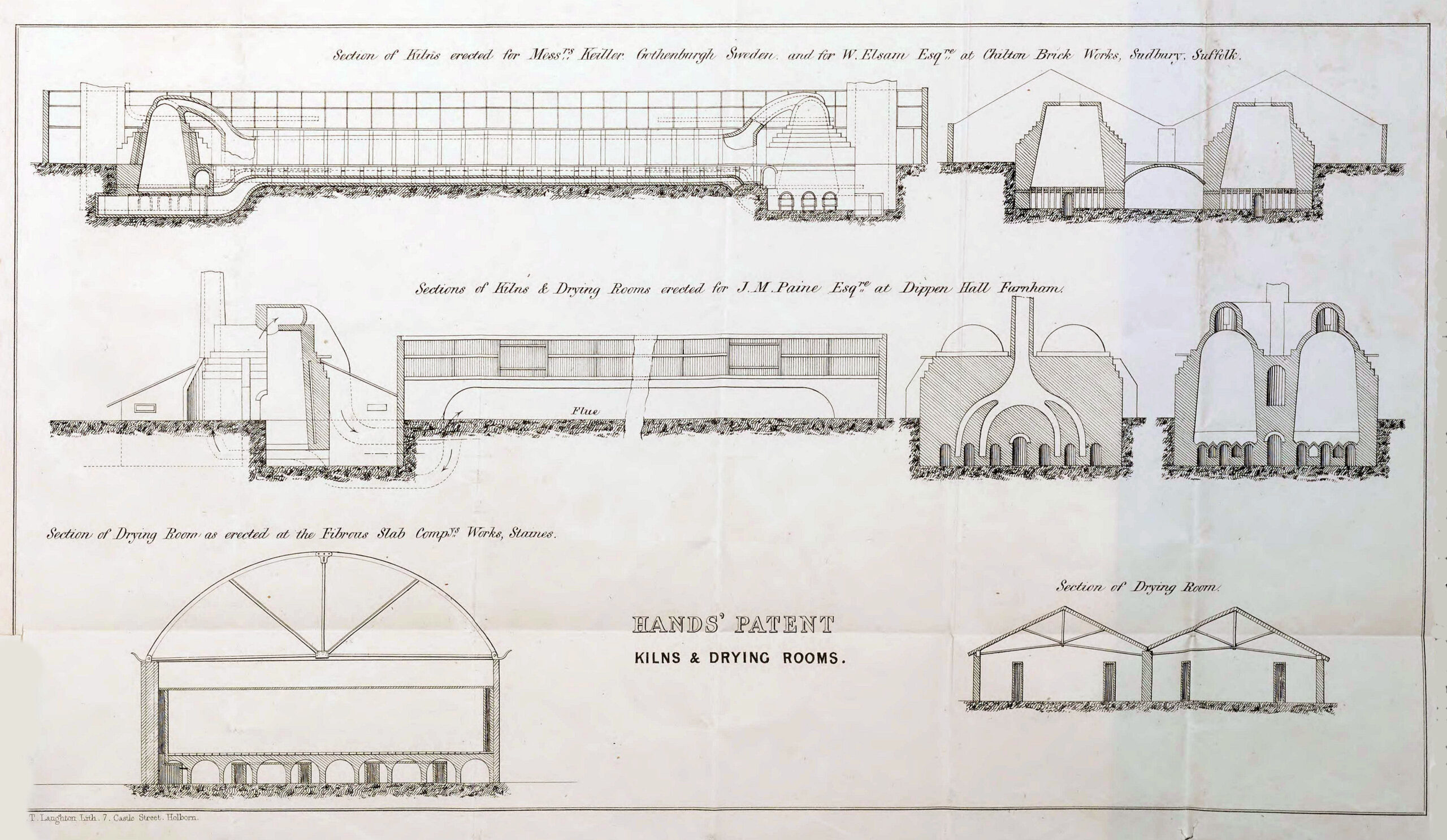
It seems that this system could handle pretty much any material (as well as the obvious function of drying a large amount of bricks/tiles in continuous processes and effectively dealing with noxious emissions). Two of the fundamental drawbacks of earlier kilns were that an immense amount of heat was lost into the air via the open chimneys and thick black smoke poured into the atmosphere. Johnson’s idea (if it really was his idea – see later) was that the smoke and gas generated by the process would be diverted back into the lower parts of the kilns. Or, to explain another way, the heat and smoke didn’t escape, but went round and round to dry more bricks and the smoke was burnt off in the process. The idea does seem to have gained some traction, especially on the Continent, and a ‘flagship’ development which used the process was the Dippen Hall Brick Manufactory near Farnham, owned by the Payne family.
It doesn’t seem that the Hands patent was an earth-shattering moment in brick manufacture and that could be because of the advent of Hoffmann kilns. Friedrich Hoffmann, a German, patented his idea in 1858, at around the same time as Johnson Hands was promoting his process. To cut a long story short, Hoffmann kilns took off and the Hands process sank without trace, even though they were based on similar principles. Johnson became very ill and then died in 1862, so he was not around to continue with his work and, when you read about the children in Part 2, you will see immediately that he left nobody behind who was capable of carrying it forward.
Hoffmann kilns are no longer in use (they were often converted to lime-burning) and the advent of concrete for building eventually reduced the demand for bricks in any case, but in their heyday these kilns could burn continuously for years, even decades. Hoffmann ultimately had his patent revoked, since it was established that someone else had invented virtually the same thing as far back as 1839 but had never applied for a patent.
You can see, or even visit, a Hoffmann kiln in the UK, should you feel so inclined. They are in various states of disrepair. There is an example at Prestonpans in East Lothian, which is part of a much wider industrial exhibit. Or, if you happen to be in Germany, there is a similar ‘theme park’ /exhibit at Ziegeleipark Mildenberg.
The Daniels
There’s no escape from the Daniel family, because Mary Roffey/Daniel/Hands was the mother of the John Daniel who died in 1825 and the Edward Daniel who didn’t, so these two boys were half-brothers to Johnson Hands. It took me forever to sort out who the Daniels were and where they came from, but I finally had a Eureka moment. If I’d paid proper attention to the fact that the older John Daniel married Mary Roffey in CROYDON, we’d have got here much sooner, but I started at the Epsom end originally. Wrong!
So, there once was a miller called Edward Daniel (ED1) who plied his trade at Waddon Mill, Croydon (see the postcard at the beginning of this article) and he died in 1782. Crucially, his will mentions a son named Edward (it would be handy for researchers if parents had more imagination about the forenames of their offspring, but there you are), so this was ED2, who died in 1827. He had two sons, called – wait for it – Edward (ED3) and John, both of whom had predeceased him, so John (JD1) has to be the man in St Martin’s Churchyard who married Mary Roffey and died in 1813. ED2 also mentioned his grandsons, Edward and John – yes, I know! -, so let’s call that Edward ED4 and, therefore, the lad who died in 1825 was JD2. Hang on to ED4, as we’ll want him very soon. By the way, ED3 had a daughter called Elizabeth, but I have no idea what happened to her and I shan’t look. ED4 was in Epsom for some time, until he married Charlotte Busby, also of Epsom, at St Martin’s on 13 January 1831; they then set up home in Dorking.
The rapid demise of Johnson Hands
Johnson is missing in the 1861 census (taken in April of that year), although he was almost certainly living in a cottage at Parson’s Mead, Croydon and very probably much too ill to be anywhere else. Eliza and the children are easily uncovered (mostly lodging in her home town of Leatherhead). On 16 January 1862, aged 44, he died of phthisis at Rose Cottage, Parson’s Mead. Phthisis is generally taken to be tuberculosis/consumption/wasting, but in those days it could be caused by constant exposure to various harmful substances occurring naturally in the ground or working with industrial-type processes, so it’s possible that his trade/business activities might have been a contributory factor.
The death certificate says that an ‘L.R. Daniel’ was present at the death. Obviously this was one of our Daniel family and I think the only viable candidate is Elizabeth Roffey Daniel, adult daughter of Edward and his wife Charlotte, so maybe she gave her name to the registrar as Lizzie. All of them might well have been living at Rose Cottage, without mentioning Johnson to the enumerator, in 1861, but this was one of those irritating censuses where names and numbers of properties weren’t specified: however, the Daniels certainly did live at the cottage during the 1860s, as you will find out momentarily. Edward’s occupation was given as ‘retired publican’, the hostelry in question being the Queen’s Head in Dorking, which is still there today on the Horsham Road.
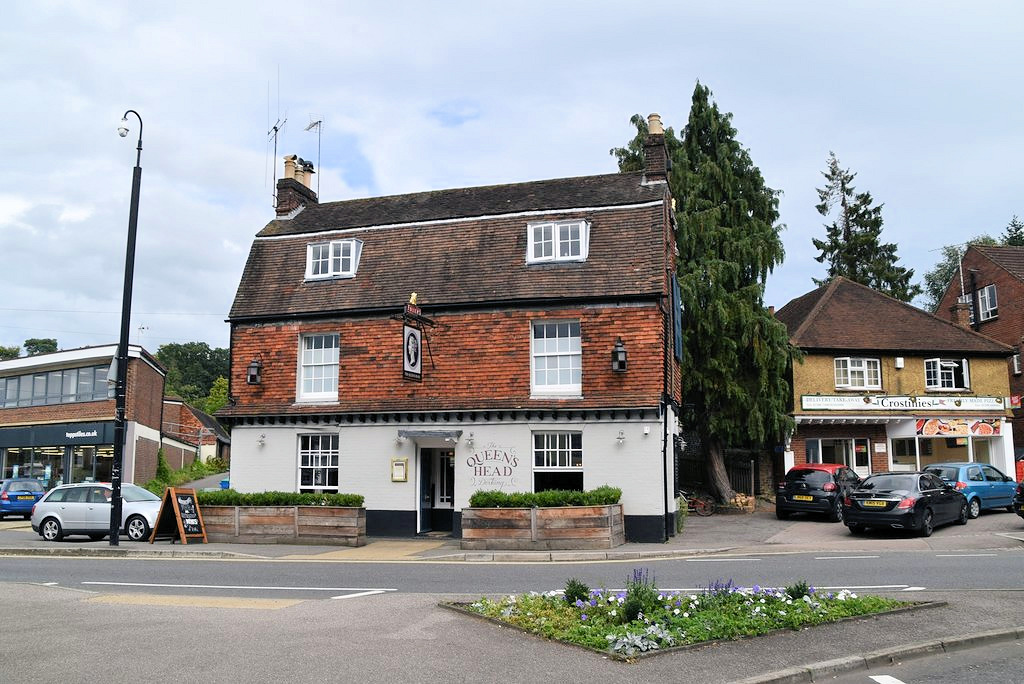 The Queen’s Head, Horsham Road, Dorking, photographed c.2019
© Copyright N Chadwick and licensed for reuse under this Creative Commons Licence.
Edward and Charlotte had a son, also imaginatively called Edward (he would be ED5 if I could be bothered with any more of them), who died in 1864, aged 31. ED4 expired in 1867 and left effects of under £100. Thereby hangs a tale, so we shall pick up the Wonhams, Mrs Eliza Hands and the Hands children in Part 2.
The demise of Edward Daniel (ED4)
I apologise in advance for the length of this newspaper report (and the length of this article in general), but it does tell us a great deal about ED4’s household circumstances. This is from the Croydon Chronicle and East Surrey Advertiser of 25 May 1867. The headline says it all, but the report itself is something of an eye-opener.
|
DEATH THROUGH EXCESSIVE DRINKING An inquest was held at the Fox and Hounds Inn, London Road, on Saturday evening last, before W.Carter Esq., Coroner on the body of Edward Daniel, about 60 years of age, who resided with his wife and daughter at Rose Cottage, Parson’s Mead. The first witness called was Mrs Fuller, a neighbour, who deposed that on the previous Friday morning she was called in to see the deceased. He appeared to her to be dying and she at once requested that a medical man should be sent for. Some person went for a medical man and witness afterwards went to see the deceased, and found that he was dead. On examining the body she found a few slight scratches on the right elbow but, beyond these, no marks of violence were perceptible. Deceased was dressed, with the exception of his coat and boots. A scarf was tied loosely round his neck. Witness had known the deceased for the past 20 years; formerly he was a very quiet man, but latterly he had given way to drink, although she did not think that he drank excessively. She saw him walking in the street on the previous day, when he appeared to be in his usual health, but when she saw him the next morning he smelt of drink. George Parker, potman at the Fox and Hounds, who lodged at the deceased’s house, deposed to going home about a quarter to twelve on Thursday evening, when he saw the deceased in a state of intoxication; in fact he never saw him more intoxicated in his life. Whilst he was in the passage Mrs. Daniel and her daughter came downstairs and the latter flew into a rage because her father had come in so late; she pulled him, saying, “Go to bed.” Deceased fell and witness assisted to get him up. They made up a bed for him and laid him on it, after which witness went to bed in an adjoining room. He saw the deceased the next morning, about half-past 6, when he was snoring loudly; he assisted in getting the deceased upon his proper bed and, with the exception of the snoring, there appeared to be no animation in him. Witness went for some brandy, which he gave his wife and daughter, who said they would make him a cup of tea. He did not see them do anything with the brandy, as he went to his work; he had not seen the deceased since. During the three weeks he had lodged in the house deceased had given way to drink and had been in a desponding state. The wife and the daughter also drank. He had heard them threaten each other but he had never seen any blows struck. They were all so much alike that he could not say which was the worst. The jury having viewed the body, the evidence of Mrs Daniel was taken. She appeared in Court with a black eye, said to have been given by her daughter, whilst her father lay dead in the house. Her evidence was to the effect that her husband came home about a quarter to 12 on Thursday night. She heard him fall down once or twice in the back garden. She went downstairs and found her husband in the passage with the lodger. Her daughter also came downstairs, and if she pushed her father witness did not see it. He fell down in the passage and was very drunk. She did not go to bed any more, but occasionally went and looked at her husband, who was placed on a temporary bed. He was quiet, but snored very much, as was usually the case when he had taken too much drink. The next morning he took a little tea, with brandy in it, and, as he looked very ill, she sent for Mrs. Fuller. Dr. Strong was also sent for. She did not understand that the deceased was dead before the doctor arrived. He frequently got drunk, but then he kicked about. This time he was exceedingly quiet. The Coroner having summed up, the room was cleared, and after about 20 minutes’ deliberation, the jury returned a verdict that the deceased, Edward Daniel, met with his death through excessive drinking. The Coroner told Mrs Daniel that this was a lamentable case to go before the public, and he hoped it would serve as a warning to her and her daughter to abstain from strong drinks. |
I can’t know if the ladies heeded the coroner’s warning, but Mrs Charlotte Daniel survived until 1880, aged 84; and at the age of 52, in 1882, the seemingly robust and punchy Elizabeth Roffey Daniel married widowed bootmaker Henry Norman (of similar age). Having seen him off, she finally expired in 1911, aged 87.
In Part 2 we shall deal with the Wonhams, Mrs Eliza Hands and the Hands children.
Linda Jackson 2022