
A visit to the Farm Veterinary Stables, Epsom
The Illustrated Sporting & Dramatic News, 7 June 1907
 Mr Coleman riding Tip Top over a gate
“The ills that flesh is heir to” is a phrase which applies to equine as well as to human beings, and in each case, of course, suitable remedies are necessary. A skilful doctor achieves, in either event, immense popularity. Patients flock to him from all parts of the world—a fact which reminds us that in his infirmary at Epsom Mr. John Coleman, the celebrated veterinary surgeon, has over sixty horses under his charge at the present time, and they are nearly all racehorses. A visit to this large establishment is most interesting; a sportsman might stop there all day with enjoyment, and improve his mind. Mr. Coleman has elaborated a distinct mission in life—to cure broken-down racehorses, his success in that line has been quite remarkable. Innumerable cripples have been set on their legs again. Some of the most famous “flyers’” on the Turf have been submitted to his treatment for one ailment or another, including Polar Star, Cicero, Jardy, Vedas, Black Arrow, The Thrush, and Colonia; whilst Lord Lonsdale’s Crest, whom he recently fired [see the Annex], has since won three races on the flat. Old Nick, who won the Apprentices’ Plate at Gatwick on May 18th, was fired by him about three months ago. It will also interest sportsmen to know, for the fact has not been previously mentioned, that Mr. Coleman operated on The Grafter’s leg a fortnight before that renowned Australian horse won the City and Suburban, or he would never have been able to go to the post. A little Turf history was thus satisfactorily adjusted.
 Firing The Grafter under cocaine
Horses are sent here from all parts of this country and from abroad when they need Mr. Coleman’s unique and effective methods of cure. He has, for example, just sent Shoe Black back to Germany quite sound. Many of his other ‘‘resurrections’’ have been sufficiently noteworthy. Having ideas of his own as to broken down racehorses, he determined at first to carry them into effect on those which were his own property; accordingly, he had several hopeless animals given to him—it was thought by their owners that they would never be able to gallop again—and he not only set them on their legs, but he has won many races with them. As instances of such triumph we may mention Tambour, given to Mr. Coleman as a complete wreck, and with whom he subsequently won two races in one day; Jam Jar, acquired under similar conditions, with whom he likewise secured a couple of events in one afternoon; and Morocco Bound, another cripple, who—vide the Racing Calendar—has been very successful for Mr. Coleman since undergoing the latter’s remedial treatment. With Rough Chance, another broken-down horse, supposed never to be able to be trained again, he won two races in one day at the recent Lingfield meeting, thus helping to disprove the theory advanced by certain so-called authorities that firing a horse lessens his speed.
 Gamaliel II in slings for a broken leg
Our accompanying pictures, taken at Mr. Coleman’s veterinary farm at Epsom, cannot fail to interest all horse lovers and sportsmen. The subjects illustrated need brief description. There we see Lord Sefton’s Gamaliel II in slings with a broken leg, which will probably take several months to heal; also the operating yard, with a foot of sifted sand all over it, and the proprietor sitting down after a hard day’s work; view of the stables, front yard, with Miss Lawrence on her pony Butterfly, winner of many hackney prizes—this young lady has ridden astride since she was a child; White Rose, a famous “lepper,” in the exercising school, clearing high timber without the assistance of a jockey—this mare has won over two hundred prizes in all parts of the country for jumping when ridden by Mr. Coleman himself; view of horses with patent breaking tackle or straight jacket, with which, as Mr. Coleman says, “If I get a bad horse I make him a good one”; Lord Hamilton of Dalziel’s Cherry Ripe being fired by Mr. Coleman; and Tip Top, a noted jumper and winner of numerous prizes. We may add that the horses depicted in the patent breaking tackle are Rough Chance, previously referred to, and Sugar Baby, both winners at Lingfield and it is a noteworthy fact that the last mare had been fired by Mr Coleman within ten days of her victory , showing what can be done by thoroughly skilful treatment. Sugar Baby won her race by thirty lengths in a canter, so it is obvious that the operation of firing has not affected her speed.
 White Rose, an old jumper, going
straight to home according to custom
Like all successful pioneers in any sphere of activity, Mr. Coleman has not only original theories and ideas of his own: he also possesses the capacity to carry them into practical effect. He does not treat all horses in the same stereotyped manner; he carefully studies their individual needs, and many of them are worked as though they were in a gymnasium or hospital. He is obliged sometimes firstly to break down old adhesions, so as to accomplish a perfect cure of an injured limb. His work is always most carefully done by himself, and at his Epsom establishment he does not employ a qualified assistant, the reason being that, naturally enough, he does not wish a man to study his methods and then try to apply them elsewhere. In connection, however, with his large practice in London, Mr. Coleman employs three fully qualified assistants, who find that the demands on their ability are sufficiently numerous. He has also other stables at Sandown Lodge, Epsom—together with a jumping field and schooling ground—and here is room for a large number of horses. Few boxes are ever empty.
In association with horses and sport we often find that talent is inherited, and that appears to be so in the case under notice. Mr. John Coleman is the son of the late Mr. William Coleman, of Sutton, who was for many years the principal racing “vet.” in this country, having amongst his clients the late Alec Taylor, Tom Stevens, John Day, M. Dawson, the late Duke of Beaufort, Lord Cholmondeley, and many other distinguished sportsmen. He was consistently successful in his work. His mantle has fallen worthily on the shoulders of his son, who has advanced with the progress of modern science, and has introduced new ideas and methods of his own for the benefit of the equine race. He is often able to make horses sound that would have been formerly regarded as quite hopeless, and they would probably have been shot. He has turned out many winners of his own in that way. Happily, he continues to devote his personal energies to this good work. Results are, as intimated, very satisfactory.
 1. The covered yard. 2. Mr Coleman outside his house “The Farm”
3. Some of the tackle used by Mr Coleman 4. Firing Cherry Ripe
Click image to enlarge
Show jumping is a branch of sport in which Mr. Coleman has taken a prominent part since he was twelve years old. He has owned, and now owns, some of the most brilliant ‘‘leppers” in the world. They have won prizes in competition with the finest performers in every district, and still continue to do so. They are equally efficient in the hunting field, where Mr. Coleman rides them when he has the necessary leisure. Truly he is both versatile and accomplished as a sporting “vet”.
The Illustrated Sporting & Dramatic News
7 June 1907
NOTE
John Coleman died on 8 June 1923, aged 61, having (as mentioned in The Times obituary) been called from his sick bed to attend on Town Guard, the favourite for the Derby – which, notwithstanding his ministrations, was sadly unplaced. After brief interim usage by racehorse trainer Stuart Hyde, 1927 saw the site taken over by the newly-incorporated Farm Garage – dealing with a different form of horsepower.
ANNEX: What is Horse Firing?
The practice of horse firing has been carried out for many centuries. It is also known as thermocautery, and used to treat an injury to a horse’s leg, by applying heat, cold, or chemicals to induce a counter-irritation and speed up healing.
In the UK the Royal College of Veterinary Surgeons say that firing should only be used when other methods have failed.
The horse is sedated, the leg clipped and a local anaesthetic applied. Then a red-hot iron is placed against the lower leg to either burn lines around the leg or quickly pushed into the leg to actually puncture the tendon itself. Freeze firing using liquid nitrogen and acid firing have also been used.
Peter Reed 2022
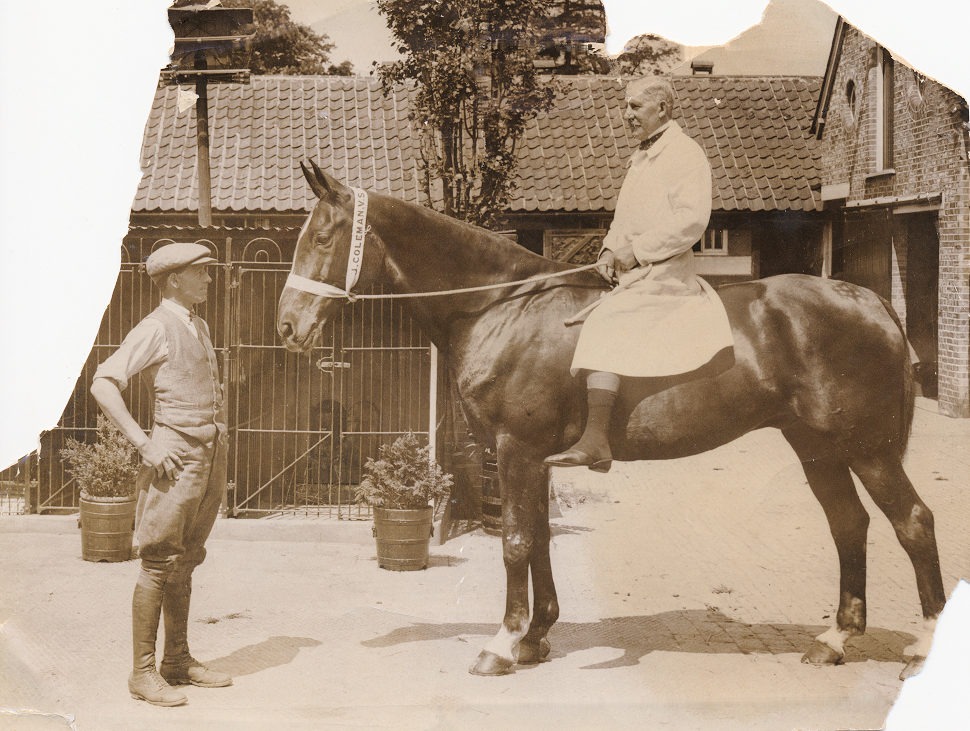 Photograph of John Coleman sitting on a horse and his assistant.
Courtesy of Ann Wood © 2023. Date not known