
THE BATTLE OF EPSOM
A NEW BALLAD.
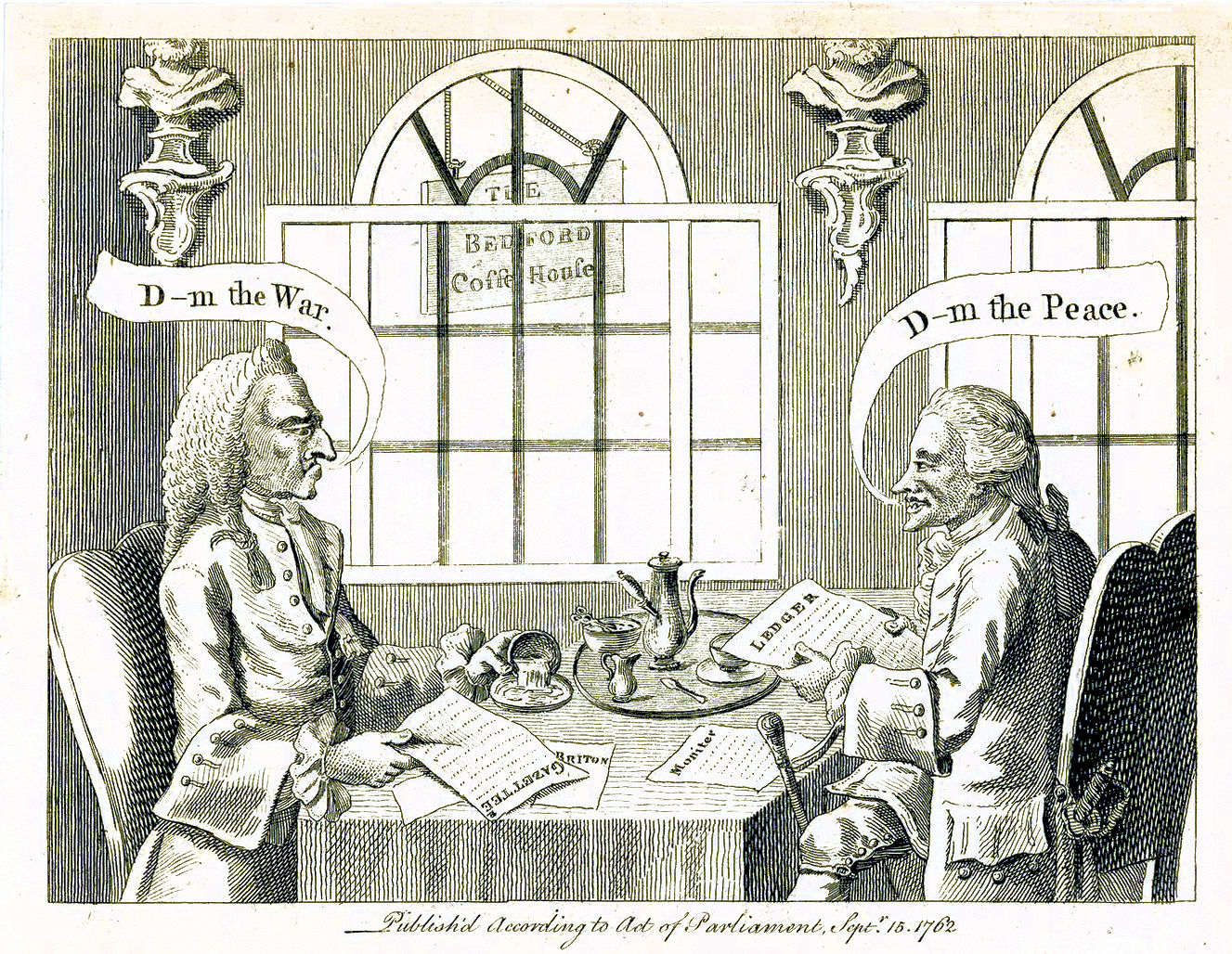
Image taken from a broadside satirising Lord Bute’s mission to Paris
to arrange peace with France, disputed by two patrons of the
fictitious “Bedford Coffee-House”. Tringham : 1762
© The Trustees of the British Museum (CC BY-NC-SA 4.0)
The text and ballad that follows was written by Joseph Mawbey following a meeting held to discuss an address to the King following the end of the Seven Year War (1756–1763).
This was a global war fought over several continents with Britain fighting France and Spain mainly over colonies in North and South America and Prussia against Austria, France, Russia and Sweden over parts of Europe. The conflicts also extended to parts of India and Africa. The war ended in 1863 with the signing of two treaties the Treaty of Paris and the Treaty of Hubertusburg which involved a complex exchange of colonies between the combatants.
Mawbey felt that the meeting would be ‘fixed’ so he brought in people from other parts of Surrey to express their feelings to ensure that the address to the King would reflect a consensus view.
THE BATTLE OF EPSOM
ADVERTISMENT
It may be proper to inform the reader, that at the desire of eight gentlemen of the County of Surrey, a meeting was appointed by the Sheriff, to consider of an address to his Majesty on the peace. This meeting was fixed, by public advertisement, for the 7th of July, 1763, at Epsom, which was thought the more extraordinary, because the body of the County were to meet at the Assizes, so soon afterwards as the 27th. As no good reason could be given for the meeting at Epsom, it was believed that the gentlemen who desired it, were afraid of trusting the proposition for an address to the natural and usual channel, the Assize-Meeting; and therefore, though an address on the peace, from any place, would have been disliked by many, the manner in which this was intended to be brought on, made it the more objectionable.
The County of Surrey has ever been distinguished by it’s attachment to the present Royal Family. That attachment was manifested in the strongest manner in the year 1745; a season, when many gentlemen, now holding considerable posts in the administration, were so far from giving any proof of their love of liberty, and our present happy establishment, that they were, with too much reason, suspected of wishing the destruction of both. The uncommon industry which has lately been exerted to procure addresses from every part of the Kingdom, on so stale a subject as the peace, has induced many to imagine, that they – have been sent on foot to serve ministerial purposes only, and to support an administration which has found means, by a creation of new and unnecessary places,* by conferring titles ±, pensions, and reversions in a degree unknown to former times, to continue in power, notwithstanding the inability they have discovered in business, and their pursuing the most odious and unpopular measures that could possibly be adopted. This apprehension, and the firmest belief that the space was inadequate to our situation, compared with that of our enemies, as well as to our successes in the war, induced many gentlemen to attend the meeting at Epsom. Their public spirit had the desired effect they prevented, at that time, the opinion of a few from passing as the sense of the county; and from the spirit then shewn, it is believed the motion for an address on the peace will not be carried at any future meeting. The Author of the following trifle has turned into verse the principal debates and transactions of the Epsom meeting. He did this for his own amusement only; but having shewn it, perhaps indiscreetly, to some of his friends, he has by them been prevailed upon to permit it to be printed.
Surrey, July, 18, 1763.
* There are now twenty Lords of the Bed-Chamber, including the Groom of the Stole, instead of thirteen; and fifteen Grooms of the Bed-Chamber, (all Members of the House of Commons, except one) instead of the former Number eight. Economy has indeed been established amongst cooks and scullians, who have no Parliamentary interest, but profusion has usurped her place in every instance where influence might be extended. This unnecessary addition to the Bed-Chamber, the great increase of pensioners, and probably other transactions of the winter, of a more private nature, will account perhaps for the great debt which is said to be owing on the Civil List.
± Vide the great increase of the peerage, since the death of the late King; an increase, which has given a new turn to the deliberations of the House of Lords.
THE BATTLE OF EPSOM
A NEW BALLAD.
Bella, horrida Bella.
Virg.
——
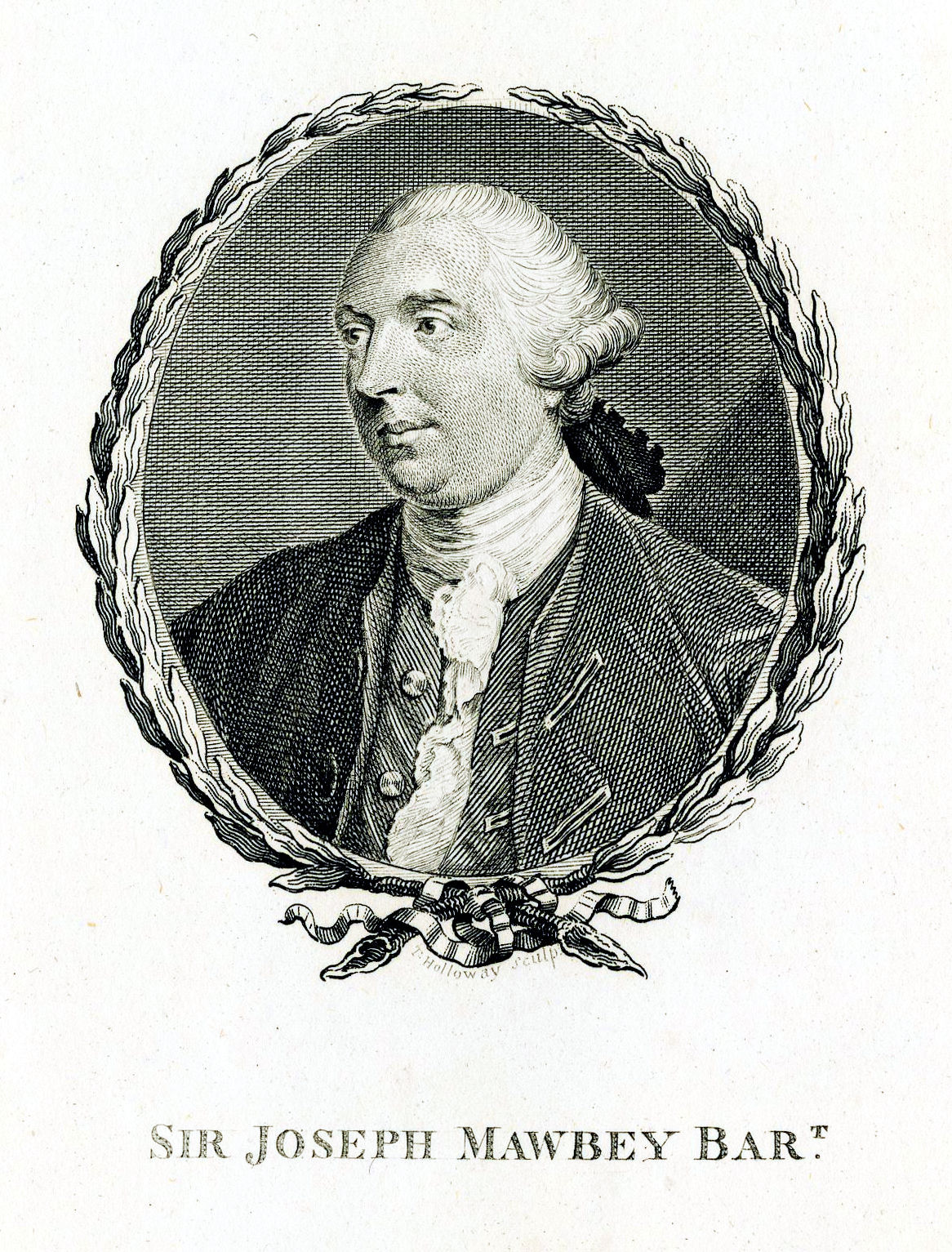 Joseph Mawbey
© The Trustees of the British Museum (CC BY-NC-SA 4.0)
YE good men of Surrey, both ancient and young,
All loyal and true, pray attend to my song;
I sing, tho’ the Scotchmen should smile, or should frown,
The wonderful Feats done at Epsom fair town.
Derry down, down, down, derry down.
How eight English worthies a meeting desired,
To address on the peace, by their duty inspired,
Tho’ scandal has said, with a very ill grace,
Some wanted to keep, others get—a good place.
Derry down, down, down, derry down.
Th’ Assizes, tho’ near, would not answer their ends;
The Jury might vanquish this Junto of friends;
From whence “twas inferred, that fair Epsom they chose,
Presuming that none would come down—to oppose.
Derry down, down, down, derry down.
But Mawbey, who heard of their plan, and could guess,
Set engines at work to prevent their success;
To his firm Borough friends his objections made known,
Who vowed to go with him to Epsom fair town.
Derry down, down, down, derry down.
There was Stevens, Smith, Jackson, and brave Johnny Wood,
Waite, Winter and Jeffries, all stout men and good;
Hills, Stapleton; Liversidge, Fry once again,
Tovey, Maidman and Andrews, and Protestant Ben.
Derry down, down, down, derry down.
The Doctor was there, for his coach Mawbey lent,
Tho’ Cholic, ’twas thought, or else sleep would prevent:
But rather than countenance actions to small,
He’d wait a year longer—without any stall.
Derry down, down, down, derry down.
There was Giliam, Leach, Fox too, from Red’riffs famed town,
From Clapham and Wandsworth, Wright, Atkins and Brown,
Webb, Draper and Chilwell, and many a score,
From Putney and Lambeth, and Villages more.
Derry down, down, down, derry down.
There was Hollowley, Hopkins — besides other votes,
To liberty true, led by brave General Cotes;
Who firm to his: country and: friend will e’er shine,
As free in opinion, as free with his wine.
Derry down, down, down, derry down.
At fair Epsom arrived, see, the Enemy near,
Survey with concern, as awakened by fear
Some think of the combat, of others the aim,
Was only to steal away just as they came,
Derry down, down, down, derry down.
Northey, Godschall and Tucker, their fears making known,
Did not like the Appearance, so wished to postpone;
But Tollett, the furious, and dull, won’t agree,
And Geary the valiant, cried, Sirs, it shan’t be.
Derry down, down, down, derry down.
It ne’er shall be told that of danger afraid,
A true English Tar ever drew back his head;
The thought, I must own, puts me into a rage,
So, on, worthy Sirs, hasten quick, and engage.
Derry down, down, down, derry down.
The Troops all drawn up, Mawbey ‘gan the attack,
And Northey and Godschall were forced to draw back;
Their quarters were taken by surprize and neglect;
Overthrown by a weapon they did not expect.
Derry down, down, down, derry down.
What? let it be said; Boys, in Surrey’s famed Shire,
That we Onslows forget, tho’ there’s none of them here;
I’m sure you will all with my motion agree,
Thanks to Vincent and Onflow, the honest and free.
Derry down, down, down, derry down.
When tools most corrupt, late together were yoked,
And this land, by a thistle, had like to hae been choaked;
When a Cyder—Excise, did our annals disgrace,
Both firmly opposed, and ore gave up his place,
Derry down, down, down, derry down.
The many were pleased, tho’ the motion was new,
And joined in applause of a conduct so true:
But waked from his trance, Godschall begs they would wait,
And pay respect to the King — and all that.
Derry down, down, down, derry down.
Respect to the King, Sir, I’ll ever approve,
Says Mawbey, and shew in all places my Love;
I’ll wave now my Motion, my very good Friend,
And for freedom and George, my last shilling would spend,
Derry down, down, down, derry down.
The Peace let’s consider, and vote an address,
One glorious and great can deserve nothing less;
You see, cries bold Godschall, how fast they come in,
We’re almost the last, to it’s time to begin.
Derry down, down, down, derry down.
What is it to us, Mawbey cries, in a pet,
If venal addresses fill every Gazette:
Who’s first, of Scotch Counties let that be the strife,
Clackmannagh, or Peebles, or Elgin, or Fife?
Derry down, down, down, derry down.
Shall, we, independent, contribute Applause,
And sacrifice Truth to support a bad cause ?
The peace I think had, yet even now let it pass, —
The addresses ill timed — there’s a snake in the grass,
Derry down, down, down, derry down.
Eight Months are elapsed since the Treaty was made,
Which gave up our conquests, our fishery, our trade,
Guadaloupe, Martinique, other places a score, —
It this was well done, why not thank for’t before?
Derry down, down, down, derry down.
When Providence late, in return to our prayer,
To maintain all our rights, gave to England an Heir, 1
What then was the way your respect to express,
You staid all at home, nor would meet to address.
Derry down, down, down, derry down.
Cotes, Atkins, and Stevens, their arguments bring,
Thus late to address, is a very odd thing;
It would look like a want, or of place, or of sense,
The peace we dislike — no addresses from hence.
Derry down, down, down, derry down.
Blood, Death and confusion, what words do I hear,
Says T—lb—t, by G—d, I’m a stranger to fear?
Help, Geary, help, Sampson, help, Halifax brave, 2
The Ministers want,—an address they shall have.
Derry down, down, down, derry down.
You’ve seen a mad bull roar and tear up the ground,
Vex’d, furious, and loud, with his eyes rolling round;
You’ve seen the bold Thunder, on Drury—Lane stage,
Rant, threaten, and bluster,—’twas like T—lb—t’s rage.
Derry down, down, down, derry down.
Zounds ! why does this Fellow rave, bully, and sweat.
Fore God, I will lay him down low at my feet,
If he hectors, cries Humphrey, and pushes away,
I’ll give him enough to remember the Day.
Derry down, down, down, derry down.
Ye black—guards of Southwark, Says Sampson the bell,
Pray what do you here ?—you shall know I can scold;
Your betters they are, Sir, ‘cries John, with a frown,
The Parson was mute, and sat quietly down.
Derry down, down, down, derry down.
The Battle now rages, a terrible sound,
Address, no Address, were the words all around;
The 3 Clergy desert, such achievements they scorn:
It was not the Way,—to preferment and lawn.
Derry down, down, down, derry down.
Who’s that in grey hair, who the foe so defies?
Nab Waters, isn’t you, may I credit my eyes?
Your zeal, I well know, would do this and much more,
But thought you’d enough of the County before.
Derry down, down, down, derry down.
Help Waters, help Sampson, help gallant men all,
Poor Bund is o’er thrown, a most terrible fall!
O’er whelmed he must die, if he cannot get loose,
Adieu! then alas ! the famed Cause of the Goose.
Derry down, down, down, derry down.
Where’s Evelyn, where’s Webb, for I cannot yet see,
Come Curt’ret and help, and we’ll give you a fee:
But Evelyn attended his father’s last call,
And Webb has enough of the Affair at Guildhall. 4
Derry down, down, down, derry down.
Cries, Talbot, tis vain to oppose such an Hott,
And Godschall, and Tucker were pale as a ghost;
Help, Turner, dear Nic, for we’re all in a Fright —
NO Turner was there,—he was drunk over—night.
Derry down, down, down, derry down.
Come 5 knight, clerks, and pensioners, come to our aid,
Come foreigners, minors, or else we’re betrayed:
Stand firm, my brave lads, or our wishes are croft,
Our Honour is soiled, and our places are lost.
Derry down, down, down, derry down.
In vain,—for these combatants fairly were beat,
Tho’ some, by fresh help, now secured a retreat:
The field they relinquished, the Dead were all found,
And buried they’ll be,—in some rich Abbey—Ground. 6
Derry down, down, down, derry down.
Now God bless the King, and all those of his blood,
And send him a Ministry able and good :
May Surrey’s famed County henceforth be at rest;
If not, pray remember the blow from the East. 7
Derry down, down, down, derry down
F I N I S.
1 It is observable that none of the gentlemen that desired this meeting, and were so anxious to address on the Peace, attended the meeting last autumn, to address the King on the Firth of the Prince of Wales.
2 The Preliminary Articles of Peace were signed at Fontainebleau, on the 3rd of November, 1762.
3 The Rev. Mr. Halifax, Vicar of Ewell. The greatest part of the Clergy left the Assembly—Room after the debates were begun about the peace and were not present at the division.
4 The actions brought against the King’s Messengers, Ec. by the Journeymen Printers, were. decided at Guildhall the day before this meeting.
5 Alluding to a certain knight, Sir Henry St. John, two attorneys clerks, gentlemen pensioners, boys and others, (Foreigners with respect to the County, as having no Property in it) who came to vote for the address.
6 In allusion to a song of Dr. Howard’s (Rector of St. Geo. Southwark)
7 The East half Hundred of Brixton, and that Neighbourhood, from whence most of the Gentlemen came who opposed the address.