
SHOCKING TRAGEDY AT EPSOM.
 Epsom Union Workhouse (Post 1834)
The Illustrated Police News – 20 November 1869
On Saturday, Mr. William Carter held an inquest at the Epsom workhouse on the body of Samuel Butcher, aged fifty-five, It appeared from the evidence that deceased was deaf and dumb, and was an inmate of the workhouse. Deceased was admitted to the infirmary with a very serious cut on the head. Deceased was seen to enter the workhouse gate followed by a man named Gutteridge, who had half a brick in his hand, He struck deceased with it on the right-hand side of the head, and deceased fell backwards upon the ground. His head bled freely. It appeared from the evidence of Dr. Stillwell that the deceased had received a frightful scalp wound, from which he died on Friday. The wound went right through to the bone, and was such as might have been produced by half a brick in the mode alleged. The jury returned a verdict of man slaughter against John Gutteridge.
Further research found the following article:
The Surrey Advertiser and County Times – 13 November 1869
EPSOM.
INQUEST – VERDICT OF MANSLAUGHTER.
On Thursday morning last an inquest was held at the Epsom Union, Before R. Carter, Esq. Coroner for Surrey, touching the death of Samuel Butcher, an inmate of the union, who died from the effects of a blow on the head from half a brick, which was thrown at him by another inmate named John Gutteridge. The jury having chosen Mr. Charles Blake as their foreman, after having been sworn, the following evidence was taken :-
James Bird said that he was a pauper inmate of the Union. He was present at the death of Samuel Butcher, who was 55 years of age, and was formerly a postman. He was an inmate of the union, on and off, for the last four years. He died on Friday, 5th November, under witness’s care, who is the nurse of the infirmary. The deceased was deaf and dumb, and came under his care on 27th October, by reason that he had received an injury to his head, which was cut on the right side over the ear. He had medical treatment by Mr. George Stilwell, the medical officer to the union, who ordered cold water dressings. He went to bed on the day he received the blow, but got up in the afternoon and continued up for about four days after, when he again came into the infirmary, and continued a patient there up to his death. He was seen by the medical officer daily. He complained by motions of pains in his head. On 25th October witness saw deceased enter the gates about quarter to eight in the morning, saw John Gutteridge with half a brick in his hand following the deceased, whom he struck with the brick in his hand just above the right ear, knocking him down and cutting his head, which bled freely. The blow was not followed by any expression from Gutteridge. The deceased was in the habit of mocking Gutteridge when he was in a fit, which he is subject to. He had never heard Gutteridge threaten to do anything to the deceased.
William Wood, another inmate, said that he had known the deceased about forty years, He also knew John Gutteridge. On Monday, 25th October, he saw Gutteridge throw half a brick at the deceased while they were in the yard, which hit him on the head, and knocked him down. Previously to that they had been in another yard together. Witness had never seen deceased do anything to offend Gutteridge. Gutteridge did say anything when he threw the brick.
Jane Stanley, another inmate, knew both the deceased and Gutteridge. On 25th October, about eight o’clock, she was in the lodge. She saw Gutteridge and the deceased in the yard quarrelling. Gutteridge had a basin in his hand, which he put down, and they began to fight. They struck each other. The deceased caught up a broomstick, and struck Gutteridge about the head and shoulders. Gutteridge then picked up a brick, and threw it at Butcher as he was running away, which struck him on the side of the head. The deceased fell, and blood flowed from his head. Witness did not hear Gutteridge make use of any expression a the time he threw the brick. She did not see him strike or throw anything at the deceased before. Gutteridge was three or four yards away at the time he threw the brick at the deceased.
George Stilwell, of Epsom, and medical officer to the Epsom Union, deposed that on the morning of the 25th October he went to the union, and his attention was called to the deceased, who had a considerable cut on the scalp, on the right side about two inches in length. The scalp was cut through the bone, it bled very freely, and was the effect of a blow from some blunt instrument—a half brick being thrown at his head would cause such an injury. The deceased did not seem to suffer much at the time. He attended him until the time of his death. About four or five days’ before which he became feeble and refused his food and gradually sank. Up to four or five days of his death he had no apprehension of him dying from the effects of the blow. He made a post-mortem examination on the body and the head. In examining the chest he did not find anything as relative to death. He remove the scalp of the head and found a fracture of the right parietal bone, with a very slight depression. The wound was about an inch in length. He removed the cranium and the fracture had gone quite through the bone, which must have been the effect of external violence, There was an effusion of blood over the brain which had turned to matter and the brain was dissolving under it, which appeared to be in consequence of the external injury, was caused by violence and not by nature. He was of opinion that that was the immediate cause of the death. Upon the return of the jury after having viewed the body, the Coroner summed up the evidence, in the course of which, he said that the jury had to consider whether there was an intent to kill; if they were satisfied that Gutteridge had the brick in his hand and followed the deceased, then there might be some reason to believe that he intended to do some mischief, although he thought they would not find a verdict of murder. In the case of self-defence there must be such evidence before them as to make it clear that danger was apprehended for the man’s own life.
The jury then considered their verdict, and after a lapse of about a quarter of an hour returned a verdict of guilty of manslaughter against John Gutteridge. The prisoner was taken to Horsemonger Gaol to await his trial, which will not take place until March next.
Peter Reed & Linda Jackson 2022
Postscript
At the Kingston Assizes of 21 March 1870 John Gutteridge was found not guilty of manslaughter. We don’t know any further details.
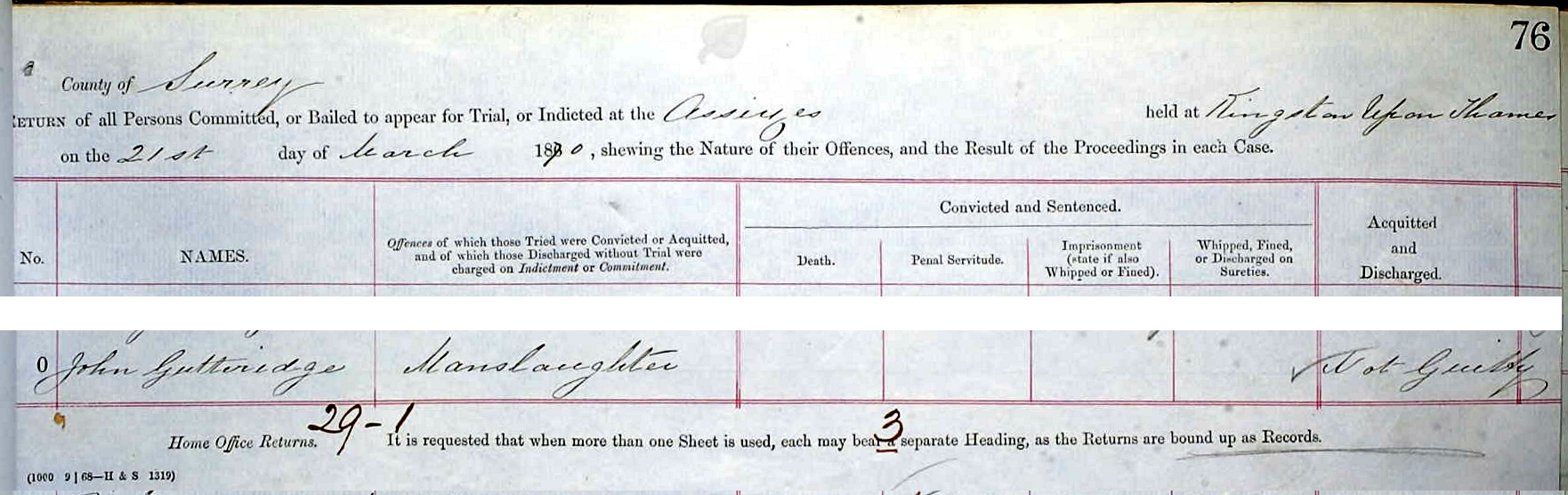 Extract from the records of Kingston Assizes for 21 March 1780
(Click image to enlarge)
Workhouse Records
Samuel Butcher
Admission (Last) 03/11/1868 (368 days)
Death 6 Nov 1869
John Gutteridge
Admission (Last) 27/07/1867 (1484 days)
Census 1871
Death 19 August 1871