
FATAL ARMED ROBBERY
AT EWELL UNIGATE DEPOT
 A Unigate milk float, similar to those which would have operated out of the Ewell depot
Image Source Wikimedia
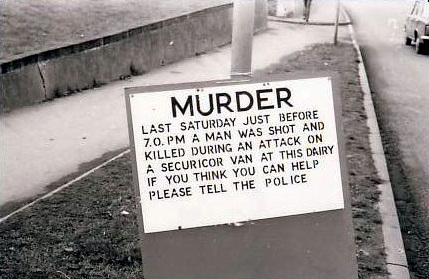 The Police appeal for information
Image Source Epsom & Ewell Local & Family History Centre
The Robbery
Armed robbers are often career criminals who belong to gangs and this was the case when the Unigate dairy depot in Ruxley Lane, Ewell was raided on 17 February 1973 by hooded men, one of them wielding a loaded shotgun. The robbers had been following a Securicor van, which was collecting cash, and the dairy was almost the last stop on its round, so that it had maximum cash on board; they then burst into the office, overpowering the Securicor men, the depot manager and young Frank Kidwell, a milkman who was on duty at the depot that night.
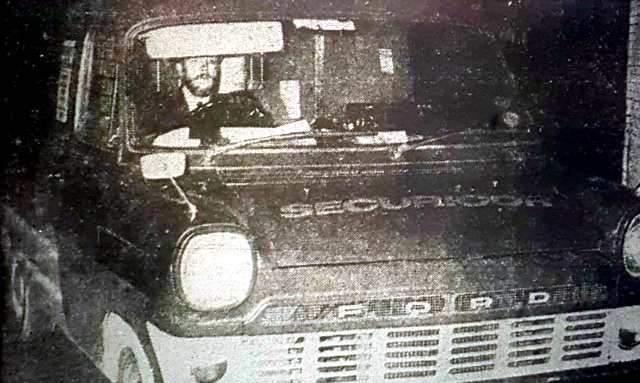 The Securicor van being towed away for examination
Image Source Epsom & Ewell Local & Family History Centre
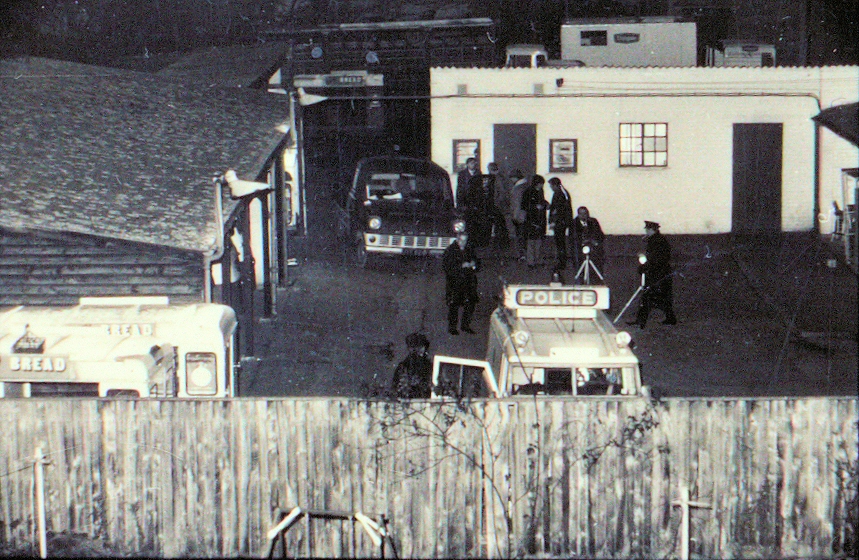 Police begin their examination of the scene
Image Source Epsom & Ewell Local & Family History Centre
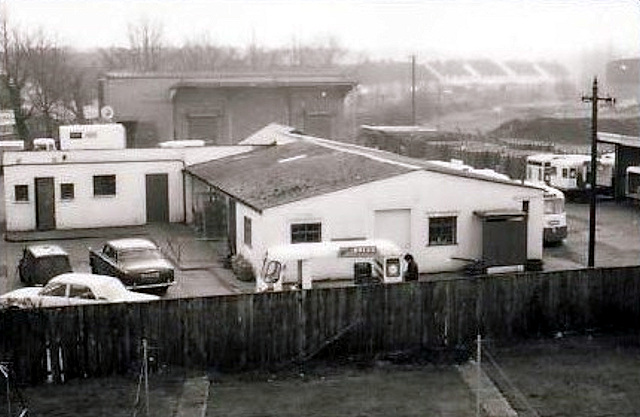 The Depot
Image Source Epsom & Ewell Local & Family History Centre
The victims were ordered to lie face down on the floor while the robbers took the cash (somewhere around £160,000 – about £2m in today’s terms –, although the amount varies in the reports, as do many other details). One of them then fatally shot Frank in the back and the gang escaped into the night.
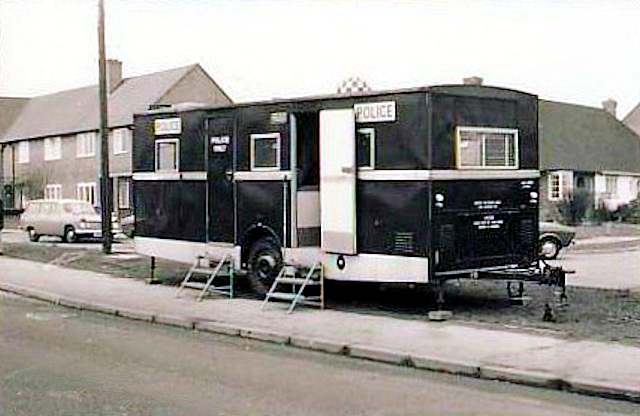 Mobile police incident unit
Image Source Epsom & Ewell Local & Family History Centre
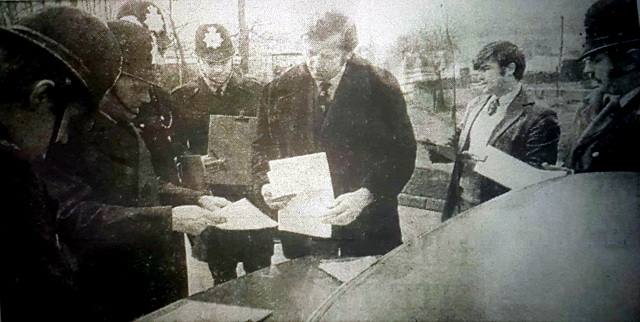 Police officers working on the investigation
Image Source Epsom & Ewell Local & Family History Centre
Francis ‘Frank’ Eric John Kidwell was born on 16 February 1947 and had only just passed his 26th birthday at the time of his death. He was the eldest child of Eric and Rita Kidwell, who were separated, and lived with his mother and six siblings in Fendall Road, West Ewell. (Both Eric and Rita are now deceased.) Frank was planning to get married very soon.
 Frank Kidwell with a friend and her baby
Image Source not Known
It soon emerged that this crime was just one in a multitude of large-scale armed robberies which had gone on for several years, involving up to 30 men in total. On 13 April 1973 Philip Anthony Morris, a farmer from Camborne in Cornwall, was charged with Frank’s murder, but this turned out to be the tip of a large iceberg concerning the so-called ‘supergrass’, Derek Creighton ‘Bertie’ Smalls, and we probably need to deal with him at this point.
Bertie Smalls
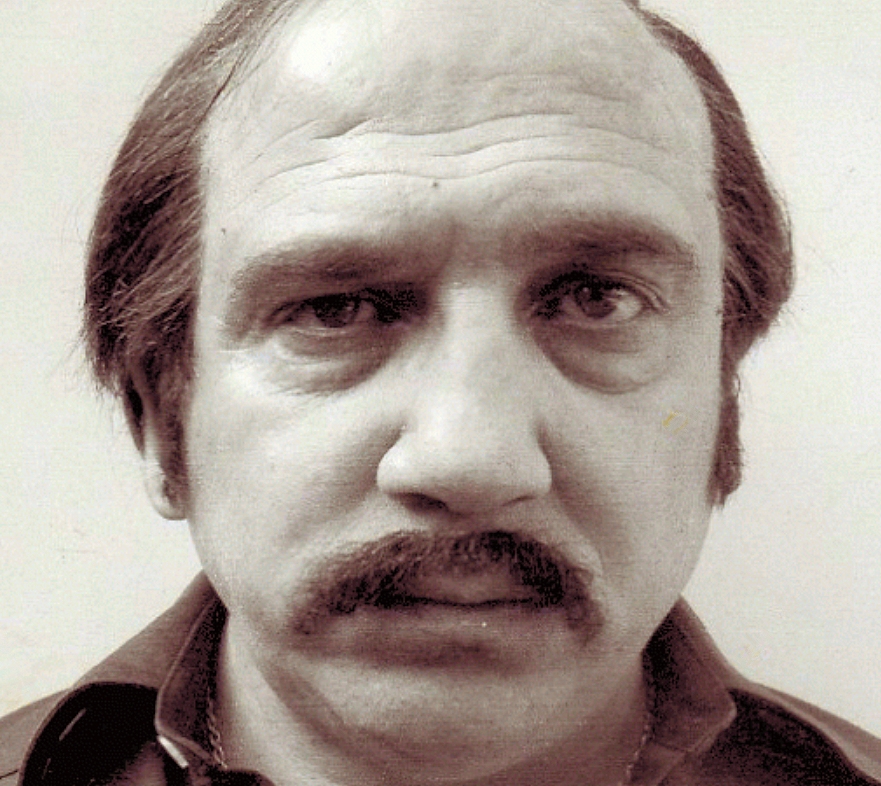 Bertie Smalls
Source Not Known
Smalls was a big-time bank robber, leader of ‘The Wembley Mob’, but his life of crime came to an abrupt halt after he was arrested for his part in the 1972 robbery at the High Street, Wembley branch of Barclays Bank. He then did a deal with the police and Director of Public Prosecutions, whereby he got away with his crimes in return for naming other robbers, many of whom were subsequently convicted. As a result, the amount of bank robbery dropped quite dramatically. Although he did take a new identity and moved to the country, Smalls eventually returned to some of his old haunts and, remarkably, his former associates didn’t take their revenge. Smalls died in 2008 of natural causes.
Philip Morris
One of those ‘fingered’ by Smalls was the aforementioned Philip Anthony Morris, who pleaded not guilty to five robberies, but he admitted his part in the Ewell robbery, claiming that he had killed Frank accidently when the shotgun suddenly fired of its own accord.
In court, Morris told a remarkable story (as per the Daily Mirror of 16 January 1974), saying first of all that, if Frank hadn’t been so brave, he would have escaped without harm. The depot manager had shouted at him to run, but instead he turned back into the office to grapple with the robbers and protect the other victims. Morris said that the guard lying face down next to Frank had kept trying to take a look at him (Morris) and eventually was given a prod with the shotgun, which went off, hitting Frank in the back. Morris claimed that the safety catch was on and he had been holding the gun by the butt, with no finger on the trigger. Perhaps surprisingly, the prosecution accepted his plea of manslaughter and he got 17 years. However, he also received 20 years (to run concurrently) for his part in the Wembley bank robbery, which he eventually admitted; the charges concerning the other four robberies were not proceeded with.
The wider picture
Owing to Smalls’ deal with the authorities and police investigations, a significant number of other people appeared in court along with Morris. It turned out that most of the men on trial were the kind of 1960s/1970s criminal equivalent of the modern ‘gig economy’ – a pool of robbers, getaway drivers etc, who passed each other information on possible heists and assembled teams to carry them out. Having read multiple newspaper reports on some of these criminals, it does appear rather mix and match. For example A, C, F and H might rob bank 1 and then C, H, J and R would do bank 2. Some of the men ostensibly had regular day jobs, such as dealing in used cars and greengrocery, and one was a seemingly respectable property developer: others were officially unemployed or lived under the radar altogether. The Costa del Sol was a popular new home for the more successful criminals.
One of Smalls’ jobs was the National Provincial Bank in Brighton in 1968, although Smalls said he missed the actual robbery because he stopped to pick up his glasses, which had broken, outside the premises. A modern photo of the bank illustrates one of the reasons why such robberies are now fairly rare.
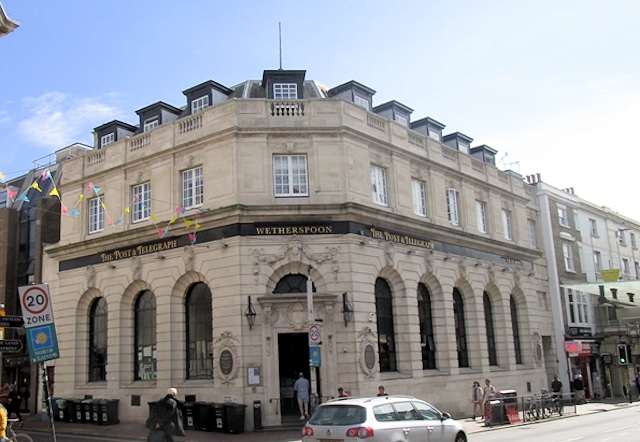 The former National Provincial Bank, North Street, Brighton,
which is now a Wetherspoon’s pub
Image © Linda Jackson 2021
In recent years the closure of physical bank branches has accelerated and modern security, forensic techniques and so on have improved greatly, to the point where major criminals wouldn’t bother with trying to rob a bank in the old-fashioned way – instead they have turned to such activities as drug smuggling/distribution.
The site of the old depot in Ruxley Lane is now part of Epsom & Ewell High School.
Linda Jackson 2021
Addendum
An accidental reader happened on this article via something that triggered a relevant memory from over 50 years ago. The lady concerned was in her very early twenties at the time, living and working in Salcombe, South Devon. Back then, in 1972, Salcombe was still primarily a charming fishing village rather than an enclave of well-heeled Londoners in their second homes.
To set the scene, this lady was working in the local ironmonger’s shop. In her words:
‘It was the most fascinating place with so much to learn; we sold everything from paint to fishing rods, we found lugworms or crayfish in buckets behind the counter, we sold rubber boats, screws, drills, knives and it was never boring. You met so many different kinds of people, from the lifeboatmen who were treated like gods in Salcombe to the French yachtsmen and their families who would come across from France looking terribly smart.’
It’s probably fair to say that most of us have never met a serial big-time criminal – not knowingly anyway – but this lady did, although she wasn’t aware of it at the time. The criminal was Philip Morris, the man who just months later shot and killed young Frank Kidwell in the Unigate robbery.
So, one day in 1972 two men, one older than the other, appeared in the Salcombe ironmonger’s with a long list of items they required, they said, for fitting out a trawler to go to sea. Locating all these items in the shop kept the lady busy for about an hour. She recalls that the older man (who was Morris) looked as if he was straight off the television from a tobacco advertisement, probably Capstan.
‘When it came to paying I had never seen so much cash in my life. I remember saying to my colleague that something’s not quite right about these two, to have so much cash on them, They were very pleasant and polite and over the next couple of weeks they would come back for things they had forgotten. I just had the strangest feeling in my gut that something was not quite right and I was alone in the shop once with the older gentleman and I said to him, “I know you’re not ‘straight’ but people like you here and in Salcombe that means a lot. I don’t think anybody will ever say anything.” He didn’t reply, just smiled at me, and I thought, I think I have my answer.’
The lady remembers that the older man had a certain charisma about him (and please bear in mind here that she had no idea who he really was or what he did for a living). The younger man – to this day we don’t know his identity – was very quiet and didn’t smile much. The men then went away for two or three months but they did return to Salcombe and would pass the time of day. Morris even took the lady and her colleague from the ironmonger’s to see round his trawler, which she now surmises was the ultimate in ‘getaway vehicles’.
Imagine her shock then when, a few months later, having left Salcombe and moved to Bristol, she saw a photo of Morris on the cover of the Daily Mail with the story of the Unigate robbery. Apparently, Morris couldn’t live with the guilt of what he had done and gave himself up to the police.
If anyone out there knows anything further about Philip Morris and, in particular, what happened to him after he left prison, please contact the webmaster. There would be no comeback whatsoever on this and any information would not necessarily be published, but the lady would really like to know. As would the author of this article, having read about the brief encounters in Salcombe all those years ago.
Linda Jackson 2025