
CHILD’S PLAY – PART 1
Games, toys, puzzles and pastimes from the past
 Inside the ticketed area of Brighton Toy and Model Museum
Photo by Eric Baird via Wikimedia Commons
The photo above encompasses many of the toys and models we may remember from childhood (or even adulthood!), some of which will be mentioned in this article.
Bourne Hall Museum has a collection of old games, toys and puzzles, not necessarily with a direct local connection, but often donated by local people. Inspired by these items, here is a selection of things that occupied/amused children in years gone by. There is no high-tech, so fans of Xbox, PlayStation and suchlike should look away now. Most of what follows didn’t even need old-fashioned batteries, let alone electronics/electricity.
All images that follow are courtesy of Bourne Hall Museum, unless otherwise attributed.
Construction
Here is a basic set of blocks for the younger builder.
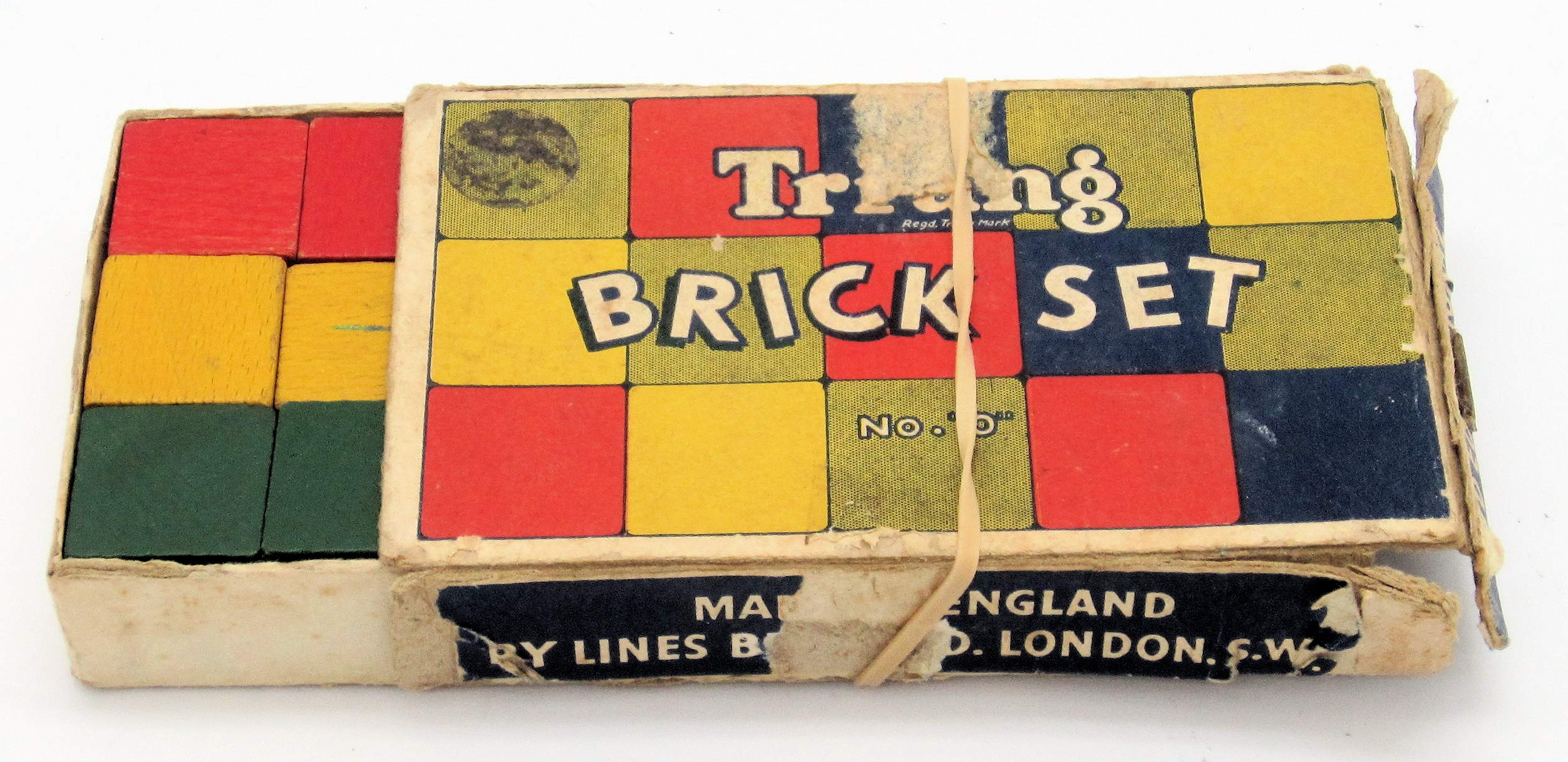 Tri-ang brick set
Tri-ang was a brand name of Lines Bros Ltd. Although the brand was originally known for model railways, the company diversified into other toys. The idea was to mass-produce and keep the prices down. I had a Tri-ang scooter once – probably the bottom of the range model (i.e. solid wheels and no white tyres) – and it was a sturdy, well-made little ‘vehicle’.
Did you have a set of building bricks or blocks when you were a child? I vaguely remember some very large, square ones with pictures and letters on each side, but I think they were to teach me the alphabet and to recognise animals, or something like that (well, it was a very long time ago!).
 A box of Lott’s bricks
Lott’s bricks resembled blocks of stone but were actually resin-bonded powdered stone, pioneered by Friedrich Richter in Germany: he didn’t invent them, but spotted their commercial potential and purchased the rights. Richter’s products were called Anchor Stone Building Sets and they were pretty amazing. You can still get them today and they are much admired by enthusiasts.
 Anchor stone block set No. 10A
Photo by Richard Marsak via Wikimedia Commons
Richter died in 1910 and his sons squandered their inheritance. Then came WW1 and, in 1918, Ernest Lott launched his bricks. The sets were not as grand as the Anchor Stone products, but they sold well.
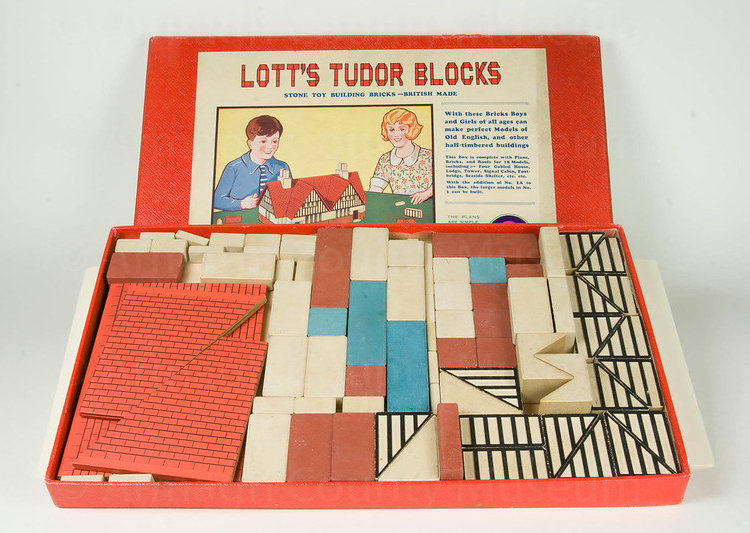 Lott’s Tudor Blocks
Armagh County Museum via flickr
Whilst on the subject of Lott’s items, they also made chemistry and electrical sets, which could have come in useful for destruction if your construction project hadn’t gone to plan. The contents of these sets were pretty dangerous and horrifying for children to handle, as this next photo demonstrates.
 Lott’s Chemistry Set
Photo by Dave Patten via flickr
This next item is not precisely building blocks and bricks, but it is highly educational and was designed to engage kids with the basics of mathematics in an entertaining way.
 A Cuisenaire set with Workbook c.1969
Georges Cuisenaire was a Belgian violin player who taught music and arithmetic in a primary school. He observed that young children found it quite easy to pick up a tune and that they enjoyed music, whereas they didn’t like arithmetic and found it difficult. Once the colourful Cuisenaire rods were in existence (from the 1950s), kids started exploring arithmetical concepts with them. I don’t understand how it all works, as my primary school didn’t have such things, but coloured rods would have made ‘sums’ more palatable.
What a fine mess you could get into with plastic construction kits – polystyrene cement all over the place, anywhere but where it was supposed to be. The Airfix brand dates from 1939, but the company didn’t begin to make models/ kits until the late-1940s, when it was commissioned to produce a promotional Ferguson tractor.
 Airfix kit for Evening Star locomotive 1960s/70s
It does seem, though, that many people were and are able to assemble Airfix kits properly and then paint them, add the decals and display them nicely.
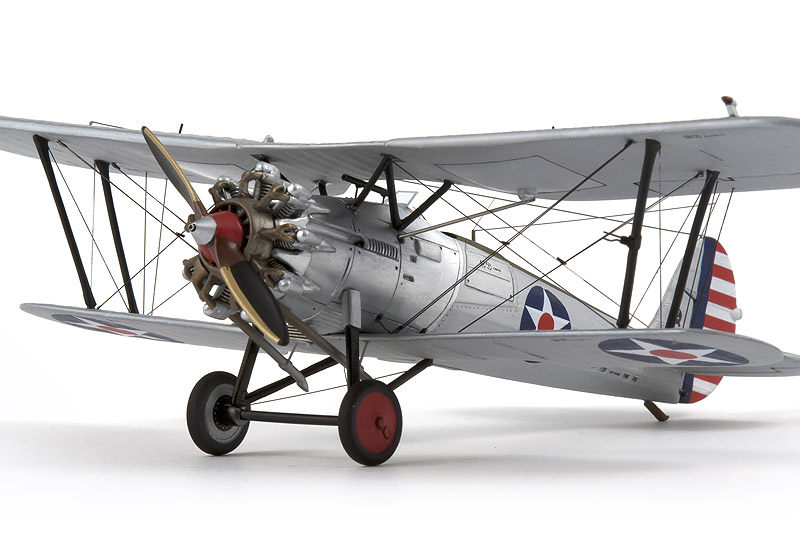 Airfix 1/72 Bristol Bulldog
Photo by Mike G via flickr
We are on less sticky territory with Meccano.
 1920 advert for Meccano
Photo by Alfie-C via wikipedia
 Assorted Meccano parts
 Meccano generator van
Photo by Les Chatfield via flickr
The beauty of Meccano was that you could build practically anything you liked if you had the right bits and, if you didn’t, you could invent something weird instead. Meccano was the creation of Frank Hornby, who was responsible not only for Hornby Model Railways but also Dinky toys.
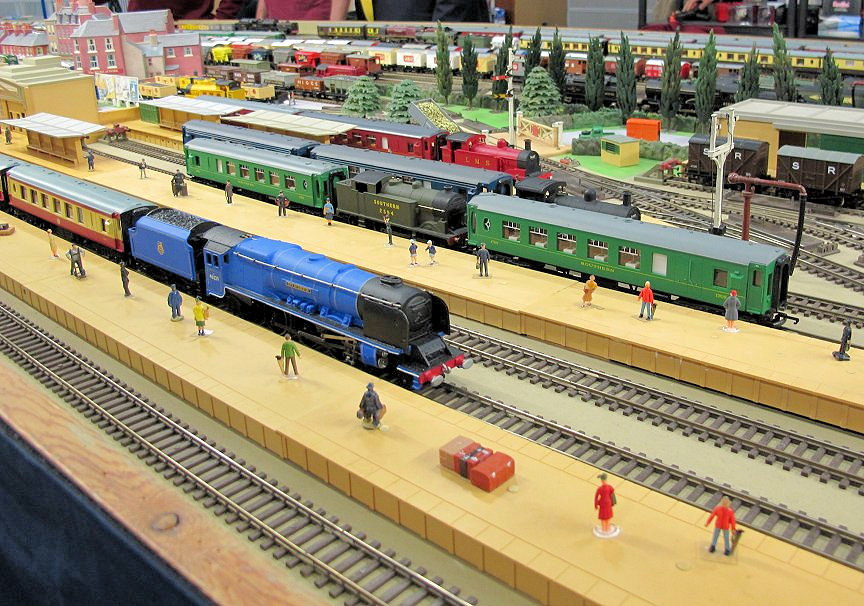 Hornby Dublo layout
Photo by Phil Parker via flickr
 Vintage open-top bus by Dinky
Photo by Bruno Preschesmisky via flickr
 Meccano toys leaflet from Jas Seymour & Co, Epsom
Dolls and associated equipment
I tend to find very old dolls rather sinister-looking in the sense that their faces are often not appealing – it’s often something off-putting about the eyes. This next example is a Parsons Jackson Biskoline doll: Parsons Jackson was an American company, based in Cleveland, Ohio, and Biskoline was a type of celluloid.
 Parsons Jackson Biskoline doll c.1911-13
By contrast, the Rosebud dolls, produced by British firm Nene Plastics from about 1947, were more attractive: the toy giant, Mattel, bought out Nene Plastics 20 years later.
 Rosebud doll and clothes from the 1950s
Incidentally, in 1959 the Rosebud brand introduced Kitmaster (yes, I’m afraid we’re back to polystyrene cement), which mainly comprised plastic kits for model railways. The enterprise went bust three or four years later and was taken on by Airfix.
 Every Kitmaster kit ever produced
Photo by kitmasterbloke via flickr
Sorry for the digression into kits, but, as I have discovered in researching this article, it is a feature, of older toy companies especially, that there were several product lines under different brand names. In some cases the whole company was bought out: in other instances, product lines were sold off separately and, if the brands survived long-term, they likely ended up in the portfolio of one of the titans, such as Mattel or Hasbro. Back to dolls!
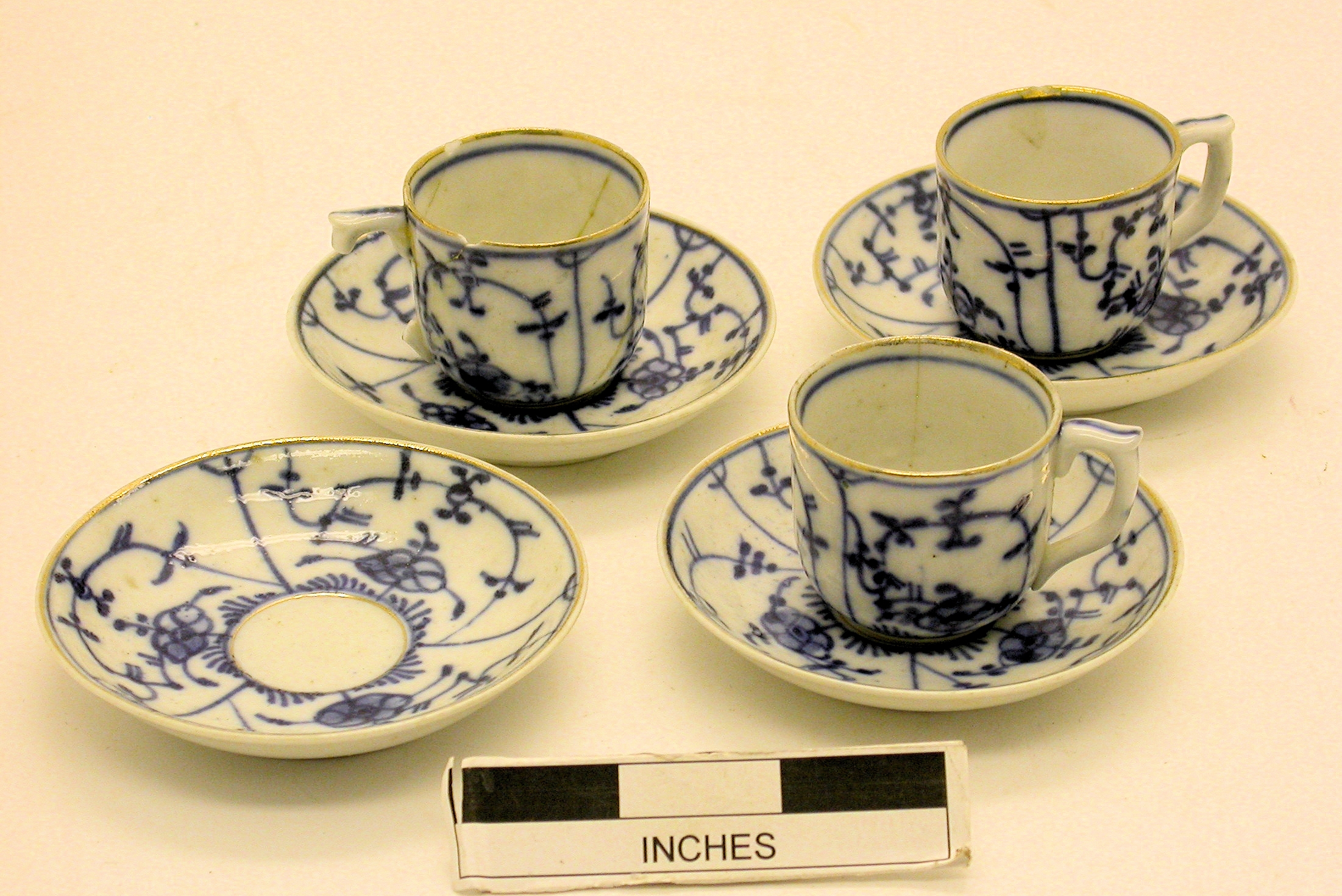 Doll’s tea set, c.1880
I always wanted something like that, but only ever had one in blue plastic (just as well, or I would surely have broken a porcelain set). I did have some doll’s furniture (plastic again), but no doll’s house to put it in. Some people evidently had very spacious doll’s houses, since they could accommodate a full bathroom.
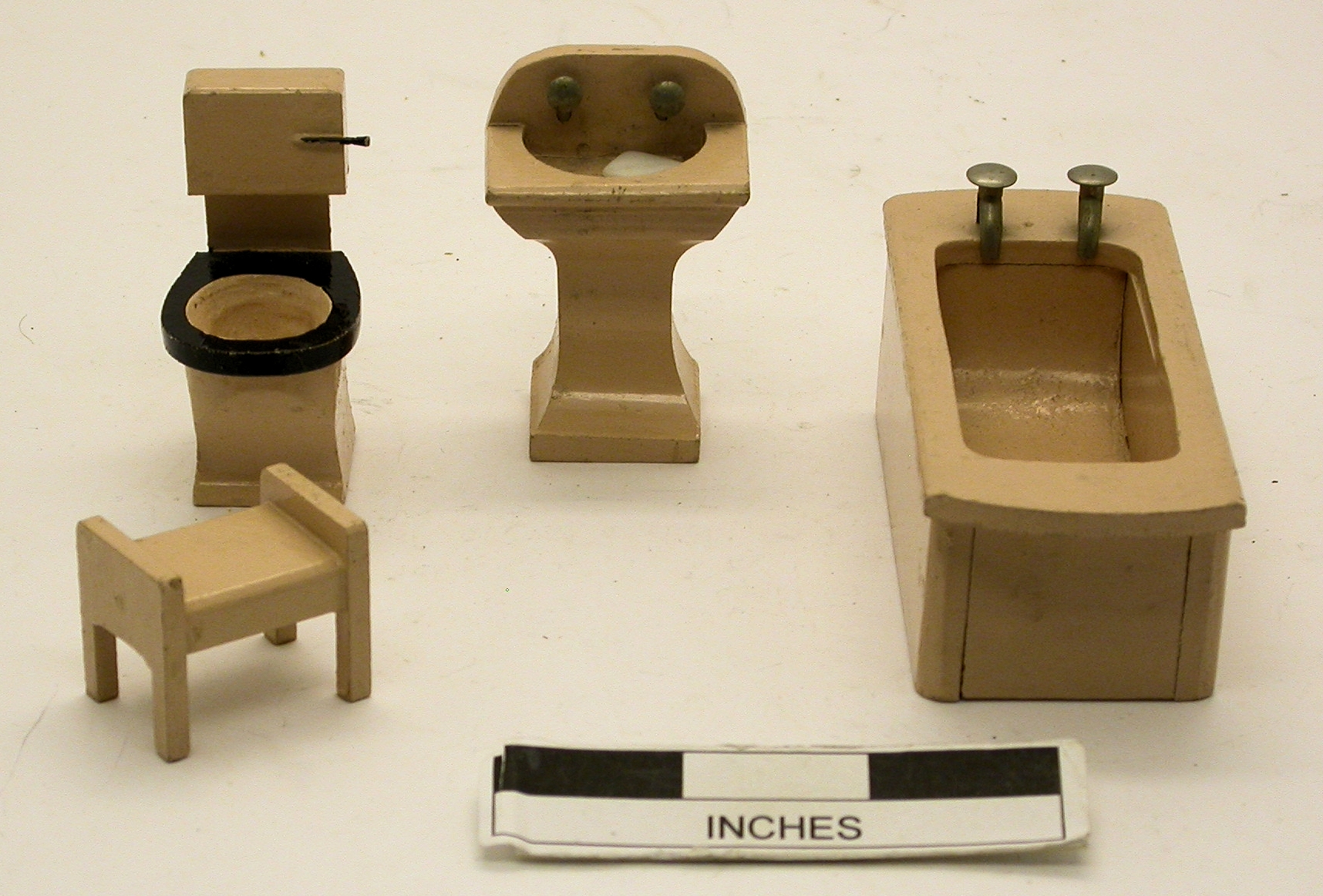 Doll’s bathroom furniture, 1960s
… and a fancy wooden set of bedroom furniture.
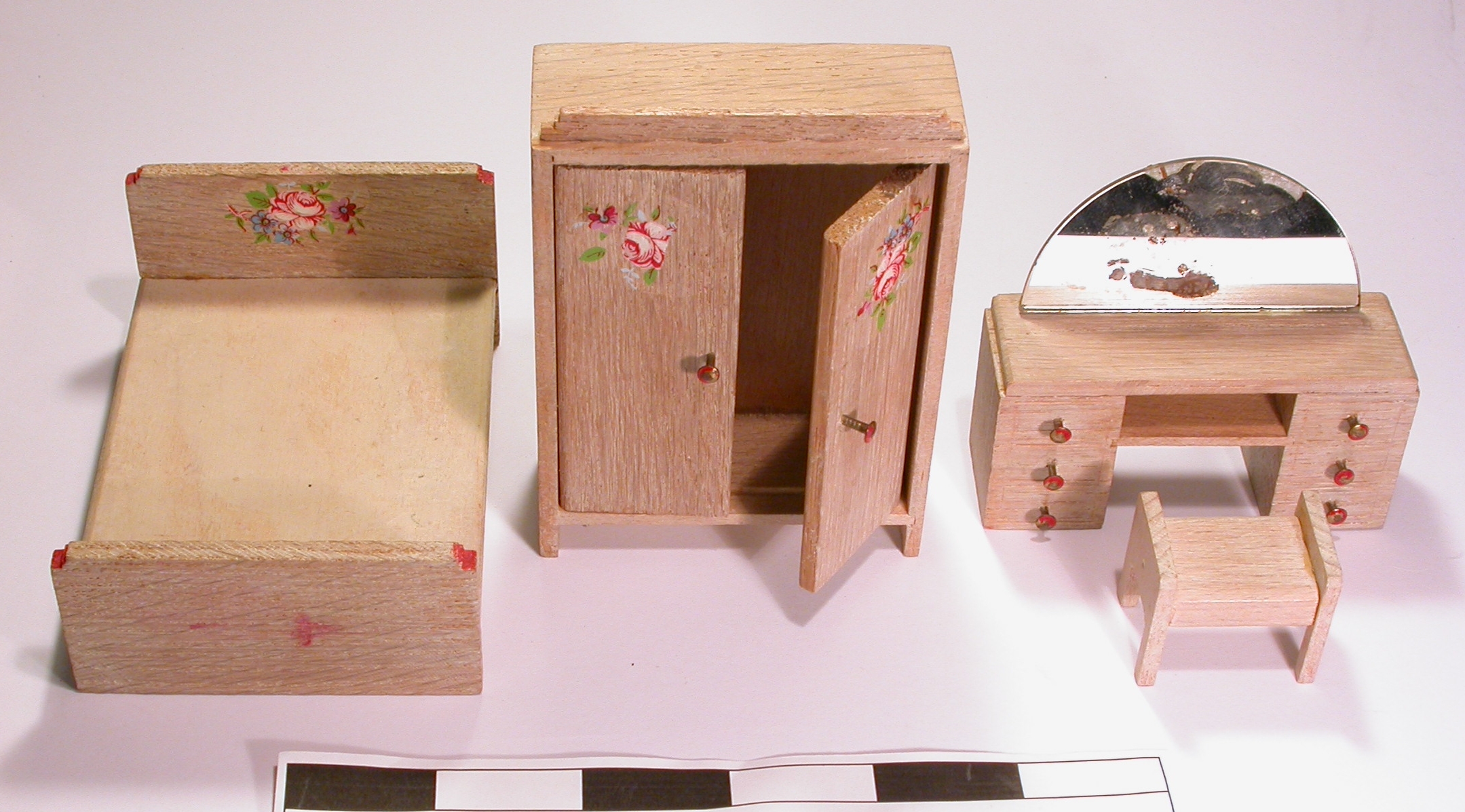 Doll’s bedroom furniture, 1960s
I did have some of these next items, or similar. I recall a pink cake, a Vienna loaf and an Edam cheese with a portion cut out.
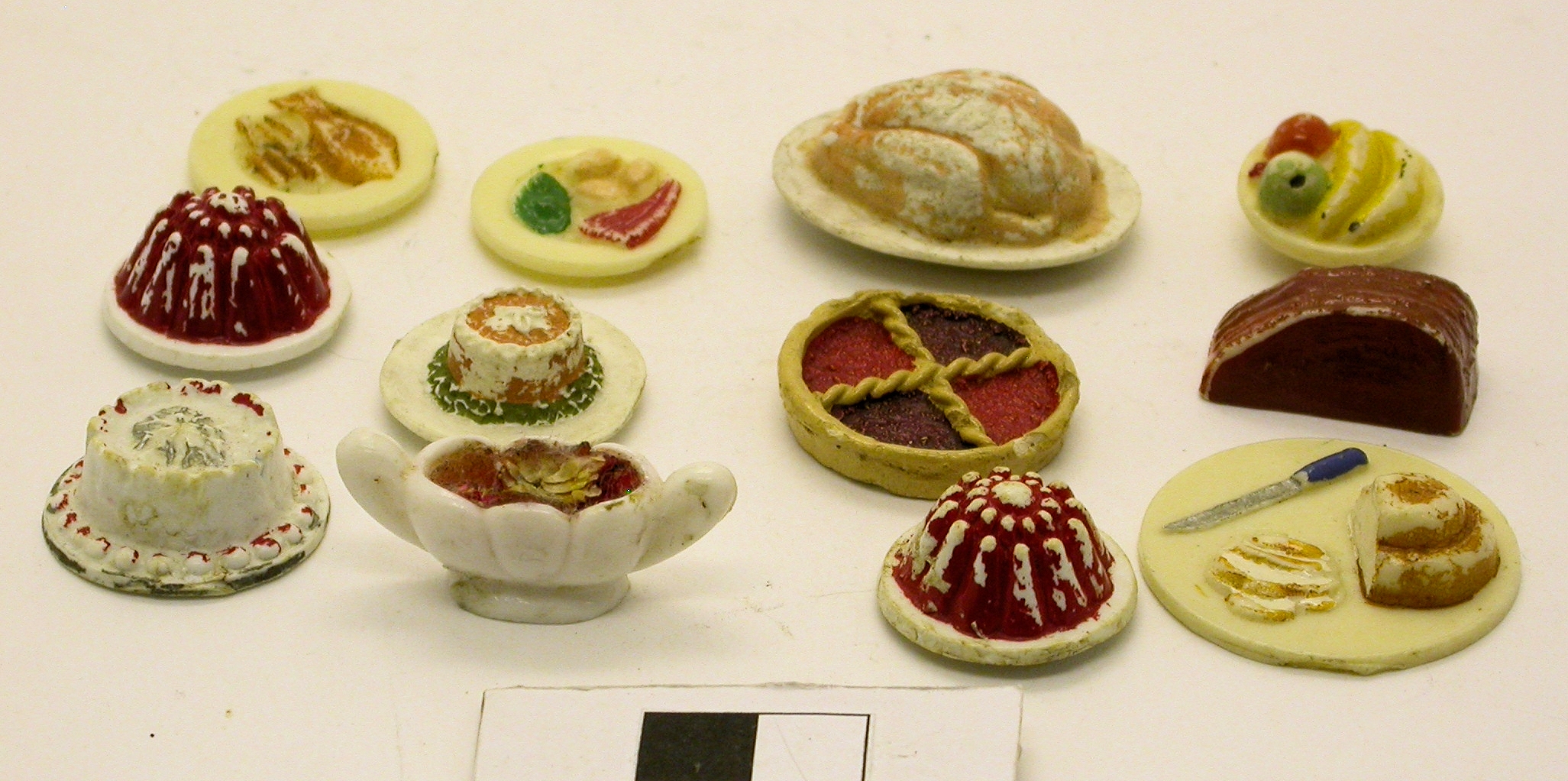 Doll’s kitchen food plates 1960s
On this general tack, a couple of friends recalled toy grocery stores. I never had one, but we saved packets and tubs (such as Bird’s Custard Powder) and I played shops with those, assisted by a toy till. Nevertheless, miniature groceries did exist.
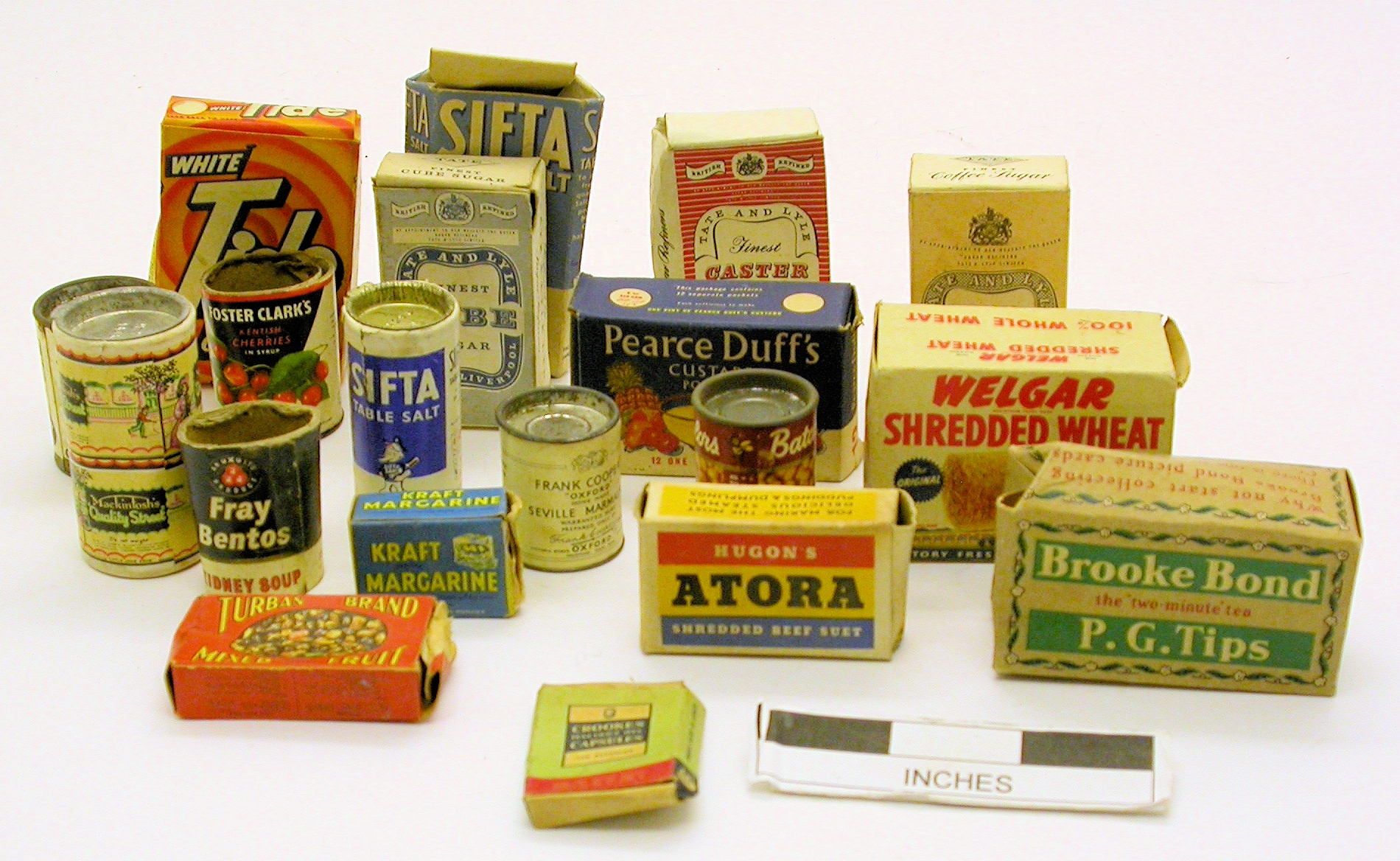 Miniature kitchen packets collection
 Toy cash register by Marks & Spencer, 1960s
Indoor puzzles
Bourne Hall Museum has quite a few jigsaw puzzles, varying in age. Some are complete and others have pieces missing, but they cover a wide range of eras and subject-matter.
 A Leigham jigsaw puzzle
The above plywood puzzle (approximately 224 pieces) dates from around the 1930s and apparently, when assembled, depicts the Mouth of the River Yar at Yarmouth. As there’s no picture on the lid we’ll take the manufacturer’s word for it. The Leigham Puzzle Club was run by Frederick Alfred Hedger (known on his jigsaw boxes as Fred A. Hedger of 268 Knight’s Hill, West Norwood), but his day job was as a newsagent, stationer and sub-postmaster at that address. The Norwood Review No. 220 for spring 2018 has an interesting article on local post offices and makes specific mention of Fred, who started out as a book publisher but then became a stationer and sub-postmaster (Number 268 Knight’s Hill was then 194). There is mention of the puzzles in the article, when someone says, ‘He was, I should imagine, the first person to make a jigsaw puzzle, cut on a fretwork machine, and sold in Linden Toys for about 2 shillings each’. The reason I mention Fred Hedger in particular is that he subsequently became a resident of West Ewell (24 Park Avenue). One of Fred’s sons, Cyril, also became a newsagent and sub-postmaster, as this extract from our articles on Local Postal History – Part 4, Buildings tells us.
‘Ruxley Corner: The first sub-post office was set up here in about 1933, at 10 Ruxley Parade, Kingston Road, with Cyril D. Hedger, a newsagent, as the sub-postmaster; he remained in office at least until 1940. Later the shop was numbered 421 Kingston Road, and the post office remained at these premises until about 1968. ‘
Many of you will remember this 1980s craze and you may well have owned one of these.
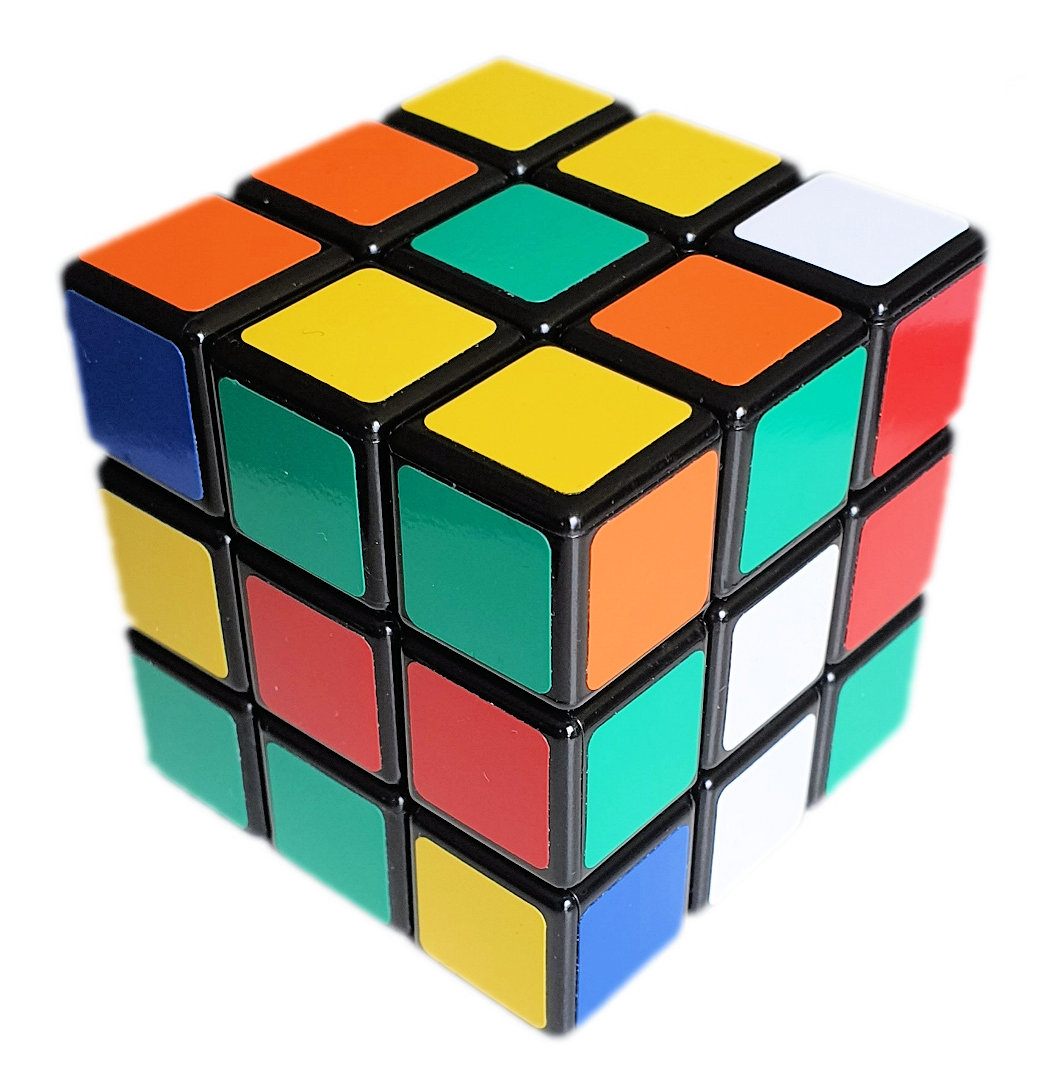 Rubik’s cube (scrambled)
Photo by Imk3nnyma via wikipedia
However, there were earlier cube puzzles, such as this one.
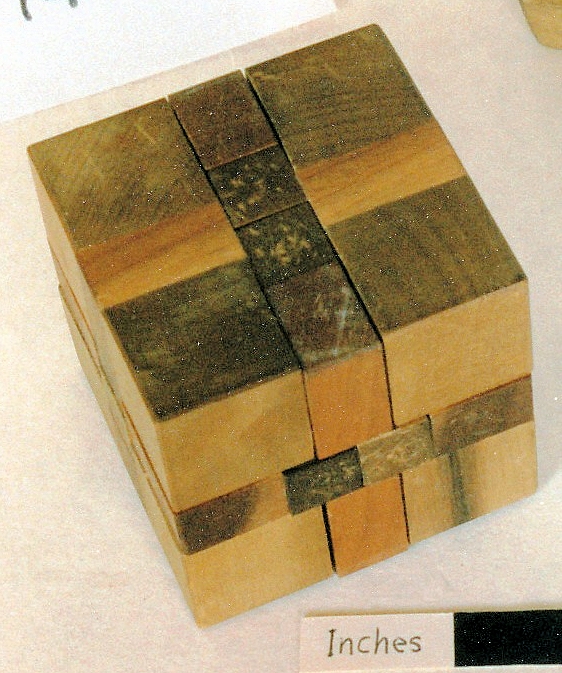 A wooden cube puzzle, c.1920-30
And then we have this.
 Coloured balls puzzle, a variation on Rubik’s cube
 Wooden pistol puzzle
The pistol was another wooden puzzle from the 1920-30 era, donated by Mr Geoffrey Johnson, as was the wooden cube shown earlier.
Does anyone remember metal puzzles? I had such trouble doing them that I ‘accidentally’ lost them, only to be given a replacement set the following year. Mine weren’t as elaborate as this next collection, but I daresay the principles were the same.
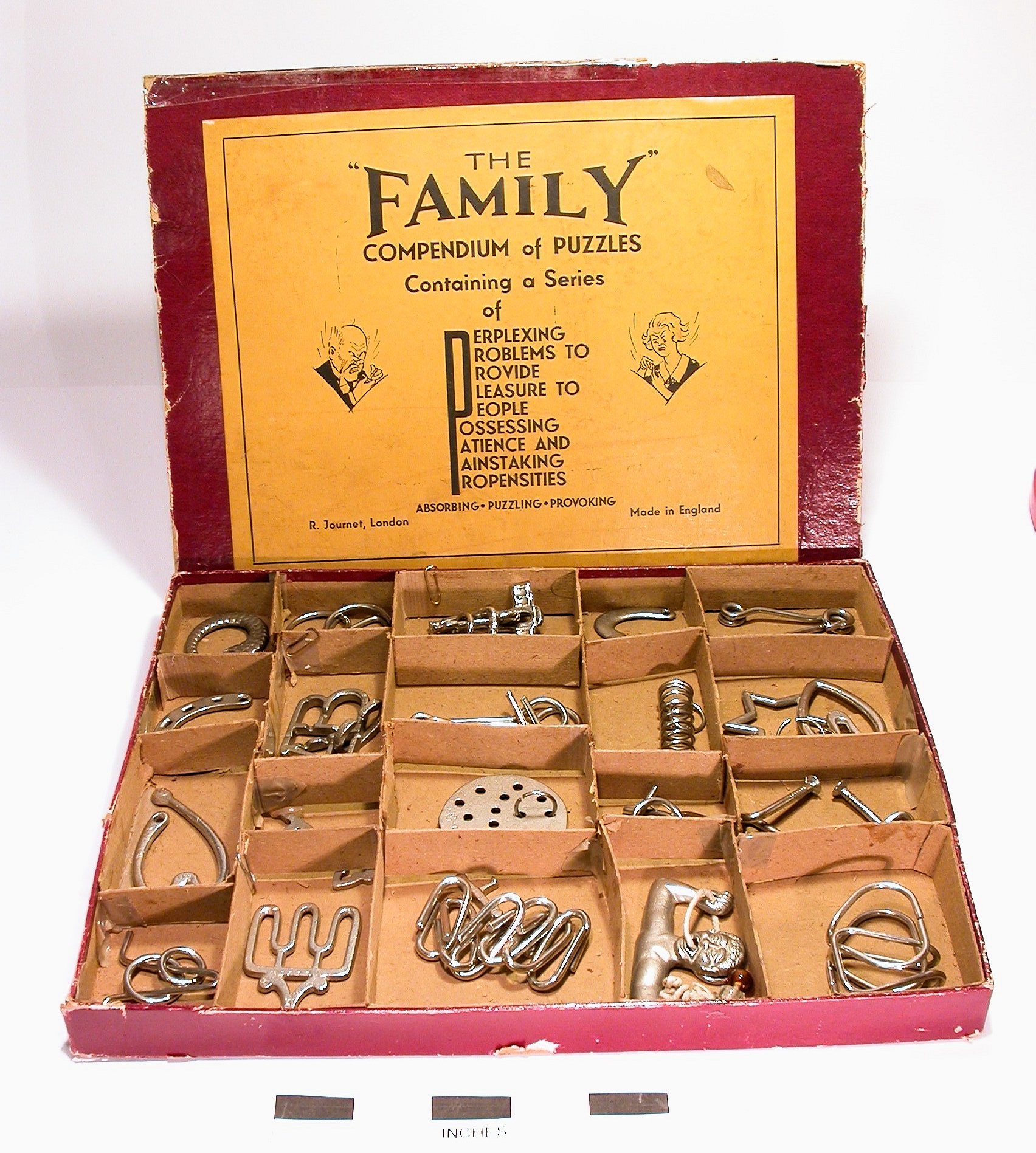 Compendium of metal puzzles, 1920s
I was always being given card and board games of various sorts, especially for Christmas, but most of them didn’t catch on. I suppose that the enduring ones were the Happy Families card game, which had variants, Snakes and Ladders, Ludo, Monopoly (but it took a long time), Lotto/Housey Housey and Scrabble – a lot of the rest were nine-day wonders. Here’s a selection from the Bourne Hall vaults.
 A vintage version of Lotto entitled ‘Housey-House’
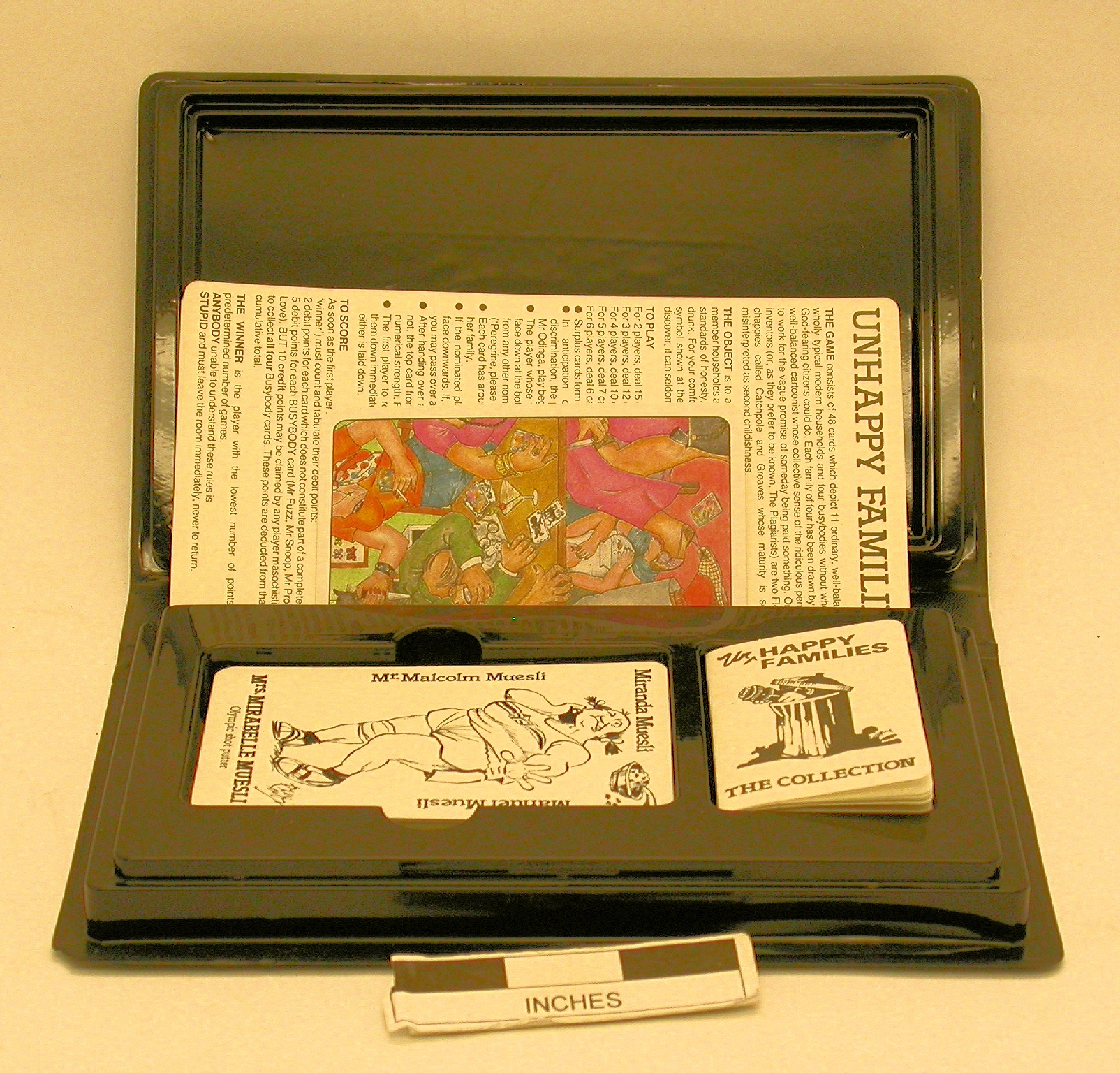 Unhappy Families card game
The above variant of Happy Families was described as ‘a game of cards, cranks and misfits to make a rainy day even rainier’ and featured 11 normal families plus four busybodies who were causing major havoc. This was obviously a bit more advanced than the basic version of the game, such as this one.
 Standard Happy Families card game, 1920s
Sundries
It’s not much use having some types of toy if you don’t have the outfit to go with it.
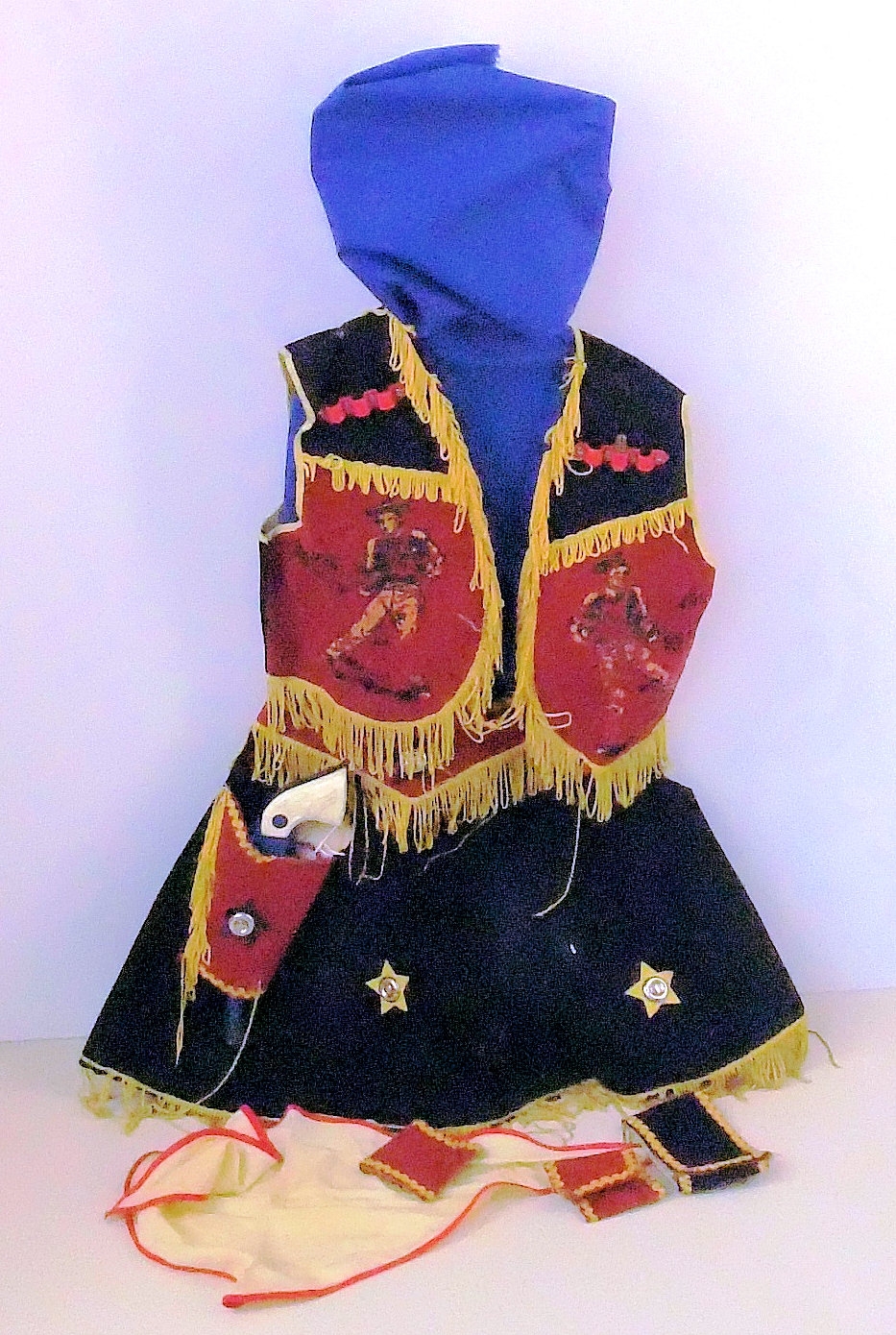 Toy gun and Cowgirl outfit
Over the years Bourne Hall has mounted many exhibitions on all kinds of topics, and one of them featured Dan Dare, hero of the strips in Eagle comic. See our article on Frank Hampson for more information on the comic. However, Dan wasn’t just a character on paper, but a whole line of merchandise.
 Dan Dare jigsaw puzzle in box
 A completed Dan Dare jigsaw puzzle
 Dan Dare Spaceship Builder
Nearly all of us must have had a teddy bear. They’re not as old as we might think and date from the early 20th century. The American version was named after the US President, Theodore (‘Teddy’) Roosevelt, and was first produced by Morris Michtom and his wife. They were an immediate success. Meanwhile, in Germany, Richard Steiff was developing his own toy bear and, as his aunt had a toy company, it didn’t take long to go into production. Steiff bears are famous and are still being manufactured today, along with all sorts of other cuddly toys, such as Little Floppies (filled with beans) and Farm Animals. My teddy was made by Chad Valley and survived for nearly 50 years, until he was so threadbare and decrepit that he had to be inhumanely disposed of. Chad Valley made many types of toy and the brand still exists (sort-of), but has been through many hands since its foundation in the early 19th century.
You don’t have to dress up a teddy, of course, and mine was usually naked, but Bourne Hall has wittily made use of them in past exhibitions.
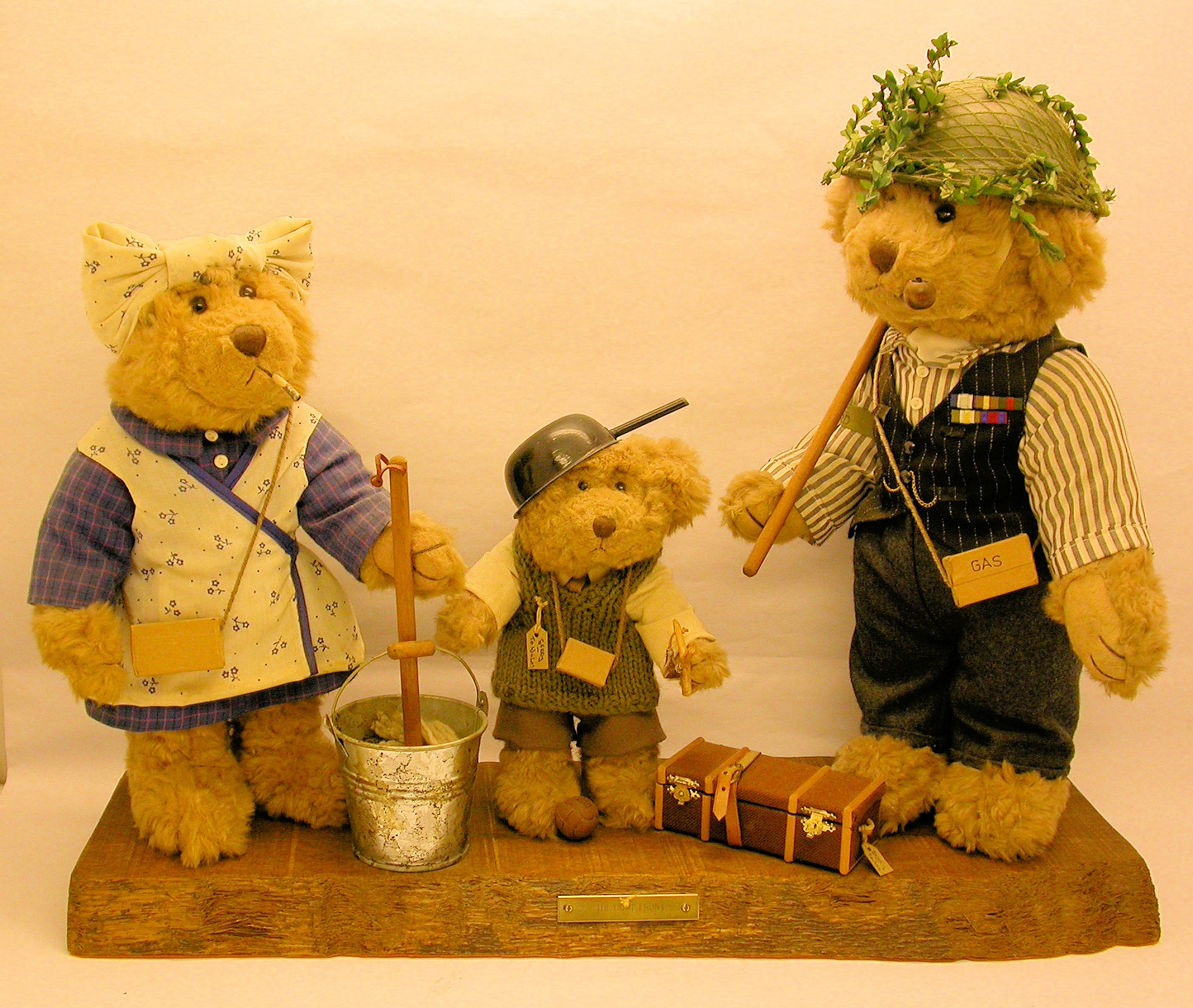 Three teddies going about their work
Linda Jackson 2021
In Part 2 we shall look at some more games, pastimes, and crafts.