
FRANK HAMPSON (1918-85)
creator of DAN DARE
 Left: Frank at work in his studio in Bayford Lodge, Epsom.
Screenshot from the 1956 British Pathé newsreel item – of which more below.
Right: His famous creation, against a collage of images from The Eagle.
Image with thanks to Rossall School, Fleetwood, of which Dan Dare was to have been an old boy.
Frank Hampson was born on 21 December 1918 at 488 Audenshaw Road, Audenshaw, Manchester, which now bears a blue plaque, the second son of Robert Mason Hampson and his wife Elsie Annie (nee Light). The elder boy, Eric, an assistant steward in the Merchant Navy, was killed on 2 April 1943 when his vessel, the MV Melbourne Star, was torpedoed and sunk by submarine U-129 in the Atlantic. The family moved to Southport shortly after Frank’s birth and a third child, Margaret, was born there in 1927. After a stint working for the Post Office and commencement of a design course Frank saw war service in the RASC (starting out as a Private and rising to Lieutenant); once demobbed he studied art at the Southport School of Arts and Crafts. In 1944 he had married Dorothy Mabel Jackson (born 5 February 1918) and a son, Peter, was born in 1947.
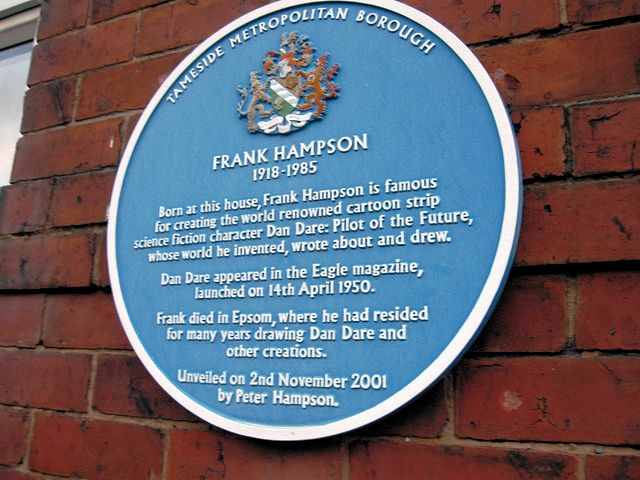 Blue plaque on 488 Audenshaw Road.
Photo © Alex McGregor and licensed for reuse under this Creative Commons Licence.
From 1954 the family lived over Frank’s studio at Bayford Lodge, 1 College Avenue, Epsom – on the front porch of which is one of the Borough’s memorial plaques.
 Memorial plaque at Bayford Lodge, College Avenue, Epsom.
Photographs by Roger Morgan © 2023
No matter how talented one might be, it was and is difficult to make a decent living from art. While still at college, Frank set up a partnership with fellow student Harold Alfred Johns (1918-80) and Harold was to feature prominently in the Dan Dare enterprise, which grew from the Reverend Marcus Morris (John Marcus Harston Morris, 1915-89) and his parish magazine.
Marcus was unusual for a clergyman: he was married to an actress, but apparently had affairs with other women, and was very keen on publishing. In 1945 he became vicar of St James’s Church, Birkdale and decided to liven up the parish magazine, which was called The Anvil, with good writing and material suitable for children; Frank received 3s.6d (17.5p) for each cover he did. (Another illustration legend involved with The Anvil was Norman Thelwell, who is best remembered for creating the characters of Penelope and her pony, Kipper.) The problem was that Marcus bore the costs of production and couldn’t afford it; he eventually employed Frank full-time, which depleted his meagre resources even further. All of this led to a commercial venture – Frank’s creation of Dan Dare in 1949 and the two men’s joint creation of the The Eagle Comic in 1950. We shall return to Marcus later, as he also lived in Epsom for a time.
British comics were not particularly exciting in that era, but they were wholesome: we had, for example, the Dandy and Beano, Hotspur and Rover and they mostly featured kids doing what kids did – getting into scrapes, playing football and having adventures. The American comics that made their way into Britain were substantially trashy horror and this was what inspired Marcus, in association with other clergymen (particularly the Reverend Chad Varah, founder of the Samaritans, who wrote the entries for both Marcus and Frank in the Oxford Dictionary of National Biography, as well as scripts for Marcus’s publications), to get into the comics business: the idea was to produce something wholesome but colourful and exciting.
 An example of an American horror comic, 1947.
“Eerie Comics No 1 Avon” by unknown.
Image source: Wikimedia Commons.
My particular favourites were Beano, Dandy and Radio Fun – and, from 1958, Bunty – but not Eagle, as it was firmly aimed at boys (although I did see it now and then, along with Swift and Robin, two more of Marcus Morris’s publications). The Eagle was very different from the other British comics of the time: not only was it in full colour and printed on nice glossy paper (hence the steep cover price of threepence [1.5p], which was 50% more than Beano and Dandy) but it featured grown-ups doing things that kids could not do – such as joining the Foreign Legion, sailing the oceans, travelling in space and big game hunting. There were also Captain Pugwash and PC 49. Hulton Press took it up and the first issue carried ‘Dan Dare, Pilot of the Future’ on the front page: it was an enormous success and the print run of 900,000 sold out.
 Bust of Dan Dare, present whereabouts unknown,
latterly in Southport Botanic Gardens Museum.
(See the end of this article for the replica now in Bourne Hall Museum.)
Photo © Peter Hodge and licensed for reuse under this Creative Commons Licence.
Frank and his collaborators continued the Dan Dare strips for the Eagle, initially in a Southport studio (a dilapidated corrugated iron building at The Old Bakery in Botanic Road, Churchtown, where there is another plaque), but in 1950 operations were moved to Epsom – initially in accommodation provided by Marcus Morris but, from 1954 in the studio at Frank’s home in Bayford Lodge
In 1956, British Pathé made the following short (83 second) newsreel item – from which the screen shot of Frank at the head of this article is taken.
British Pathé 1956 newsreel item showing Frank and others at work in his Epsom Studio.
Video via YouTube
The first two people seen in the video are Frank and his father, Robert (in army uniform, ready to model as the Space Fleet Controller). Some of Frank’s team members were Harold Johns, Eric Eden (1924-83), Joan Porter and Don Harley – who trained at Epsom College of Art and eventually became the illustrator for Dan Dare. In the video it is Don painting the mask and placing it on the head of Frank’s son, Peter; Eric is in the red space suit; and the lady is Joan. Frank would first make a quick pencil outline sketch of each frame of the week’s story. For group scenes, the team (in appropriate costumes) would pose for a photograph from which Frank would then draw the final frame. For just one figure, he would normally draw direct from life.
I should also mention Dr James Hemming, who promoted the comic to teachers and acted as a consultant in the early days; I saw him at a few school functions, as he was married to the Deputy Head. Had I known then of his involvement with Eagle I might well have been star-struck.
 Some mid-1956 Eagle comics with the usual front page Dan Dare story – for these, drawn by Frank in Bayford Lodge, Epsom.
Image via eBay (click to enlarge).
In 1959 Hulton Press was sold to Odhams Press and subsequently became part of IPC. Ultimately Frank and his publishers fell out and he officially left the comic in 1962. Another artist, Frank Bellamy, (who later drew the Garth strip for the Daily Mirror – anyone remember that?), took over the illustrations for Dan Dare: he was an excellent illustrator but he had been given a brief to modernise the character and Dan didn’t look quite the same any more. The last work Frank Hampson did for the Eagle was a biblical strip called ‘Road of Courage’, the story of Jesus. After that he illustrated some Ladybird children’s books (see the Bear Alley Blogspot for the front covers – you may still have one of these tucked away in your attic somewhere), but contracted cancer in 1970, for which he endured a very long course of treatment. Subsequently he took an Open University degree and worked as a technician in the graphics department at the North East Surrey College of Technology (NESCOT) in Ewell.
 Ewell County Technical College Jan 1971
Image By LR James and held in the Epsom and Ewell Local & Family History Centre
Frank never got rich from Dan Dare: he was employed by the publishers, who owned the rights in his work for The Eagle and licensed his images to producers of merchandise for a 5% cut of the profits.
The Eagle declined during the 1960s and in 1969 it ceased to exist as a stand-alone comic, being merged with Lion, which was apparently the favourite comic of Prince Charles when he was a lad. There was a revival from 1982, featuring the great-great grandson of the original Dan Dare 200 years later, drawn by a different artist. Although it continued until 1994, the new Eagle, then owned by Robert Maxwell, never recaptured the popularity of its predecessor: this would have been impossible, since the secret of the old Eagle’s success was that it was a ground-breaking original. And, sadly, the heyday of those traditional British comics has been over for a long time.
Frank died in Epsom Cottage Hospital from the effects of a stroke on 8 July 1985; Dorothy died in 1998. Frank did not receive many official plaudits during his lifetime (most notable is a 1975 Prestigio Maestro award at an international convention in Lucca, Italy). However, his contribution has not been forgotten and in 2008 the Science Museum made Dan the pivotal point of an exhibition entitled ‘Dan Dare and the Birth of Hi-Tech Britain‘, which won an award as London Visitor Attraction of the Year.
Marcus Morris (1915-89)
We have already seen how Marcus went from energising his parish magazine to starting up The Eagle, Robin (1953-69, merged into Playhour) and Swift (1954-61, merged into Eagle); there was also Girl (a female version of Eagle), which lasted from 1951 to 1964. He moved to Epsom before Frank and initially gave the artist studio space in his own home. Subsequently he lived in London.
 Marcus Morris & Frank Hampson outside Bayford Lodge, Epsom in 1958.
(The houses in the background are 57 and 59 College Road.)
Frank is smoking his pipe as did, on occasion, the inset Dan Dare. (As noted above, Frank was the usual life model for Dan Dare.)
Images from Dan Gorton’s blog “Future Perfect: Dan Dare, Pilot of the Future“, copyright acknowledged.
Marcus edited Housewife magazine from 1954-59: this was a monthly glossy, published by Hultons, in which the ladies were nice-looking with stunning white teeth, fresh perms and wearing their best frocks – the husbands and kids looked pretty good too. When Odhams took over he left to become editorial director of the National Magazine Company (Nat Mags), but he still wrote for Eagle. Later he became managing director and editor-in-chief of Nat Mags and launched the British edition of Cosmopolitan, which was something really different back in the 1960s, when the staple magazines for ladies were Woman and Woman’s Own. My mother continued with those but I used to read Cosmo.
Marcus retired from publishing as Deputy Chairman of Nat Mags in 1984. Unlike Frank he did receive an official accolade, being awarded the OBE. He died in London on 16 March 1989.
As noted above, the Dan Dare bust went missing from the Botanic Gardens Museum in Southport, where Frank grew up. A replica was prepared, but (because of the Borough connection) eventually came to Bourne Hall Museum. The plinth on which it stands has a plaque which reads:
This bust was commissioned by the Eagle Society as a tribute to Eagle creators Marcus Morris and Frank Hampson, but also to recognise their colleagues who contributed to the success of Eagle. By kind permission of the Dan Dare Corporation Ltd.
This plinth and plaque were kindly donated by the friends of the Botanic Gardens Museum.
 The Dan Dare bust in Bourne Hall Museum.
photograph by Roger Morgan © 2023.
Linda Jackson © 2014 & (with Roger Morgan) 2023
Link to the official Frank Hampson website which contains some great material:
The Artwork of Frank Hampson
Main sources and further reading:
Wikipedia
Oxford Dictionary of National Biography
‘Dan Dare, Pilot of the Future’, published 2001 by E C Parker Ltd
www.dan-dare.org
www.frankhampson.co.uk