
The Thirtles of Cuddington (and Elsewhere)
 Mermaids by John Thirtle (Jason), of Ewell
A friend of mine mentioned an artist who lived at The Elms, Banstead Road, Cuddington in the late 19th century and just into the 20th century. The proposition was that he was a man of the same name who produced art nouveau illustrations under the pseudonym of ‘Jason’. He almost certainly was, but I have been unable to prove it definitively so far. The artist in question was John Thirtle, born 23 February 1869 in Islington, son of George (born c.1843 Brentford, Middlesex).
John’s works used to win prizes in the competitions run by Studio Magazine but I can find no evidence of an actual professional career. In any case, he did not last for long and died in Guildford on 13 June 1904. However, I was surprised by the amount of his effects – £7426, which, when adjusted for inflation, would be nearly a million pounds today. Presumably, all of this went to his widow, Sara Jane, whom he had married in 1903 in that seaside resort so beloved of Victorians/Edwardians with a bit of money – Brighton.
Sara Jane Talbot, otherwise known as Saidie, was in residence at The Elms at the 1901 census, described as a hospital nurse. Whether or not she was looking after George I couldn’t say, but he might not have been that well, as he died on 15 February 1903. Saidie was a few years older than John and originally came from County Kerry, although she had been in England for some time – for example, in 1891 she was a nurse at the District Royal United Hospital in Walcot, Somerset (effectively Bath). After John’s death, she moved to Bushey, where she was ‘of independent means’. Ultimately she lived in Stockport, where she died in 1945.
When stuck for direction, as I am now, follow the money – backwards in this case. George Thirtle was described as a retired cow keeper in censuses and had been retired since he was in his thirties in Islington. I don’t know too much, if anything at all, about cow keeping in olden times – you know, one just thinks of a fairly rustic looking man, maybe in a smock, either owning or looking after some cows in a rural field/barn. In fact, the scale of the enterprise could vary, from a few cows to a large herd. Whichever, it doesn’t sound particularly lucrative, but if I tell you that George left effects of around £26,600 (about £3 million in today’s money), I have obviously got it all wrong. And his father, William, who was in the same business and died in 1862, left around £16,000 (now approximately £2m).
Urban cow keeping was mostly to do with milk supply. Without getting too deeply into the subject, urban ‘farms’ were either enterprises that had gradually been hemmed in by buildings or they were deliberately urban to be near their market for milk. Here’s a picture of a cow keeper’s modest establishment, i.e. a dairy, in Golden Lane, City of London. The milk would have been very fresh indeed, since you can see the cows in stalls at the back.

The ‘Cow Keeper’ (dairy) in Golden Lane, London
Credit: Wellcome Collection. Attribution 4.0 International (CC BY 4.0)
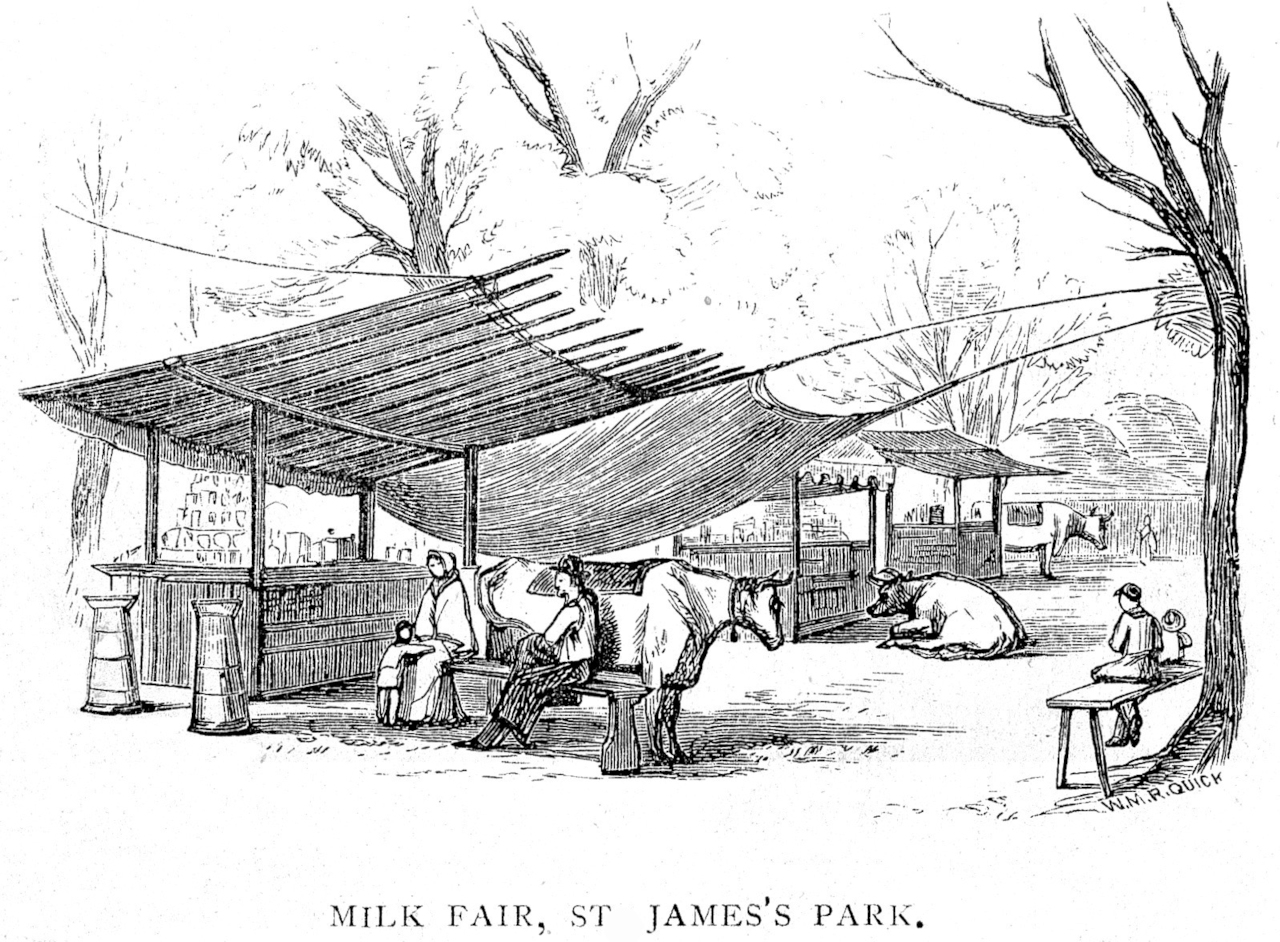 Milk Fair in St. James’s Park.
Credit: Wellcome Collection. Attribution 4.0 International (CC BY 4.0)
Milk in the olden days was very capable of killing you – tuberculosis was a major threat – and this is why it was produced near to the consumers, which reduced its ‘age’ and, thus, the risk of disease. Proper pasteurization came along much later. I assume that the Thirtles were upright folk, as they seem to have been in business success fully for a very long time, but not everyone was so scrupulous.
In the 1850s in New York City there was a “Swill milk” scandal and it was estimated that in one year about 8,000 infants had died as a result. The cows concerned were often kept in appalling conditions and were abused and ill: they were ‘fed’ on residual mash from whisky distilleries. The so-called milk emerged at the wrong consistency and was an odd colour, so was further adulterated with plaster of Paris and other things to make it look like the real thing. The illustrations are too horrible to show here, but it’s hugely sobering to know that something we now take for granted – pure, safe milk – was once so lethal and that the animals were treated so awfully.
William Thirtle was in partnership with a man called Joseph Harvey and the firm of Thirtle & Harvey continued after William had died, so presumably the milk and money continued to flow. The Thirtles generally did pretty well. One of William’s daughters, Frances/Fanny, married James Asser who, along with his cousin, Charles Sheppard Sherwin, established a firm of cutlers, unsurprisingly called Asser & Sherwin. Although they were described as cutlers, this wasn’t about knives, forks and spoons – they produced upmarket luxury goods. The Sherwins had a background in games boards and even today the firm’s varied products, some bespoke, appear regularly in auctions.
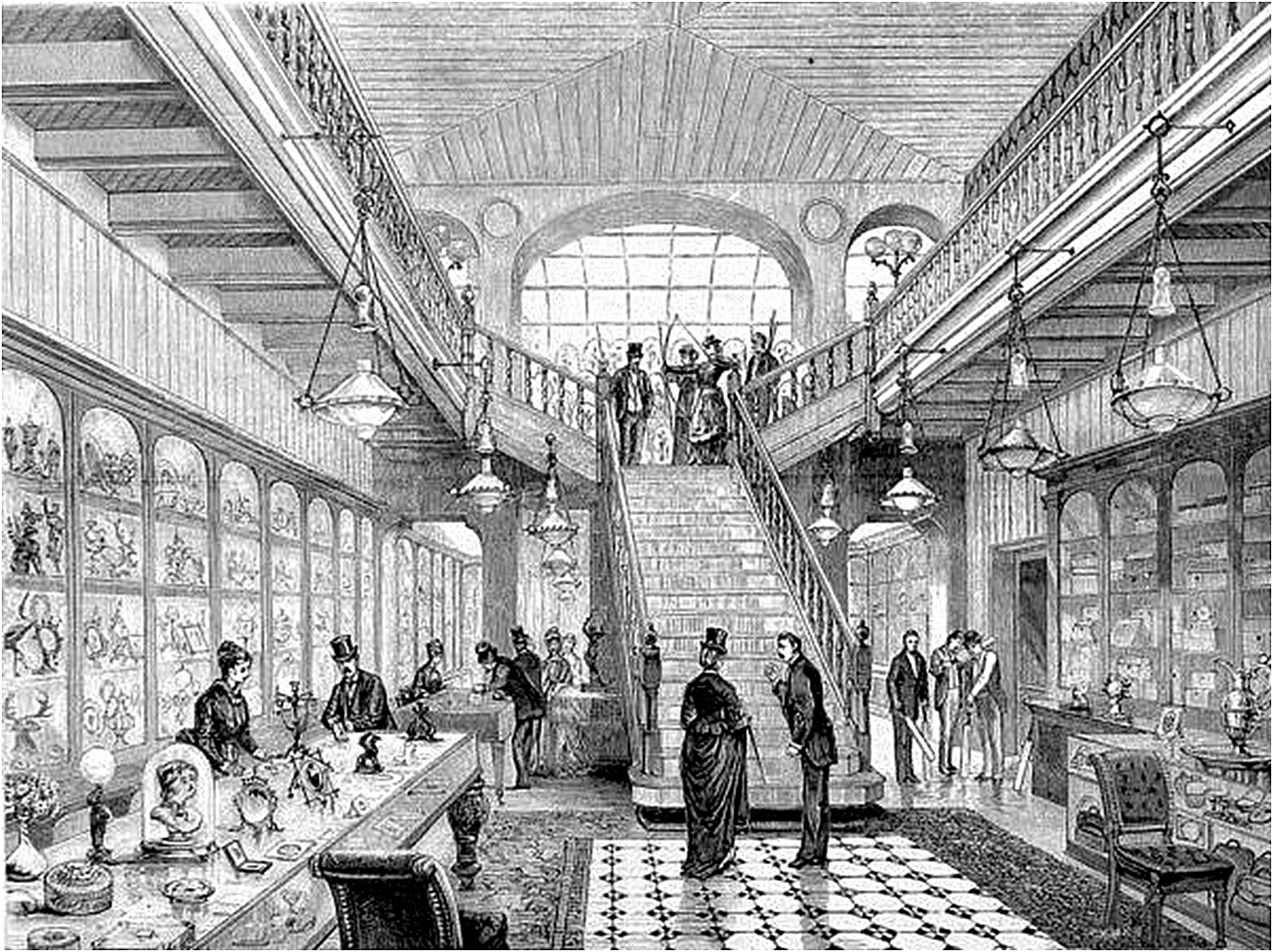 Asser and Sherwins Archery and Cricket Repository, London,
as depicted in the Illustrated London News 1875
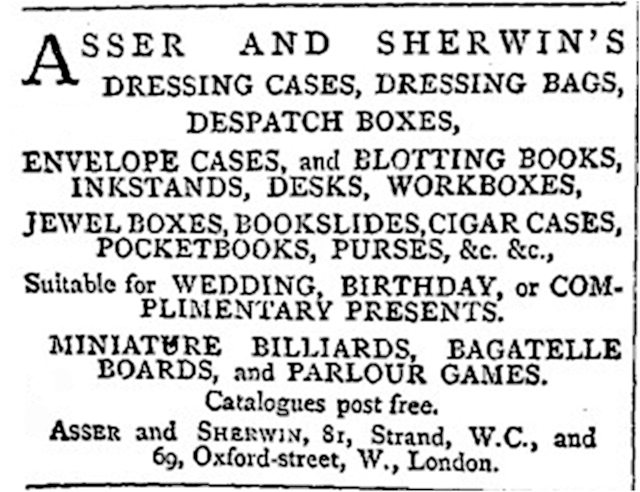
Advertisement for Asser & Sherwin
Source: The Pall Mall Gazette 1866
The name of Asser may sound vaguely familiar and that could be because Ernest Asser, one of the sons of James and Frances, was a co-founder of the prestigious shirtmakers, Turnbull & Asser.
We must return to Cuddington immediately! George Thirtle and his wife Fanny (née Druce) had three sons who survived to adulthood, besides John, plus a daughter, Ada. Fanny died in 1878, but her sister, Elizabeth, remained with the family, probably assisting with the children’s upbringing. Elizabeth had been widowed young, her husband, Francis Adolphus Smart, a civil engineer, having died at sea in 1868.
The Cuddington family group effectively dissolved after George died in 1903. Son Henry (born 1873) had been an ironmonger’s assistant in 1901, but he emigrated to Canada, where he grew wheat. However, he returned to England, ending up in Berkshire where, in 1939, he was living with Mrs Smart’s unmarried daughter, Elizabeth Knight Smart.
The other two sons, William and Edward Thirtle, were nurserymen. William operated his business from West End, Esher but had retired by 1911. Edward had also ceased to be a nurseryman by 1911, when he was aged just 40; he gravitated to West End, Esher as well.
Ada was unmarried and moved to the Winkfield/Ascot area, where her mother and aunt had originated. She lived at Furze Bank, Locks Ride and died in 1929: this was the same house that Henry Thirtle lived in after his Canadian adventures.
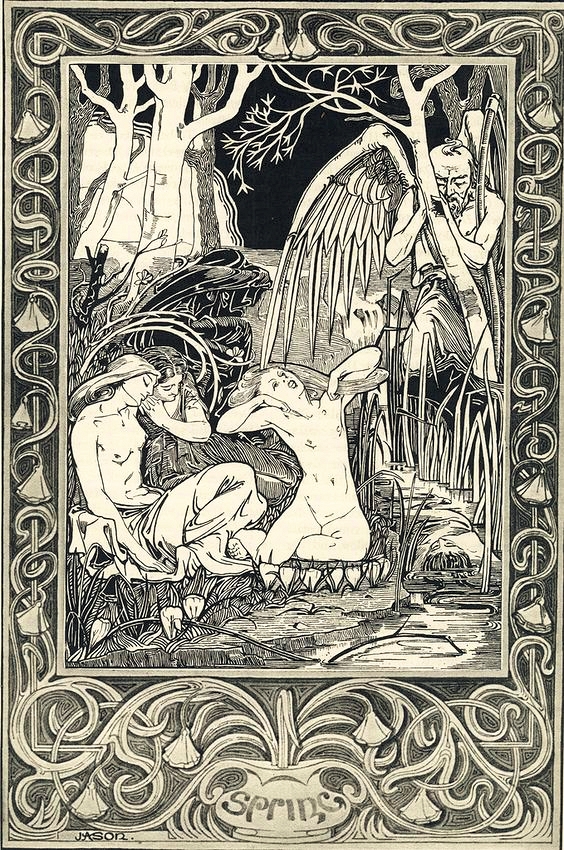 Spring
by John Thirtle (Jason), of Ewell
 Summer
by John Thirtle (Jason), of Ewell
Linda Jackson 2021