
Five ships called “EPSOM”
(You may also be interested to see our articles on Two locomotives called Epsom and Four ships called Ewell)
Over the years, we have learnt of five ships called “Epsom”, as set out chronologically below.
1. The Clipper Epsom
The earliest “Epsom” was a 19th Century sailing ship – a “Clipper” – about which we have a free-standing article.
2. The first SS EPSOM
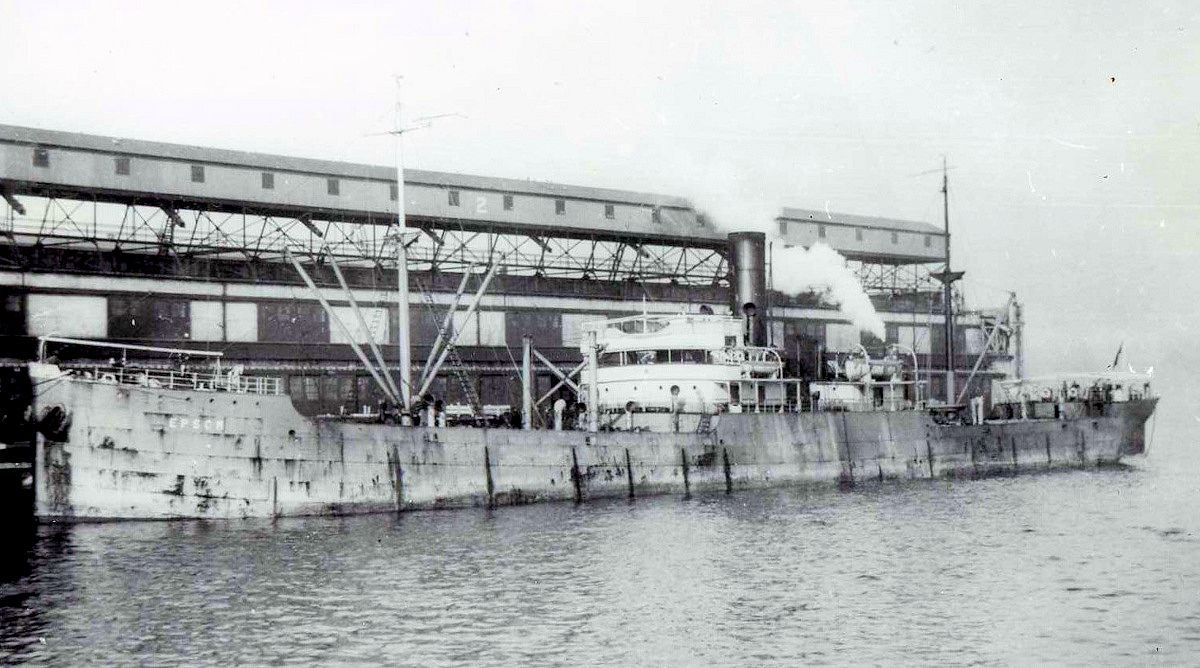
The 1902 SS Epsom
Image Source http://teesbuiltships.co.uk
This general cargo ship – 370 ft long and with a gross tonnage of 4,556 – was built in 1901-02 by Ropner & Sons, Stockton-on-Tees for the British Steamship Company operated by Watts, Watts & Co. It was the Company’s practice to name their ships after English towns – hence “Epsom” for this one. (The company’s fleet of 20 ships at the outbreak of WW1 ranged from SS Aldershot to SS Windsor.)
An unusual incident in the ship’s generally routine career was a 1906 mutiny by its Chinese crew when docked in Naples. This was the subject of the following Parliamentary exchange as reported in Hansard (HC Deb 19 March 1906 vol 154 cc56-7):
Mutiny of Crew of s-s. “Epsom.”
MR. HAVELOCK WILSON To ask the President of the Board of Trade whether he has received any Report from His Majesty’s Consul at Naples relating to the alleged mutiny of a crew of Chinamen on board the s.s. “Epsom,” which is under the management of Messrs. Watts Watts, who have had frequent trouble with Chinese crews; and whether he has received a Report as to the trouble with a Chinese crew on board the s.s. “Heathbank,” now the “Wandsworth,” under the same management; whether he is aware that the Chinese seamen employed on this vessel claimed their discharge and wages on the ground of a change of ownership, although the solicitors representing Messrs. Watts Watts informed the North Shields magistrates that there had been no change of ownership; whether he is aware that the crew refused to proceed in the ship, and were afterwards arrested at Newcastle on the master’s instructions; that when the case was tried before the magistrate, no interpreter was present to explain the men’s objections to proceeding in the ship, and that they were ordered to be put on board by the Newcastle City Police; whether he is aware that, on the vessel proceeding down the Tyne, five Chinamen jumped overboard and one man was drowned, the captain making no attempt to rescue the men; whether he is aware that the managers alleged the change of ownership did not affect the men’s agreement; and, seeing that a summons taken out against an official of the Seamen’s Union, 57 on the alleged ground that he had persuaded the men to desert, was dismissed, whether he will inquire into the disturbances on the s.s. “Epsom” at Naples, and the s.s. “Wandsworth,” and say how many Chinese crews Messrs. Watts Watts are employing on board their vessels.
(Answered by Mr. Kearley.) The Board of Trade have not yet received any Report from the Naples Consul with regard to the case of the “Epsom,” which is, I am informed, managed as stated by Messrs. Watts, Watts, and Company, but I have called for a Report, and hope to receive it in a few days. With respect to the “Heathbank” or “Wandsworth,” the Registrar General of Seamen informs me that she was purchased by the Gracechurch Steamship Company, Limited (Harris and Dixon, managers), in November, 1905, and sold to the Britain Steamship Company, Limited (F. S. Watts, manager), in February, 1906. So far as my information goes, the facts in this case are as stated in the Question, but the owners state that the Chinese left the ship surreptitiously, and the captain had no knowledge of the circumstances at the time. As to whether, under articles of agreement, these men were liable to be transferred to another owner, this was the subject of legal proceedings at Newcastle, and the magistrates directed the men to return to their duty. I believe Messrs. Watts, Watts, and Company, Limited, carry many Chinese seamen, but as to how many I cannot say.
In 1931, the ship was sold to Orazio Rosini of Genoa and renamed Ninfea. After 30 years’ service it was nearing the end of its useful life, and was broken up in Genoa in 1933.
3. HMS Epsom
The only Royal Navy “Epsom” was one of 32 Racecourse Class (hence the name) minesweepers delivered during WW1 – about which we have a free-standing article.
4. The second SS EPSOM
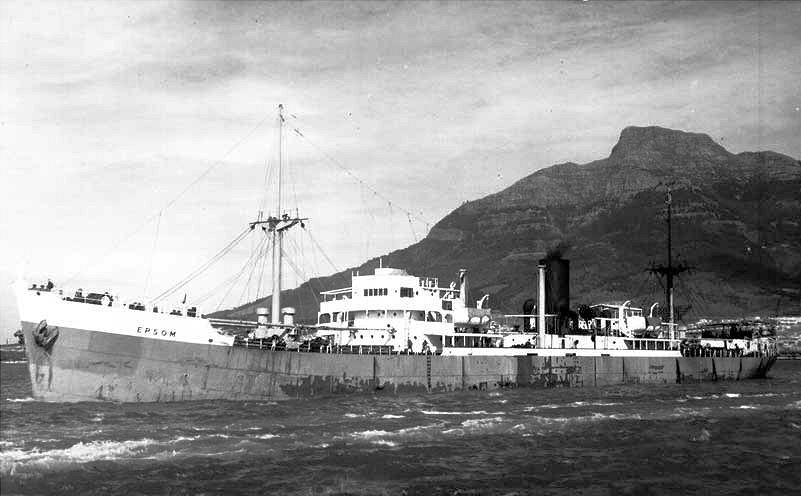
The second SS Epsom
Image source The Allen Collection via https://www.benjidog.co.uk
This ship began life as the SS Empire Favour. It was built by the Caledon Shipbuilding & Engineering Co Ltd of Dundee as a general cargo ship of the Empire Type (B) for the Ministry of War Transport and, after completion in November 1945, was managed by Clark and Service of Glasgow.
It was 446ft long with a 56ft beam, and its gross 7,050 tonnes were propelled at up to 11 knots by a single screw powered by a coal fired triple-expansion steam engine built by Duncan Stewart & Co. Ltd of Glasgow.
In 1947, it was sold to the Britain Steamship Co Ltd and, like their 1901-31 ship (see 2 above), was given the name SS Epsom.
During 1950, it was sold to Tharros Shipping Co Ltd and, operated by John Livens & Sons Ltd, was renamed the SS Tharros. Later the same year it was sold to Haldin & Phillips Ltd and renamed the SS Errington Court – only to be sold again in 1956 to Cia. de Nav. Penelope S.A. Monrovia, and renamed the SS Penelope. In 1964 it was sold to Dalia Cia. Nav. S.A. Piraeus, Greece (managed by Purvis Shipping Co. Ltd. London) and renamed the SS Andromachi.
On 25 June 1969 (in the early days of the 1969–73 Arab-Israeli War), the ship was at Suez when it was damaged and set on fire by Israeli shelling. The ship was abandoned and, in March 1976, was scrapped at Adabiya, Egypt by Hosai Abdel Ariz.
5. LPG Tanker Epsom
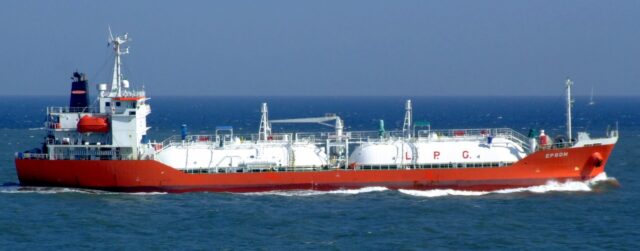
Epsom (IMO 9191785) approaching Rotterdam, Holland 19-Apr-2007.
Photo by AlfvanBeem via Wikicommons (CC0 1.0)
This latest “Epsom” was build by Higaki Shipbuilding of Imabari, Japan in 1998. It was commissioned by Aegean Enterprises, and it is not known why they chose the name.
The ship is 100m long with a 20m beam and a 5.2m draught with a gross tonnage of 4,490 tons (Summer DWT 5214). Its function is the bulk transport of liquefied petroleum gas (LPG) – a flammable mixture of hydrocarbon gases used as fuel in heating appliances, cooking equipment, and vehicles.
In November 2013, the ship (still registered in Panama) was renamed as the “Epic St. John”. At the time of writing, it is being operated as the “Gas Eastern”, registered in Vietnam.
Peter Reed & Roger Morgan © 2020