
TOWER HOUSE, ASHLEY ROAD, EPSOM
(later “The Tower House Hotel”)
One of the pictures from the Bourne Hall Museum’s archives selected to illustrate the article on Rosebery Park was a late 1920’s postcard with a view across the pond to the newly installed bandstand. In the left background (as arrowed below) was an unusual building. This looks rather like a church or some imposing civic structure but, as we shall see, turns out to be a private house (and, later, a private hotel).

Rosebery Park, with the mystery building arrowed red.
Image with thanks to Bourne Hall Museum.
By chance, a further postcard of the same vintage came to light, a section of which (as below) shows another rather distant view of the house.

Part of another postcard with a slightly clearer view of the mystery building.
Image courtesy of Jim Sapsed.
Further delving in the Museum’s archives yielded another postcard with a closer view – unfortunately a bit obscured by a couple of trees. This is likely to date from around the end of WW1, as the Park Keeper’s lodge seen on the right of the previous photographs has yet to be built. (As an aside, it has to be said that these few square yards are hardly representative of the 11¼ acres of what the publisher entitled “Lord Roseberry’s [sic] Park”.)
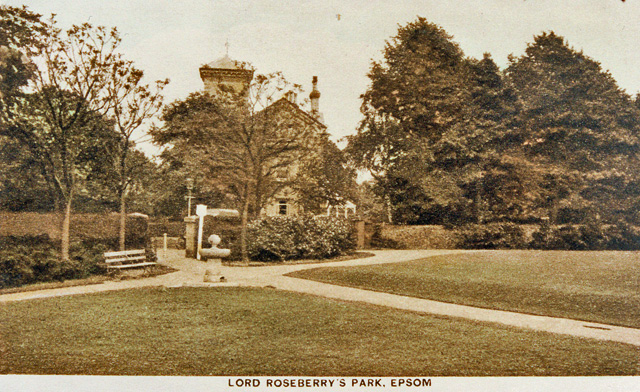
The mystery building yet closer up.
Image with thanks to Bourne Hall Museum.
As shown in the present-day photograph below (taken, thanks to the reference point of the base of the old drinking fountain, from almost exactly same point), the old building has gone and its site is now part of the Epsom Campus of the University of the Creative Arts.
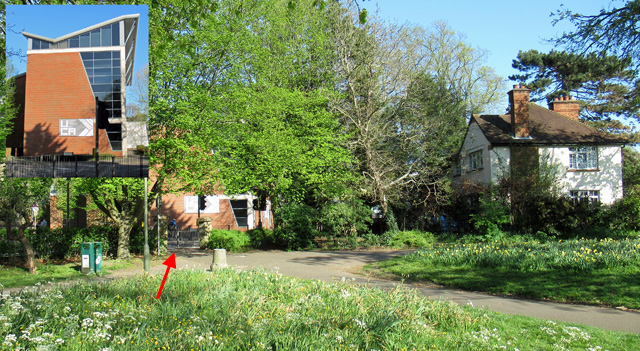
Main: A present-day picture of the same view.
Inset: a view across Ashley Road from the red-arrowed spot.
Photographs by Roger Morgan © 2020.
As shown in this reverse view (in which the base of the drinking fountain is arrowed red), the gateposts that were on the right of the old photograph became the entrance to the Park Keeper’s lodge (now a private residence).
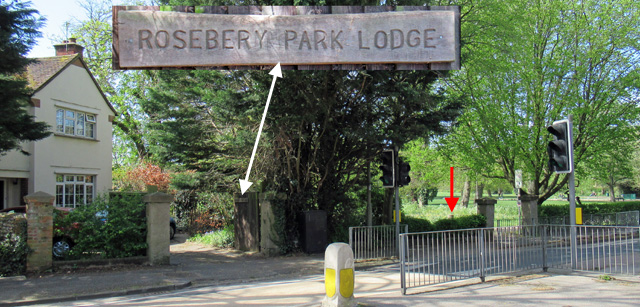
A present-day view across Ashley Road back into Rosebery Park.
The base of the old drinking fountain is arrowed red. Note the old gateposts at the entrance to what was the Park Keeper’s Lodge.
Photograph by Roger Morgan © 2020.
The building first appeared on the Ordnance Survey map of 1896. (The edition printed in 1893 was a reissue of the 1866 survey.) The building’s plan was unchanged on the 1913 and 1936 editions. On the extract of the latter shown below, the building is arrowed red. The unusual architecture makes it tempting to think of some cross-fertilisation with the smaller and equally unusual 1879 “Turret Villa” in the nearby Ladbroke Road, where it is now numbered 19. (Ladbroke Road and its buildings also first appeared on the 1896 OS map.)

Left: “Turret Villa”, 17 Ladbroke Road (as arrowed blue).
Photograph by Roger Morgan © 2020.
Right: Extract from the 1936 Ordnance Survey map, on which the mystery building is arrowed red.
While quite an imposing house, the mystery building was – unlike Worple Lodge (the core of today’s Swail House) facing it across Heathcote Road – not grand enough to be named on the OS map. However, looking though the Census returns for Ashley Road reveals that the residence next after Worple Lodge was called – somewhat obviously – “Tower House”.
The Post Office/Kelly’s Directory for 1887 notes that (the globe-trotting) Charles Cairns Murray was the resident of Tower House. By the time of the 1891 Census, the house was occupied by 53 year old Ivie McCutchan and his 48 year old wife Adelaide Isobel, née Dimmock The couple had married in Kent in 1872 – a county in which they then had 5 children, none of whom was at home on Census day. The Census return notes Ivie – a distinctive name he inherited from his father, and which the couple gave to their first son – as a “Retired Merchant & Warehouseman”. Other records show that, with his son Ivie and others, he ran the firm of I McCutchan & Co, being “Warehousemen & Tea Dealers at No 30 Friday Street in the City of London”. The household was supported by two domestic servants.
The couple were still at Tower House for the 1901 Census, and the unmarried eldest daughter (Adelaide, after her mother) was now at home. There were still two domestic servants – but now also a “Groom (Domestic)” in the separately recorded Tower House Stables. The McCutchans subsequently moved away, being recorded in the 1911 Census living at 7 The Avenue, Eastbourne.
The occupants of Tower House in the 1911 Census were 53 year old David Grinstead and his small family. He gave his occupation as “Carpenter (caretaker of private house)” and, while the return notes that the house has 10 rooms, he qualified this by adding “4 as caretakers”. Perhaps he was readying the house for the 61 year old William Wilson Coltart who, with his wife and one of their six surviving children, was recorded in the 1911 Census living a few doors up the Road at 1 Ashley Villas.
The 1913 Post Office/Kelly’s Directory lists William Coltart as having moved to “Tower House, Ashley Road” – describing him as “MRCS Eng, LRCP London, physician & surgeon (firm, Coltart, Daniel & Thornley), & medical officer, Epsom district, Epsom Union, certifying factory surgeon & medical officer to the workhouse”. By the time of the 1921 Census, Tower House had been numbered as 17 Ashley Road. The widowed Mr Coltart (“Physician & Surgeon”) was still in residence, together with his unmarried 35 year old daughter, Marjorie (“Home Duties”) and 55 year old visitor, Mary Elizabeth Coltart (“Not occupied for a living”).
The 1921 Census has a second entry for 17 Ashley Road – on the original schedule, noting that this related to the “Stables” which are likely to be the caretakers’ 4 rooms in the 1911 Census. The occupants here were the mid 30s Alfred Edwin Smart (“Ostler at Normans Stores, High Street Epsom – Oil & Colour Merchants”), his wife Edith Emily (neé Holley – they had married in Q2 1919) and their recently born daughter, Helen Sabina.
William Coltart’s last listing in the local directories (still at Tower House) was in the 1922 edition. (He then moved away to Margate, where he died in 1925.) By 1924, the local directory’s list of “Private Residents” has Edward Allen at the now numbered Tower House. His entry at that address is repeated in the local directories for 1927, 1930 and 1934.
In the 1934 edition, however, there is also the first entry in the directory’s “Commercial” section for “Tower Private Hotel” at 17 Ashley Road, with “Mrs L A Allen” (presumably Edward’s wife) as the proprietor and giving the telephone number 813. By the time of the 1936 street directory, the name had been expanded to “Tower House Private Hotel” and Edward Allen himself is listed as the proprietor.
The ownership of the hotel then changed: the 1938 local directory lists the proprietor as Leslie Hase. The September 1939 Register records the mid-40s Leslie Hase and his wife, Ellen, as the joint proprietors – and lists 27 others on the premises, most of whom were guests.
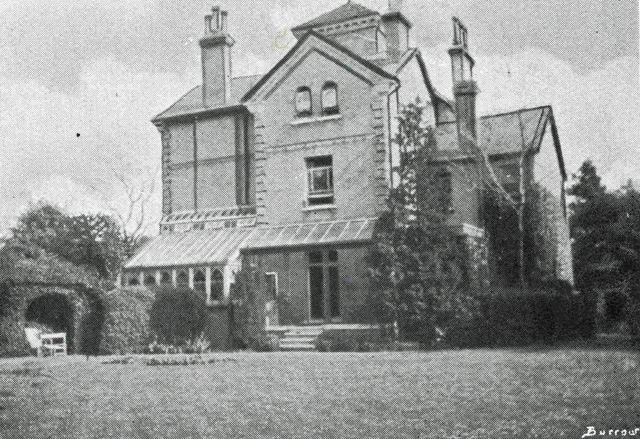
The rear of Tower House in its days as a hotel.
Image with thanks to Bourne Hall Museum.
The “Tower House Private Hotel” remained in operation until at least 1952, when that year’s local directory lists it with proprietors as “Mr & Mrs R Woods”.
It is interesting to note that the 1952 directory also lists the adjacent 19 Ashley Road in use as “Moorgarth Private Hotel” – with “Mrs G K Ladd” as the proprietor. That property had been a private residence pre-war: the September 1939 Register listed the occupants as the 61 year old retired solicitor Sidney Haslett and his wife Isabel.
Both these properties were, in due course, demolished to make way for the expanding Epsom School of Art which, following further growth and mergers, is now a campus of the University for the Creative Arts.
Roger Morgan © 2020 & 2024