
ROBERT HONEY FABIAN
‘Fabian of the Yard’
Left to right: Detective Inspectors Bob Higgins and Fred Hodge, Detective Chief Inspector Robert Fabian, 1947
Introduction
Many decades ago, senior detectives, especially those at Scotland Yard who headed big murder enquiries, could become well-known to the public, but I can’t think of any others who were a household name like Bob Fabian. Fabian qualifies for this website because he lived in Ewell for many years and, before that, in Ashtead. There is also a connection to Epsom.
Background
Bob Fabian’s parents were Devon-born engineer’s fitter Andrew Pinwill Fabian and his wife Ada Eliza (née Taggart), who was a Londoner. At the time of their son’s birth in 1901 they lived in Lewisham. Bob had little formal education and, after elementary school, trained as an engineering draughtsman. Like so many lads in the First World War, he enlisted when underage but he was found out and remained in the UK. He did work in drawing offices afterwards, which didn’t suit him, and he applied to the Metropolitan Police. Having been accepted, he was posted to Vine Street Police station as a uniformed constable.
Early career
In 1924 he graduated to ‘plain clothes duties’, as CID work was called in those days. The following year he married Winifred Letitia Stockwell. In Paul Lawrence’s piece for the Oxford Dictionary of National Biography there is this wonderful sentence: ‘ Working in the heart of Soho and the West End he came into contact with many of the colourful characters of London’s underworld at the time, including Kate ‘Queen of Clubs’ Meyrick, ‘Brilliant Chang’, and Eddie ‘the villain’ Manning.‘
Kate Meyrick sounded respectable, with a doctor father, a clergyman for a step-father and a doctor husband. When her marriage broke down she embarked on nightclub ownership, her best-known enterprise being the 43 Club in Gerrard Street, Soho. Apparently, she got into this scene because she needed significant funds to finance the education of sons at Harrow and three daughters at Roedean (the daughters made their expensive education count and married titled men). Mrs Meyrick’s clubs were rather wild in the 1920s and she accumulated a number of convictions and prison sentences for such offences as keeping a disorderly house, breaching licensing laws and regularly bribing a police sergeant not to raid her premises: this last offence got her 15 months in prison with hard labour.

Kate Meyrick (seated centre front) and friends
by Planet News vintage print, 1928
Image Source ©National Portrait Gallery NPG x194141 (CC BY-NC-ND 3.0)
The 43 Club in 1945, by which time it had become a gay venue
‘Brilliant Chang’ had a Chinese restaurant and later lived at Limehouse Causeway, which was in the same neck of the woods as the infamous opium parties hosted by Lo Ping and his wife Ada – see our article on Billie Carleton. This was a similar tale, featuring the hedonistic lifestyle pursued by some in the period after the First World War and the people who facilitated that lifestyle for their own profit. Chang apparently supplied drugs to a string of young women who were club hostesses and suchlike, and one of them, Freda Kempton, died of a cocaine overdose in 1922. He got away with that, but the publicity damaged his businesses, which were quite upmarket until then, and eventually he ended up in Limehouse. In 1924 he received a prison sentence for possessing and supplying cocaine and was deported. Fans of ‘Peaky Blinders’ may have noticed that he appeared as a character in Series 5.
 Brilliant Chang c.1922
Image source: Wikipedia
Eddie ‘the villain’ Manning was a Jamaican jazz musician who was also involved in supplying drugs; he ran a protection racket for prostitutes and had been jailed in 1920 for shooting three men in the legs in Cambridge Circus. He died in prison eventually.
Bob Fabian was posted to a job in the criminal records office in 1929, which sounds a waste of his potential but, apparently, he spent a lot of time studying the records of villains he might encounter when he was back on the street.
The IRA Bomb
By 1939 Fabian was a Detective Inspector in charge of the Vice Squad at Vine Street.
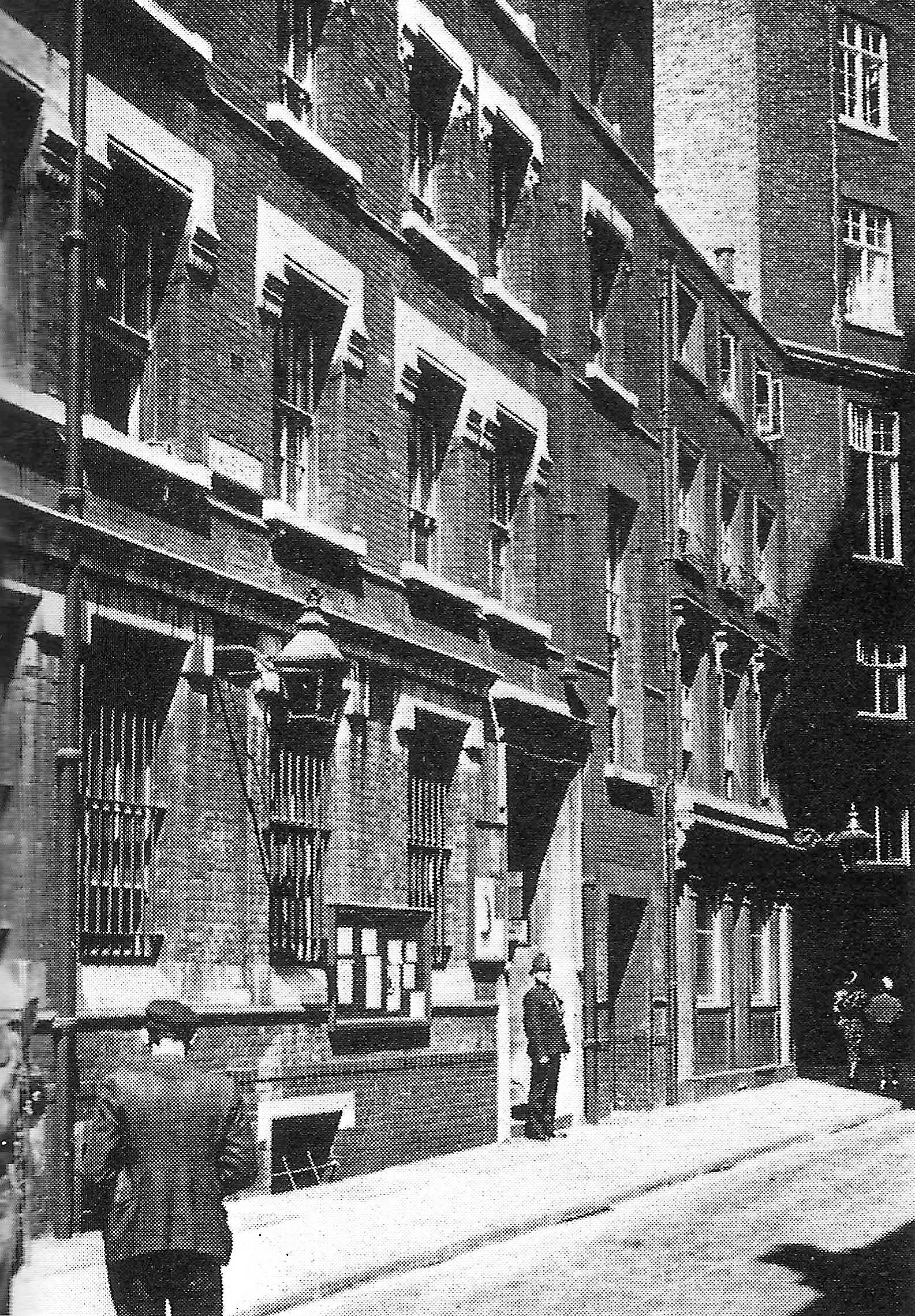 Vine Street Police Station c.1940
Image source: Wikimedia Commons
During 1939 and into 1940 the IRA was carrying out the S-Plan, designed to cripple UK infrastructure and sabotage defence installations. On 15 January 1939 the IRA formally declared war on Britain. There were large numbers of explosions throughout that year, which had varying success from the aggressors’ viewpoint and some of the devices failed to detonate, mainly through incompetence on the part of the bomb-makers. The worst atrocity occurred in Coventry, just days before war broke out with Germany, when a device left in the basket of a parked bicycle exploded, killing five civilians and injuring 70 more.
 Aftermath of the Coventry bomb attack
Image source: Wikimedia Commons
On 25 June 1939 there was a loud explosion which shook the windows at the Vine Street station and sent a wave of hot air through the building. The blast had occurred at the corner of Piccadilly Circus and Glasshouse Street. Having dashed to the scene, Fabian spotted a brown paper parcel, which was another bomb, containing sticks of gelignite and a fuse. He laid out the sticks of gelignite separately, to lessen the chance of a chain reaction if one exploded, and then cut out the fuse with a pocket knife. For this exploit he was awarded the King’s Police Medal for gallantry in 1940.
Inspector Fabian and his wife after the investiture at Buckingham Palace on 7 February 1940
The murder at Lower Quinton
Lower Quinton is a village near Stratford-upon-Avon and on 14 February 1945 it was the scene of a brutal murder. Local farm worker, Charles Walton, 74, left home that day with the necessary tools to cut hedges: these were a slash hook (like a billhook, designs and names vary) and a pitchfork. When he did not return his niece and a neighbour went out searching, finding him dead near a hedgerow, pinned to the ground with the pitchfork: he had suffered a head injury and his windpipe had been cut. Scotland Yard was swiftly called in.
Fabian’s main suspect at the time was the man Walton had been working for – farmer Alfred Potter -, although there was no real evidence against him, or against anyone else for that matter. Somehow, the idea gained credence in the village that the murder was connected with witchcraft, although there was no corroboration for that either, despite a rumour of a cross being carved in Walton’s chest. In fact, there was no evidence of any kind to indicate who had committed the murder or why and the case remains unsolved to this day.
Alec de Antiquis
This was a high-profile case for more than one reason, but I shall deal with the crime first. Alec de Antiquis was born in 1911, son of an Italian father and English mother. He was married to a Croydon girl, Gladys Collins, and they had six children, the eldest being about 12 at the time of the murder. Alec ran a motorcycle repair shop in Colliers Wood, London SW19. On 29 April 1947 three armed and masked men held up a jeweller’s shop in Charlotte Street, London (near the Tottenham Court Road) and left their car outside with the engine running. The manager tackled them and was clubbed with a pistol butt; the shot that was aimed at him mercifully missed. The manager’s assistant activated the alarm and the men fled to their getaway car. Had the aftermath not been so tragic, this ‘robbery’ would have been a comic farce, since the car had been blocked in by a lorry, so the men fled on foot, waving their guns to discourage intervention. Alec de Antiquis was in the area on his motorbike, getting parts for his repair business, and tried to stop them. He was fatally shot in the head and the robbers escaped.
Two passers-by attempting to assist Alec de Antiquis
Solving this case hinged on the information supplied by a cabbie, who had been driving a fare along Tottenham Court Road moments after the murder when a man jumped on the running board, wearing what looked like a bandage round his jaw. The man was pushed off and disappeared into an office block called Brook House. Three days passed before this information was relayed to the police, but when they searched the building they found the key to the getaway car, a raincoat and other outer clothing, plus a scarf which had obviously been used as a mask (cowboy baddie style). Nowadays everything would be on CCTV – the police could view the footage without leaving the station and spot the unmasked man leaving the building, but Fabian and his team had to do this the old-fashioned way. As luck would have it, there was a numbered maker’s ticket sewn in the raincoat, which led to a manufacturer in Leeds and then to a retail outlet in Bermondsey. As the purchase would have required wartime clothing coupons before being sold (there’s an interesting article about clothes rationing on the Imperial War Museum website), there was a record. The buyer’s name rang a bell with Fabian, because he knew of someone called George Vernon, who had a young and violent relative, very recently released from Borstal. The cousin was Charles Henry Jenkins and Vernon said he had lent the coat to Jenkins.
Jenkins wasn’t picked out at an identity parade and had to be released, but his ineptitude, which had begun with a remark about the raincoat before the police had even mentioned it, continued. He said he had lent the coat to a man called Walsh, who’d been involved in a previous robbery with Jenkins and his accomplices. Walsh admitted the earlier offence but certainly wasn’t going down for murder and he named the other members of the gang: they were Christopher James Geraghty and Terence Peter Rolt.
Charles Henry Jenkins arriving at the magistrates’ court, May 1947
The real breakthrough came when police found two guns in river mud and both were linked forensically to the robbery/murder. One had fired the bullet which missed the shop manager and the other had killed de Antiquis. Geraghty and Rolt then confessed, but Jenkins said nothing – he had already put both feet in it over the raincoat business.
All three appeared at the Old Bailey in July 1947 and were found guilty. Jenkins and Geraghty were hanged at Pentonville, but Rolt escaped the death penalty because he was under 18 at the time of the murder: he was ordered to be detained at her Majesty’s Pleasure.
Under-18s and the death penalty
As mentioned earlier, the de Antiquis case was high-profile for another reason and that was the fact that Rolt was too young to be hanged. The debate about capital punishment had been rumbling on for years (interrupted by the Second World War) and it had started up again. There were a few cases where one of the perpetrators was under 18 and escaped execution, whereas the older participant(s) was/were hanged. In the notorious case of Bentley and Craig (1952) PC Sidney Miles was fatally shot. It was Craig’s gun, Craig’s ammunition and he fired the shot, but he was only 16, so Bentley (19) was executed and Craig was detained, to be freed after 10 years. Bentley received a posthumous pardon in 1993 and the Court of Appeal quashed his conviction in 1998. As with the de Antiquis case, the trial and execution followed the crime with indecent haste: the shooting occurred on 2 November 1952, the trial took place on 9-11 December, Bentley’s appeal was heard on 13 January 1953 and he was hanged 15 days later.
There was another case, in 1960, near to where I lived at the time, and the vicious and senseless nature of it was shocking. My great-aunt was particularly shaken, since one of the perpetrators had been her dustman. Young Allan Jee was kicked to death on a footpath near his home for ten shillings (50p), which was all the money he had with him. Francis ‘Flossie’ Forsyth and Norman ‘Flash’ Harris were hanged, Christopher Darby received a life sentence for non-capital murder and the lad who had been just as involved in the murder as the others was detained because he was only 17 – once again, he served just 10 years. Forsyth was, if you care to put it that way, unfortunate, since he was 18 at the time of the murder. In 1965 the death penalty was suspended for five years in mainland Britain and four years later it was abolished for all but a few offences such as treason.
On the subject of the death penalty you may also be interested in our article on Chuter Ede.
Retirement and new career
In mid-1949 Bob Fabian, by now a Superintendent, resigned from the police force, announcing that he was going to work in business. This seems like the usual thing for retired senior police officers, who often take jobs in security. Bob did that too but he also wrote newspaper articles and books, making personal appearances and so on. One of his books was ‘London After Dark’, which told of the sleaze and crime in the capital. During 1954-56 he was involved with the television series called ‘Fabian of the Yard’ in which Bruce Seton played the title role. Bob Fabian himself would appear briefly at the end of each episode to tell viewers how the case had ended. This may seem very tame TV nowadays, but it was fairly novel for the 1950s and even pre-dated the homely ‘Dixon of Dock Green’, which started in 1955, – it was a further 7 years before the grittier ‘Z Cars’ came along.
Personal life
Bob and Winifred had one son and from 1947 at the latest they lived at 13 Bramley Way, Ashtead. However, by 1956 Bob had moved out and was living with Hilda Donoghue at 73 Meadow Walk, Ewell. Apparently, he and Winifred had not divorced at that point, but the marriage had broken down.
I said at the beginning that there was an Epsom aspect to this tale and Hilda Donoghue was it. She was the ex-wife of Pat (Patrick Joseph) Donoghue, son of the famous jockey Steve Donoghue.
Pat Donoghue, left, with his father, Steve Donoghue
As Bill Eacott says in his article on Steve Donoghue, Pat was apprenticed to Stanley Wootton at Treadwell House, Epsom Downs. Pat was nothing like as successful as his father and eventually went into training at Sandown Lodge, Epsom and Woodruff Stables at Ashtead, amongst other places. He and Hilda had two children.
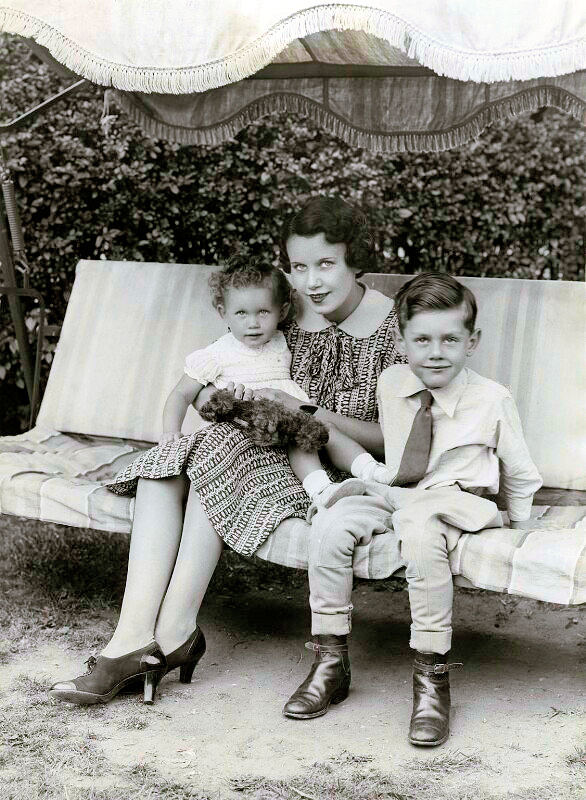 Hilda with her children, 1937.
by Bassano Ltd bromide print, 29 July 1937
© National Portrait Gallery, London NPG x84112 (CC BY-NC-ND 3.0)
Hilda divorced Pat in 1945 and he remarried the following year. Their daughter was living with Hilda and Bob at Meadow Walk until she married. I assume that Bob and Winifred divorced eventually, since the latter was still alive when Bob married Hilda in 1972. Their final address was 40 Fairfax Avenue, Ewell. Bob died in Epsom Hospital on 14 June 1978. Hilda survived until 1998.
Winifred Fabian and her son moved to Bognor Regis, where they died in 1986 and 1982 respectively.
Linda Jackson 2020
Sources:
- Oxford Dictionary of National Biography
- Wikipedia
- Numerous newspaper reports
ADDENDUM

Cat-o’-nine-tails
By Pearson Scott Foresman Via Wikimedia
Bill Hern has contacted us with this description of an unusual Fabian case.
‘Four wealthy young men took part in a violent jewel theft in an up-market London hotel on 20 December 1937. The story of the theft and associated matters is covered matchlessly and comprehensively in Angus McLaren’s book Playboys and Mayfair Men – Crime, Class, Masculinity and Fascism in 1930s London.
In short, the four men lured Etienne Bellenger, a Director of Cartier’s, to a London hotel under the pretext of wanting to purchase a diamond ring. Bellenger took eight emerald cut diamond rings set in platinum valued at £13,824 (over £650,000 at 2020 prices) to a room in the hotel. There he was attacked viciously by one of the four, Michael Harley, who beat him several times about the head with a truncheon.
Fabian took the credit for the subsequent arrests of the four young men and in his memoirs termed the crime “the case of the Mayfair Playboys.”
The subsequent Court case in February 1938 attracted massive media interest as the public were astonished that privileged gentlemen could carry out such a crime. Harley was revealed as a violent man with a number of petty misdemeanours hanging over his head. In addition, Fabian admitted that Harley, who he knew as Mike Harley, was a police informer. In a pathetic attempt to escape blame Harley claimed he only became involved in the planning for the theft in order to report it to the police. He also claimed that he held on to the rings after the theft as he wanted to return them to their rightful owner, the insurance company.
Unsurprisingly Harley was found guilty and sentenced to seven years penal servitude with two year’s hard labour for conspiracy to steal, to be served concurrently. Sensationally the Judge also sentenced him to twenty lashes of the cat-o-nine tails for robbery with violence. This provoked uproar with many senior figures regarding such a punishment as savage and unacceptable. However, the Home Office refused to rescind the sentence and the lashings took place in Brixton Prison in early March 1938.’
Bill Hern ©2020