
MOUNTHILL GARDENS
A tale of two estates
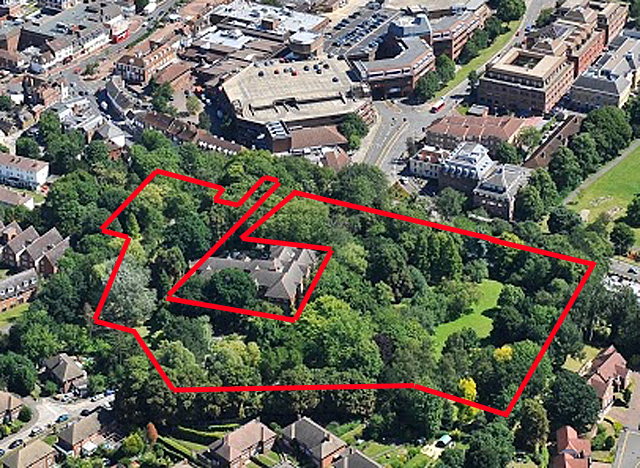
Mounthill Gardens (as roughly outlined in red) from the southwest.
Aerial photograph with thanks to the Epsom Civic Society.
From 1947, the old properties Rosebank and Mounthill on South Street, Epsom (both of which were across the road from the subsequently erected Epsom Playhouse) were up for sale together with their extensive grounds. In 1950, Epsom & Ewell Council purchased them, setting aside five acres for what became Mounthill Gardens and using most of the remaining area for new housing.
The extract from the 1932 Ordnance Survey map below will help set the scene for the remainder of this article, which first considers each of the original properties; and, second, discusses the development of the park “Mounthill Gardens”.
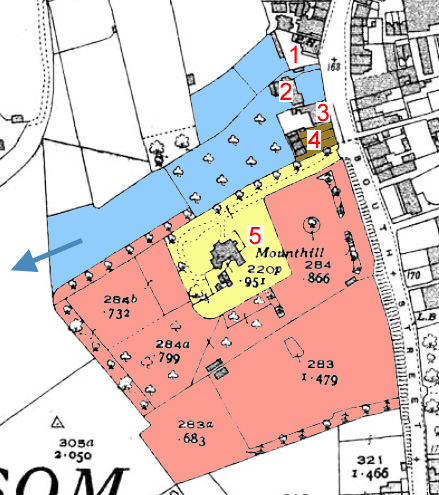
A section of the 1932 Ordnance Survey map.
The key to the numbers and coloured sections is set out below.
In the 1932 map above:-
1 is what was originally the Symonds Well pub which, after a spell as The Magpie, reverted to the original name before other reincarnations. At the time of writing, the last of those (“The Rocket Bar”) had just closed and the property put up for sale.
2 is the house Rosebank – of which more below – and the area coloured blue is part of its grounds, most of which were taken into Mounthill Gardens. The Blue arrow is to indicate that Rosebank’s land extended further west. After the Council’s purchase, that area (including part of the blue-shaded area round the tail of the arrow) was developed for what was then Council housing – the estate’s origins being acknowledged by naming its new roadway (the continuation of West Street running up to what is now St Joseph’s School and Church) as “Rosebank” .
While the house Rosebank was demolished (with part of its footprint being taken up with a new electricity substation), 3 is another old property which, at the time of writing, is occupied by the restaurant Sicily.
At 4 are some subsequently demolished small properties which, either in 1950 or otherwise, came into the Council’s possession and whose sites became part of Mounthill Gardens.
5 marks Mounthill – of which more below. The area coloured yellow around the house is its formal garden (together with the access to South Street) while the area coloured pink is its “home park”. As discussed below, these two areas were handled differently.
Rosebank
Rosebank (sometimes called Reston House, and subsequently numbered 32) was built in the 1700s – one of the many properties erected during the “Epsom Spa” period. Such properties were mainly used during “the season” and were often let to the visitors who flocked to Epsom’s somewhat notorious entertainments.
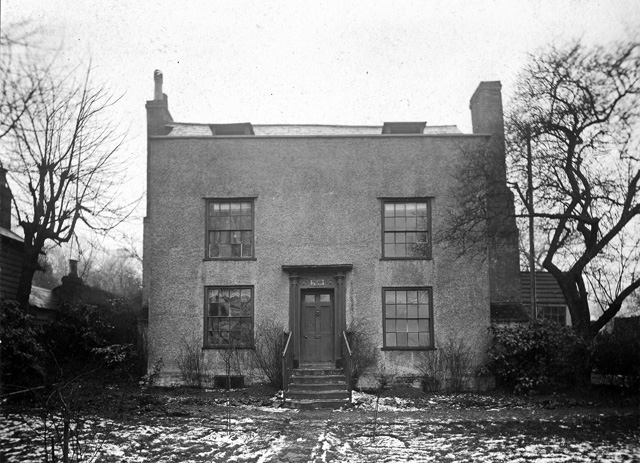
Rosebank in December 1906
Photograph by A.E. Long, courtesy of Bourne Hall Museum.
As shown in the photograph above, Rosebank was in a rather poor state by December 1906. However, as shown below, it was transformed over the next few months.
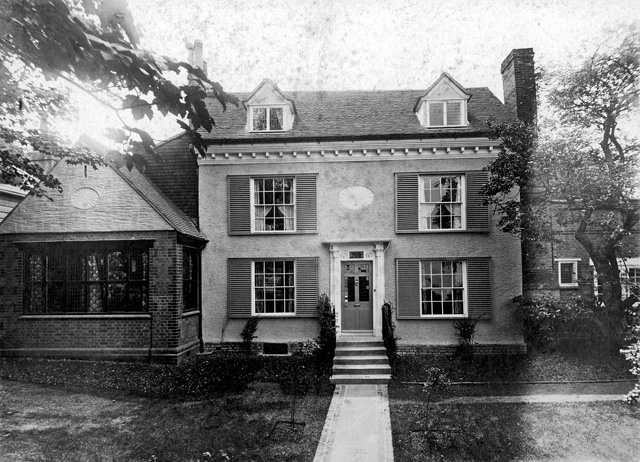
Rosebank in July 1907
Photograph by A.E. Long, courtesy of Bourne Hall Museum.
The first occupants of the transformed property were Gordon Home and his brother Percy (who had been living at Cromwell Lodge, Church Street from about 1901 to 1907). However, by the time of the 1911 Census, the residents were William Swainston (a 51 year “Consulting Marine Engineer and Naval Architect”) and his 36 year old wife, Gertrude. This was a prosperous household: the couple were supported by three domestic servants. They were still living there at the start of WW2. On 30 September 1940, in the first few weeks of the Luftwaffe’s “Blitz” bombing campaign, the 81 year old William was injured by “enemy action” while at home, dying in hospital a fortnight later. (Fuller details are in our WW2 pages.)
The assumption that Rosebank was damaged beyond repair in that wartime attack is supported by the fact that Gertrude then moved to College Road, Epsom, where she died in 1949. Certainly no attempt was made to resurrect the property after the Council’s 1950 purchase. As previously noted, an electricity substation is situated on part of the original building’s footprint and, apart from the area taken into Mounthill Gardens, its lands were used for housing on the new Rosebank extension of West Street.
Mounthill
Mounthill was built in the mid-1800s, positioned well up the hill rising from South Street. As the hill had fewer trees than today, the house had commanding views over Epsom and up to the Downs, as illustrated in by the following couple of photographs taken in about 1860 by Epsom’s pioneering photographer, George Snashall.
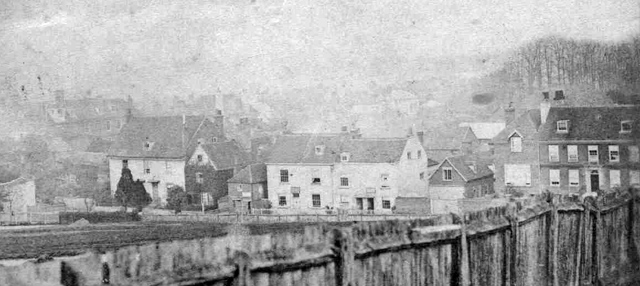 An 1860-ish view over Epsom from Mounthill.
On the far left can be seen the roof of the “Assembly Rooms”. All the other buildings have been lost except those in the centre which were integrated with the present-day Epsom Playhouse to form its bar area. The building on the right of the picture is “The Shrubbery“.
Photograph by George Snashall, from the writer’s collection.
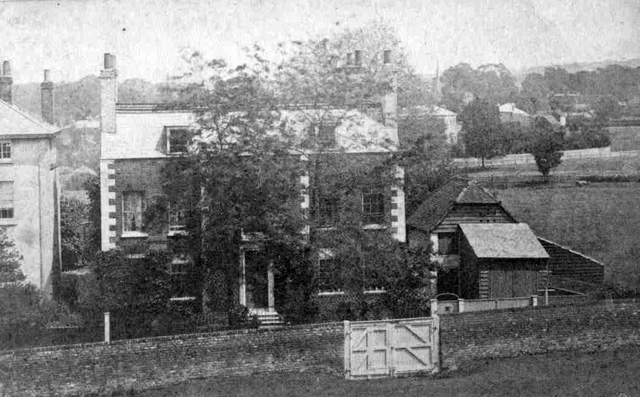 An 1860-ish view from Mounthill.
To the right is part of the area that later became Rosebery Park. In the foreground is the now lost “Mead House”, the site of the present day “Novellus Court”.
Photograph by George Snashall, from the writer’s collection.
The 1990s image of Mounthill below has the original solid Victorian house on the right of the building with, on the left, the wing that was added between 1913 and 1932.
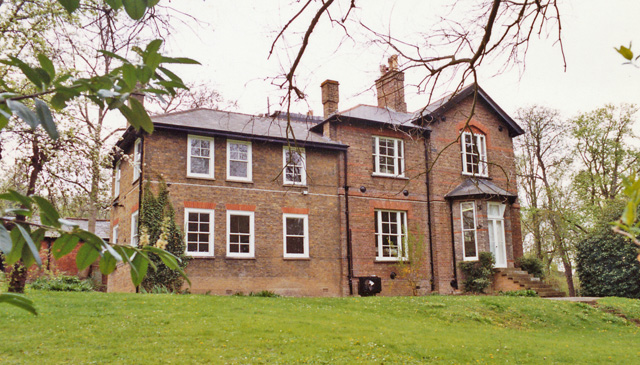
Mounthill in the 1990s.
Photograph with thanks to Bourne Hall Museum
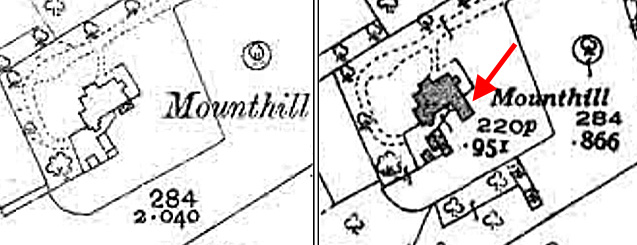
Mounthill in the 1913 (left) and 1932 (right) Ordnance Survey maps, with the new wing arrowed in the latter.
Almost the first residents of Mounthill were the Phillips family. In 1891, the occupants were the Burlton family, whose son Francis was a WW2 casualty. By the time of the 1911 Census, the house was occupied by a 39 year old couple, John – a “Muslin Manufacturer” – and Constance Torrance, supported by three domestic servants.
The September 1939 Register records the occupants as 60 year old Alec Guy Houlder – “Lt Colonel (Retired) Invalid” – his 46 year old wife Muriel – with the conventional “Unpaid Domestic Duties” – supported by three domestic servants. The Houlders had been there for some years: Alec first appears at that address in the 1927 Kelly Directory. And, after Alec’s death at Mounthill on 19 April 1947, the relationship with their former neighbours in Rosebank was strong enough for the widowed Gertrude Swainston (by then living in College Road) to be appointed as one of the executors of Alec’s £124,269 estate.
It seems likely that Alec’s death was the trigger for Mounthill and its grounds coming onto the market in 1947 – logically linked to the sale of the adjacent grounds of Rosebank and, following the 1940 bombing mentioned above, its assumed to be derelict house.
These properties and their grounds were purchased by Epsom & Ewell Council in 1950. To cope with the shortage of accommodation, the Council used Mounthill as offices, keeping with it the surrounding formal garden all as highlighted yellow in the map near the beginning of this article. (The above photograph of the house dates from this period.) As Council office accommodation was rationalised, Mounthill was no longer needed and, in the late 1990s, the old house was demolished and Saddlers Court, a large block of retirement apartments was built on the site, opening in 1998. The area highlighted yellow in the map is, today, that Saddlers Court, its grounds and access road.
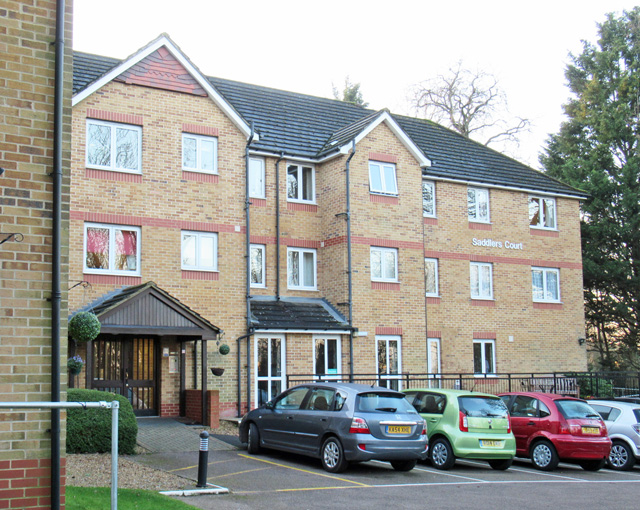
Part of Saddlers Court, taken from about the same point as the 1990s picture of Mounthill above.
Photograph © Roger Morgan 2020
Mounthill Gardens
Finally, we come to the five acres of the 1950 purchase that the Council had earmarked as a park.
Because of the gradient from South Street, a lot of work had to be done before the park could open to the public. A landscape specialist was appointed to advise on laying out the steeply sloping site. The work was to be done in four stages and the original estimate of £7,140 was later doubled.
The solution, in place for the opening day in 1965, was a roughly circular path starting and ending with the two entrances from South Street (one each side of the roadway to what is now Saddlers Court) which, at the top of the slope, also had access from the spurs of the new Rosebank housing. Up the central steepest slope, just to the south of what is today Saddlers Court, was a zig-zag paved path.
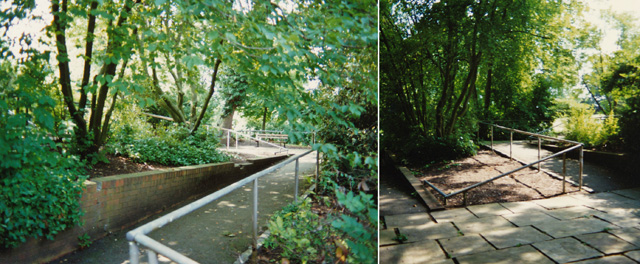
Two views of the original zig-zag path in the centre of Mounthill Gardens.
Photographs with thanks to Bourne Hall Museum.
The York stone paving of this zig-zag path became unsafe and it was subsequently replaced by a more direct (but steeper) tarmac path.
In the northern section of the new Gardens (behind the original Rosebank at 2 in the the map near the beginning of this article) was a bed planted with scented varieties for the enjoyment of the blind.
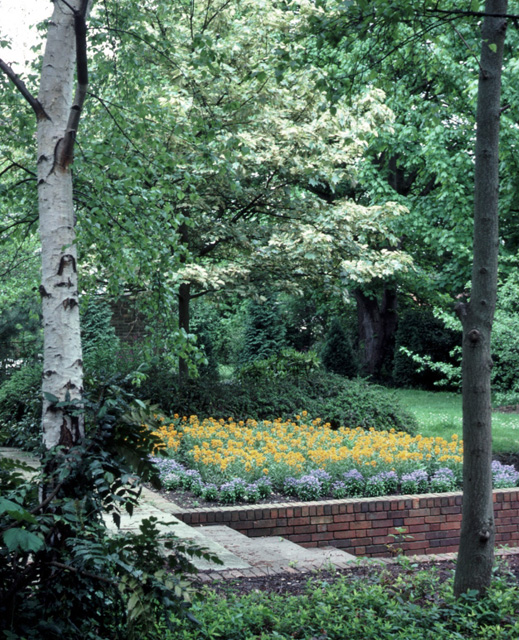
The original “sensory garden”.
Photograph with thanks to Bourne Hall Museum.
This “sensory garden” proved to be a non-starter: Swail House, the nearest centre for the visually impaired, was two main road crossings away on the other side of Rosebery Park. The raised bed remains but is no longer specially planted.
There was a tragedy in the Gardens in 1965. A local boy, 13 year old Alan Richard Jones, was playing there when he was run over by a grass cutting machine and badly crushed. The injuries and consequent complications were such that he could not be saved, and he died at Hammersmith Hospital on 19 October. The Inquest of 26 & 29 October 1965 returned a verdict of “accidental death”. There was talk at the time of erecting a memorial in the Gardens to his memory, but that was not realised.
Today, Mounthill Gardens is a small and peaceful park with shady walks and seats for hot summer days. (It was not always peaceful: there is a report of the peace being shattered more than once in the late 1960s by the Rolling Stones rehearsing in the nearby bungalow of their early manager.) The Gardens also provide a short cut to central Epsom for those living in the housing around Rosebank – that name being a reminder of the lost property at 32 South Street.
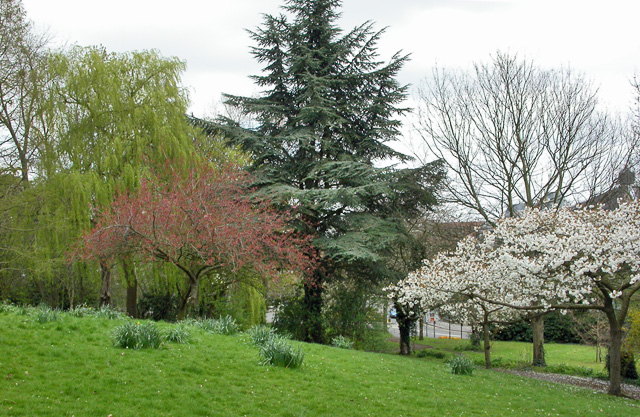
The southern section of Mounthill Gardens in the Spring
Photograph with thanks to Bourne Hall Museum
Roger Morgan © 2020