
The disputatious Captain James Battersby
of the 29th Regiment of Foot,
and his duel on the Epsom racecourse in 1784
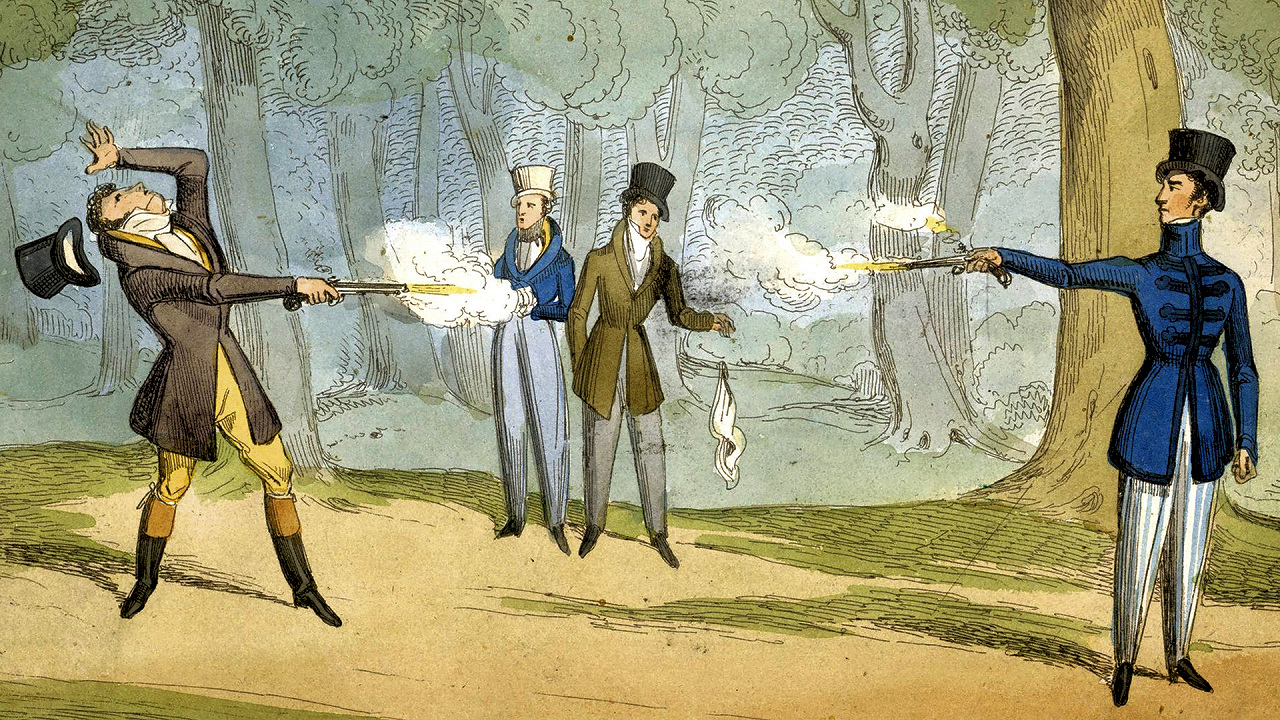
Pistols at Dawn. Image source: not known.
James Battersby was an Irishman (b. 1751) who entered the 29th Regiment of Foot as an Ensign in 1770 “at which time this regiment was stationed in Boston and won unpleasant notoriety in the ‘massacre’ of the fifth of March following. He was promoted to a lieutenancy, December 16, 1773, and in February,1776, embarked at Chatham with his regiment for the seat of war in America. He was wounded in the action of October seventh, and was one of the convention prisoners. He was promoted to a captaincy, February 16, 1778, while a prisoner. His name appears on the army lists for the last time in 1784”. Battersby had been in the companies which surrendered with the rest of Burgoyne’s force in October 1777 following the Battles of Saratoga. He was amongst the prisoners exchanged on 24 January 1781 and returned to his Regiment in Canada.
Complaint of wrongful imprisonment
While a Prisoner of War Lieutenant Battersby pursued an objection to his incarceration in a guard-house, through Lieut. Gen. Burgoyne to Maj. Gen. Heath, as shown by the latter’s response:-
“Headquarters, Boston, March 27, 1778.
Your favour of yesterday, enclosing a complaint of Lieutenant Battersby, came to hand the last evening, and was new and surprising to me, as the least hint of it had not been communicated by my officers.
Strict order and discipline are constantly inculcated and required in my orders, and always where it respects officers, whether Continental or of the Convention, that delicacy which is due to the character of the officer and the gentleman, is strictly enjoined. The time of night when the lieutenant was taken up, and the terms of his parole, might properly subject him to confinement until the morning. This, however, ought to have been in the officer’s room, and not with common prisoners. But you are sensible that the officers of the guards, although men of the best characters, are not so fully acquainted with the refinements of military discipline as were to be wished. It must, therefore, be considered as an error of judgment, and from the best intelligence, it is an error which has been frequently committed during the present war, especially at New York, where our unfortunate officers are often sent to the provost for the smallest trifles, and sometimes they know not for what, and there remain for weeks. It is a proceeding, however, which I equally detest, both there and here, and have ordered Colonel Keith to release Lieutenant Battersby immediately, which should have been done the next morning afer his confinement, had it been reported to me.
I am, your Excellency’s most obedient servant, W. Heath”
The Robert Morris Affair
As remarked in an article on this website about the 6th Lord Baltimore, Frederick Calvert had, amongst a number of illegiimate children, fathered Frances Mary Wheland, alias Harford. She, reportedly aged only 13, came to marry Robert Morris.
Morris had been named as one of Lord Baltimore’s Executors but controversy arose over administration of the deceased’s estate leading to the case of Harford versus Browning heard in Lincoln’s Inn Hall, 19 January 1787. In the course of those proceedings it was testified:-
“On the 5th May 1772, Robert Morris one of the executors contrived to carry away the plaintiff Frances Mary Harford, then only between twelve and thirteen years of age, from the boarding school at which the executors had placed her, and took her abroad, where he went through the form of a celebration of marriage with her two several times; and they continued abroad some time...
Robert Morris had on the 21st day of May 1772 compassed the celebration of a pretended marriage with the said Frances Mary Harford at Ypres, in Austrian Flanders, and had carried her from thence to some place near Hamburgh,…
On the 5th of January 1773 Robert Morris celebrated a second marriage with the said Frances Mary Harford at Ahrensburgh in the Duchy of Holstein…
A suit of nullity of marriage having been instituted in the Court of Arches against the said Robert Morris, and brought by appeal before the delegates, the two marriages were declared null and void to all intents and purposes.”
[The heiress had already gone on to join in matrimony William Frederick Wyndham, the fourth son of the Charles Earl of Egremont, at her home at Russell Place, St Pancras, Middlesex, 21 July 1784. On 6 April 1785, Mrs. Frederick William Wyndham was granted the arms of her reputed father. She died in 1822 ]
In The Life and Career of Major John André: Adjutant-general of the British Army in America, Winthrop Sargent, writing in 1861 about Benedict Arnold, remarked:-
“A more interesting tirade, insomuch as it lets in more light on Arnold’s history, was made by a Mr. Robert Morris, a Welshman, who had been Secretary to the Bill of Rights Society. Morris had been left in a confidential relation by Lord Baltimore to his natural daughter. The girl had property, and he married her while she was yet very young. In two years she separated from him. He published his transactions about Arnold in a pamphlet of which I know of but one copy. It is entitled Morris, Arnold and Battersby. Account of the Attack I made on the character of General Arnold, and the dispute which ensued between me and Captain Battersby. R. Morris. London,1782.’ 8vo. pp. 32.
The fray began by Morris publishing, Feb. 9, 1782, a letter in the General Advertiser, in which he says Arnold had been transported from England to America for horse-stealing and was thus exposed in both countries to be hanged. But he should not be averse to the rope, since he left André to be hung, to spare himself the risk of sending him back as he came. ‘He sent him off to run every hazard by himself, secure of his own flight in case André was stopt’ The bribe was all he wanted: ‘$8000, which he was sure to touch, was a capital sum for such an original beggar’. He is indignant at Arnold’s reception at Court. ‘When Sir H. Clinton was trying every negotiation and manoeuvre to save his Aid-de-Camp, when whole battalions were turning out to make an offer of their blood in one desperate attempt to rescue him from the midst of the American Army, this inglorious fellow, who had brought him into and left him in all this scrape, made no offer of the surrender of his person back to the Americans, which he knew was a sacrifice that would at once be accepted, and would be a sure preservation to Major André from his impending fate;. He concludes with the wish that Arnold would resent his letter; but unfortunately, liberal as he is of assertion, he had made one here that did not serve his turn. A Captain James Battersby, of the 29th Foot, who had sailed from Chatham, Feb. 28, 1776, for the relief of Quebec, and was captured with Burgoyne and several years a prisoner, had returned to England in the summer of 1781 [on leave]. He wrote to the Morning Herald that he verily believed Arnold did offer to surrender himself. Morris’s reply evaded this point, and generally abused Clinton and Arnold: on which Battersby wrote a sharp letter, suggesting that he had already offered to fight Morris and now repeats the challenge: that Arnold will not notice such a low fellow:-‘were he disposed to resent audacious and unprovoked insolence, there are a few braying asses of rank whom he would first chastise’:- but the captain has ordered one of his negro drum-boys to chastise his antagonist. Morris again writes in general invective against Arnold, and follows with an address to Battersby, in which he says he does not believe the story of Arnold’s offer of surrender, because he never heard it from any one else: and that if it were true, Armold should have gone off without Clinton’s knowledge. Morris now strove to get a meeting from Arnold while a friend looked after Battersby. ‘Captain Battersby’, he gently observes, ‘I should have no objection to see killed by any other hand instead of my own, while there was any chance of General Arnold giving me the meeting’. Volunteers came to his aid against Anti-Yankey (Captain Battersby): ‘I am your man’, writes Mr. Thomas Halling, ‘against Anti-Yankey, or any other rascally refugee whatsoever. I’ll fight him, I’ll beat him, I’ll roast him, I’ll eat him’.
At last, a duel was arranged. Major Stanhope (Lord Harrington’s brother) was the captain’s second; but being prevented from acting, Governor Skeene took his place. Captain Ballie acted for Morris. A reconciliation however intervened and the dispute was accommodated: and since Arnold’s courage at least was unquestionable, we must suppose there was some other reason for his not meeting his assailer. In truth Morris’s publication was in very bad taste. He says Burgoyne remarked of the dispute between himself and Battersby and its occasion: ‘that it was just like two gentlemen quarreling for a common. …’.”
Between 25 December 1782 and 24 June 1783 Battersby seems to have been back in Europe, marked ‘Absent’ in his Regiment’s Muster Roll.
The Duel between Henry Drummond and Captain James Battersby 1784.
A series of letters may be found reported in The Political Magazine and Parliamentary, Naval, Military, and Literary, Volume 8, [LINK]
In the first from the Free Masons Tavern [established in 1775 at 61-65 Great Queen Street in the West End of London], 17 December 1784, Battersby took up the case of a lady and her horse said to have been mistreated by the banker Henry Drummond, junior [1762 -1794?]. The parties eventually arranged to meet on Epsom Downs, near the Stand, for ‘hostilities’ at 10 a.m. on Sunday 19 December. Mr Drummond fired the first shot but without effect. A ball from Captain Drummond’s return passed through Drummond’s elbow to lodge in his wrist before being safely removed by a surgeon in attendance. In a subsequent compliment to the character of his adversary Captain Battersby attributed some misunderstanding to the ‘petulant duplicity of a stable-keeper’!
Captain Battersby’s demise
On the morning of 22 February 1785 Captain Battersby, then an officer on half-pay, went to visit Mr [William] Cowden, Agent of the 29th Regiment, at King’s Mews [Charing Cross, formerly the stables for the king’s horses, on the northern side of Trafalgar Square, where the National Gallery now stands ]. There he took his own life.
According to The Gentleman’s Magazine: 1785, Volume 55, Part 1:-
“His martial and uneasy spirit frequently involved him in unnecessary broils and disputes. Under prosecution for several breaches of the peace, he, who could smile at captivity in a military prison in America, could not brook confinement in a civil gaol in London. That he had a serious sense of the enormity of the crime he committed on himself, a paper, superscribed with his own hand found stuck upon the point of the penknife (which he had taken up unobserved in the house he was in, and with which he perpetrated the act of desperation) will shew. It contained the following words and marks : ‘An apology (if any there can be) for suicide. Death before dishonour!!!’
The coroner’s inquest sat next day on the body, and brought in their verdict Lunacy. This new mode of palliating suicide is certainly one great cause of encouraging self-murder!”
[Later, Coroners never used the word ‘insanity’. They preferred the more compassionate verdict that the subject had ‘taken his life while the balance of his mind was disturbed’. ]
William Cowden, a fellow Irishman, Clerk of the queen’s Stables and Agent for both the 29th Regiment and 16th Dragoons died at the King’s Mews on 14 October 1784. His Will was proved in the Prerogative Court of Canterbury, 28 October 1784, and in Ireland.
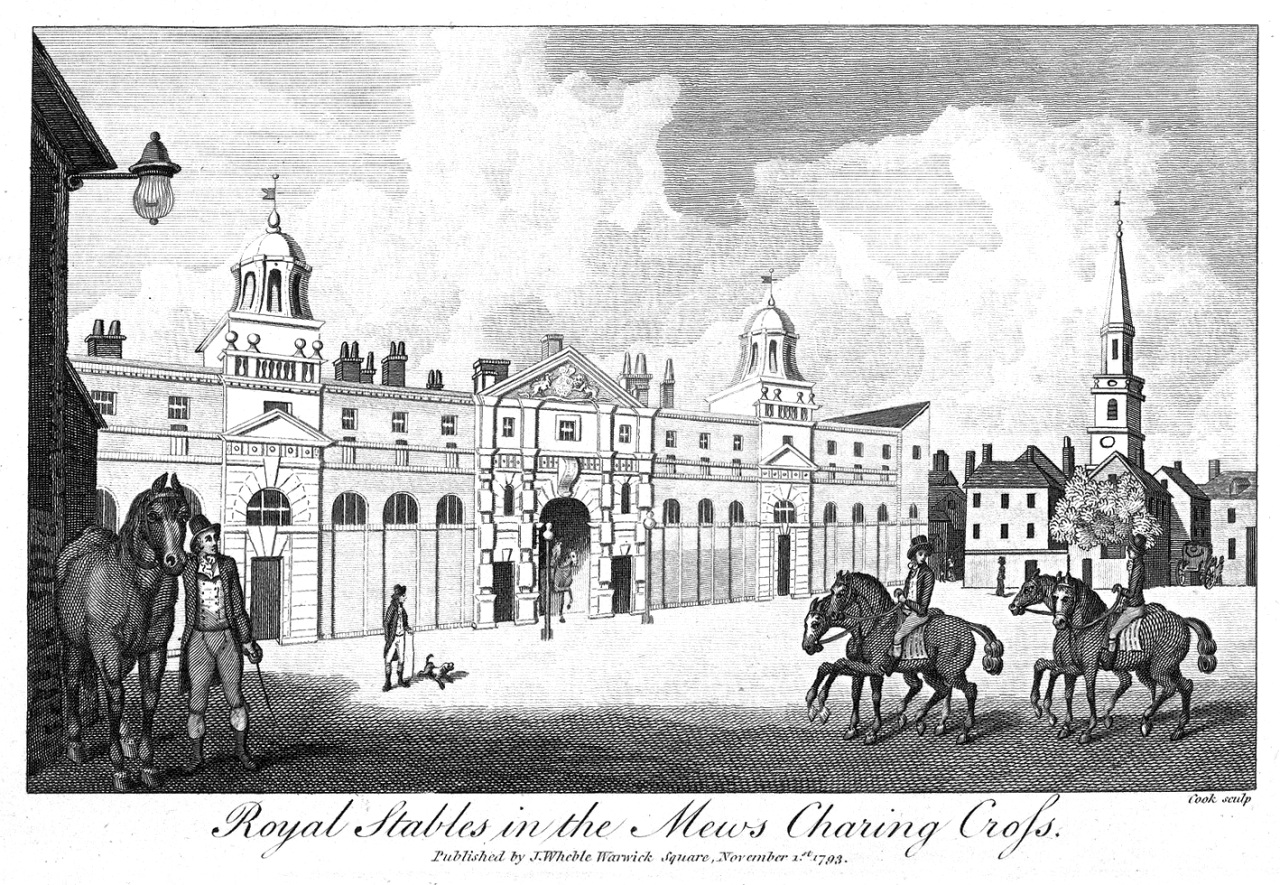 Royal Stables in the Mews Charing Cross published 1 Nov 1793
Image source : Royal Collection Trust