
NORMAN WITHALL ASTON (1883-1900)
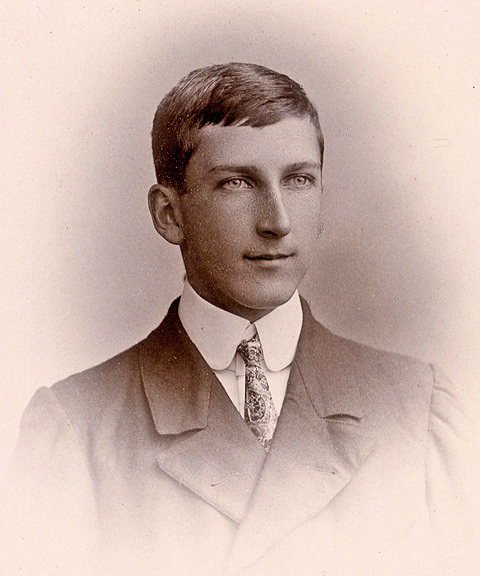 The teenage Norman
Photograph courtesy of and © The Eton College Photographic Archive
At first glance, the red and white tiling at the east end of Christ Church Epsom Common and the quotation (“Be thou faithful unto death and / I will give thee a crown of life” – from Revelation 2:10) in gold on blue above appears to be part of the elaborate decoration, as illustrated below, around the East Window. It is, however, the result of a quite separate 1900 project.
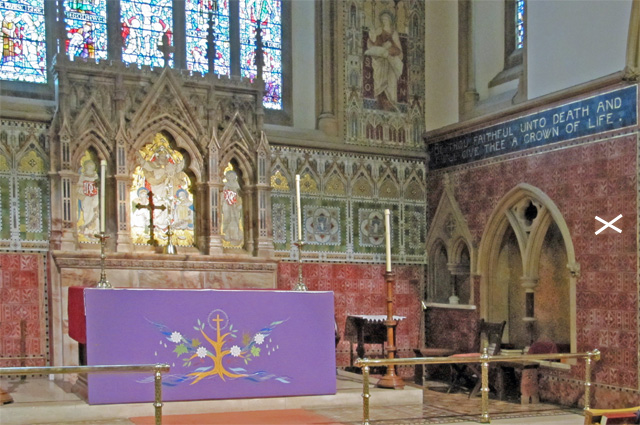 Part of the decoration around Christ Church’s high altar
(The white X marks the dedication text, see below)
Photograph by Roger Morgan © 2019
The exquisite “Opus Sectile” (Powell’s “opaque stained glass”) and mosaic work around the East Window was installed during Advent 1887 in memory of William Trotter (1800-87) of Horton Manor who had been instrumental in the mid-1860s building of the present church. As noted in the panel (marked with a white X in the picture above and as illustrated below) discreetly tucked away under the quotation, the tiling is dedicated to “Our dear son Norman Withall Aston who died at Eton College, Good Friday 1900, aged 17“. (As discussed at the end of this article, there was other, but now lost, decoration of the Chancel as part of the memorial – and the tiling itself is technically interesting.)
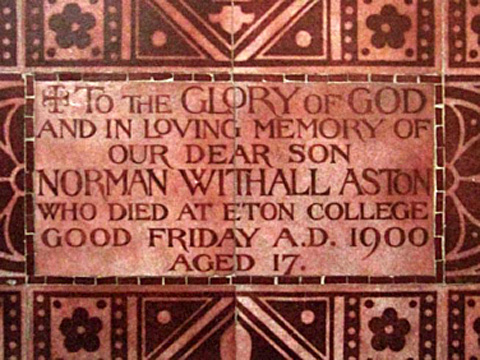 The dedication to Norman Aston
Photograph by Roger Morgan © 2019
Norman Withall Aston was born in early 1883, the second child of Alfred Withall Aston and Frances Amy (née Hennell ). The couple had married in Q4 1879, registered in Kensington. Each was from a more than comfortably off family: Alfred’s father was a Barrister and Frances’s a “Merchant”, and both their households were supported by a number of domestic servants. The 1881 Census records the recently-married 29 year old Alfred (“Member London Stock Exchange”) and 22 year old Frances living at 7 Stanhope Place, London (just to the north of Hyde Park) with their first child, new-born Dorothy. They were supported by four domestic servants.
The couple had two more children while in London: Norman in early 1883; and Harold (who was in the forces for both World Wars) in late 1884. By the time of the 1891 Census, the family had moved to West Hill Lodge – a grander house than its name suggests – on West Hill, Epsom. (The house was demolished in 1959 and the homes around 35 West Hill were built on its site.) The five-strong family (with Alfred now listed as “London Stock Exchange Dealer”), plus three visitors, are recorded as supported by six domestic servants and a groom.
Alongside his obviously successful stockbroking, Alfred was active in local and wider affairs. For example: he chaired the then Epsom Urban District Council for two years; with the encouragement of his friend, Lord Rosebery, he contested (unsuccessfully) the Epsom constituency as a Liberal in the 1906 Parliamentary elections; and he was involved in many local and national benevolent institutions. Alfred was also a Churchwarden at Christ Church Epsom Common for a total of some 20 years – 1894-1911 and 1916-18.
Alfred’s friendship with Lord Rosebery seems likely to be the explanation for the couple’s fourth child, May (born on 7 May 1895 and baptised at Christ Church on 1 June) being given “Primrose” (Lord Rosebery’s family name) as one of her Christian names. The parish record of that baptism noted the family’s address as West Hill Lodge. Before long, however, the family moved to the even grander Woodcote Grove.
In the meantime, teenage Norman was a pupil at Eton College. The reason for his death, aged just 17 on 1900’s Good Friday (which, in that Century year, fell on the inauspicious thirteenth of April) is set out in his Death Certificate. This records that he died of “Pleuro Pneumonia (8 days) following 14 days of Rubella” (German measles). It is likely that modern medicine would have saved him but, in those days before antibiotics, Norman was simply one of the many who died – of what we regard today as minor illnesses – well before their time. As Norman’s was not a sudden death, the family was able to be with him at the end: the Certificate records that his father was present at the death, noted as being at “The Timbralls”, one of the houses at Eton College.
Six days later, on 19 April 1900, Norman was buried in Grave A166 of Epsom Cemetery. The headstone, illustrated below, carries the inscription “In loving memory of our dear son Norman Withall Aston who died at Eton College on Good Friday April 13th 1900” and concludes with one of the beatitudes from Matthew 5:8, “Blessed are the pure in heart, for they shall see God“.
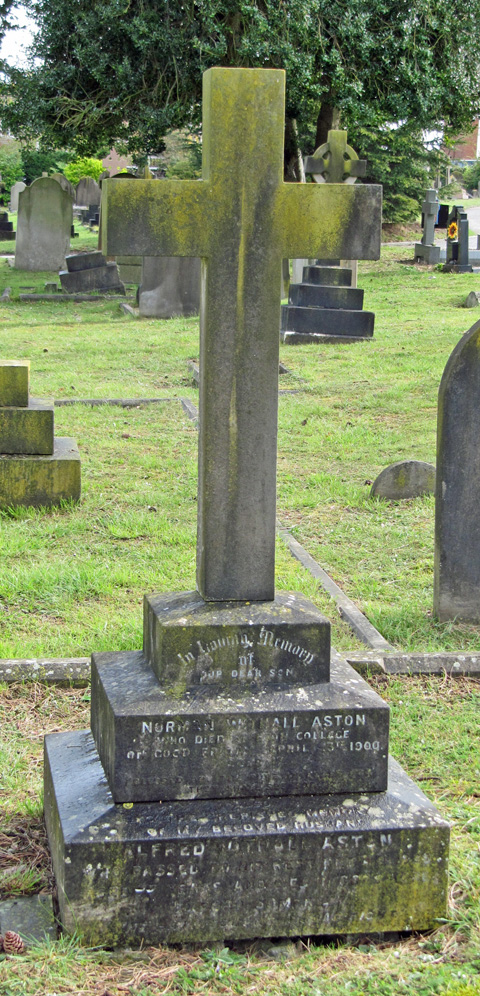 Norman’s headstone in Epsom Cemetery
Photograph by Roger Morgan © 2019
Both the 1901 and 1911 Censuses record the Aston family (with seven domestic servants) at Woodcote Grove. Alfred is listed not only as a “Member of the Stock Exchange” (he was a senior partner in the firm Hensley and Aston) but also as a “Justice of the Peace”. (The 1901 Census also styled him as a “Gentleman”.)
After WW1, the Aston parents retired to Court House, Exford – a rural village in the centre of Exmoor. Alfred died there on 4 October 1929, aged 77. The widowed Frances remained in Exford (being recorded still at Court House in the September 1939 Register with her unmarried daughter May, some visitors and servants). She died there on 26 July 1944, aged 85. Both parents’ names were added to Norman’s headstone in Epsom Cemetery, but the Cemetery’s records make no mention of their burial in the plot.
The lost decoration
Norman Aston died during the long incumbency (1881-1911) of Christ Church’s second vicar, the Revd Canon Archer Hunter, who in his 1935 memoir Incidents in my Life and Ministry noted that, as an integral part of the parents’ memorial for Norman, the walls and roof of the Chancel had been “most beautifully decorated”. In his contribution to Christ Church’s 50th Anniversary history in 1926, Canon Hunter noted that the artist was “Mr Bryans of Regent’s Park”.
Those decorations were lost when the Church interior was redecorated in the 1950s. We now have only tantalising glimpses of them in the two monochrome photographs below. (In addition to geometric stencilling on the walls, the lower part of a winged angel can be seen in the left hand image.)
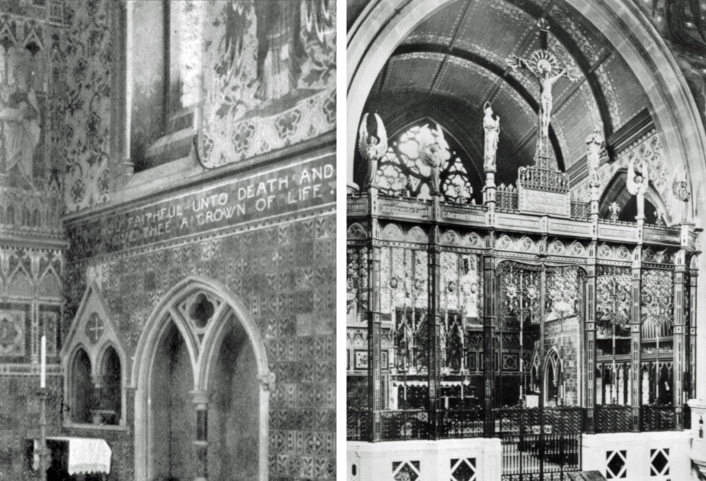 Left: part of a picture from Christ Church’s 50th Anniversary history in 1926
Right: part of a 1916 postcard
A technical note on the tiles
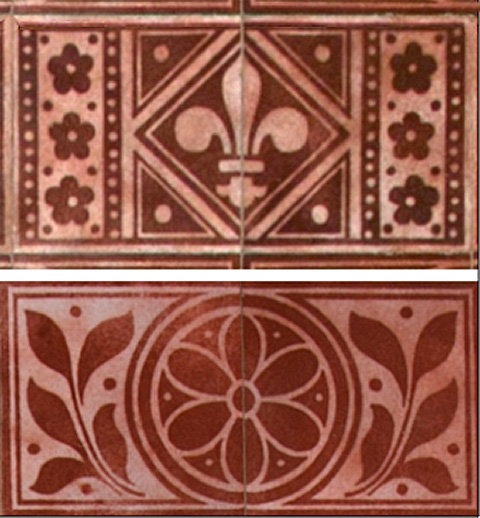 Some detail of the tiling
Photographs by Roger Morgan © 2019
The tiles are not the usual glazed ceramic tiles but a comparatively rare example of glass tiles made by James Powell & Sons – better known for their stained glass, of which Christ Church has many fine examples. These tiles were sort of a by-product of stained glass manufacture, much of the source material being waste glass contaminated by clay from the crucibles in which the glass had been smelted.
The starting point for each tile was a sheet of plain glass. The pattern was formed by applying powdered coloured glass through a stencil. The geometric patterns are, as illustrated above, made up of two square mirror image tiles – the mirror image being simply achieved by reversing the stencil.
After stencilling the pattern, a frame was fitted around the glass sheet which was then filled to the required thickness with the background colour of the powdered glass/clay mixture. The whole was then transferred to the kiln where it was fused into a solid tile. This explains how the design appears to float in the middle of the tile.
Red (the main colour at Christ Church) was Powell’s usual colour. Elsewhere, there are some examples of large glass tiles in blue and even fewer of green ones. Sections of glass tiles in those rarer colours are seen at Christ Church – as shown below: in the blue background (of “crazy paving” mosaic) to the Bible quotation; and in the green and blue boundary to the main tiles.
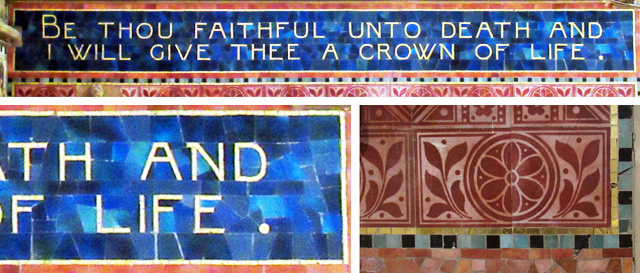 Examples of blue and green glass tiling.
Top: the Bible quotation (with more detail bottom left).
Bottom right: the green and blue edging.
Photographs by Roger Morgan © 2021.
Roger Morgan © 2019 & 2021