
Ashley Centre
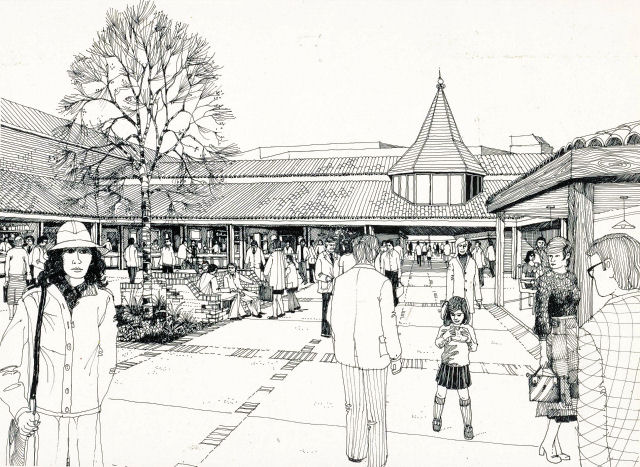 An Artists Impression of the proposed Ashley Centre c. 1975
In June 1975 Epsom residents were presented with an outline of the Ashley Avenue Redevelopment Scheme, some ten years after the project had first been proposed. At this time Kings Shades Walk, a small 1960s shopping development, was the only post-War retail building in Epsom. The Walk took its name from the Kings Shades, a beer house which had stood next to the historic Kings Head pub. Both properties were demolished to make way for the new development. Kings Shade Walk was later covered over and became the entrance to the shopping centre from the Market Place. It disappeared into history like its namesake when it was incorporated into the new Boots.
 High Street. King’s Shade precinct entrance. Photographed by L.R. James in 1966
Image courtesy of Epsom & Ewell Local And Family History Centre
The Kings Head had already been trading under this name in 1663, three years after the Restoration of the monarchy, and Samuel Pepys stayed there on one of his visits to the town. This was one of the social centres of Epsom. In the late 1770s it was used for vestry meetings, and in the 1830s the original courtyard was enclosed to form a large assembly room in which county balls, dinners, concerts and fetes were held. At one time it hosted a corn exchange along with toy fairs. In the nineteenth century the landlord claimed that two hundred people could sit down together for dinner here, while at quieter times gentlemen could play a match in the billiard room or enjoy a smoke in the saloon, while their horses were housed in the livery sable at the rear.
 Epsom High Street on 5th December 1963
By the 1970s, Epsom had become a third-rate shopping centre and was falling behind Camberley, Woking and Staines; local people had got used to shopping in Sutton, Kingston and Guildford. Matters had not been helped by the number of banks, building societies and estate agents which had taken over retail shops. But Epsom had a lot going for it. There were 170,000 people living in the town’s catchment are, and 75% of them earned more than the national average wage.
 Another view Epsom High Street on 5th December 1963
The new centre would provide first-class shops and an attractive shopping environment, but it was also planned to preserve the existing High Street and its historic buildings. By building behind the High Street and keeping offices and car parking at the back, and by hiding the service areas in the centre of the site, it would be possible to retain the character of the old town. What was in fact a second, under-cover High Street was built running behind the old one with links to the old town, an improved market place and new car parks for 800 cars.
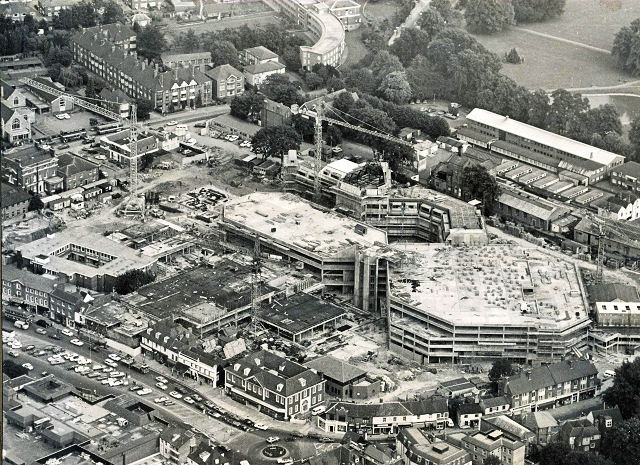 An aerial photograph of the Ashley Centre construction site
A new road diverted traffic away from the Market Place around the back of the Centre, and this greatly improved the environment, making traffic through the town less congested. A very similar arrangement had in fact been tried in Victorian times but had been stopped by Lord Rosebery when he bought up land and gave it to the Council as a park, which was named Rosebery Park after him. He did this in order to stop such a proposed road causing disturbance to his daughter’s house on the Dorking Road.
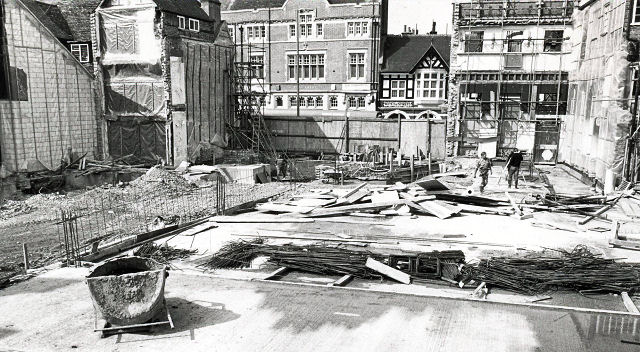 The Ashley Centre under construction
Just before Christmas 1979, a four-day public enquiry was held into the ten-million-pound plans. There were many interested parties; 21 freehold ownerships and 39 different leasehold interests had to be taken into account. Hopes were now riding high on the new centre which would, when completed, provide 1,500 new jobs. Most people felt that the crucial player in whether the scheme went ahead was Marks and Spencer. If they took a space, everything would be alright; if not, the scheme was in danger.
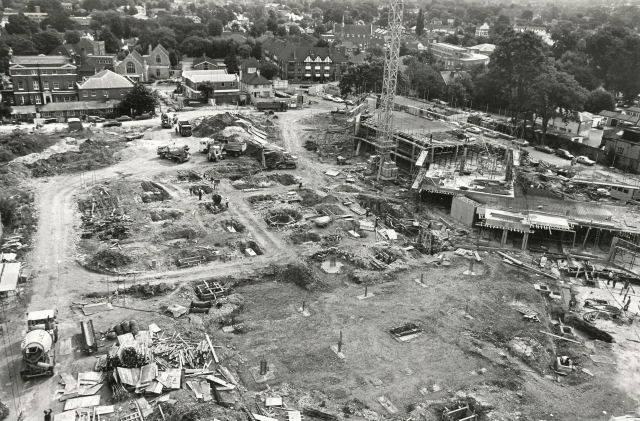 The Ashley Centre under construction
March 1980 saw the Town Centre Scheme, as it was now known, approved – but the cost was now twenty million pounds. There were new fears as Sainsbury’s announced their plans for a new supermarket opposite. How would this affect the new centre? When Waitrose said they would move from small store in the High Street into the new centre, it became obvious that the whole balance of shopping was tipping from the High Street into the new development.
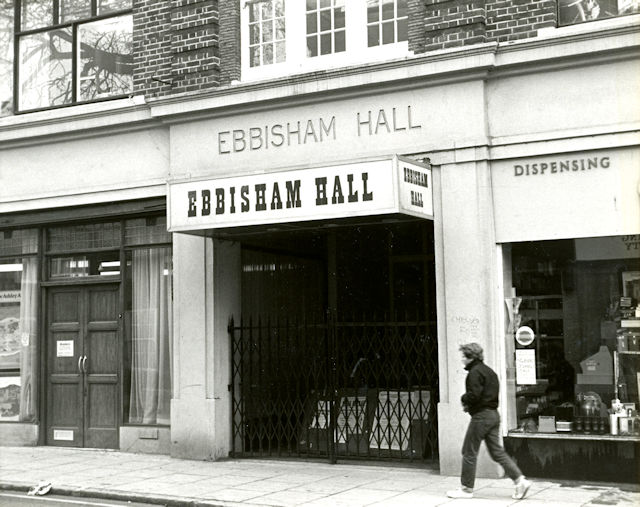 The entrance to the Ebbisham Hall became an entrance to John Menzies (later, W H Smith)
In June work began and, by January 1981, clearance and demolition was completed. In cottages off South Street, later to become part of the Playhouse, rare seventeenth-century wallpaper was discovered beneath the panelling. As the work progressed, Bourne Hall Museum worked with the developers to recover as much as possible of the archaeology on the site. This cast new light on Epsom’s days as a Spa town, and countless chalk-lined wells and rubbish pits yielded up their secrets. One contained the remains of a large number of dogs, and the other a large and important collection of clay pipes, thrown out from the old Assembly Rooms.
 Interior shot of the Ashley Centre
The Assembly Rooms, built in 1692, had been the first premises of its kind in the country. Here visitors to the Epsom Wells went to see and be seen; the building housed a tavern and coffee shop with rooms for dining, dancing and gambling. At the back there were areas laid out for bowling and cock-fighting. A grand flight of stairs took visitors up to the dining room and ballroom, so that in wet weather they could step out of a sedan chair under cover of the archway. The original assembly rooms closed in the 1720s and were used for many years first as homes then as shops, with a builder, an upholsterer and even an undertaker housed in different parts of the premises. Ely’s of Wimbledon restored the building in 1952 and after some years as a building society it is now a pub again.
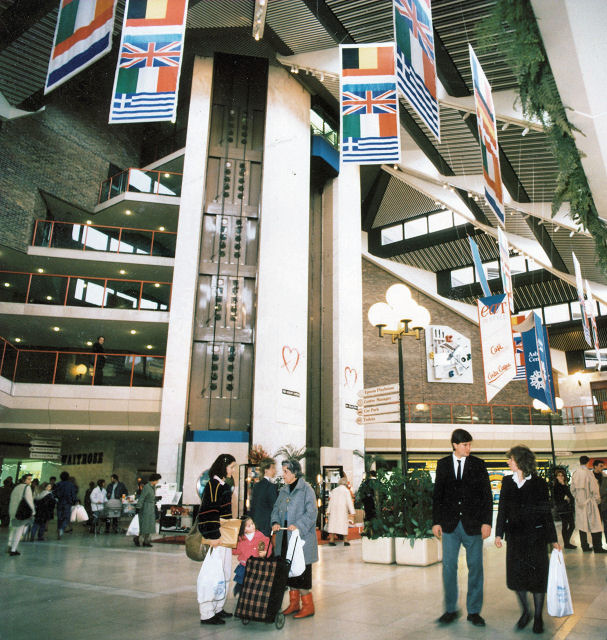 Another interior shot of the Ashley Centre
Proposals for the new shopping centre had originally included a cinema and library. The library had fallen out of the scheme quite early on, and the cinema was now dropped, although the café and management offices occupying the designated space were felt to be poor replacements. With the abandonment of the cinema the developers, Bredero, offered an area to the Council as an Art Gallery – this is now incorporated into the upstairs section of Waterstones. The Gallery opened in June 1985 but had closed by the end of that decade. These two units were combined and are now Sports direct (2024)
 The Ashley Centre was named after Ashley House
This photograph of Ashley House was probably taken in the early 1900s.
Image courtesy of Epsom & Ewell Local And Family History Centre
The cost had now reached twenty-five million. In 1981 the project became the Town Centre Development Site and it was not until 1982 that it was called the Ashley Centre. The name Ashley has its root in Epsom’s past – its immediate source was Ashley Avenue, the road which was pulled down to build the Centre, but this derived its name from Ashley Road, and this road in turn was named after Ashley House, a fine property built in 1769 which still stands facing the Parade. The house took its name from Mary Ashley, a great benefactor to the local poor, who lived there until her death in 1849. Much of the Ashley Centre was built on land that had at one time been Mary Ashley’s garden. In 2007, after a change of ownership at the Centre, the new management decided to call it the Mall, but no-one else followed suit, so it went back officially to being the Ashley Centre in 2009.
 Ashley Avenue prior to its demolition to make way for the Ashley Centre
During 1982, Petrofina (UK) Ltd took the office space as its headquarters. By June, building work had reached the half-way point. The council wanted to redevelop the old Ebbisham Hall which had long been the social centre for the town. But to bring this old building up to date would have cost so much that a new theatre was built instead. It was originally intended to call this replacement the Spa Theatre, but it was formally opened as “Epsom Playhouse” on 24 January 1984. (Part of the shell of the Ebbisham Hall still survives as part of W.H. Smith.)
 The Queen opens the Ashley Centre in the pouring rain.
The Centre was finished in October 1984. It was a feat of the modern builder’s art, containing 250 miles of bricks, 72,000 tons of concrete and 3,000 tons of steel, and cost had finally escalated to thirty-seven million pounds. It was officially opened by the Queen on 24 October 1984. Despite the torrential rain, some two thousand people turned up to see Her Majesty. Arriving some 15 minutes later than the scheduled three o’clock start, she was greeted by a roar of welcome which was only just louder than that given some three minutes earlier to John Furniss as he grabbed a vacuum cleaner to remove some footmarks from the red carpet. The first thing that the Queen saw was a shop selling umbrellas and she said that they should do a lot of business that day.
 The original Ashley Centre Clock.
(See the postscript below.)
Text by David Brooks, Bourne Hall Museum
Unless otherwise indicated images courtesy of Bourne Hall Museum
Postscript
The Centre’s original and rather quirky clock (at first floor level, next to the lifts to the car park) was replaced in 2004 with a more conventional timepiece as below.

The replacement clock, installed in 2004.
Photograph by Roger Morgan © 2021.
The plaque underneath the clock face reads “This clock is to commemorate / the Mall Epsom’s [as the Ashley Centre was known at the time] / 21 years service to the Community / and was unveiled by / the Mayor of Epsom and Ewell / Councillor Brian Angus / on / 18th September 2004″.
Roger Morgan
We are very grateful to Steven Coe who let us us use these photographs of the models
he made at the start of his 46 year career whilst working for a London based company.


