
The SS Ewell
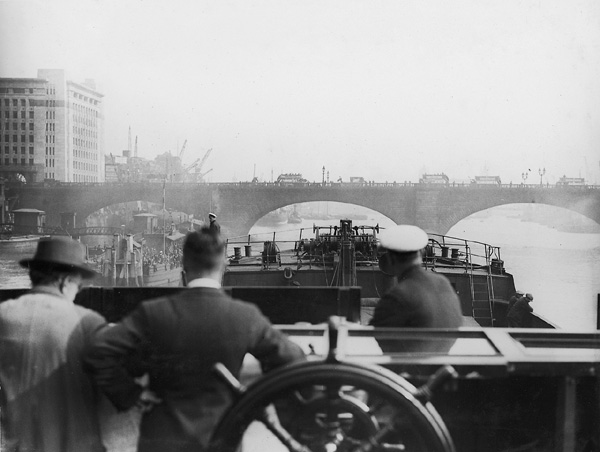
The SS Ewell on 22 September 1926 approaching London Bridge with her mast, funnel and wheelhouse folded down.
Image source: Flickr & Royal Museums Greenwich
The SS Ewell was a “flatiron” – a type of coastal trading vessel developed in the UK in the latter part of the 19th century. They were designed to pass under bridges with limited clearance: so, masts and funnels were hinged and wheelhouses could also fold flat. Most were colliers built to bring coal from North East England and South Wales to gasworks and power stations on the River Thames that were upriver from the Pool of London.
The SS Ewell was built in steel by the Burntisland Shipbuilding Co. Ltd.(yard number 138) and was launched on 29 May 1926. It had a gross tonnage of 1,350 and was 226ft long x 36.4ft wide x 16.5ft high; and was powered by a 3cyl North Eastern Marine engine. It was completed in July 1926 and was given the official number 148788. It was built for the Wandsworth Wimbledon and Epsom District Gas Co., and its name was doubtless chosen from among the places that the company served. (It carried on working for the gas company and its successors until 1958. It was then sold to Ditta Ferruzzi Serafina, Ravenna, Italy, renamed the “Candiano” and converted to work as a grain lighter.)
Travelling upstream during the ebb tide, the collier had to pass under 17 Thames bridges to reach the company’s gas works at Wandsworth. The cargo would be unloaded in just 4 or 5 hours allowing the vessel to catch the next tide.
The Wandsworth gasworks were built in 1834 on the Surrey bank of the River Thames near Wandsworth Bridge. It supplied Wandsworth, Putney and part of Battersea. The undertaking became the Wandsworth and Putney Gaslight and Coke Company in 1854 and was incorporated by Act of Parliament in 1856.
In 1912, the company merged with the Mitcham and Wimbledon District Gaslight Company and the Epsom and Ewell Gas Company to form the Wandsworth, Wimbledon and Epsom District Gas Company. In 1924, it bought land at Worcester Park to build more gas holders. The company took over the Kingston upon Thames Gas Company and the Sutton Gas Company in 1931 and retitled itself the Wandsworth and District Gas Company. In 1936, it also took over the Leatherhead Gas and Lighting Company and the Walton upon Thames and Weybridge Gas Company.
During WW2, the colliers had to cope not only with bad weather but also with magnetic mines, enemy aircraft and U-boats. On 8 November 1940. the SS Ewell left Southend as part of the destroyer escorted convoy FN 329 bound for Methil Docks in Fife, Scotland. About 20 miles out (at 51-43N, 01-23E) the convoy came under attack and SS Ewell was damaged by bombs dropped by a German Stuka divebomber. It was, however, able to reach the Tyne without further incident.
Under the Gas Act 1948, the Wandsworth and District Gas Company was nationalised in 1949 and became part of the West Surrey Division of the South Eastern Gas Board.
In 1958, the SS Ewell was sold off and replaced by the MV Ewell.

The SS Ewell approaching Tower Bridge 22 September 1926
Image source: Flickr & Royal Museums Greenwich
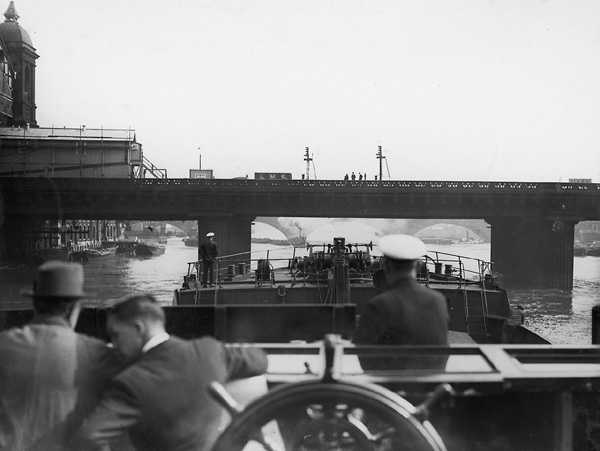
The SS ‘Ewell’ approaching Cannon Street railway bridge 22 September 1926
Image source: Flickr & Royal Museums Greenwich
 The SS ‘Ewell’ approaching Southwark Bridge 22 September 1926
Image source: Flickr & Royal Museums Greenwich
 A cut-away diagram of a larger flatiron called the SS Chessington
operated by the Wandsworth and District Gas Company
Source: The Sphere 02 November 1946
The above is just one of our Four ships called “EWELL”
(You may also be interested to see the Mitcham History Note about SS Ewell’s sister collier, SS Mitcham.)
Sources:
1.museumoflondon.org.uk
2.https://en.wikipedia.org/wiki/Flatiron_(ship)
3.www.burntisland.net
4.Coasters: An Illustrated History By Roy Fenton
Another image of The Wandsworth Gas Company collier ‘Ewell’ can be seen on the wwww.museumoflondon.org.uk website.
Peter Reed © 2014.