
LLEWELLYN LOVELL, RN
Drowned on 27 February 1906, aged 22.
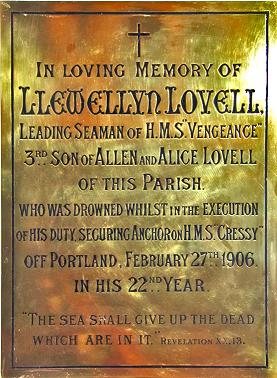 Llewellyn’s plaque in Christ Church, Epsom
Image courtesy of Clive Gilbert
More than a century on, this memorial plaque in Christ Church on Epsom Common gives only tantalising glimpses of the tragedy that was doubtless well known locally at the time. Why was a sailor from HMS Vengeance on HMS Cressy – securing its anchor? And how did that task lead to his drowning? Recent research has rediscovered the sad story.
Llewellyn Lovell was born on 27 July 1884 in Epsom. As noted on the plaque, he was the third son of Allen Curry Lovell and Alice Jane (née Edwards) who had married in St. Martin of Tours, Epsom on 12 November 1868. (Taking account of daughters, he was the couple’s fifth child and one of the ten that survived beyond infancy.)
His father, Allen, was originally from Somerset. The 1851 Census records him, aged 12, as the oldest of three children living with their parents – Valentine (significantly, as we shall see, a “Carpenter”) and Ann Lovell – in the village of Cameley, about 10 miles south of Bristol. Allen took up Valentine’s trade and the 1861 Census records him as a 22 year old “Carpenter” lodging with the Ash family in Timber Street, Chippenham, Wiltshire.
Llewellyn’s mother, Alice, had been born in Epsom Q3 1846. She is recorded in both the 1851 and 1861 Censuses living with her parents – John and Margaret Edwards – and siblings on Epsom Common. Her father was also a Carpenter, and it seems likely that it was this common trade that led to the obviously itinerant Allen meeting Alice.
As noted above, Allen and Alice married in 1868. The 1871 Census records them also living on the Common – alone, but for a visitor. However, Alice was pregnant: the couple’s first child, Louis Valentine Edward who was baptised in St. Martins of Tours on 9 July 1871. Their next child (Margaret Ann) was, in 1873, also baptised at St Martin’s. The rest of their children were baptised in the new church Christ Church: Louisa Birdie in 1875, Frederick in 1877, Grace in 1879, Victor in 1881, Llewellyn himself on 14 September 1884, Alice in 1886 and Harry Broadrib in 1888. (However, their son Allen Curry, born in 1890, does not appear to have been locally baptised.) First-born Louis died in 1874, and there is an 1878 burial of a twelve-hour old unnamed daughter in Epsom Cemetery.
Instead of the general “Epsom Common” address of previous Censuses, the 1881 one records the couple living at 2 Stamford Cottages on West Hill, Epsom. In addition to their four children, the couple were hosting three 20-ish single lodgers whose occupations were noted as a Gardener, a Carpenter (like Allen) and a Plumber. (An interesting aside is that the lodging Carpenter was the 21 year old Henry Roll who, with local Henry Taylor, went on to establish “Roll & Taylor, Builders & Undertakers” at what is now 87 High Street, Epsom.)
Llewellyn was aged six when the 1891 census was taken which recorded him and his parents and siblings (Margaret, Frederick, Grace, Victor, Alice and Allen) living at 1 Stamford Cottage, West Hill, Epsom. On 23 April 1897, thirteen-year-old Llewellyn was admitted as an “accident case” to the Epsom Union Workhouse where he stayed for seven months until he was discharged, at his father’s request, on 2 November 1897. (It is not known what his injuries were.)
On 1 November 1899, the 15 year old Llewellyn – obviously now fit again – joined the Royal Navy. His service record card shows that his occupation before enlisting was “Errand Boy” and that he was 5ft 4in with brown hair, hazel eyes and a fair complexion – but with no “Wounds, Scars, Marks &c.”. He was assigned to HMS Boscawen, a shore-based training establishment at Portland, Dorset as a “Boy, 2nd Class”. After a year, he was made “Boy, 1st Class” and, in 1901, was recorded aboard “Agincourt”, a training ship harboured in Portland Harbour. (That year’s Census recorded his family living at Home Cottage, Stamford Green Road, Epsom)
 HMS Agincourt
Image source Wikipedia
By March 1902, Llewellyn was sufficiently trained to be posted to active duty. He was assigned to the brand-new battleship HMS Vengeance, destined for service with the Mediterranean fleet. On his 18th birthday, 7 July 1902, Llewellyn (who had now grown to 5ft 9¾in) was promoted to Ordinary Seaman. In July 1903, HMS Vengeance was sent out to strengthen the British presence in the China Station. In June 1904, the increasingly experienced Llewellyn was promoted to Able Seaman. (Although his memorial plaque states that he died as a “Leading Seaman”, there is nothing in his service record about such a promotion, and his death certificate states his rank as Able Seaman.)
 HMS Vengeance
Image source Wikipedia
After a couple of years, a fresh crew for HMS Vengeance was sent out on HMS Barfleur, which the relieved crew (including Llewellyn) brought back to the UK, arriving on 9 May 1905. It seems likely that the crew then had some leave, and that Llewellyn would have come back to Epsom to see his family. He then returned to Portsmouth for some further shore-based training.
Very shortly after the change of HMS Vengeance’s crew, a new treaty between the UK and Japan eased the tension in the Far East and the ship was recalled to the UK. After arriving at Plymouth on 2 August 1905, she was sent for a refit in Devonport. That refit had not been completed by the time Llewellyn completed his further training, and he was instead posted to the armoured cruiser HMS Cressy, serving in British waters.
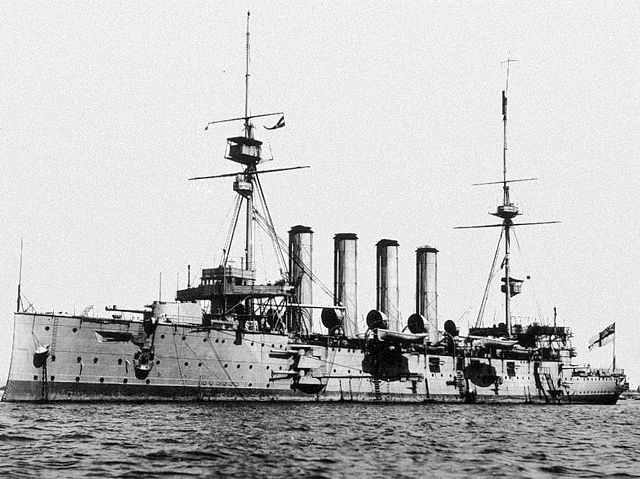 HMS Cressy
Image source Wikipedia
Llewellyn took up his new duties on 20 February 1906. Only a week later – on Wednesday 27 February – he met his death. The memorial plaque says simply that this was “in the execution of his duty securing anchor.” The fuller story revealed by his service record and death certificate is as follows.
On 27 February 1906, HMS Cressy was under way in the English Channel off Portland. Llewellyn was sent over the side in a bowline to secure the port anchor. A large wave came and not only struck him but also knocked down the man holding the bowline which then slipped through his hands. In what must have been difficult conditions, Llewellyn could not be found and the death certificate records that he was “lost overboard”.
As the grieving family had no body to bury, the memorial plaque is presumably in lieu of a tombstone. And it is now clear why the plaque concludes with “THE SEA SHALL GIVE UP THE DEAD THAT ARE IN IT” – a text drawn from Revelation 20.13, but with the tense changed from past to future.
Llewellyn’s parents spent the rest of their lives living at 21 Stamford Green Road, Epsom. The 1911 Census records the residents as: 72 year old Allen still as a “Carpenter”; 64 year old Alice as a “Shopkeeper”; and 34 year old unmarried Frederick as a “Greengrocer” – with both Alice’s and Frederick’s entries annotated to show this was their own business carried out at home.
When Alice died in 1925, she was buried in the same grave, B12A in Epsom Cemetery, as first-born Louis and their late unnamed daughter. Allen died in 1927 and was also buried in Epsom Cemetery, but in grave K255.
Hazel Ballan & Roger Morgan © March 2019