
ERNEST SHADBOLT (1851-1936)
and his Park

Ernest (on the right) and his gardener at “Darkfield” (now “Shadbolt House”) in about 1930
Photograph, with thanks, from David Rymill’s “Worcester Park and Cuddington: A Walk Through the Centuries”
Shadbolt Park – off Salisbury Road, Worcester Park – is the northernmost park in the Borough. It is named after Ernest Ifill Shadbolt, an interesting character whose life deserves to be better known – hence this article.
Ernest was born on 15 July 1851, the third of eight children born to George Shadbolt and Elizabeth (née Pierrepoint) who, in their mid 20s, had married on 24 June 1846 in St Peter’s, Walworth. George, like his father (another George), was a timber merchant. Elizabeth (who had been born in Bridgetown, Barbados) was the daughter of another “merchant”.
The couple set up home nearby – at 26 Sutherland Street, St Mary Newington – where, with their first two children and three domestic servants, they were recorded in the 1851 Census. George was listed as a “Mahogany Broker”. However, alongside that work, George Shadbolt was a keen photographer, microscopist and botanist. He is reported to have been the first to take a photograph through a microscope. He was a President of the Royal Microscopical Society and a founding member of the Royal Photographic Society. For seven years, he edited the publication that later became the British Journal of Photography. As a botanist, he is the “Shadbolt” noted in the International Plant Names Index.
The 1861 Census records the 9 year old Ernest as one of 52 pupils at Bruce Castle School in Lordship Lane, Tottenham. By the time of the 1871 Census, he was back with the family (and their four domestic servants) now living at “Cecile House”, 104 Crouch Hill, Hornsey, Edmonton – on which there is now a plaque (as below) recording his father’s residence there from 1865 to 1879.

The plaque on 104 Crouch Hill commemorating Ernest’s father
Photograph with thanks to “Plaques of London”
This 1871 Census records Ernest, the main subject of this article, as a “Student for Civil Service”. He went on to study at the newly established Royal Indian Engineering College, at Coopers Hill in Egham. He passed out in the autumn of 1874 and moved to India to work in the Railway Branch of the Public Works Department.
He began as an assistant engineer on the construction of the Indore, Dhond-Manmad, and Bhopal State Railways. Over the years, he worked on various railway projects across the sub-continent, gaining increasing seniority. A principal feature of his work came to be the construction of large bridges – and a project of which he was justly proud was the construction of what is called the “Lansdowne Bridge” over the Indus at Sukkur in what, since partition, is Pakistan.

The “Lansdowne Bridge” over the Indus at Sukkur
Photograph with thanks to old.harappa.com
The bridge was one of the great engineering feats in the 19th century – being the longest cantilever bridge ever built and, to support the load of heavy steam locomotives, particularly robust. (Before its construction, trains from Karachi towards the north had to cross the Indus by ferry.) The bridge was inaugurated on March 25 1889, probably the day on which the photograph above was taken by the celebrated Victorian photographer Fred Bremner.
Ernest, who never married, spent the whole of his working life in India (which, at the time, included what is now Pakistan and Bangladesh). He may have returned to England on leave from time to time, but the only certain sighting of him is in the 1901 Census when, as a 49 year old “Superintending Engineer Indian Public Works Department”, he was recorded lodging with the unrelated John and Rosa Jones at 88 Hamilton Terrace, St Marylebone. This may have been in connection with his father’s failing health: George died 6 May 1901 at 119 Hopton Road, Streatham. (Ernest’s mother, Elizabeth, had died a decade earlier – on 4 December 1891 – at 11 Pavilion Parade, Brighton.)
Ernest retired in 1906 as Director of Railway Construction to the Government of India (a position he had held since 1904) and returned to England. The 1911 Census recorded this 59 year old “Indian Railway Department Pensioner” living at “Ardeley”, Row Lane, Pirbright supported by an unrelated housekeeper. He was listed, with that address, in the 1915 Indian Biographical Dictionary – which listed his recreations as “Music, Cycling & Gardening”.
While it is that last interest which was most significant in the closing decades of Ernest’s life, mention must be made of his music and of something that speaks to his determined character. He was a violinist and, when an accident with a deckchair crushed his left hand, he taught himself to play with reversed hands, so his undamaged right hand could do the delicate fingering!
During his almost thirty years of retirement, Ernest was a keen supporter of the movement to promote open spaces for the public’s enjoyment, serving as Treasurer and Vice-Chairman of the Metropolitan Public Gardens Association that was founded in 1882 to create and preserve open spaces and gardens for the people of greater London.
In 1920, Ernest bought a piece of land off Salisbury Road (near its junction with The Avenue) known as “Darkfield”, so called as a nearby copse cast dark shadows across the field. This was farmland (which, in the 16th century, had been part of the Great Park of Nonsuch Palace) that was now being sold for housing to cater for the growing local population.
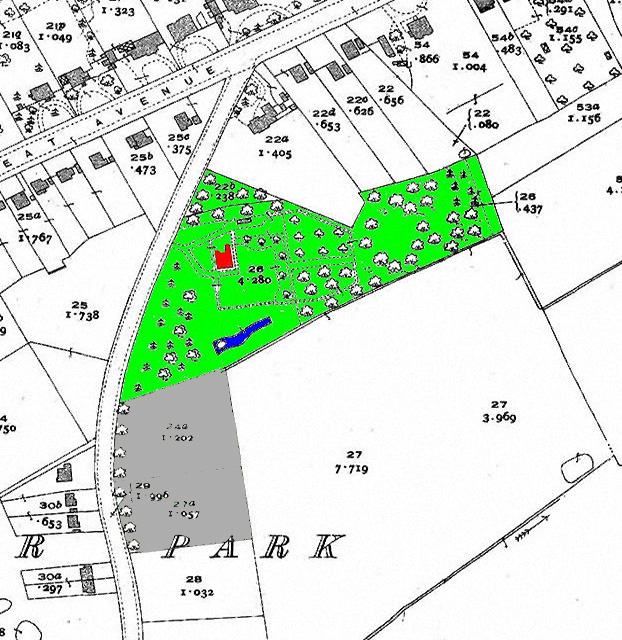 Part of the 1933 OS Map showing Darkfield House (shaded red), its gardens (shaded green) and pond (shaded blue).
The area shaded grey is the land added by the Council when it created Shadbolt Park.
Ernest’s new house was ahead of its time in being centrally heated: as pictured at the head of this article, the house had no chimneys. Ernest also arranged for rainwater from the roof to drain to a newly created pond in the gardens which he began to lay out around the house. He was a keen plantsman and, doubtless thanks to his contacts with Kew, added rare trees and shrubs from around the world. The end result was that, as reported, he “converted the land from a wild field into a private garden”.
Ernest died on 16 June 1938, just short of his 87th birthday. He was buried in Norwood Cemetery in the same grave (29,652) as his father, George – and alongside the grave for other members of the family. Sadly, no gravestones remain. One of the executors of Ernest’s £17,755 estate was his unmarried niece, Ethel Lilian Brimble, who had been living with him at Darkfield. Her life is also of particular interest – see the appendix below.
After Ernest’s death, the house and garden were offered to the Council at around half the market price and they were purchased for £3,500 in 1937. An additional quarter of an acre (shaded grey on the map above) was also purchased to provide access from Edenfield Gardens. (This area is today’s playing field and playground – an informal area to complement the more formal garden.)
Shadbolt Park was opened to the public in 1937. Mr W J Bean, CVO, VMH, compiled a catalogue of trees and shrubs in the garden, their origin, date of introduction to this country and their appearance for the Metropolitan Public Gardens Association (in conjunction with Epsom and Ewell Council). The introduction to the catalogue praised the Council for “their foresight and public spirit in purchasing the park … which sets a seal upon the lifework of the former owner, Mr E Shadbolt”.

Four 1950s postcard views of Shadbolt Park
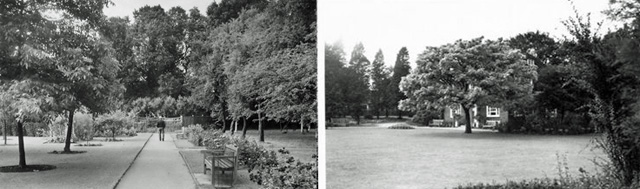
Shadbolt Park is a compact little gem. Its level paths give easy access round the quiet and tranquil main section where the layout remains unchanged from Ernest’s original design and planting. The trees have of course matured and, while there have been some casualties, a replanting programme is ongoing.
As noted above, the Council added some land to Ernest’s original gardens and, as shown in the photograph below, this is mainly laid out to grass (providing open space for recreational purposes) with a children’s playground, an outdoor gym and some seating.

The “added section” of Shadbolt Park (seen from the SE corner on Edenfield Gardens).
Photograph by Roger Morgan © 2020.
In 2005/6 a new survey of the trees in the park was carried out by EEBC’s Tree Officer (Jeremy Young) accompanied by two members of the Surrey Gardens Trust. It identified trees that were in the 1937 catalogue that remained in place and also noted those planted after Mr Bean’s Survey.

Above and below: Some of the trees in Shadbolt Park
(the railings in the backround, bottom right, surround the restored pond)
Images courtesy of Carol Hill © 2010

It was originally hoped that the house would house a relevant reference library and museum. That was not realised and, for a period, it housed a branch County Library. When that closed, it became a doctors’ surgery, as it remains today.
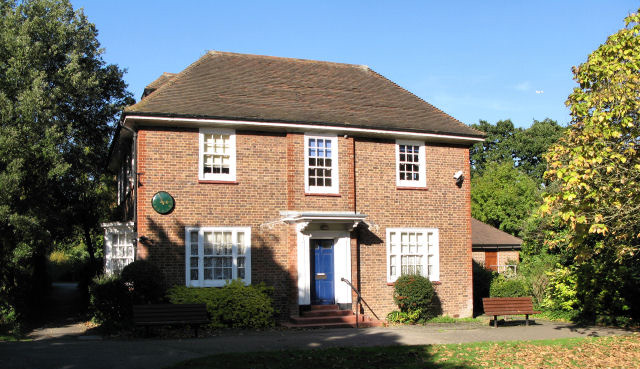
Shadbolt House in October 2010
Image courtesy of Peter Reed © 2010
Roger Morgan © 2020
Extended from the late Carol Hill’s 2010 article
Appendix: Ethel Lilian Brimble (1877-1952).
As noted in the main article, Ethel lived for a while with her uncle Ernest at Darkfield.
She had been born on 6 September 1877, the third child of Ernest’s older sister Agnes who, in Q2 1871, had married Edward Henry Brimble. The 1881 Census recorded the early 30s couple (with Edward, like Agnes’ father, listed as a “Mahogany Broker”) and their now four children living at 34 Freelands Road, Bromley, Kent. Ethel became a governess, recorded in the 1901 Census in the household of Veterinary Surgeon John Nasworth in Market Drayton, Shropshire.
She then became governess to the children of Crown Prince Wilhelm of Germany, heir to the Kaiser, being appointed in 1911 as “Director and Head of the Crownprincely Children’s Department” and governess to the oldest princes Wilhelm and Louis-Ferdinand. After Prince Wilhelm’s eighth birthday in June 1914, she returned to England for annual leave, but growing international tension (and then the outbreak of WW1) ruled out a return.
Ethel wrote an affectionate memoir of her time with the princes, “In the eyrie of the Hohenzollern eagle” published in 1916 by Hodder and Stoughton.
A couple of years after Shadbolt Park was opened, the September 1939 Register recorded Ethel living (“with private means”) in an apartment at 79-80 London Road, Royal Tunbridge Wells. She died in Bristol, aged 74, on 10 May 1952 having been living in the College Close Hotel, Clifton.