
Lord Kitchener and the 1915 parade on Epsom Downs

The commemorative plaque at Epsom Racecourse.
Photograph by Roger Morgan © 2024
This commemorative plaque – one of a series sponsored by the Borough Council – is rather tucked away in the forecourt of the Queen Elizabeth II Stand at Epsom Racecourse. As stated, it commemorates Lord Kitchener’s review of 20,000 soldiers of the 2nd London Division on 22 January 1915. While there is much more that needs to be said about this event, we first need some background.
Lord Kitchener
Firstly, something about Lord Kitchener. Horatio Herbert Kitchener was born on 24 June 1850, in Ballylongford near Listowel in County Kerry. Both his parents originally came from Suffolk, but were in Ireland because his father, having just resigned his Army commission, had bought land there. In 1864, the family moved to Switzerland, with young Kitchener being educated in Montreux before returning to the UK to attend The Royal Military Academy, Woolwich.
He was commissioned into the Royal Engineers in 1871, and served in Palestine, Egypt and Cyprus as a surveyor. He was promoted to Captain in 1883 and, having become fluent in Arabic, was posted to Egypt (which had recently become a puppet British state) and took part in the reconstruction of the Egyptian Army. Various promotions ensued, with Kitchener making his mark in active combat. After success in Sudan, Kitchener was made its Governor-General in September 1898 and, a month later, was created Baron Kitchener.
In 1899, he was sent to South Africa for what is now seen as somewhat controversial service in the Second Boer War. Promoted to the substantive rank of General in 1902, he returned to a hero’s welcome in the UK: Edward VII admitted him to the Order of Merit; and Kitchener was also elevated from Baron to Viscount.
Kitchener was then appointed Commander-in Chief, India. He took up the position in November 1902 and, straight away, began reorganising the Indian Army. He developed a prickly relationship with the Viceroy, Lord Curzon, who later resigned. In 1909, Kitchener was promoted the Army’s highest rank of Field Marshal, and went on a tour to Australia and New Zealand. Having lobbied unsuccessfully to be made Viceroy of India, he returned to Egypt in 1911 as British Agent and Consul-General.
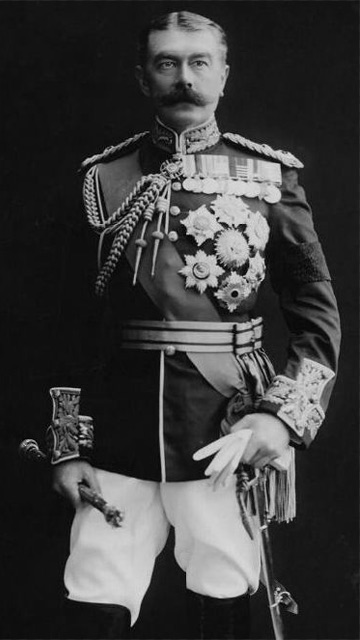
Field Marshall Lord Kitchener in full dress uniform, July 1910.
Photograph (public domain) with thanks to the National Portrait Gallery, via Wikimedia.
.jpg)
This photograph shows something of Lord Kitchener’s commanding presence. That was compounded by his height: at 6’ 2” (1.88 m), he was substantially taller than average. In addition, his slight divergent squint inhibited people in meeting his gaze.
The “Great War” arrives
By mid-1914, deteriorating international relations within Europe made it clear that war was inevitable. In those circumstances, it is odd that the UK had been without a Secretary of State for War since the holder’s resignation in March – the role being covered by the Prime Minister, Herbert Asquith.
Kitchener had been in the UK for his annual summer leave and was about to return to Cairo when summoned to London, where he accepted Asquith’s request to take the War Secretary post. Britain declared war on Germany at 11am the following day, Tuesday 4 August, 1914.
Recruitment

The iconic WW1 recruitment poster.
Public domain image via Wikimedia.
_Britons_(Kitchener)_wants_you_(Briten_Kitchener_braucht_Euch)._1914_(Nachdruck),_74_x_50_cm._(Slg.Nr._552).jpg)
Immediate steps were taken to build up Britain’s Army by appealing for volunteers – as symbolised in the iconic poster shown above, and its many variants. (Conscription was not introduced until January 1916.)
Young men responded enthusiastically, creating enormous challenges in meeting their needs for accommodation, uniform, equipment and training. Epsom played a significant part in all this: the RAC’s recently acquired Woodcote Park was taken over to house the new University and Public Schools Brigade.
The parade on Epsom Downs
To help mark the success of the recruitment drive, Kitchener decided to hold a mass parade of the new troops which he would inspect, accompanied by the French Minister of War, Alexandre Millerand. Friday 22 January 1915 was chosen as the date, with Epsom Downs as the venue. The summons went out to 20,000 troops in the 2nd London Division of Kitchener’s New Army stationed across Surrey, and with some from as far away as Maidstone.
On the day, and contrary to expectation, snow started falling at 6am and continued all day. There was already a good covering as troops started arriving from 8am, when they were divided into groups – some set on the move to keep warm, while others were stood to, with frequent periods of marking time in order to stave off the chill. Word of the parade had quickly spread around Epsom townspeople and a good number made their way up to the Downs to see Britain’s greatest war hero.

Troops (with townspeople in the foreground) awaiting Kitchener’s arrival.
Photograph with thanks to Bourne Hall Museum.
While the main parade (featuring the University and Public Schools Brigade) was to be by the Grand Stand, the route to that from Buckles Gap (at the top of Fir Tree Road) was also lined with two brigades: the London Scottish, stationed at Dorking, and the London Reserve Infantry from Horley and Reigate. During the 2-3 hours wait for the inspection to begin, several men collapsed from the cold. The worst affected were taken to the War Hospital that had been set up in the Grandstand – where one of them died.
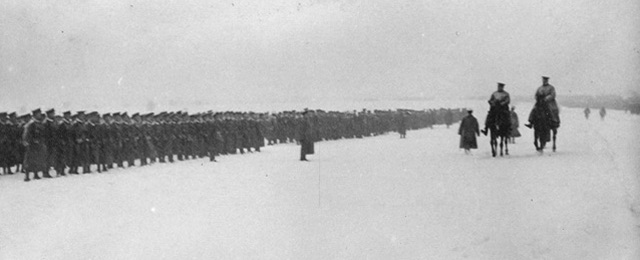
Kitchener’s party arriving at the parade.
Photograph with thanks to Bourne Hall Museum.
Kitchener’s party arrived at 11am, but the inspection was far briefer than planned – lasting little more than 5 minutes.

The inspection under way.
Photograph with thanks to Bourne Hall Museum.
Some reports are that Kitchener curtailed the inspection because of the cold. Another view is that he was embarrassed by the massed troops’ manifest lack of rifles. Anyway, he and his French counterpart quickly departed for lunch. (A brief Pathé Newsreel clip appears to show Kitchener calling it a day.) The thoroughly chilled troops made their way back to their various home bases to prepare for despatch to the front – in too many cases, never to return.
(It is worth noting that Kitchener also died in the line of duty. In the midst of his many other political and military concerns, he had devoted personal attention to the deteriorating situation on the Eastern Front and, in mid 1916, he led a diplomatic mission to discuss matters with the Imperial Russian Government. On 5 June 1916, his party left Scapa Flow on board the armoured cruiser HMS Hampshire en route to the Arctic port of Archangelsk. It never arrived. During a force 9 gale, the ship struck a German mine and sank west of the Orkney Islands. Kitchener was lost in the sinking and his body was never recovered.)
The 2015 commemoration
The centenary of the parade was marked in late January 2015. Re-enactors, in period uniform, marched from Ewell’s Bourne Hall, through Epsom and up to the Grandstand. (The weather was far kinder than in 2015.) In front of the Mayor, local MP and a good number of townspeople, there was a short service of commemoration. Epsom’s Male Voice Choir sang appropriate songs. A local violinist played part of “The Lark Ascending” by Ralph Vaughan Williams, who had been among the volunteers who had paraded in 1915.
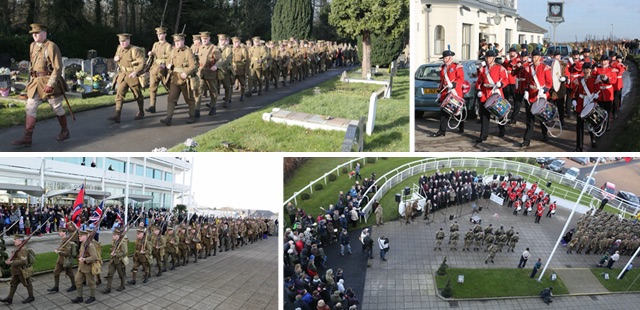
Click the thumbnails above to view SurreyLive’s excellent pictures of the 2015 reenactment.
Roger Morgan © 2024