
The Crown Inn, Epsom, c.1715 – c.1842
(situated on what is presently 4-8 West Street)
& The Mary Dundas Charity
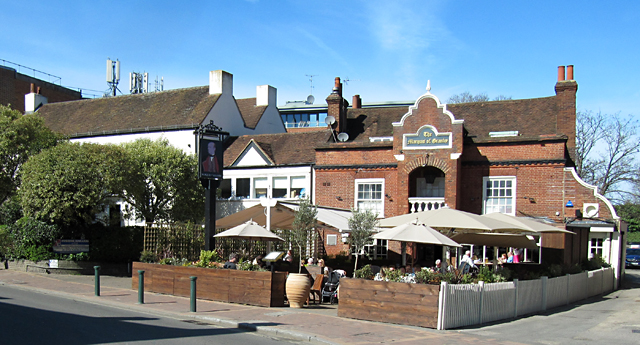 4-8 West Street in 2025
Image courtesy of Bourne Hall Museum
As the 17th century came to an end changes were arising related to a copyhold estate situated at the foot of Clay Hill, at its junction with the High Street, Epsom. On 5 November 1664, Simon Mason, gentleman, customary tenant of the manor, had surrendered through the Steward into the hands of the lord of the manor all that cottage, orchard and one small piece of land pertaining to it, then containing 1 acre more or less, with a barn situated in Clayhill. This surrender was for the use of George Frank, described as a weaver, and Maria his wife, with their heirs in perpetuity at the will of the lord according to the custom of the manor. George and Maria Frank were then formally admitted and took seisin by the rod and paid a fine of £6.
Mary Franke, daughter of the occupier George Franke, yeoman, who died after 1673, had married John Dundass on 27 December 1683.
On 23 October 1698 Mary Franke, widow, was admitted in tail to two messuages, barns, stables, buildings, gardens and orchards – one messuage recently erected by John Hillman, gent., and in his occupation, and the other recently erected by the late George Franke, in the occupation of John Dundass gentleman – together with a piece of land to the north of the property in the occupation of Mary Franke widow, in all half an acre. Mary Franke’s son George Franke and her daughter Mary, the wife of John Dundass, were admitted in moieties (half shares) to the reversion.
From 16 December 1699 John Dundass of Epsom, gentleman, and Mary his wife, and George Franke of Epsom, cordwainer, together mortgaged the two messuages. From 19 February 1703, however, George Franke sold his half share outright to Anthony Bill.
John Dundass and Mary his wife on 1 June 1704 obtained a licence to let their property
The death of Anthony Bill was recorded on 8 November 1706, when his only brother Henry Bill of Eastbourne, gent., was admitted to the one moiety of the two messuages, one in the occupation of Samuel Tayler, and the other of Mary Dundass widow.
The death of Henry Bill was recorded on 12 July 1715, and on 19 October 1715 Susanna Benn, a cousin of Henry Bill late of Sompting, gent., was under his will dated 26 February 1714 admitted to the moiety of all those several messuages, one of them called the Crowne Inn and the other adjoining, in the several occupations of Mr. Breton, Mrs. Honey, and Mrs. Dundass.
On 17 October 1715 James Benn and Susanna his wife sold to Robert Parker of Epsom, brewer, and Eleanor his wife their moiety of the two messuages, barns, stables, buildings, gardens and orchards, the one messuage erected by John Hillman deed in the occupation of George (?) Bentley, and the other of Mary Dundass widow, and the piece of land in the occupation of Richard Selby and Mary Dundass. On 7 April 1719 Mary Dundass and Robert Parker and Eleanor his wife divided the property by an exchange of their moieties: Mary Dundass obtained the western part, a messuage called the Crown, now in the occupation of George Bentley, and Robert and Eleanor Parker the two messuages, one occupied by Richard Selby and known by the name and sign of Equi et Gremetti, anglice Horse and Groom, and the other occupied by Mary Dundass.
As reported in our Newsletter 26 (January 2011), during 1721 Zachariah Collier, charged with theft – in fact with grand larceny – had been found at the Crown Inn, Epsom, where by means of a counterfeit recommendation he had got himself into service. Having been found guilty and sentenced to transportation he was embarked upon Prince Royal in August of that year with 9 other felons and it took until November for him to get to Virginia. Collier married in America and became a successful merchant
Mary Dundass by her will dated 1 November 1728 devised her messuage called the Crown Inn to Richard Fuller of Epsom, groom, for life, remainder in trust to the Revd. John Price, vicar of Epsom, and the churchwardens and overseers of the poor to buy sea coal for distribution to poor aged widows whom they thought most deserving. The demise of Mary Dundass was recorded on 26 October 1741, and on 24 May 1742 Richard Fuller was admitted for life in accordance with this will to the messuage heretofore commonly known by the sign of the Crown and in the tenure of George Bentley, together with the small houses, garden ground and buildings thereto belonging, now in her own occupation or in the tenure of John Copper.
The death of Richard Fuller was recorded on 24 October 1752, and on 6 June 1753 the Revd. John Price, vicar of Epsom 1728–82, was admitted in trust to the messuage on the north side of the town of Epsom heretofore known by the sign of the Crown and lately in the tenure of George Bentley. On 14 May 1753 the Revd. John Price obtained a licence to let any of the properties he was holding for 21 years. Successive vicars of the parish of Epsom subsequently held in trust a messuage and two small tenements, coachhouse, stables and other outhouses and garden, about half an acre, abutting on Clayhill on the south part, on the copyhold estate of Thomas Syms on the east part, and on land belonging to Christ Church Hospital on the west part.
This Dundass estate came into the occupation of William Hasted, a coachmaker of Epsom, under a lease for twenty-one years, from Michaelmas 1821, at the yearly rent of £30.
On Thursday 25 May 1837, the 4th Baron Berners was at breakfast in the Crown Inn bemoaning the facts that his horse entered for the Derby was lame and he had no rider. Fortuitously the jockey George Edwards was found to be available and later during the morning of the Derby Phosphorus was walked for four hours to be declared sound, was cleared by Lord Berners to start, and won.
No further reference to this hostelry has been found and trading is assumed to have ceased on expiry of Hasted’s lease in 1842. The will of William Hasted, coachmaker of Epsom, was proved on 22 May 1855.
For the 1861 Census these premises, later to be 6 and 8 West Street, were occupied by James Careless, wine merchant, (formerly of the Albion Hotel) who died 11 May 1861, and Philip Waglan, cordwainer (ie. shoemaker).
In 1863 the trustees of the Mary Dundass Charity leased the property to Charles John Langlands for 21 years at an annual rent of £24.
No image has been found of these premises functioning as the Crown Inn but one of the wooden buildings may be glimpsed butting up to the left side of Marquis of Granby in the 1870s print shown below:
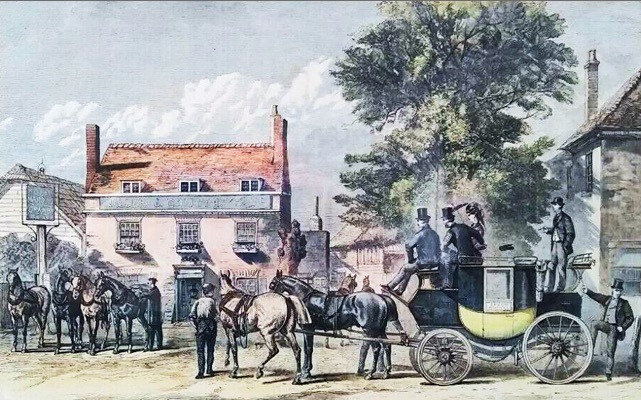 The afternoon Dorking (Cooper) Coach – changing at Epsom.
Image courtesy of Jeremy Harte, Curator Bourne Hall Museum
A serious fire at the Marquis of Granby occurred in 1880 with the aftermath shown in a photograph held by Surrey History Centre under reference PH/58/136 and reproduced with permission. The Marquis is to the left, and the Crown Inn (in brick) is on the right.
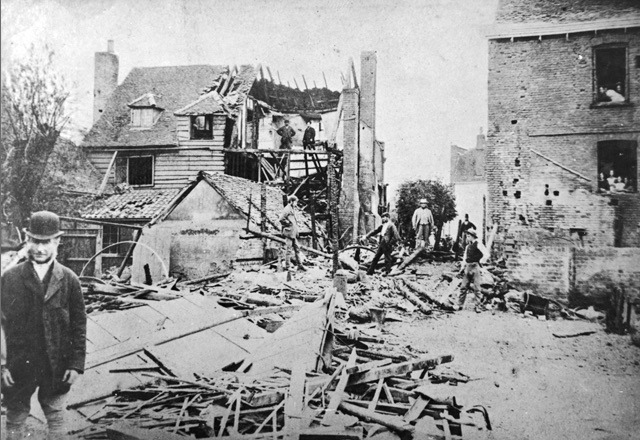 Image held by Surrey History Centre under reference PH/58/136 and reproduced with permission.
According to Chairman’s Reminiscences of Epsom the coach horses stabled there had to be taken up the bank at the back and Mr. Gray’s private house next door in West Street was also burnt.
The latter, then Jonathan Gray’s school, was built in brick, eventually becoming occupied by Waglan, builder and decorator, 6 West Street. Substantial elements of the interiors were encased in brick outer walls for the reconstruction and late 17th-century wallpaper was later found in the downstairs left-hand front room at 8 West Street , behind panelling on the wall opposite the window. This is now held in the V&A Museum under reference E.464-1993. What is presumed to have been stabling to the rear of the premises seems to have survived the fire as well as a forward projection which may have been rented out as Christ Church Guild Room and still stands as the premises of Huggins Edwards and Sharp, estate agents, 10 West Street.
On 28 Aug 1885 the three, formerly two messuages with gardens, workshops, stabling, outbuildings and premises thereto belong, formerly known by the name of The Crown, sometimes in the tenure of George Bentley, afterwards of William Hasted and then of James Careless, and for several years past of Charles John Langlands, were enfranchised and made a freehold.
Over time the premises became dilapidated and by the 1950s were categorised as a Historical Building at Risk. Consequently the County Council undertook a detailed survey of 6–8 West Street, Epsom, supported by a sequence of photographs deposited in the Surrey History Centre and catalogued from CC1101/3/58/211.
Ownership of the freehold land at 6, 8 and 10 West Hill, with property at the rear, was recorded at the Land Registry in the name of C.H.J. Waglan during 1961,
What had been the premises of C.J. Langlands, builder, were again gutted by fire during 1977, and subsequently constructed in replica as 6–8 West Street.
Brian Bouchard 2024