
Joseph Johnston Lee
1876 – 1949
 Joseph Johnston Lee
Joseph Johnston Lee, who lived in Epsom from 1926 to 1947, was a Scottish journalist, artist and poet and is known as ‘Scotland’s Forgotten War Poet’ and also as ‘Dundee’s Forgotten War Poet’. Joseph’s poetry was once ranked equal to Wilfred Owen, Siegfried Sassoon and Rupert Brooke.
Joseph was born in Dundee on 6 December 1876 the son of David Alexander and Christina Easson Lee née Blair. He was one of nine siblings. He started working at the age of 14 in a solicitor’s office in Dundee, and had also gone to sea as a steamship’s stoker.
The 1891 census records Joseph, a ‘scholar’ aged 14, living at 12 Garland Place, Dundee. The 1901 Scotland census records Joseph, aged 24, living at 24 Garland Place, Dundee and working as a ‘Shipping Clerk’.
When working in Dundee he had taken art classes. By 1904, aged 28, he was working in London as an artist, drawing cartoons for the ‘Tariff Reform League’.
He returned to Dundee in 1906, worked for publishers John Leng & Co, and regularly produced poetry for their publication ‘The People’s Journal’, which he later went on to edit. In 1910 he published a book of poems ‘Tales o’ Our Town’. The 1910-11 Scotland Postal Directory records Joseph under the heading ‘Artists and Art Teachers’, living at 22 Airlie Place, Dundee.
In 1913 he wrote a one-act play ‘The Song: An Episode from Bohemia’ which was performed in Dundee. Then in April 1914 he wrote a play called ‘Fra Lippo, Painter of Florence’ which was performed by students of the Dundee Technical College and School of Art.
At the start of the Great War Joseph was aged 37. Due to his age and the fact that he suffered from asthma, Joseph did not need to attest but did, as a volunteer. He joined the 4th battalion Black Watch (Royal Highlanders), a territorial unit. Might he have been influenced by the fact that his grandfather fought in the battle of Waterloo? Joseph was one of nine Dundee journalists who joined the 4th Black Watch and they were dubbed the ‘Fighter-Writers’.
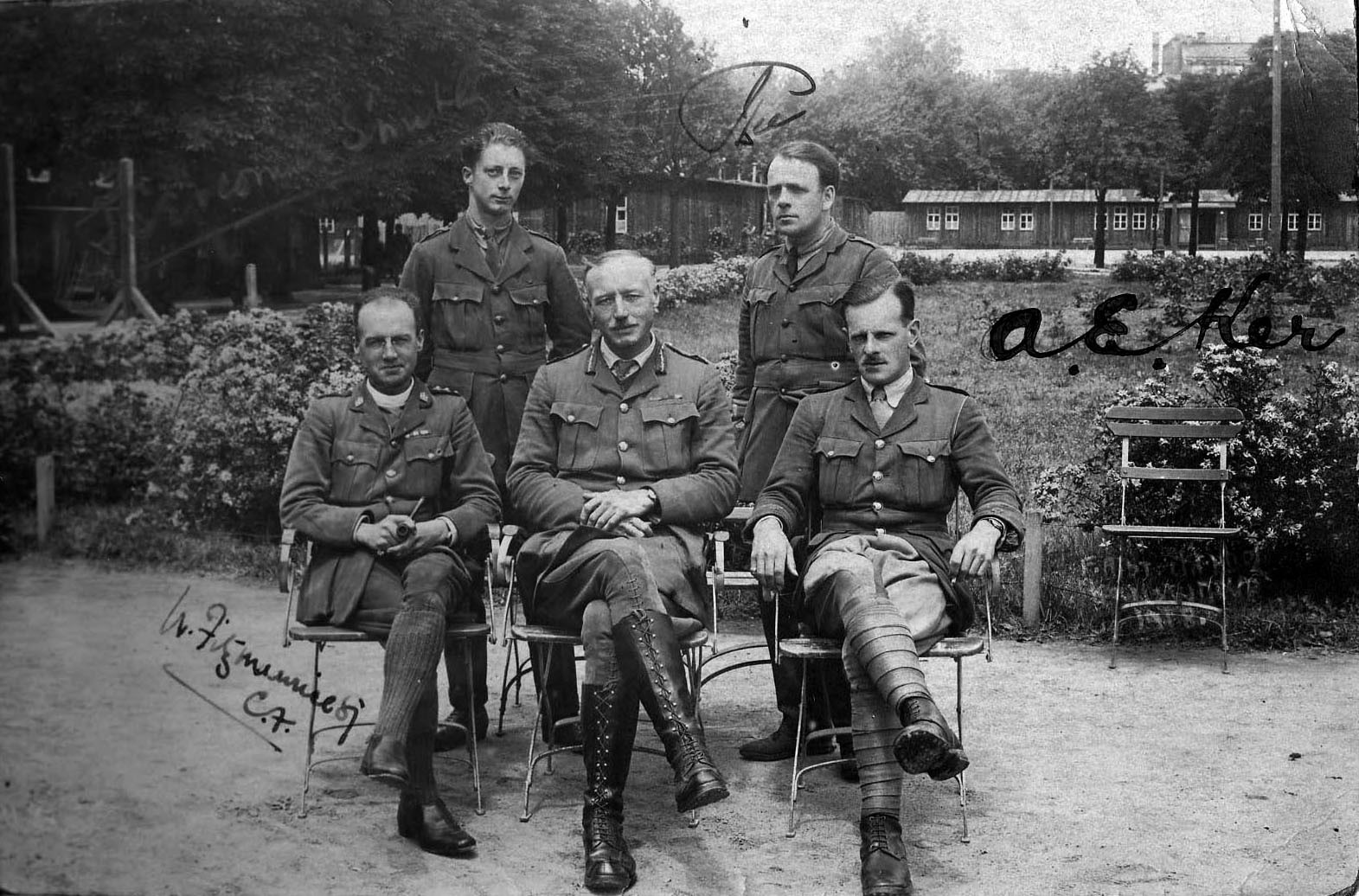 Joseph Johnston Lee (back row right) with other officers
He was given service number 3668 (later changed to 200846 when the Territorial Army renumbered in 1917). He went to France with the 4th Battalion Black Watch on 24 February 1915. The battalion was part of the Indian formation, joining the Bareilly Brigade, 7th Meerut Division. The battalion fought in the Battles of Neuve Chapelle in March 1915, Aubers Ridge in May 1915 and Loos in September 1915. After Loos the 4th and 5th battalions of the Black Watch had suffered so many casualties that they combined to form one battalion, the 4/5 Black Watch.
 A pencil drawing by Joseph Johnston Lee of Ypers on Christmas Eve 1916
The battalion’s duties, until September 1916, included unloading ships at Boulogne and ‘holding the line’. But in September 1916 the battalion fought in the Battle of the Somme. In December 1916 the battalion moved to the Ypres sector and in early 1917 carried out a trench raid.
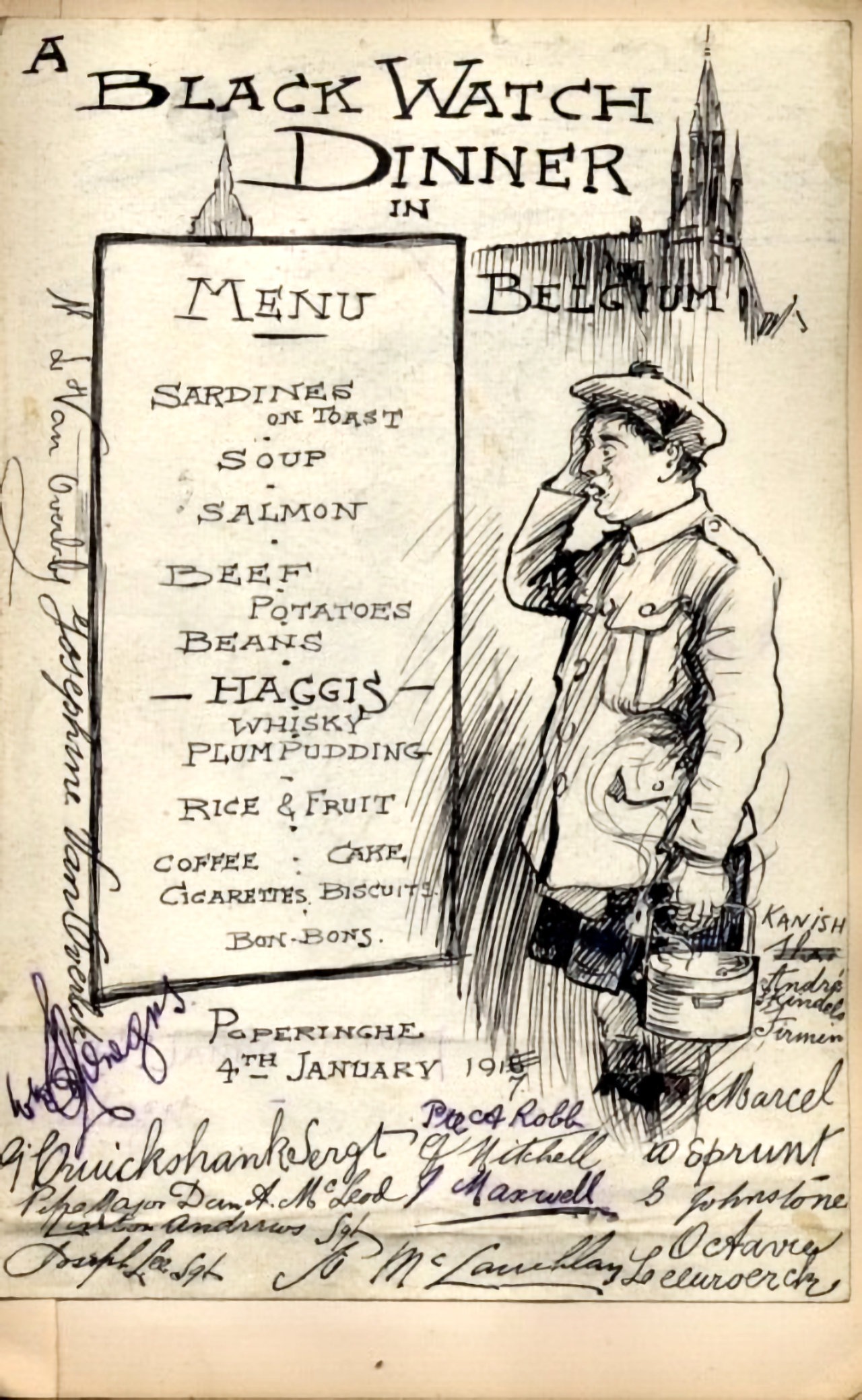 A Black Watch Dinner Menu Card for 04 January 1917
Drawn by Joseph Johnston Lee
Joseph had reached the rank of Sergeant and on 27 August 1917 he was commissioned 2nd Lieutenant into the 6th Battalion King’s Royal Rifle Corps (KRRC), a training battalion. He was later transferred to the 10th battalion and on 22 October 1917 he went to France, to command ‘A’ Company KRRC. The battalion fought in the Battle of Cambrai which commenced on 20 November 1917. The battle famously had initial success through the use of a massed tank attack, the first such use of massed tanks. However the success was short lived as on 30 November the Germans launched a counter attack that took back much of the ground it had lost plus some new ground.
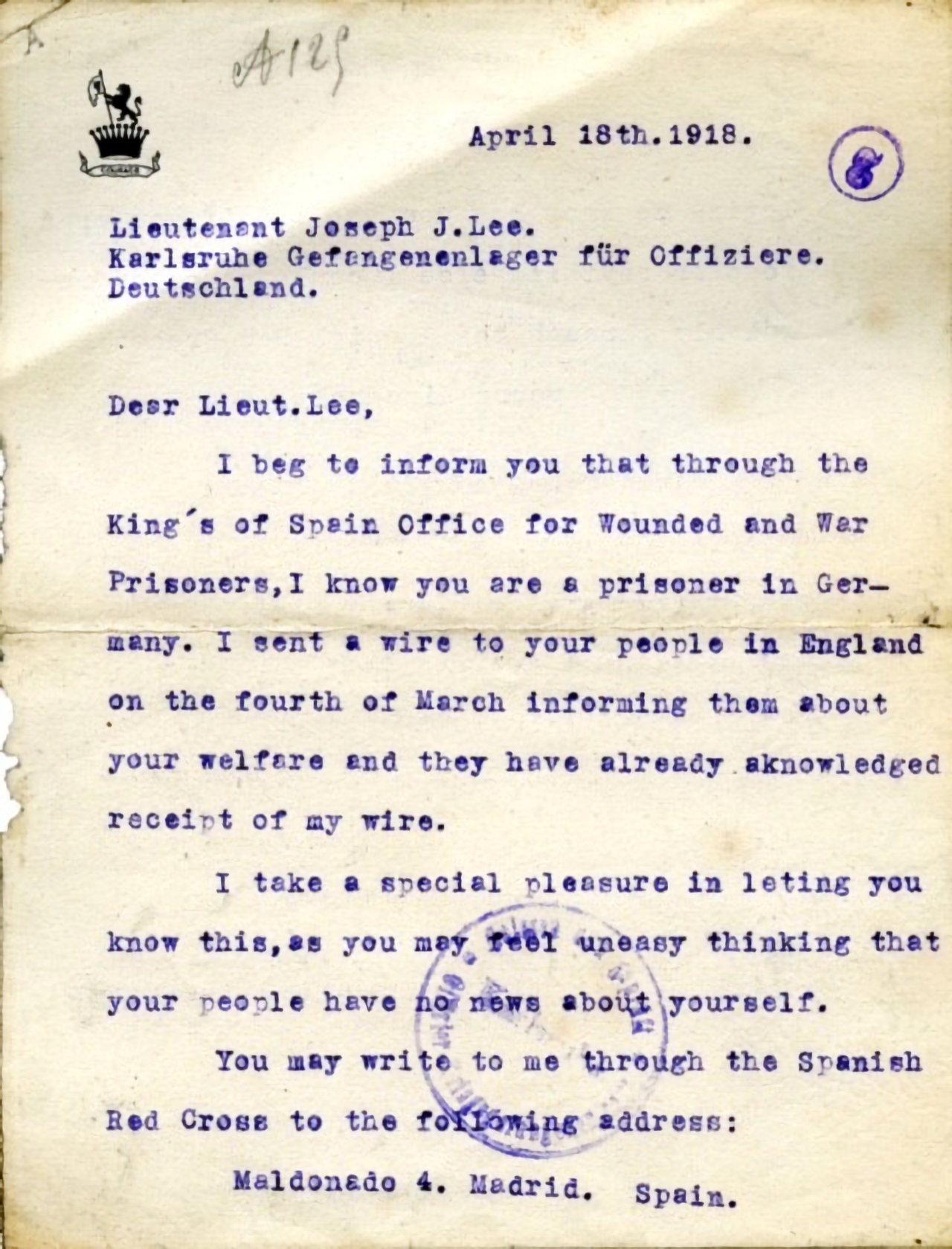 Letter Joseph Johnston Lee received while a POW
The 10th battalion KRRC War Diary states that on 3 December 13 officers were missing. As Joseph became a POW it is likely that he was one of the 13. The Battle of Cambrai officially ended on 6 December 1917.
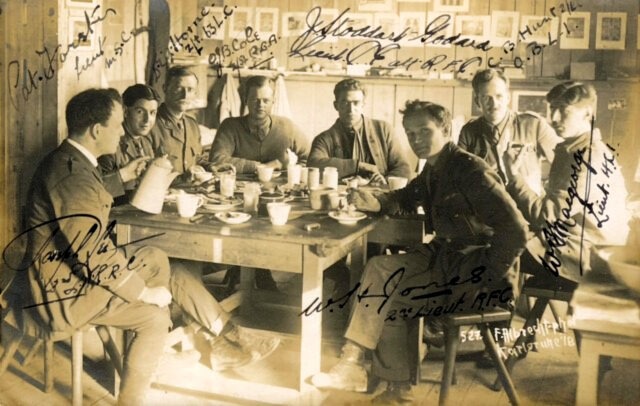
Joseph Johnston Lee (Left holding Coffee Pot) with colleagues possibly while a POW
Joseph was entitled to the 1915 Star, British War medal and the Victory medal, which he applied for on 2 July 1920. His address then was 22 Airlie Place, Dundee.
On 7 January 1924 Joseph married Dorothy Havercroft Barrie, in the parish of Mains and Strathmartins, in Fairmuir Parish Church, Dundee, Scotland. Joseph was a 47 year-old journalist living at 9B St Peter’s Square, Hammersmith, W.C. Dorothy aged 27 was a musician living at 49 Mains Loan, Dundee. Dorothy was a well known viola player.
Joseph and Dorothy settled in Epsom and lived in West Hill Avenue from 1926 to 1947. They had no children. During his time in Epsom Joseph studied at the Slade School of Art and was also a sub-editor on the ‘News Chronicle’. Between 1940 and 1944 Joseph was a member of the Home Guard.
About 1947 Joseph and Dorothy returned to Dundee where Joseph died on 17 May 1949 aged 72.
On 17 September 2023 a ‘Blue Plaque’ was unveiled on 32 West Hill Avenue, Epsom, commemorating the fact that Joseph had lived there between 1926 to 1947.
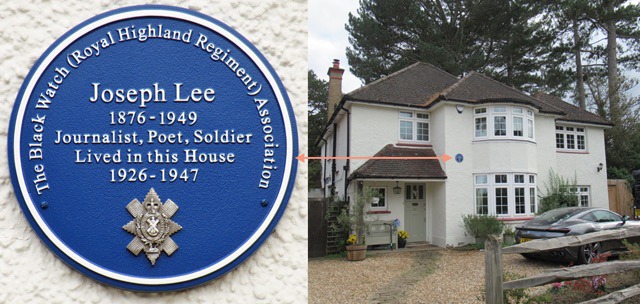
32 West Hill Avenue
Copyright image courtesy of Roger Morgan 2023
Joseph’s service record is held at The National Archives under reference WO 339/106593 and his papers are held by the University of Dundee.
Clive Gilbert 2023
Following a suggestion by David Brooks
IMAGES
Understood to be courtesy of Fire Brigades Union
SOURCES:
- https://en.wikipedia.org/wiki/Black_Watch
- https://www.scottishpoetrylibrary.org.uk/poet/joseph-lee/
- 1/4 Black Watch War Diary (National Archives)
- 10th KRRC War Diary (National Archives)
- https://en.wikipedia.org/wiki/Joseph_Lee_(poet)#Biography
- Ancestry: Medal records
- Ancestry: Marriage records
- Ancestry: Electoral Rolls
- Ancestry: 1939 Register