
Girton House School
2 Westcott Way, East Ewell
 Girton House School, East-Ewell, 1950s
Headteacher (Centre) Mrs Winsome Lily Burton-Jenkins.
Image Source
(Click to enlarge.)
We don’t know much about Girton House School, so if anybody has further information or can identify any of the staff or pupils in the photo and, hopefully, tell us something about them, please contact the webmaster. (There is no indication in any electoral records that there were live-in adult staff at the school, so we’re assuming that it had only day pupils who lived fairly locally.)
The school was run by a lady called Winsome Lillie(or Lily) Barnes/Burton-Jenkins (and I’ll explain the different surnames in due course), but let’s go back to her beginnings.
Winsome Lillie Cole was born on 27 August 1896 in Brockley, to William John Cole, a schoolmaster, and his wife Amelia Martha (née Cooper), who were married in 1887. Their first child, Ethel, died in 1894, aged 10, but in the meantime they had produced William Albert Victor. Winsome Lillie and Norma Leonie followed later. By 1901 William Junior was a pupil at Christ’s Hospital (the Bluecoat School) in Hertford – it had two sites at the time, the other one being in London. Winsome and Norma were at home with their parents in Deptford.
In 1902 all the boys at Christ’s Hospital (both sites) moved to a new site in Horsham and Hertford became girls-only. Winsome was a pupil there in 1911. William Junior had moved on to become a master at the Church Missionaries’ Children’s Home in Limpsfield.
I think I’m right in saying that both Cole parents died in the 1920s. Norma Leonie got married in 1926 and her home address on the certificate was given as 41 Malvern Road, Thornton Heath, which I assume was the family home. We pick up Winsome via electoral rolls and in 1929 she was registered at 269 Northborough Road, Mitcham, but it was noted that her abode was the Thornton Heath address. Digging in old newspapers reveals that the Northborough Road address was a private school, called Girton House, and a 1932 cutting shows that her brother, William, was involved in it too.
The reason we are trying to track Winsome through the years is that she moved around, usually within Surrey, and it isn’t always possible to tell if she was running a school or not. She also seemed to have an interesting personal life.
The same Northborough Road/Malvern Road situation applied from 1930 to 1937: however, we have a conflict in registers, because Winsome appeared to be in two, or even three, places at once from 1932 – she was also at 1 Hindhead Way, Beddington with a man named Sidney Robert Attwood Barnes, but she was going under the surname of Barnes. In 1938 they had reached Westcott Way, East Ewell and what presumably became Girton House was just ‘Plot 121’, although it was actually called Girton House in the 1939 Register.
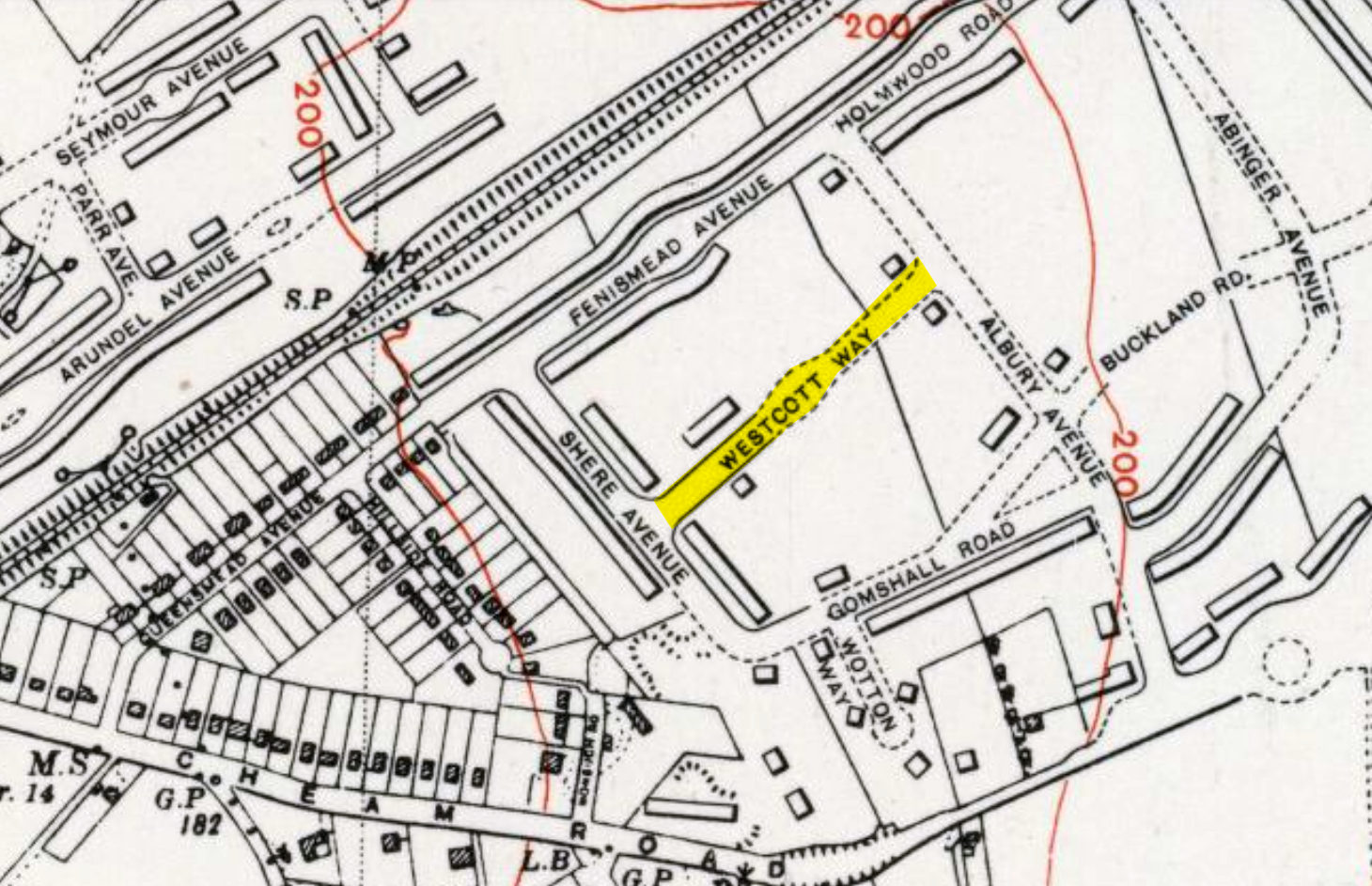 Extract from the 1938 6″ OS Map
So, who was Mr Barnes? The short answer is a man who had married in 1921 and was separated from his wife, who lived elsewhere working as a millinery buyer by 1939.
Obviously, we don’t really know anyone’s whereabouts during the WW2 years, except that the 1940 edition of Kelly’s Directory showed Mrs W L Barnes as the principal of Girton House School and by 1952 (the next edition of Kelly’s that we have) she had become Mrs W L Burton-Jenkins. In 1950 Winsome had changed her surname by deed poll from Cole to Barnes, even though she was never married to Mr Barnes, and in any case he had died in 1949, then living at 2 Elm Cottages, Grove Footpath, Surbiton. Letters of Administration to his estate were granted to his widow (i.e. the lady who bought millinery). And in 1951, Winsome married Cyril Burton Jenkins – she apparently added the hyphen in the surname for effect. Mr Jenkins had been married before, but we needn’t go there. The final edition of Kelly’s we can refer to (1956) still has W L B-J at Girton House and at some point thereafter the couple retired to Sussex. Winsome died in 1971 and Cyril in 1975.
Heaven knows how Winsome juggled all these goings-on, but I for one am exhausted with her. We have something of a rarity here – a local school that existed for quite a long time , which we know virtually nothing about, a head teacher with more names than I can cope with, and quite a few pupils, none of whom we can name. So, if anyone out there can offer some kind of enlightenment about anything, please do get in touch with the webmaster via our contact facility.
Linda Jackson 2023
Addendum
We are most grateful to Pam Hall, widow of Colin, for letting us use the following photo:
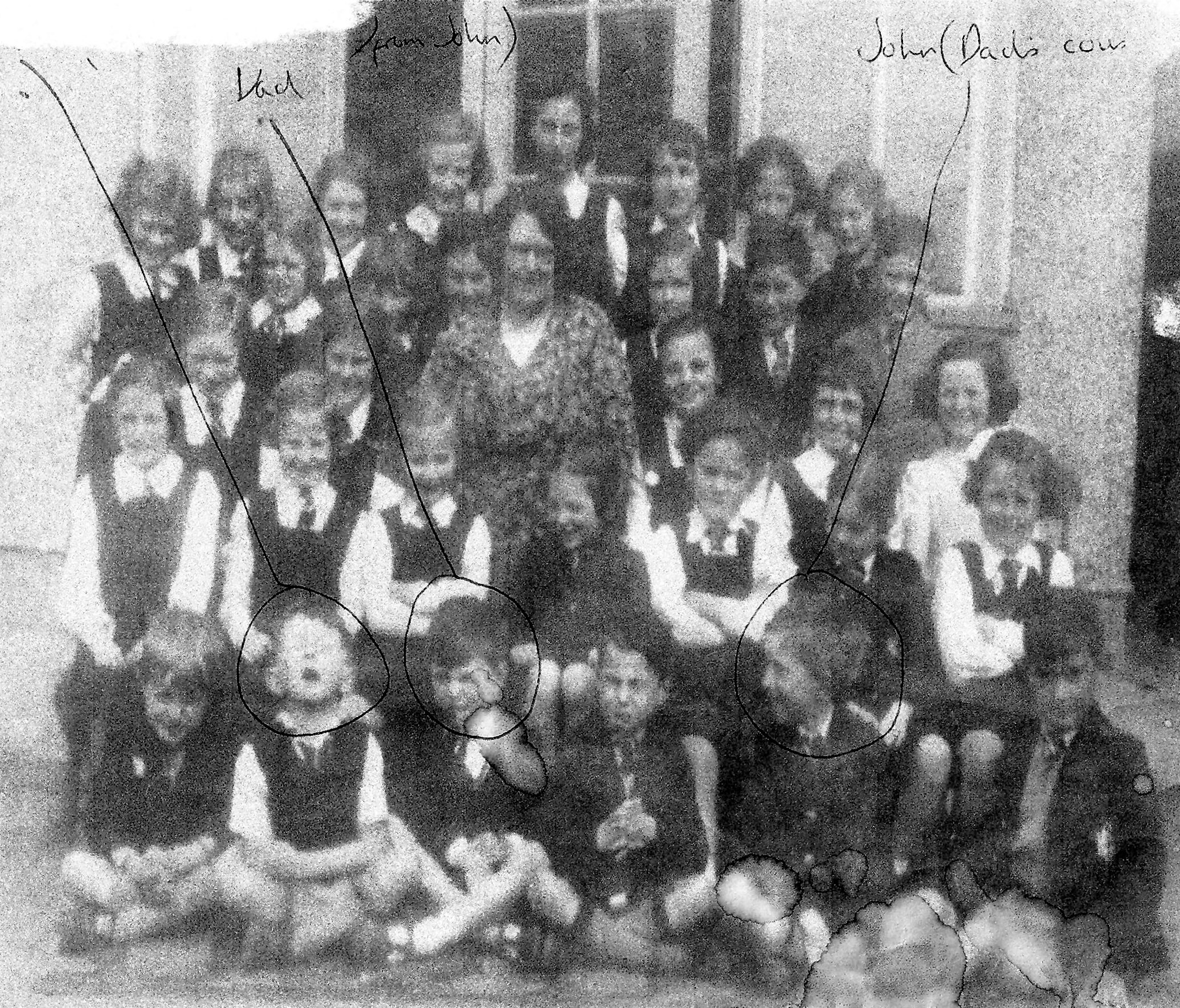 Girton House School Photo
Image courtesy of Pam Hall ©2023
The three boys marked from left to right are:
Don Holliday – Colin’s neighbour and best friend
Colin Hall
John Firth – Colin’s cousin
The lady is of course Mrs Barnes.
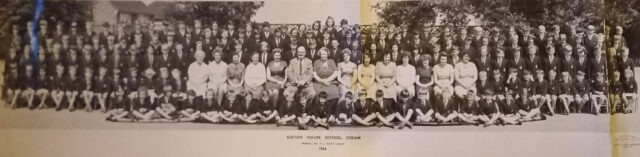
Staff and pupils 1964
See below for cropped picture of staff
Image courtesy of Helen Cook
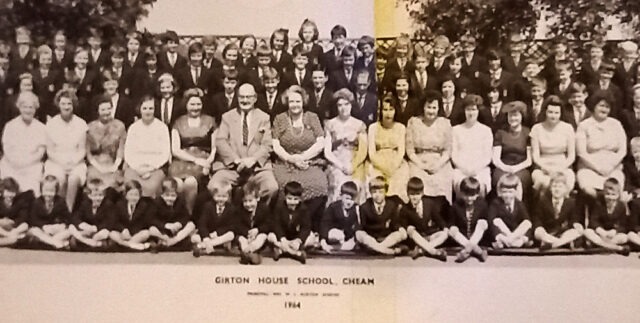
Mr and Mrs Burton-Jenkins centre
With staff and some pupils 1964
Image courtesy of Helen Cook
Just recently we have had contact with three former pupils at the school, all of whom have shed welcome light on how it was in the 1960s, at least nearly up until its demise, which seems to have been around 1968.
Steve Bridger remembers:
Local man Steve Bridger, who was a pupil from the tender age of four (1961), says that, even now, few people seem to have heard of the establishment and he’s certainly right about that. As far as this website is concerned, it just popped up out of nowhere, as recently as last year. And yet, it was a sizeable school in the area for some years – bizarre.
Helen Cook (then Newton) couldn’t imagine how they crammed in the sheer number of children that they eventually did, but Steve tells us that 2 Westcott Way was actually far bigger than it looked from the partial frontal views we have seen and explains what was tucked in where.
Helen attended the school until January 1967, when a place became available at Sutton High School – her sister already went there. Mr and Mrs Burton-Jenkins had departed in the summer of 1965 and the new headmaster was Adrian Ewart Dommersen (born 1937). His younger sister, Gemma (born 1940), was also a senior mistress there. They seem incredibly young for such positions, although we are told that their mother, Doris, was also involved, and they didn’t last all that long, because the school closed down in, we believe,1968. Our third contact, Alison Brown (then Robb) thinks this may partially have been caused by the opening of Cuddington Croft Primary School at around that time.
Helen recalls that at some point she received corporal punishment for cheeking a teacher but cannot remember if the instrument was a slipper or the cane. Either way, she says that she suffered no lasting trauma and she later became a mathematics teacher.
What is interesting to someone who isn’t local and who knew nothing of this school until last year (yes, that’s me) is that the three ex-pupils mentioned seem to have had a really good all-round grounding in both core and other subjects, which set them up for the future. I daresay there are many more who would say the same.
Steve has shown us three of his reports and it’s fascinating to see what the youngsters were studying, even from the age of about four. Here’s Steve’s first report.

Steve Bridger’s school report from 1961
I don’t know about you, but I can recall little from my very early primary school days, apart from being forced to take a nap on a camp bed each afternoon – during one of these compulsory sleep-ins a sneak thief made off with our teacher’s handbag, but I remember nothing else at all.
By the summer of 1964, Steve had gone from strength to strength in most subjects, although his arithmetic had tailed off somewhat and his singing doesn’t seem to have been quite as good. I am struck, though, by the breadth of the reporting. Not that I have any old school reports at all, but I’m fairly sure that mine never got into this much detail.
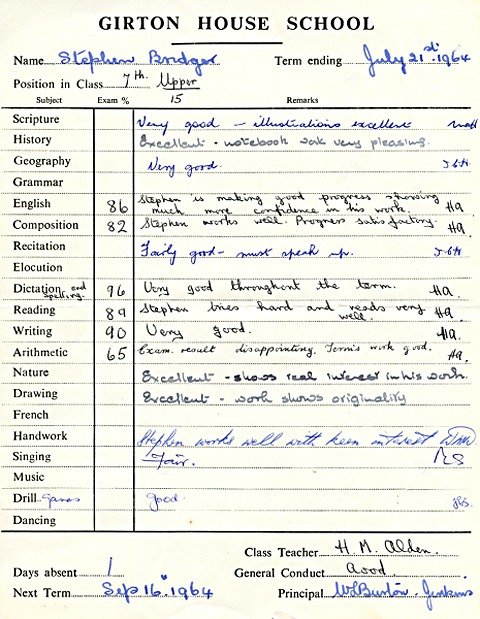 Steve Bridger’s report for the summer term of 1964
And here’s one from Mr Dommersen’s time in charge, which seems rather more curt, sparse and stingy than the previous regime, especially for a lad who achieved an impressive 29 gold stars (we’ll ignore the solitary black star).
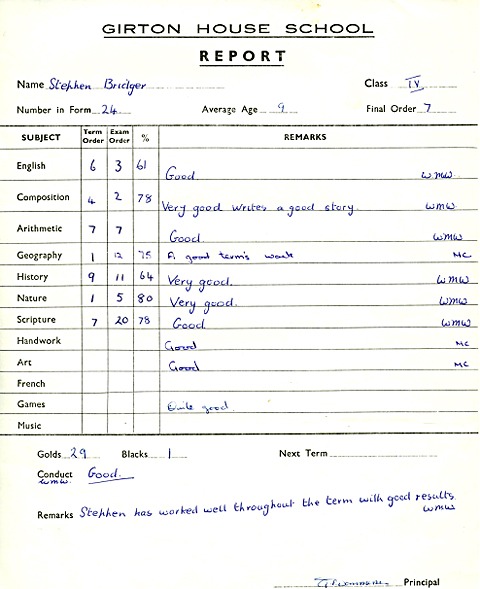
One of Steve’s reports from the Dommersen era
Steve doesn’t remember much about the Dommersen regime, as he left to attend Freemen’s School in Ashtead Park, but let’s continue with his reminiscences.
‘The school (or house now) is much bigger than the others around it and it would easily fit 100+ pupils – it has obviously not been extended to the back, apart from a conservatory, since I was there. The cook’s kitchen area was to the left of the back under the stairs. The garage was used for the ‘woodwork’ classes and very cold in the winter. The playground was all tarmac (the whole area).
For Sports then we all walked to the Cheam playing fields to play football and then walked back in an orderly fashion with very few staff attending all the classes!
I started on my 4th birthday (April 1961 -some present!) and the headmaster and mistress were Mr.& Mrs. Burton-Jenkins but were known just as the Jenkins: they were both very ’round’ and heavy smokers with yellow fingers and a smoke-filled yellow-ceilinged headmasters’ room. They sold the school to a Mr. Dommersen (who I believe opened the insurance company office along East Street, Epsom, almost opposite Kiln Lane, as a shop – since demolished when the school closed).
It was a very good school. My parents looked at sending me to Freemen’s and if I did not pass the entrance exam then I was destined to go to Ewell Castle. I went for my test at Ewell Castle, but, despite being only 8 then, I was within the 10-11 year old pupils except for French (mainly due to not being taught it). Girton House really pushed education into the pupils.’
Helen recalls that the food was pretty good, even if the cook was literally ’below stairs’.
‘I remember the school meals, which were home cooked every day. We had the same menu every week – I particularly remember jam tart and custard on Mondays and fish and chips on Fridays, two of my favourites….and they still are!’
Alison was at Girton House from 1962 until 1967, along with her brother and two sisters.
‘Mr Jenkins was a very heavy smoker of cigars, so the first floor of Girton House smelled of cigar smoke most of the time. Mrs Jenkins in particular was a kind soul but then so was Mr Jenkins’
When Alison was a pupil (and she recalls that she was in the same class as Steve Bridger) the school took only day pupils and her class contained approximately 15 children.
‘The Jenkins were quite ahead of their time in some respects as annual sports day was held in Littlehampton. All travelled down for the day by coach. Every second or third Friday an edition of Pathé News was shown in Class 6.
There was a hot, freshly cooked lunch every day and we all had to take turns in distributing cups of tea to the teachers in their various classrooms.
Every class had a weekly medal system whereby the top performers were given a gold, silver or bronze medal for good progress. There were four houses, two of which were Lancaster and York. Collectively, at the end of term, houses competed against each other in various sporting and academic events.
When the Dommersens arrived not a great deal changed but because Mr Dommersen was so much younger than the Jenkins there was a more modern feeling about the place.
There was a full curriculum in swing with lots of music, sport, sewing, crafts and particular emphasis on British history.’
One of Alison’s sisters went from Girton House to Rosebery School in Epsom, her brother attended Kingston Grammar; Alison herself and her other sister transferred to Sutton High School.
Melvyn Smith remembers:
I attended Girton House from 1960 to 1964 and have a store of memories about my time there. I lived just down the road at number 12 Westcott Way, a house built by my grandfather, Henry Moore Ormston, who built several properties in Westcott Way during the 1950’s and funded my school fees.
The entire back garden was tarmac, apart from a small, untended corner of earth at the far left in which stood a holly tree. The tarmac was an excellent surface for marbles, fives, and model ‘tank’ races (constructed from cotton reels, rubber bands and lolly sticks). Morning assembly was conducted in the downstairs hallway, with the overflow of children on the stairs. Mrs. Burton-Jenkins taught our class arithmetic. We’d watch her intently as she sat, chain-smoking, at her desk, fascinated by the ever longer ash residue that drooped from her cigarette. Just at the point where we were certain it would fall into her lap, she deftly flicked it into her ashtray. I wonder how many past pupils remember the Littlehampton sports day story? The week Westcott Way’s driveways were cemented? The Polio jab day? Mrs. Wright and her terrible punishments? Being sent to the head’s study? The winter of 1963?
Sometimes I pass through Westcott Way and pause outside number 2, now a residential property, and wonder if the present owners have any idea of the hundreds of shared memories that remain within those rooms.
Jo Hale remembers:
I went to the school around 1964-65. I think I was only there for a year. I don’t remember much except that Harry Secombe’s son went to the school and I think Harry was in the hallway one morning. I remember pushing my way through a large crowd to be faced by his big belly but then reading some of these stories maybe that was the Headmaster?! I do remember reciting our times tables and I remember a large climbing frame at the bottom of the garden of the school. If I climbed to the top of the climing frame I could look over the fence into the back garden of my house and see my mum at the kitchen window.
Not many memories but I would love to know more about this if anyone else has any stories!
********************************************************