
CUDDINGTON CROFT PREPARATORY SCHOOL FOR BOYS
Ewell Road, Cheam
With some recollections of a former pupil
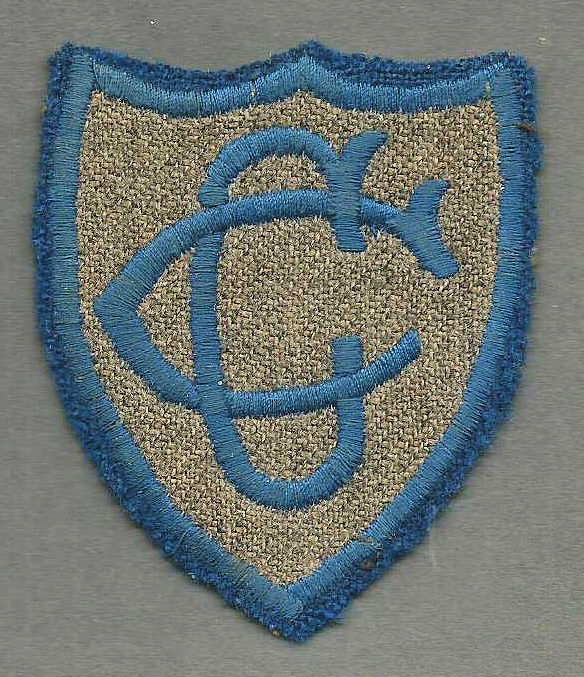 Cuddington Croft School Badge
Image courtesy of Peter Klein © 2023
Cuddington Croft school was founded in 1937 by Liverpool-born William Henry Arnold Enoch Springman, and his wife Karin Elenor Elizabeth, née Bryde-Williams. She was the daughter of an English merchant sea captain who married a Norwegian, and Karin was born at Sandefjord in 1905. Springman was universally known as Harry, not only by his wife but also by the boys at the school.
 Detail from the 1949 School photo
Harry Springman and his wife Karin,
Mr. Wright is sitting on Harry’s right
Image courtesy of Peter Klein © 2023
The Springman, or rather Springmann, family are not without interest, for they were German immigrants, the first of whom was Emil Springmann, born in Prussia in about 1812. He became a very wealthy general merchant, and by 1851 had settled in Liverpool where he established a thriving business in Sweeting Street. He also appears to have built a large house called Drachenfels (Dragon Rock) at West Derby, named after a landmark on the Rhine near his wife Maria’s home town of Bonn. He died in 1887 leaving over £137,000 in the UK, the equivalent of about 17 million pounds today, with a further third of his total wealth being in Germany. Emil’s eldest son, also Emil, was born in 1852, and he became a cotton broker. In 1900 at the age of 48 he married an Edith Mary Fairhurst in London, 23 years his junior, and there followed five children of whom young Harry was the fourth, born in 1908. By 1911 we find the curious arrangement in which parents and children were living separate lives in Blundellsands, with the parents in one house, and the children in another with three attendant servants. It would seem that children and social lives didn’t mix!
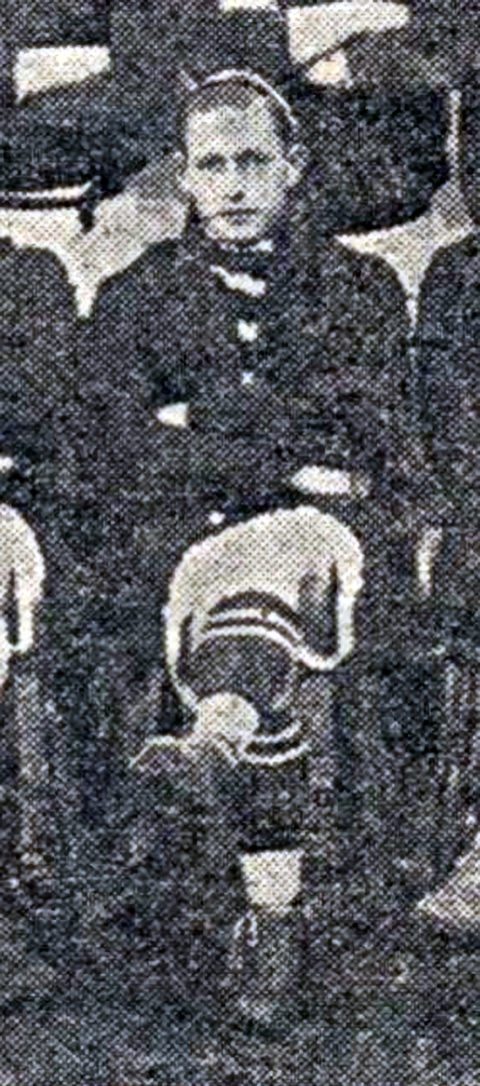 A newspaper cutting of Harry Springman in 1925
when he was a rugby player at Dover.
We know but little of Harry Springman’s early life and education. He said that he was of “Dover College & St. Edward’s, Oxford”. The last looked impressive, but both were in fact public schools, and there is no mention of him attaining a degree anywhere. He was a keen all-round sportsman, and while at Dover in the mid 1920s he enjoyed a considerable reputation as a rugby player. By 1932 we find he had become a schoolmaster, and on the 14 April he married Karin Bryde-Williams at Redhill parish church, swiftly followed the next day by being stopped by the Hampshire police in Fareham, and later fined ten shillings by the magistrates, for failing to have a rear-view mirror fitted to his car! Within five years the Springmans had acquired Cuddington Croft, a solicitor’s architect-designed house on the Ewell Road at Cheam, occupying about five acres of land, with the aim of establishing a boy’s preparatory school there, with enough accommodation for two or three borders. By 1939 the school had at least seventy pupils, during the next ten years enjoying an excellent reputation, and a separate school hall and classroom building had been constructed to the east of the original house. This was square in plan with three classrooms, two of which were formed by drawing a sliding wooden partition across the assembly hall. Here there was also a boys’ changing room with toilets and washing facilities, a staff room, and a small central access hall.
 Cuddington Croft on the 1933 OS Map
The map shows the house as originally built, with its L-shaped plan,
sloping terraced site and landscaped garden with a tennis court,
but the main rectangular school block to the east had not yet been built.
Life at Cuddington
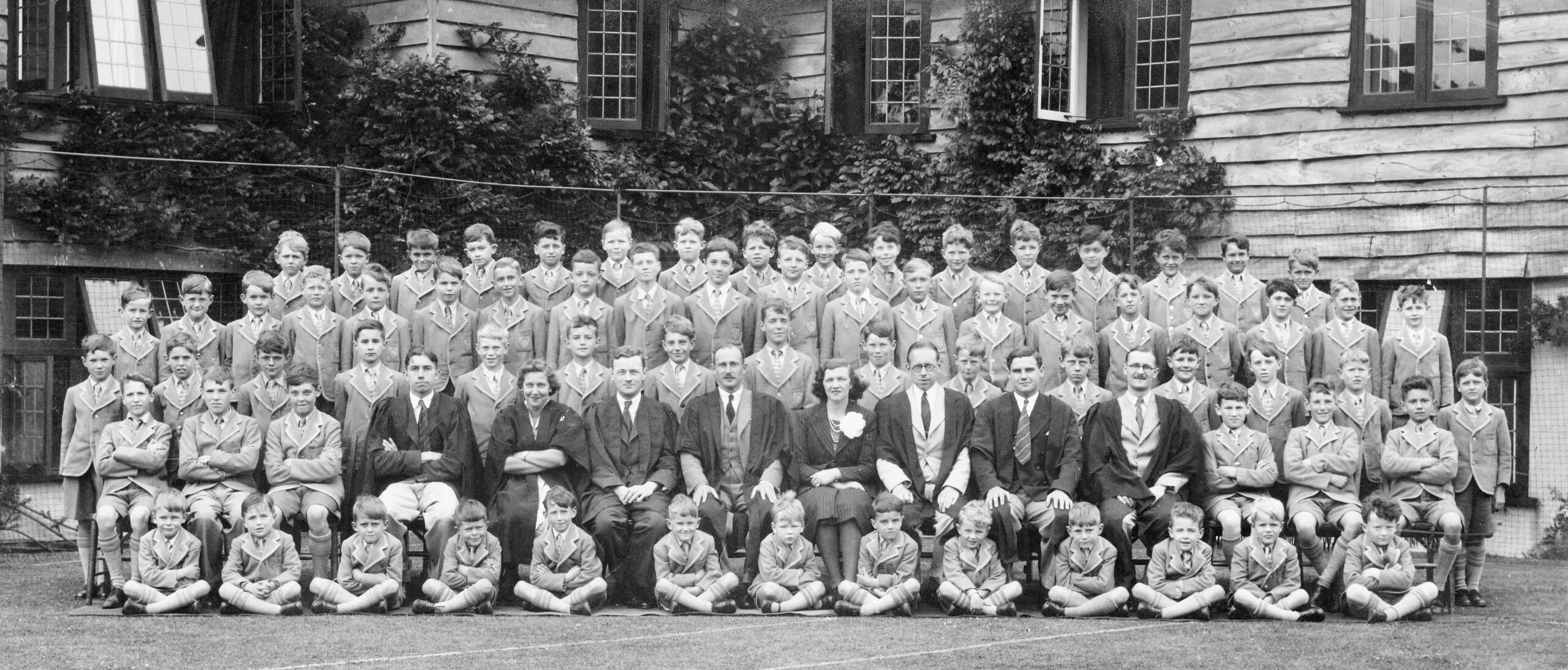 Cuddington Croft School Photo 1939.
The photograph shows the weatherboarded cladding of the first
floor of the house; for the time it was expensively finished inside,
with an arts and crafts feel. There were polished wood-block floors,
a wide staircase, and I remember the smell of wax polish everywhere.
Click Image to Enlarge
Image courtesy of Bourne Hall Museum
It was in 1948 that this six-year-old writer was enrolled as a dayboy at the school. The following recollections are of course from small boy’s perspective, written many years later, but my time there left a deep impression from which, perhaps, I never completely recovered. It is also based on what I overheard being discussed by parents at the time, but it is essentially a boy’s recollection none-the-less. Much could be written of the people there: Karin Springman, in the late 1940s, was aged about 44, and had the look of having at one time been glamorous although she had not weathered well. She spent much of her time at leisure, and was often seen driving off in their car – a black Series M Morris Ten saloon, for this was still the post-war “export or die” period. I have memories of her lying out in the sun in the garden by the pond in a comfortable deckchair sipping drinks, almost always with a cigarette. Her voice sounded husky and her accent upper class, but she was very friendly and liked to chat with the boys. She opposed the use of corporal punishment, and was said to have broken up Harry Springman’s bamboo canes so that he was obliged to hide them away, and Harry would disguise one when be came through the house by concealing it down a trouser leg (this was witnessed by the writer). Officially Karin was the school “matron”, also supervising the school meals, and she always appeared in the school group photographs, but she was also rumoured to be the money behind the school.
 Cuddington Croft School Photo 1949
Click Image to Enlarge
Image courtesy of Peter Klein © 2023
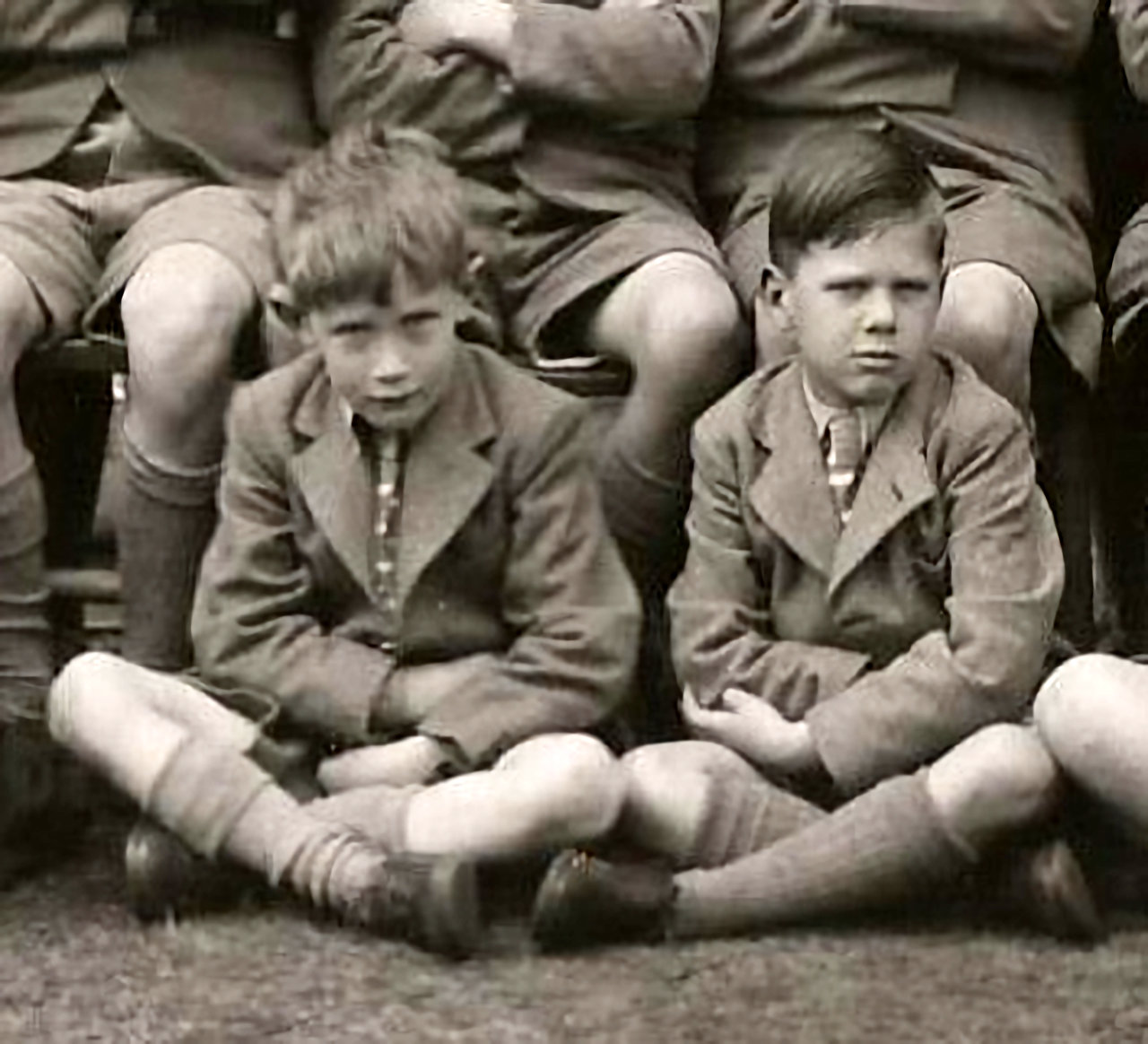 Detail from the 1949 School photo
(Left) Peter Klein
(Right) Keith the son of Beryl Harrison,
the Hair Dresser, at 2 Station Approach, Stoneleigh.
Image courtesy of Peter Klein © 2023
The Springmans had just one son, Leif, who before my time had been at Cuddington Croft as a pupil, and I remember seeing school photographs that included him. He went away for a while, returning occasionally in RAF uniform, and this was almost certainly while he was doing his National Service (?1952/53), as he had been born in 1934. During this period he acquired a pre-War MG sports car, which was kept in a wooden garage behind the school building, and here he stripped off the old body and replaced it with a metal torpedo-shaped body that he made himself. Subsequently he seemed to have lost interest, for the car appeared abandoned and just lay there, and I don’t recall it ever having been painted or finished. On completing his time with the RAF Leif had returned to the school briefly as a member of staff, and latterly I recall him dressed in a short gown, although I don’t believe he ever qualified as a teacher. He died in Croydon on the 10 August 1974 aged only 40, and just eight months before his father.
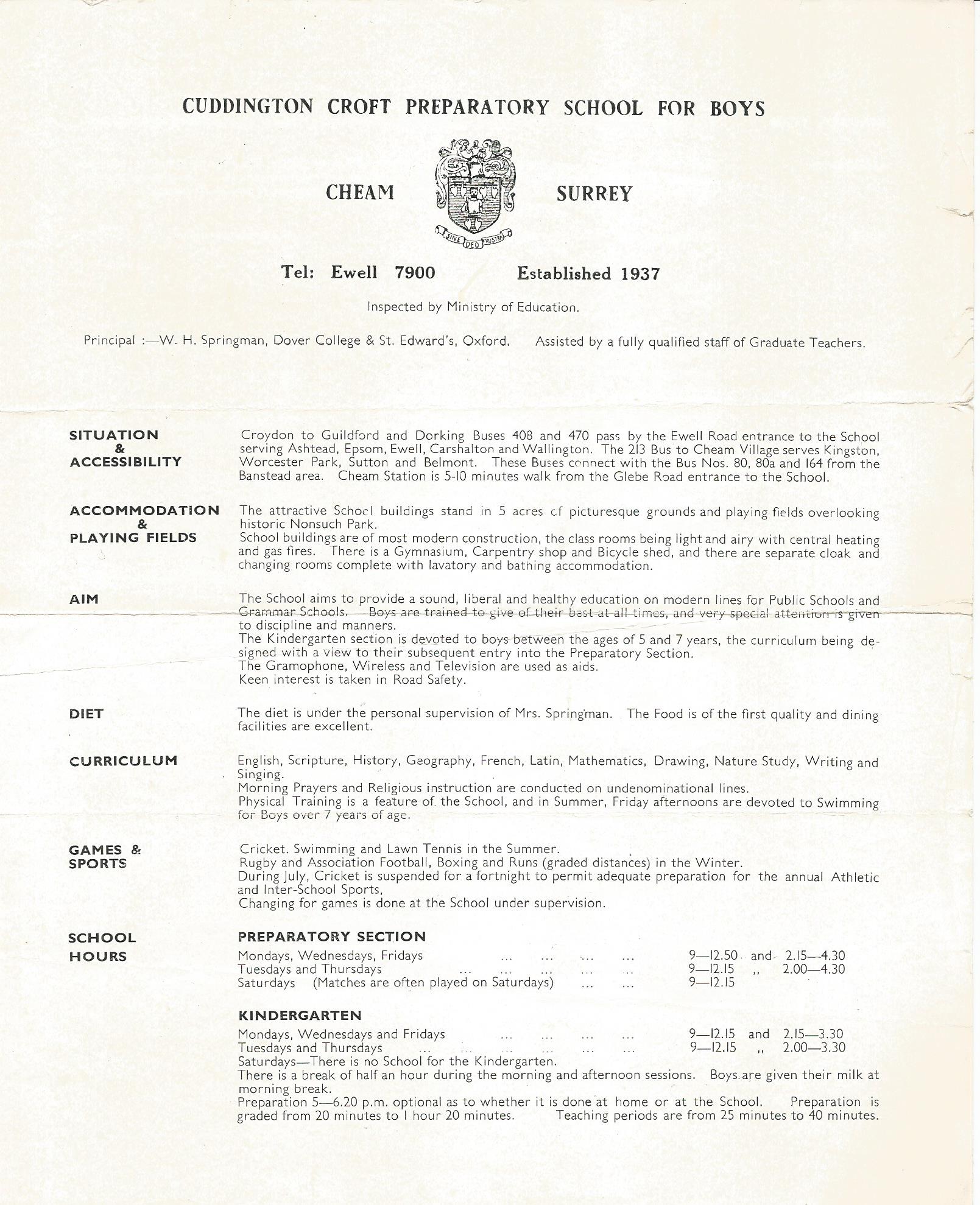
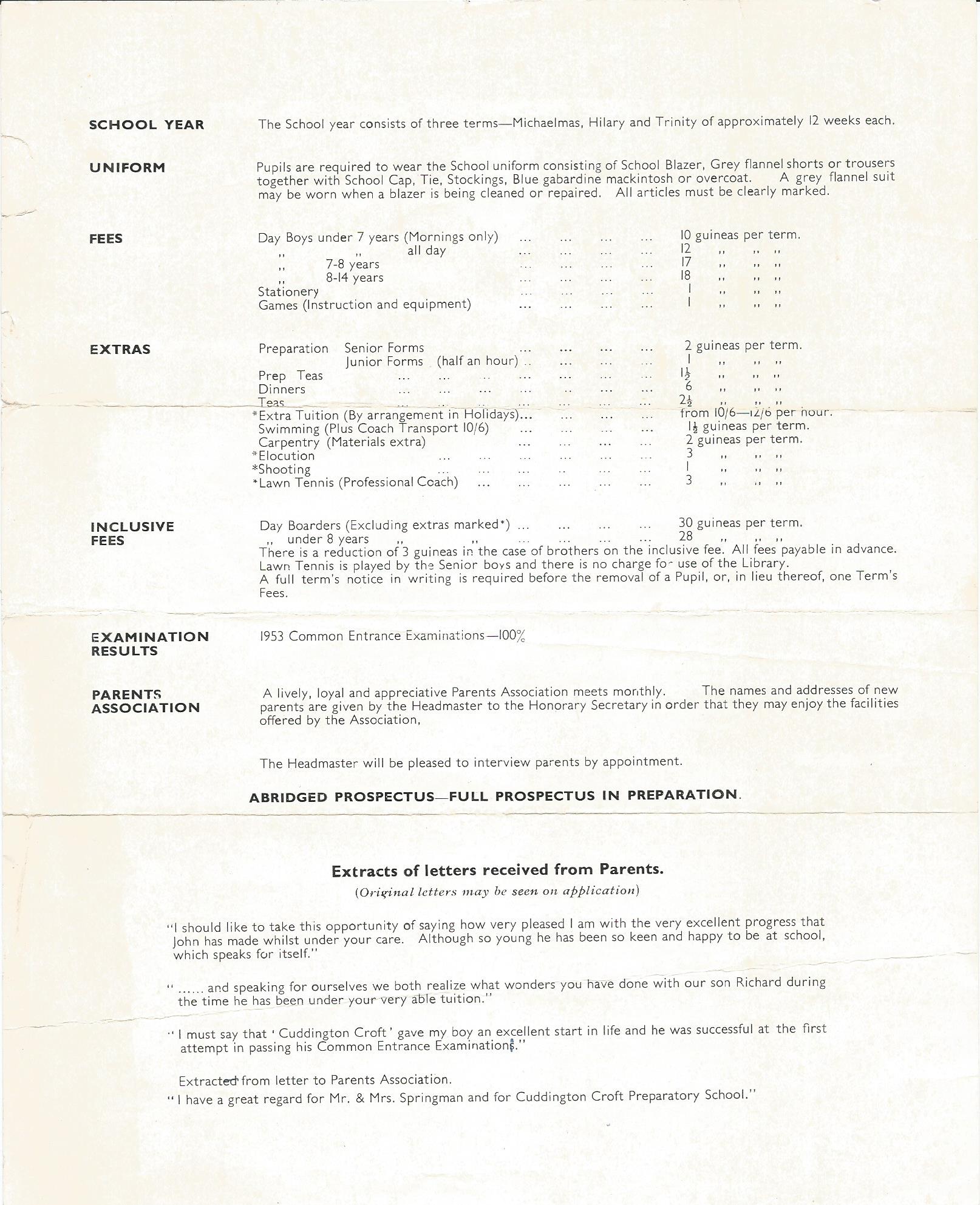 Cuddington Croft School Prospectus
Click Image to Enlarge
Image courtesy of Peter Klein © 2023
There was also Molly, a cheerful Irish girl who worked in the kitchen and prepared the school meals, and she is presumably the Mary McGing who is recorded as a voter living at Cuddington Croft in the electoral registers between 1948 and 1961. She is fondly remembered, during those days of post-War austerity, for her rabbit stews and chocolate semolina pudding, which appeared with remarkable regularity. I also remember two school dogs, although neither was there for long: Buller was a large boisterous German Shepherd who liked joining in with school games, but I think boys were a bit intimidated by him although he seemed friendly enough. There was also Bagswash, a curious name that also appears in fiction in the 19th century, who I seem to remember was an English Setter, but he was already an older dog and was about only briefly.
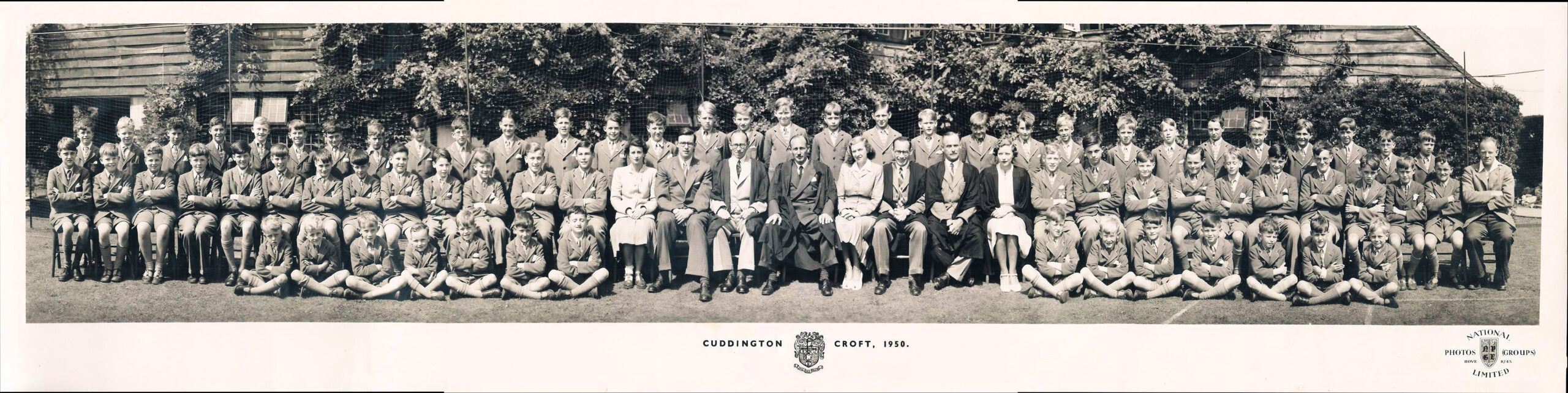 Cuddington Croft School Photo 1950
Click Image to Enlarge
Image courtesy of Peter Klein © 2023
The school was divided into two “houses” – Nelson and Wellington – for competitive sports purposes, and there was a dark varnished board on the wall in the small central hall of the school building, with the names painted on it of past boys who had won trophies or competitions. There was also a record of “stars” and “stripes”, awarded for good or bad conduct, usually allocated in quarters. These, too, featured on the “house” board, and the term’s record for each pupil was also put on his report, but I don’t recall any school sporting achievements being added to the board during my time there. Off the central hallway on the western side was the school staff room, with a glazed door and panels through which one could dimly see the staff smoking. The air was usually dense with blue tobacco smoke, and I remember Mr. Power, a lean Irish schoolmaster with a strong southern accent, who regularly lit up in class, although most did not. Harry also thought nothing of lighting up in school assembly, and on one occasion he leaned back in his chair on the dais with its back legs far too close to the back edge. Harry and chair both disappeared in a cloud of sparks from his cigarette, much to the hilarity of the whole school including the other staff. To his credit Harry emerged grinning and apparently unscathed. I also recall the day when King George VI died, in early February 1952, his death being announced in assembly, and we all sang “God Save the Queen” for the very first time.
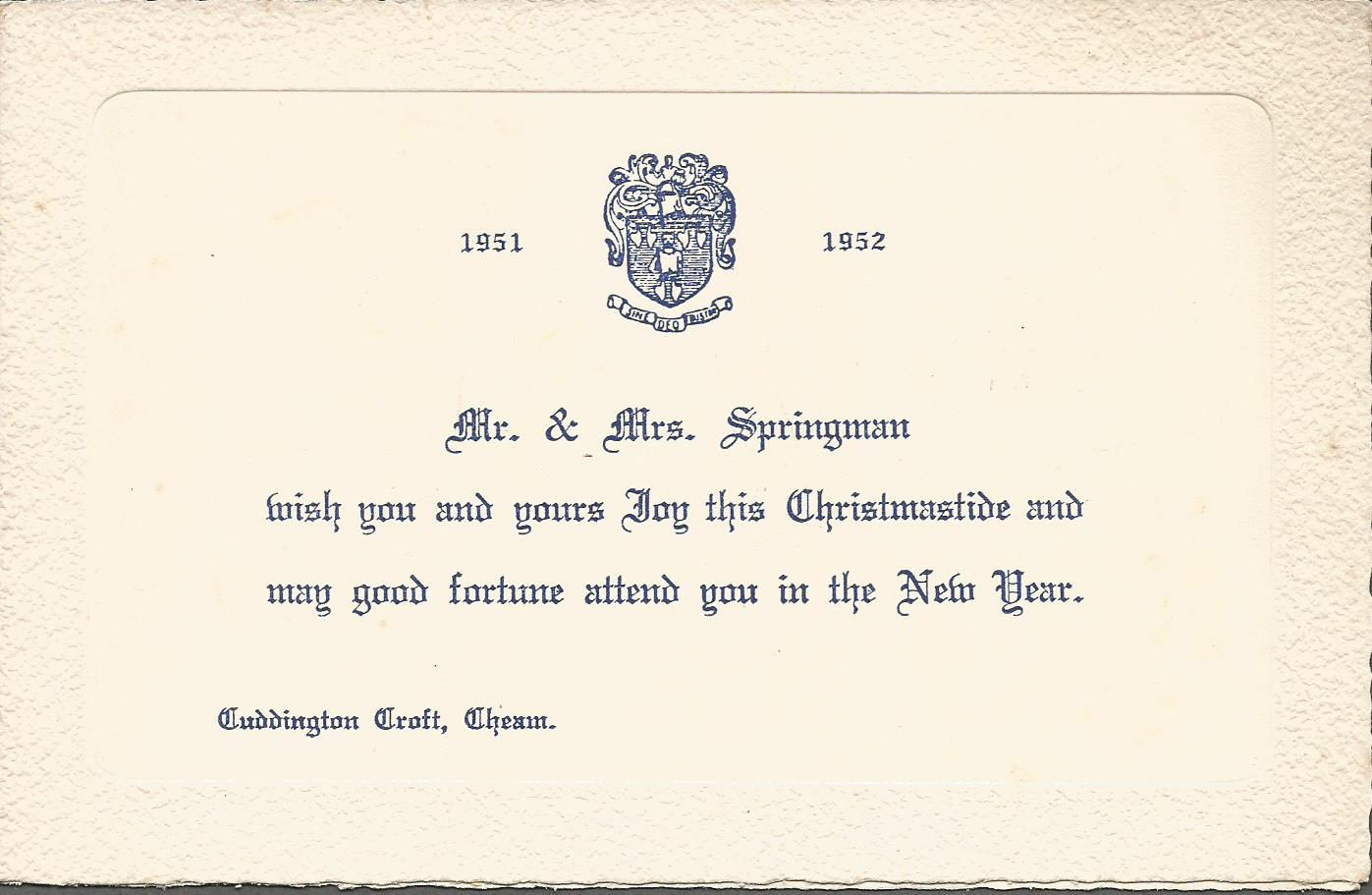 1951 Cuddington Croft Xmas Card
Image courtesy of Peter Klein © 2023
However, not all assemblies were without incident, and on occasion members of staff aired their grievances very much in public. Probably under stress, Harry Springman was increasingly irascible and abrupt in his manner, even arrogant, and I have a mental picture of him, when told about something untoward, he would say “Typical! Typical!”, with a contemptuous little toss of his head on each T. He could evidently be quite rude and short with his staff, although I don’t know of altercations being witnessed by any of the boys, but I was present on both occasions when two staff members, a feisty New Zealander Miss Gilbert, and the elderly Mr. Whitham, very publicly remonstrated with Harry in front of the whole school at assembly. Harry blustered his way out of it, but the incidents of course were duly relayed to parents. When I first arrived at Michaelmas 1948 there was an assistant headmaster, Mr. R. E. Wright, and later he was said to have been the steady hand that from 1939 had held the school together, and under him it had blossomed. On my first school report his signature appeared at the end as “acting headmaster”, but on my later reports his initials disappear after 1951. He left, apparently offered a headship elsewhere, and after this the school was said to have steadily declined until its final closure only five years later. I have an undated letter from a very loyal Parents Association recording the convening of a meeting to appeal for additional funds during a financial crisis, at which 21 parents attended, raising a promised £580, including cheques totalling £390. It makes for rather poignant reading, and what is clear is that boys were being steadily removed from the school and that numbers were dwindling, but to my knowledge among parents the cause of this was firmly attributed to Harry Springman himself.
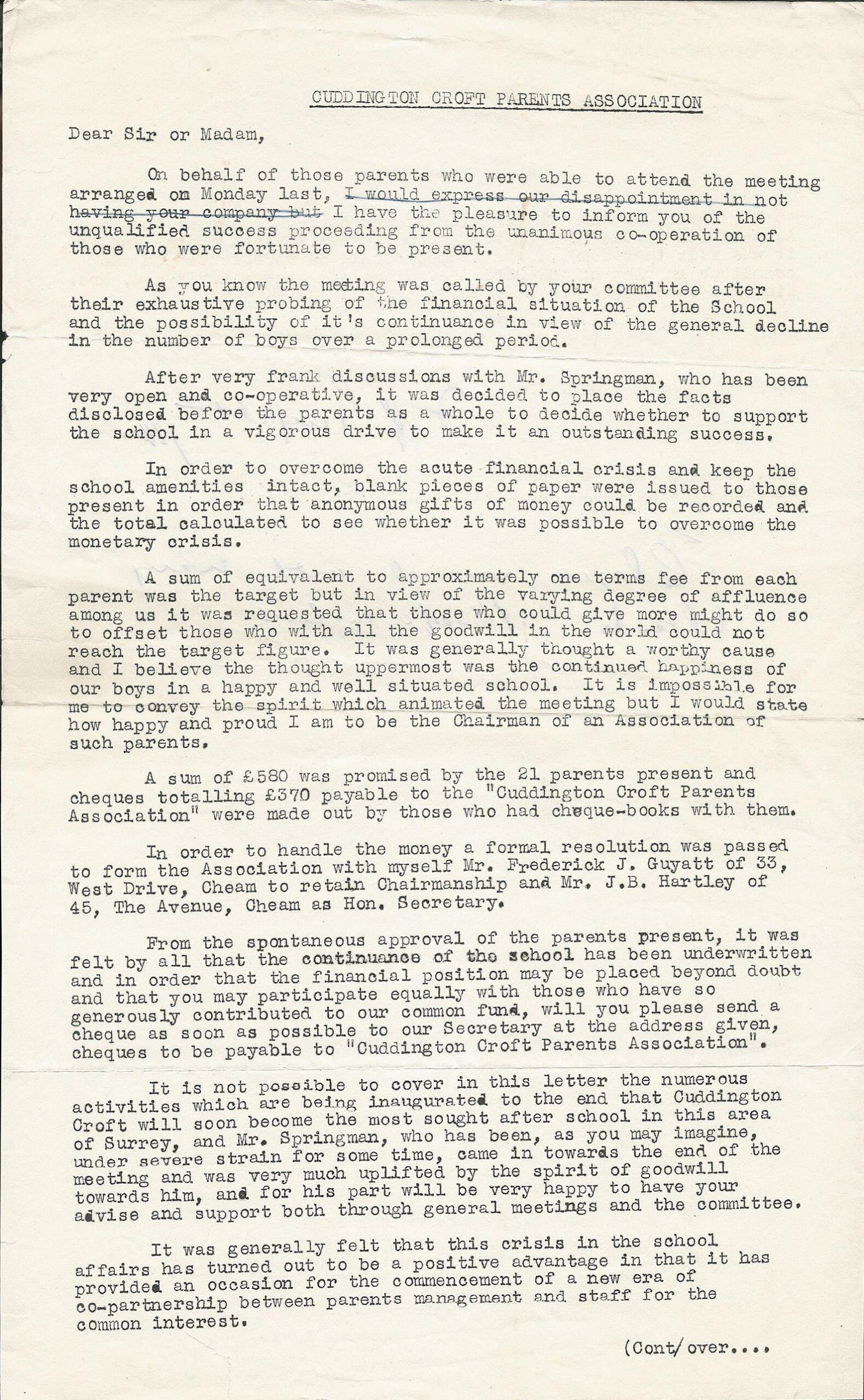
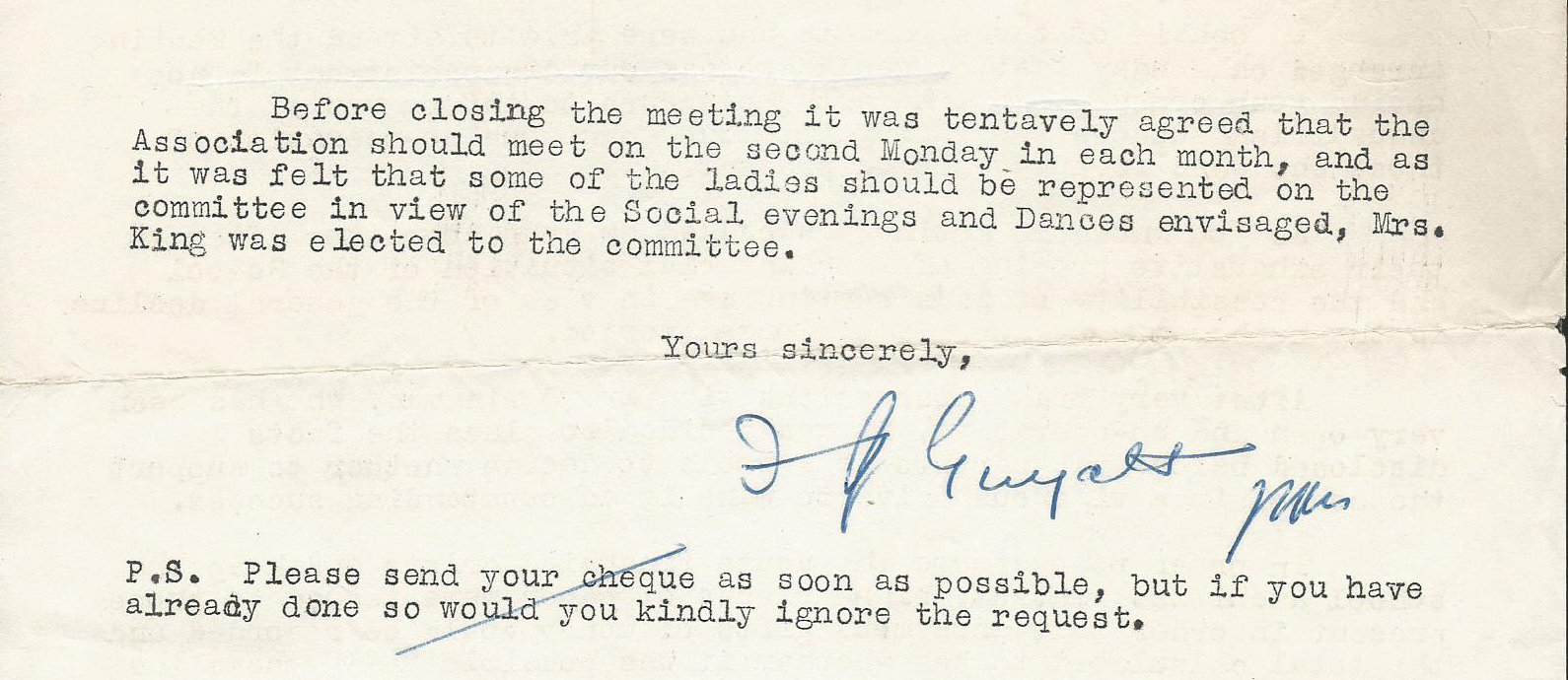 The undated letter from the Parents Association
There were one or two memorable teachers, such as the avuncular Mr. Whitham, with an M.A. from Cambridge, who taught French, Latin and History, and looking back he certainly influenced the course of my life. He seemed older than he was, walking with a shuffling limp, and as an officer in WWI he may have been wounded. I recall that he occupied the summer months and supplemented his income by leading Cook’s Tours. Between 1949 and 1951 there was also the formidable Elizabeth O’Donnell, who lived in Station Avenue, Ewell, taught English and Maths, and was an excellent teacher. She would brook no nonsense, and her favourite expression, when faced with a less than adequate piece of work, was: “… and what’s all this in aid of?” This was said to Keith Harrison, son of Beryl the hairdresser in Station Approach, after producing a drawing that consisted of a curious rather shapeless scrawl over his piece of paper, and he explained that it was a picture of a house on fire. Mrs O’Donnell was not amused, and young Keith wailed plaintively. Then there was the diminutive but irrepressible Miss Weller, with a neat range in little mauve or blue hats, and we were always pleased to see her. She had a thin piping singing voice, was an excellent sight-reader at the piano, and came in occasionally to teach us songs such as Linden Lea and Joe the Carrier Lad . I remember them still.
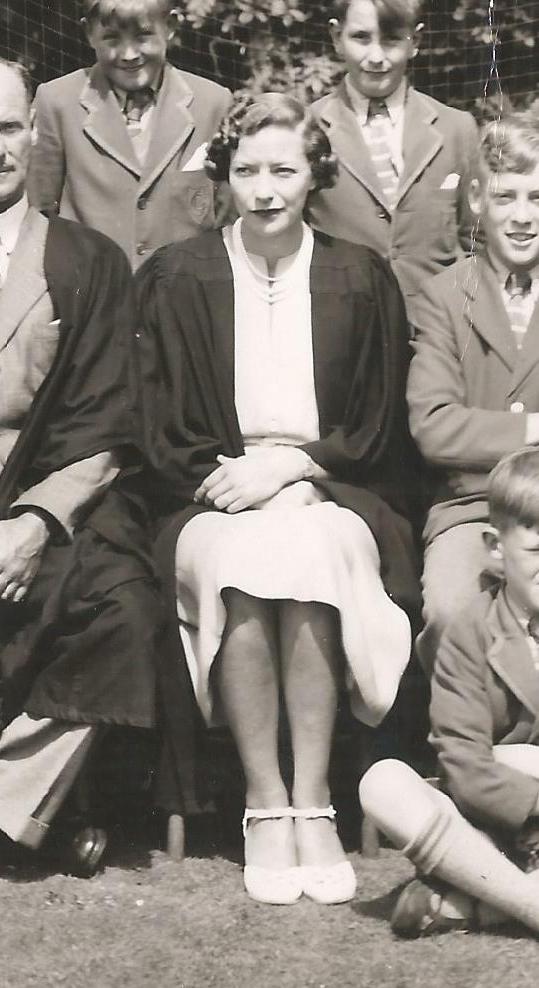 Elizabeth O’Donnell from the 1950 School Photo.
Sitting stiffly in the group for her portrait, while waiting for the
camera to traverse across, her eyes have strayed off-camera
as if she has spotted something she doesn’t quite approve of.
I remember that look well. She dominated my school life
for only two years, but to a boy of nine it seemed rather longer.
We both moved on, but my mother kept in touch with her,
and in the late 1960s I was down from Birmingham and
we called on her not long before her death of cancer.
She was charming, but I was still very aware of being
the former pupil, and still being appraised!
Image courtesy of Peter Klein © 2023
Despite these and others, there was latterly a steady turn-over in staff, the numbers of boys were dwindling steadily in the mid 1950s, and I was removed in the summer of 1955. In around 1956 Harry closed the school altogether and opened the “Cuddington Croft County Country Club”, but that venture was but short-lived, and in June 1958 Harry Springman filed for bankruptcy. The couple separated and Karin married again in 1973, two years before Harry died at the age of 67. His ashes were buried in Liverpool.
Peter Klein © 2023
Postscript.
It won’t just have been Harry’s ashes that were buried in Toxteth Park cemetery in 1975, but those of his life’s aspirations and hopes as well, and following his son’s death in 1973 the latter part of his life will have been a lonely one. Many years ago a fellow pupil and chum of mine met Harry at his local (the Glyn Arms, in East Ewell) and remarked that he seemed a changed man, and that he enjoyed his company. This has been in part a sad account of the school’s decline and fall, but there may well be those who still remember it before my time, when it was much more successful, and they may well have enjoyed their time there. It would be good to hear from them too.
Peter Klein © 2023