
Susannah Blanchet (otherwise Blanchard)
c.1761 to 24 March 1788
a convict aboard the Prince of Wales transported
in the ‘First Fleet’ to Botany Bay, 1788
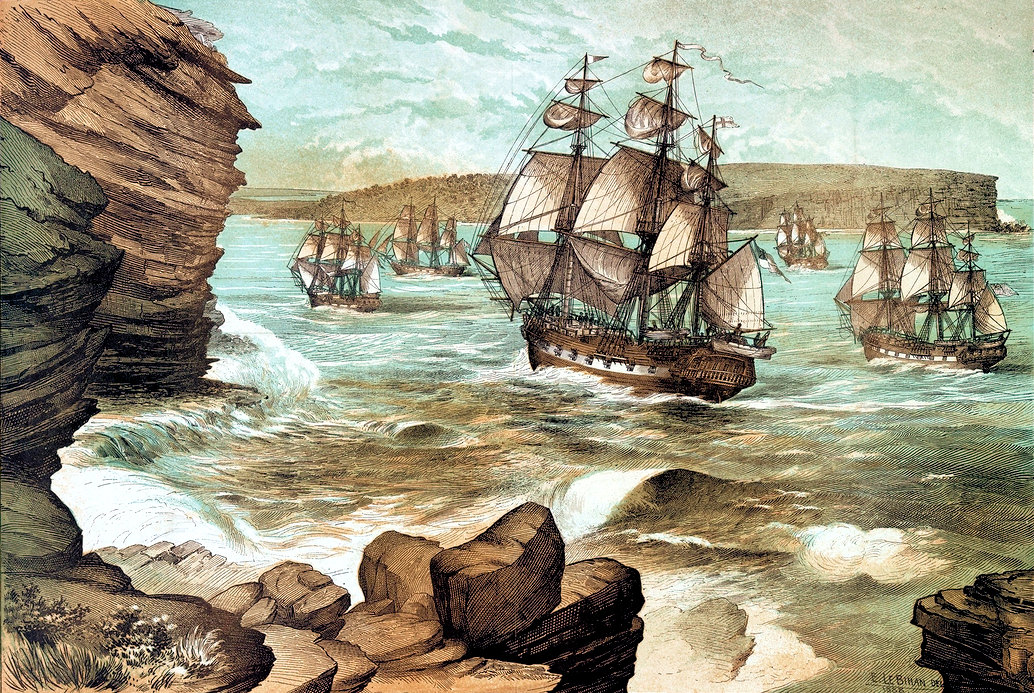 The First Fleet entering Port Jackson, January 26, 1788,
Drawn in 1888 By E. Le Bihan
Image source: Mitchell Library, State Library of New South Wales
At the Surrey Lent Assizes which commenced on Monday 2 April 1787 at Kingston upon Thames before Sir Henry Gould Kent, Susannah Blanchet was tried for burglary on 29 December 1786. Her occupation was given as servant, with an age of either 23 or 25 years.
It was charged
“… that Susannah Blanchet (sic) late of the parish of Epsom in the co. of surrey Spinster … the dwelling house of Philip O’Kelly Esq. feloniously did break and enter and .. two cotton Gowns of the value of 30s. one stuff Petticoat of the value of 7s one Cap trimmed with thread lace of the value of 1s. four other caps of the value of 4s. eight linen Handkerchiefs of the value of 8s. one muslin Apron of the value of 9s. one lawn Apron of the value of 4s. one Kenting Apron of the value of 1s. one check Apron of the value of 6d. one linen shift of the value of 2s. one cloth Cloak of the value of 4s. one black silk Hat of the value of 3s. one pair of women’s leather shoes of the value of 2s. two pair of linen Gloves of the value of 1s. of the goods and chattels of Jane Goodwin spinster … feloniously did steal ..”
Although described as ‘late of the parish of Epsom’, Suannah has not found to have been a citizen of the town. Philip O’Kelly, however, was the brother of Colonel (‘Count’) Denis O’Kelly who by 1769 had established himself as a man of substance, owning a large house & stables at Epsom. As mentioned in Colonel Dennis O’Kelly’s Racing Establishment on Clay Hill Epsom and its connection to West Hill House James Edwards’ description of Clay Hill in The Companion from London to Brighthelmston (surveyed c1790) recorded :-
‘On the very summit of the hill, on the N side, is a beautiful and elegant villa erected about 1785 by Col. Dennis O’ Kelly… In the front of the house is an elegant drawing room 40 ft. by 20 ft. with gardens shrubbery and stabling…There are 35 paddocks for his large stud of stallions, brood mares, colts and fillies’.
Charlotte Hayes, Denis O’Kelly’s mistress dispensed hospitality to racing men at Clay Hill, the Epsom property, but seems to have left it entirely in the care of Philip O’Kelly, and lived in the house at the corner of Half-Moon Street and Piccadilly, which also belonged to Dennis. So it may be inferred that Susannah Blanchet had been a maid resident in the O’Kelly mansion at the top of Clay Hill. The relationship between Philip O’Kelly and Miss Jane Goodwin can only be a matter of speculation.
The indictment of Susannah Blanchet for ‘ breaking and entering’, otherwise burglary, was grand larceny which carried a mandatory death sentence on conviction. As the 18th century drew to a close, lawmakers sought a less harsh punishment that might still deter potential offenders notably penal transportation.
In the event Susannah was found not guilty of breaking and entering, but was found guilty of stealing goods, value 39s and sentenced to be transported beyond the seas for seven years.
Consequently, on the 28 April 1787 Susannah was ordered to Newgate from the New Gaol, Southwark, for transportation by wagon fo embarkation on the Prince of Wales before its departure on 13 May.
 Convicts embarking for Botany Bay
by T. Rowlandson
Image Source : National Library of Australia
The Prince of Wales was one of eleven vessels of the First Fleet which consisted of two Royal Navy escort ships, HMS Sirius and HMS Supply accompanied by six convict transports and three store ships. The Fleet stopped at Tenerife in June, made Rio de Janeiro on 6 August 1787 and sailed from there on 5 September 1787. They arrived at Cape Town on 13 October 1787, where food supplies were replenished, eventually reaching Botany Bay in January 1788 to establish a new colony at Sydney Cove on the 26th of that month.
Women remained on the ships until the 6th February. Surgeon Arthur Bowes Smyth of the Lady Penrhyn kept a journal during the voyage. He described events when all the women were landed from the various vessels:-
“This day at 5 o’clock, all things were got in order for landing the whole of the women, and 3 of the ships longboats came alongside of us to receive them; previous to their going out of the ship, a strict search was made to try if any of the many things which they had stolen on board could be found, but their artifice eluded the most strict search, and at six o’clock p.m. we had the long wished for pleasure of seeing the last of them leave the ship. They were dressed in general very clean, and some few amongst them might be said to be well dressed. The convicts got to them very soon after their landing and the scene of debauchery and riot that ensued during the night may be better conceived than expressed”.
On Monday 24 March 1788, Susannah Blanchard (sic), a convict, was buried at Sydney Cove.
Brian Bouchard 2022
 An engraving of the First Fleet in Botany Bay at voyage’s end in 1788, from
The Voyage of Governor Phillip to Botany Bay.
Sirius is in the foreground; convict transports such as
Prince of Wales are to the left.