
GEORGE FORMBY OBE (1904-61)
and his Epsom connection
 George Formby with his trademark toothy grin and “banjelele”.
Image with thanks to kamuke.com
In the mid 20th Century, George Formby was a wildly successful music hall artiste and film star, best known for singing innuendo-laden songs – such as “When I’m cleaning windows” – accompanying himself on his trademark “banjelele” (a ukulele/banjo). This was exactly what his father did not want. Indeed, it was his father (also a music hall star) we have to thank for George’s brief connection with Epsom.
George was born (as George Hoy Booth) in Wigan, Lancashire, on 26 May 1905. He was the first of thirteen children (of whom only seven survived) born to James Lawler Booth and his wife Eliza, née Hoy. This marriage was actually bigamous because James was still married to his first wife, Martha Maria Salter. She was a 20 year old music hall performer – as was the much better known and 24 year old James.
James had had an appallingly deprived and neglected childhood – the stuff of a Dickens’ novel. In true “rags to riches” fashion, however, his talent for singing and performance made him a nationally-famous music hall star, for which he adopted the stage name of “George Formby” (now referred to as George Formby senior).
One of George senior’s characters was “John Willie” described as “the archetypal gormless Lancashire lad in baggy trousers, tight jacket, and bowler hat, slow-talking, hen-pecked, accident-prone, but muddling through.” His costume (pictured below) included ill-fitting clothes, large boots worn on the wrong feet – causing him to waddle – plus a cane to twirl. (In 1908, he shared a bill with a young Charlie Chaplin to whom he lent one of his costumes, and who seems to have built on all this for his career.)
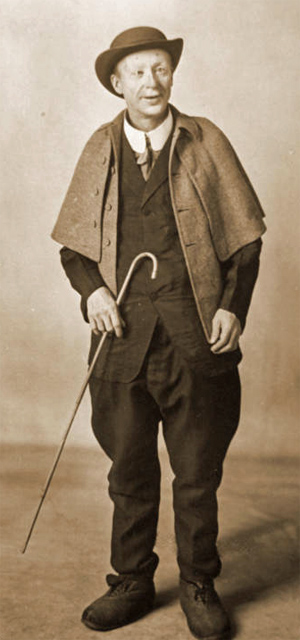 George Formby senior as “John Willie”
Image with thanks to GeorgeFormbySr.co.uk
James/George senior became a most popular music hall star and made a very good living from it, getting to the point of owning several racehorses. George junior thus grew up in an affluent home. However, he did not thrive at primary school and, at the age of 7 (and not yet able to read or write), was sent away to be a stable boy. (It is perhaps worth noting that George senior had left formal education at about the same age, also unable to read or write.) Work as a stable boy clearly flowed from George senior’s horse racing interests, but his father had another motive: he didn’t want his son to see him on the stage and want to follow in his footsteps, reportedly saying “one fool in the family is enough“.
After a year working at Malton in Yorkshire, George junior was apprenticed to Thomas Schofield at his racing stables in Epsom. (It may well be significant that Thomas was originally from the Hoy/Formby’s home county of Lancashire.)
On 6 April 1915, the 10 year old George – who weighed just under 4 stone (25.4 kilograms) and was recovering from mumps – had his first ride in public. This was in the Apprentice Plate at Lingfield Park, riding his father’s filly Eliza (named after his mother). It was an inauspicious start as he came in last. However, he was – and, to this day, remains – the youngest ever jockey to have ridden a professional race. The achievement was marked by a photo spread on the back page of the Daily Mirror, which included the following photograph taken at the Schofield stables.
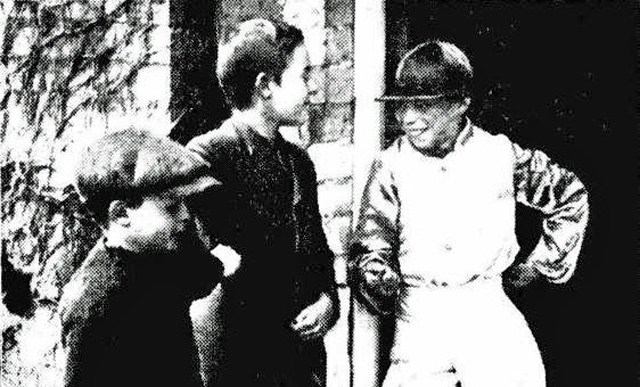 George as a 10 year old Epsom jockey in 1915.
Public domain image from the Daily Mirror archive.
Although his father was against George’s entering show business, he did consent to his son’s taking the leading role in a 1915 four-reel (but now lost) silent movie “By the Shortest of Heads”, playing a stable boy who outwits a gang of villains to win a horse race, landing a £10,000 prize.
As increasing energy was directed to WW1, racing was curtailed in the UK and George – together with five of his father’s horses – moved to Ireland to continue his career. Returning to England after the war, George raced for a number of stables, including Lord Derby’s at Newmarket. George never won a race (other than in the 1915 film!) but he did secure a number of placed finishes – including two second places in 1918 on his father’s horse Philander.
As a result of childhood neglect, George senior had long battled with respiratory disease and, compounded by the “Spanish Flu” pandemic, he died on 8 February 1921. George returned home to be with his mother, who was furious that a wholly unrelated comic was using George seniors’ material and even calling himself “the new George Formby”. She encouraged George junior to take on the family business and helped him (who had never seen his father perform) learn the material.
Less than two months after his father’s death, George was on stage – billed as “George Hoy, comedian (son of George Formby)“. At first, he did not do particularly well. Things improved when, in 1923, he started accompanying himself on the banjelele, and gradually developed his own material – including the catchphrases “Turned out nice again” and “Ooh, Mother!“. However, it was his 1924 marriage to fellow music hall artiste, Beryl Ingham, and her taking over as his manager that led to his career taking off.
Having now followed his father in adopting the stage name of “George Formby”, he started making records of his songs. These – such as “Chinese Laundry Blues“, “When I’m Cleaning Windows” and “Leaning On A Lamp Post” – sold well (indeed, becoming “standards”) and further bolstered his box-office appeal.
In 1934, he starred in a high-grossing film comedy called “Boots! Boots!” as a result of which he was given a £100,000 (£5 million at 2021 prices) contract to make a further 11 films with Associated Talking Pictures at Ealing Studios. (One of those was the 1939 “Come On, George” where he harked back to his Epsom days and his 1915 silent film by playing a stable lad who rides a nervous horse to victory.) George was subsequently contracted to make another seven movies for US studio Columbia for the astonishing sum of £500,000 (£25 million today).
The films were very popular, though generally rather formulaic with George’s character being a good-natured, but accident-prone and incompetent, Lancastrian who was trying to achieve success in an unfamiliar field, winning the affections of a middle-class girl in the process – all interspersed with songs. (In the 1950s, this was a powerful influence for Norman Wisdom – who also had Epsom connections.) George was not only the top comedian in Britain but also found considerable fame in Canada, Australia, New Zealand and South Africa.
During WW2, George did much work entertaining the troops. And he was one of the first entertainers to enter Normandy after the D-Day invasion, where he was personally invited by General Montgomery to play for the frontline troops. In 1946, he was awarded the OBE for his work entertaining Allied forces in Europe and North Africa.
 George (with Beryl) entertaining troops in Normandy, 1944.
Public Domain photograph B 7923 from the collections of the Imperial War Museums via Wikimedia
In 1951, while starring in the critically acclaimed West End musical “Zip Goes a Million“, George suffered a heart attack but recovered sufficiently to go back to work 18 months later to continuing acclaim. While starring in pantomime at Bristol over Christmas 1960, George received news that his wife, Beryl (who had been ailing for some years) had died. A couple of months later, on 6 March 1961, George also died – of another heart attack. He was 56.
George was buried with his father in Warrington Cemetery. Some 20 years later, they were joined by George’s mother, Eliza, who died on 31 July 1981 at the age of 102.
 The grave of George senior, George and his mother in Warrington Cemetery.
Photograph with thanks to Dave England via findagrave.com
Like the previously-mentioned Norman Wisdom, George Formby is commemorated by a statue in Douglas, Isle of Man. As shown below, this shows him dressed as a TT racer, playing a ukulele and – after the title of one of his most famous comedy songs – leaning on a lamppost.
 George Formby statue in Douglas, IoM.
Photograph by Andrew Abbott, via Wikimedia CC BY-SA 2.0
Roger Morgan © 2022
(Expanded from a brief article in the July 2022 edition of “Lives and Times”)