
THE HEATH FAMILY
PART 1 – Richard, Grace and Margaret
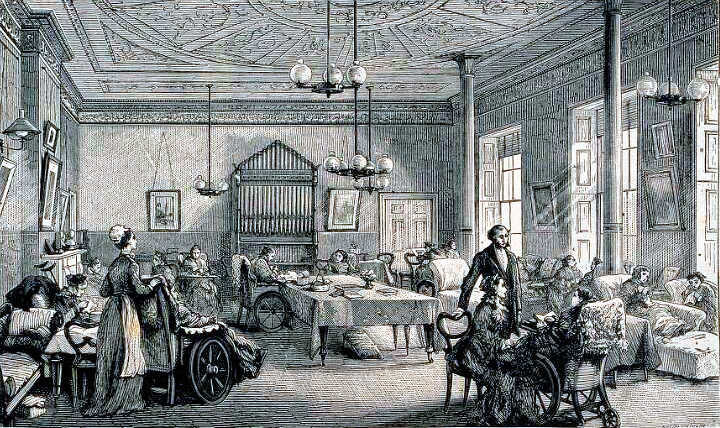 The Old Assembly Room, Melrose, Roxburgh, Scotland
Wood engraving by Butterworth & Heath
Image source: Wellcome Collection (CC BY 4.0)
‘The sort of building put up on these encroachments was about equal to an ordinary tool-house in a gentleman’s garden. One I saw and sketched on Epsom common contained two apartments and I was informed by the man residing there that the old lady to whom it belonged brought up twelve children in it. He himself lived there with eight children. His case was an illustration of the numerous accidents to which the agricultural labourer is liable. Twelve years ago he had had his foot crushed in a wheel-rut, rheumatism had seized the leg, and had at last taken possession of his whole body, so that he had never been able to do a day’s work since. His wife set to work bravely, sometimes leaving home at five in the morning to stand at the wash-tub all day. The baby, five months old, had already become so resigned to its hard life, as to be willing to go to bed and to sleep when it grew dark without a whimper. The father said he could not read or write, but he sent all his children to school, for he “knew the miss of it,” and he told me with a glow of pride that the schoolmistress said that the little bright, intelligent girl by his side was the best scholar she had.’
Extract from ‘The English Peasant’ by Richard Heath (published 1893)
I was pondering whether or not Richard Heath, wood engraver and author, sometime resident of Common Fields and Ashley Road, was worth a piece on this website and had almost decided that he wasn’t … until a rummage in his descendants found that his children, either born or brought up in Epsom, were very interesting, and also that much of his engraving is to be found under the name of a firm in which he was one of two partners. We can probably date the move to Epsom as happening in the late 1860s; the family was still around in 1881 but subsequently moved on.’
Richard’s father, Ebenezer, was in the leather trade in London and his mother, Nancy, was Ebenezer’s second wife. Ebenezer died in 1856 and it seems that Nancy, who was born in Leiden, Netherlands but whose father had originated in Lancashire, might have instigated the move to Epsom, as she was living at Parade (1871 census), Heathcote Road (1881) and ended up in Worple Road. She died in 1888, aged 83, and is buried in Epsom Cemetery (Grave F14A). Although Richard and family had moved away by then, three of his siblings remained in Epsom for the rest of their lives. Two of them were Nancy Junior and Adelaide Heath, who ran the Flint House Ladies’ School in Worple Road. The Flint House had briefly been the home of author William Hale White(Mark Rutherford) in the 1860s.
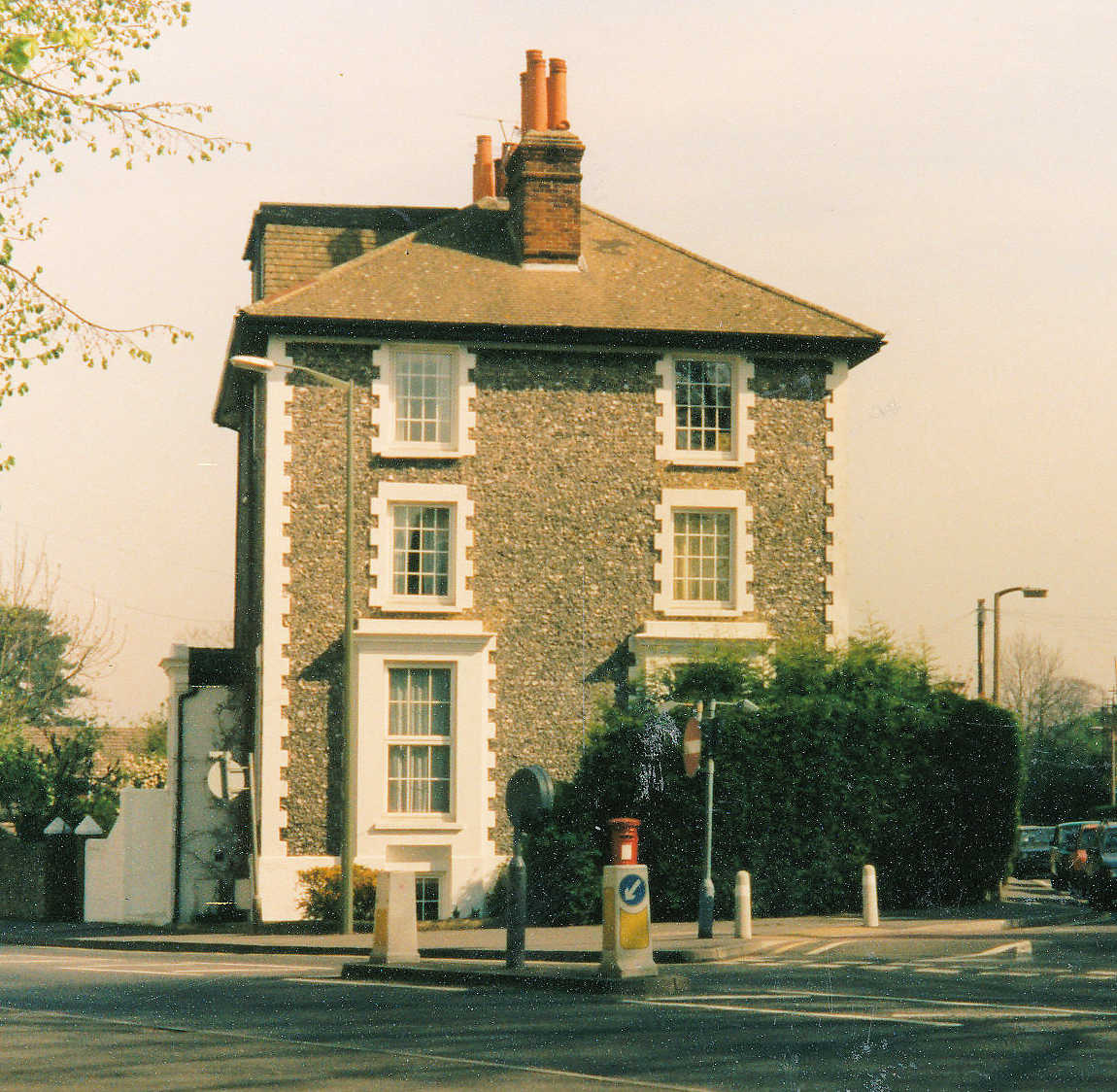 The Flint House, Worple Road
Image courtesy of Bourne Hall Museum
The other local sibling was Edmund Haighton Heath, a wood engraver originally but latterly an assistant at the school and, at the time of his death in 1896, a ‘gentleman’. Richard Heath also had a sister, Jeanette (Mrs Russell), who was widowed young and lived in Church Street and South Street with her children, eventually ending up in Liverpool, via Broadwater, Sussex.
Edmund Heath is buried in Grave F14 of Epsom Cemetery; Nancy Junior (died 1921) and Adelaide (died 1929) are with their mother in F14A.
Richard Heath
Richard was born in Southwark in 1831 and married Annie Louisa Blakemore (born 1832 Birmingham) in 1862 in Romford, Essex. There were five children, as shown below.
| Name | Born | Married | Died |
|---|---|---|---|
| Mary Nancy | 1864 Wandsworth | – | 1872 (buried Epsom Cem. F13) |
| Annie Grace (known as Grace) | 1865 Wandsworth | – | 1895 France |
| Margaret Russell | 1867 Brixton | Cyril Arthington Pease | 1917 Hertfordshire |
| Charles Richard (known as Carl) | 1869 Epsom | Effie Margaret Holden | 1950 Guildford |
| Ellen Maurice (known as Nellie) | 1872 Epsom | – | 1962 Hampshire |
As mentioned, Richard was a wood engraver (master), but also an author. I quote from Wikipedia.
‘His articles on rural topics were published together in The English Peasant (1893), which was part of T. Fisher Unwin‘s “The Reformer’s Bookshelf” series. The Times selected it as one of its “Books of the Week” and said Heath “was tolerably well known a couple of decades ago as an eloquent and persevering, if not always discriminating, champion of the agricultural labourer”. They added that the book was written with a “vein of Christian Socialism“.’
That isn’t an extract – it’s the whole entry!
Since Richard does not seem to have been rated by the sniffy Times as a literary giant, I have needed to resort to an internet digitisation of one of his books: this tome wouldn’t pass muster as a ‘good read’ for your summer holidays, but it does demonstrate considerable scholarship should you be of a theological/historical bent.
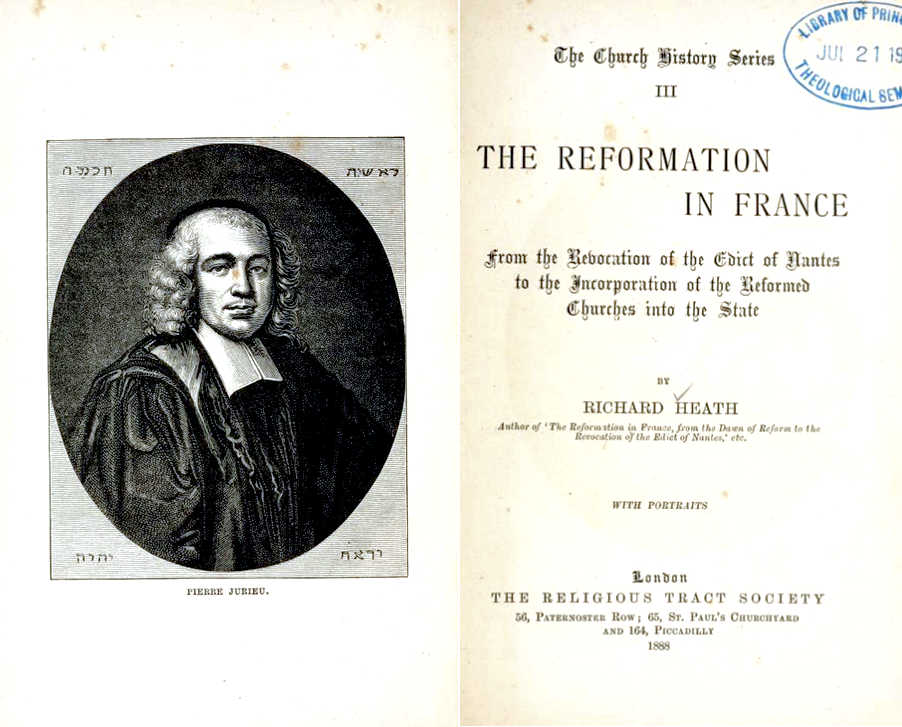 The Reformation in France
Image source: archive.org
Young Mary died early in 1872, whilst Annie was pregnant with Ellen. Sadly, Annie died of cancer in 1881 (per ‘The Uncommon Reader: A life of Edward Garnett’ by Helen Smith, a book to which I am indebted for filling in some gaps in the Heath story – you will meet Mr Garnett in Part 2).
In her book Helen Smith tells us that Richard had been apprenticed to a wood engraver at the age of 14 and worked for a firm in Strand, London which provided many illustrations for magazines and art journals. Armed with this clue, I stumbled accidentally on the fact that until 1881 he was in partnership with fellow wood engraver, Charles Butterworth, and they operated from 356 Strand. The partnership is the reason I couldn’t find any of Richard’s engravings initially, since they appear only if you know about Butterworth & Heath as a duo.
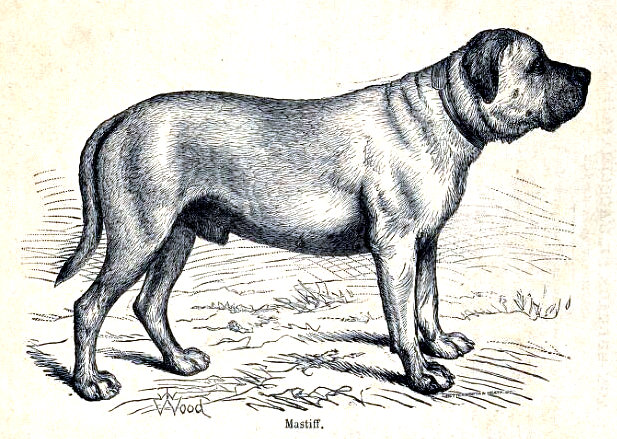 ‘A mastiff’
Engraving by Butterworth & Heath after a drawing by Thomas W Wood
Image source: Wellcome Collection (CC BY 4.0)
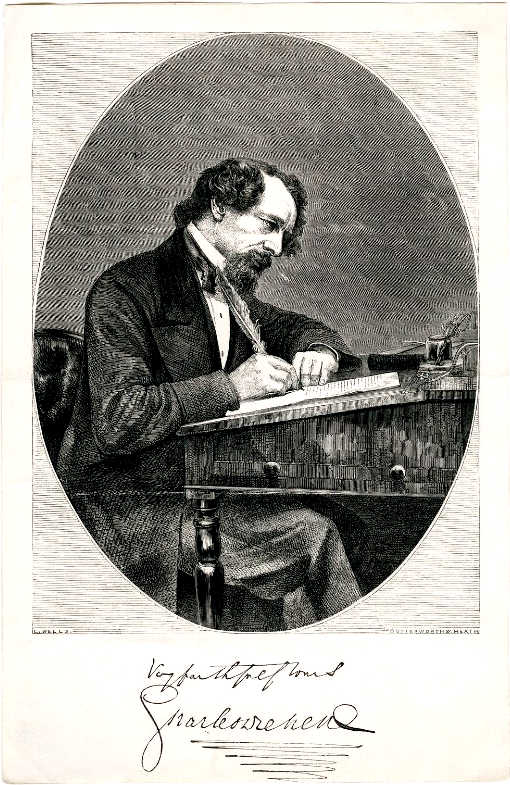 Charles Dickens
by Butterworth and Heath, after Herbert Watkins
wood engraving, (1858)
© NPG D42294 (CC BY-NC-ND 3.0)
After Annie died and the partnership with Charles Butterworth had been dissolved, Richard took the children to France, first to Normandy and then to Paris, where he worked at the Bibliothѐque nationale, staying for two years.
 Bibliothèque nationale de France (site Richelieu), Paris – Salle Ovale
Photo by Poulpy via Wikipedia (CC BY-SA 3.0)
There was much more to Richard than met the eye and his influence can clearly be detected in the lives of his children. Edward Garnett’s son, David, described him as ‘a small man with silver hair and beard, blue eyes in which one was surprised to detect a twinkle of humour.’ His own son, Carl Heath, said that he was a man of great sensitivity – ‘idealistic in temperament and constitutionally incapable of getting on’. Richard died in 1912.
Grace
Grace’s life was cut tragically short, although she had already made a mark. Richard Heath seems to have been a particularly enlightened parent for the times, for his daughters were educated well. Margaret, for example, had become a teacher (we shall get to the unusual Ellen in Part 2) and Grace studied chemistry under Henry Armstrong at the City and Guilds Central Technical College in Exhibition Road, South Kensington, which later became part of Imperial College. Having qualified as a science teacher, in 1888 she was hired by the North London Collegiate School, then in Camden Town: this school was notable for its first two Headmistresses: Frances Buss, followed by Sophie Bryant. The importance of these women is not to be underestimated in the context of female emancipation, since they not only pioneered education for women but were active in the suffrage movement. Indeed, eventual Ewell resident, Gertrude Horton was a pupil at the school during Dr Bryant’s tenure as headmistress.
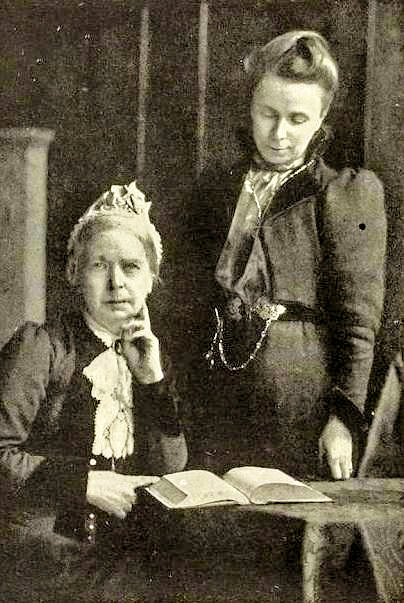 Frances Buss and Sophie Bryant, 1900
Image source: Wikimedia commons
The Magazine of the North London Collegiate School (July 1895 edition) contains a memorial for Grace, who had just died.
‘… the Science Club has lost its Founder and President. This seems a fitting opportunity to say a little about Miss Heath. Of course I can only speak of her from one side, but there are some things I should like to say about her. I did not know her till I came to teach here three and a half years ago, and we were both of us so fully occupied, that it was only gradually we came to know one another. Now that the opportunity has gone by, I feel how much more I might have made of it, for indeed I think Grace Heath had one of the sweetest dispositions I ever encountered. To me coming in as a stranger to share work which she had been doing already for some time, she was invariably so gentle, so kind, so unassuming, so willing to adapt herself to my ways, so helpful in every difficulty. Looking back I am glad to think that this friendship was never marred by one harsh or hasty thought or word, but indeed it would have had to be a quarrelsome person to quarrel with Grace Heath. I am always glad to think that her name was Grace, for it suited her so well. Her gentle, helpful manner, what can one call it but gracious? and I think the most striking characteristic of that outward presentment which some of us got to love so much was its gentle grace. I soon began to find what a conscientious and painstaking teacher she was as I saw the trouble she would take to illustrate her lessons. Till one begins to teach oneself one does not realize how much trouble and thought is involved in this kind of thing; so that here perhaps I could appreciate her better than you could.’
She wrote to me in the end of February and speaking of the Science Club said, “I hope the girls will work at the Club. They don’t realize, and I suppose one can hardly expect them, what a value it is to do a little piece of independent work and what a generous study the life of Nature is. There is such a large return, isn’t there? I am so glad we both like it.”
And the same spirit of rebellion against unreality she carried into social matters. She believed fervently in the universal brotherhood of man and did all in her power to work towards a state of society which shall express this better than the alas! largely selfish and money grubbing society of today. Her sister told me that when she was dying a servant in the house at Le Cannet* came to her and said, “J’ai toujours aimé Mademoiselle. Elle ne m’a jamais traité comme une menagerie mais toujours comme une amie.”** I think love of truth and social enthusiasm were the two dominant passions of her life. I wonder of how many women this can be said?…’
‘…She caught a bad cold just before School began again and never got over it. She was evidently and painfully ill, but at first the doctor thought it was not serious and encouraged her to keep on at School. At last in the beginning of November it was decided that there was a threatening of consumption and she must give up work at once, and winter abroad. I only saw her once more, and then it was wonderful that she could have kept up for so long, for she seemed to have no strength left. She sat there so weak yet still so bright, and talked of Dr Armstrong’s chemistry class and the flora of the South of France as well as her cough would let her. She was so fond of home, and yet it was impossible for even her specially loved sister to go away with her. I hoped she would have much pleasure in the beautiful surroundings and climate of her place of exile. She did write once “I am so glad you know the look of the olives against the blue sky; you can sympathize.” But she never was well enough to really be out much to enjoy it. Ten weeks she was in her room. She was alone, except for those who had grown to love her there, as indeed they all had, and especially her nurse. She got a little better and went out once and then – the doctor telegraphed home to say she could only live twelve hours. Think what it must have been to be there far away from everyone – to know that all her life here with its hopes and aims was at an end – to look forward alone to the great change! It is a comfort to think her sister arrived to be with her some days before she died.’
* Le Cannet is effectively part of Cannes on the French Riviera
** I have always loved Mademoiselle. She has never treated me like a servant but always like a friend.
There is more of this – the full text can be read at http://nlcsarchives.daisy.websds.net should you feel inclined. However, it is the author of the piece who gives it particular weight: she was Edith Aitken, who already had a formidable track record in education and teaching and, from 1902, became the founding headmistress of Pretoria High School for Girls, which, under her leadership, was eventually acknowledged as the best such establishment in South Africa.
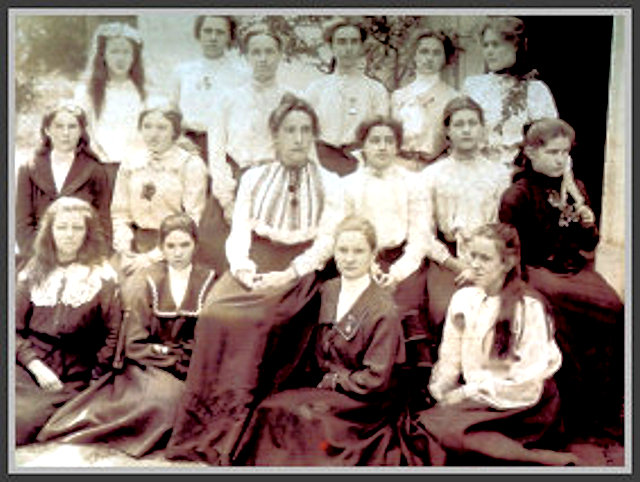 Edith Aitken and pupils at Pretoria High School, 1903
Image source: Wikipedia
Margaret
Margaret was a teacher, Quaker and socialist. In 1899 she married Cyril Arthington Pease, also a teacher and, on his mother’s side, a direct descendant of the Bristol Frys of chocolate fame. Cyril’s older brother, Edward Reynolds Pease was a founding member of the Fabian Society, one of the root organisations of the Labour Party.
Margaret was a committed socialist and I can do no better than to quote an obituary which appeared in The Labour Leader of 8 February 1917.
‘We deeply regret to record the death of Margaret Pease, wife of Arthington Pease, of Garden City, Letchworth. Margaret Pease, with her husband, was among the earlier band of Socialists who enrolled themselves in the I.L.P.* at its foundation. Her interest and faith in the cause of Socialism never faltered. Owing to exceedingly frail health she was unable to take an active part in its public propaganda, but among her personal friends and in many thoughtful ways she did much to sustain the ideals and work of the movement. She was one of the daughters of the late Richard Heath, well known for his admirable writings dealing with the English peasantry and moral and religious problems, and inherited his literary taste and aptitude. Her recent book on Jean Jaurès was reviewed a few weeks ago in our columns and she was preparing a book on “International Socialism” when she died. Her funeral took place at Golder’s Green Crematorium last Friday morning and was attended by members of the Society of Friends and friends of Socialism and peace, including Mr Ramsay MacDonald MP and Mr J Bruce Glasier. She was greatly beloved and we tender to her husband and her relatives our deep sympathy in their bereavement.’
*Independent Labour Party
The whole book is online at the Internet Archive.
In Part 2 we shall look at Nellie and Carl, with a brief nod to Edward Garnett’s son, David, who was very interesting in his own right – and inextricably wound up with Nellie, because of her unusual (for the time) involvement with his parents.
Linda Jackson 2021
Part 2 of this article is available here.