
THE CHANT FAMILY
Portraitists in different disciplines
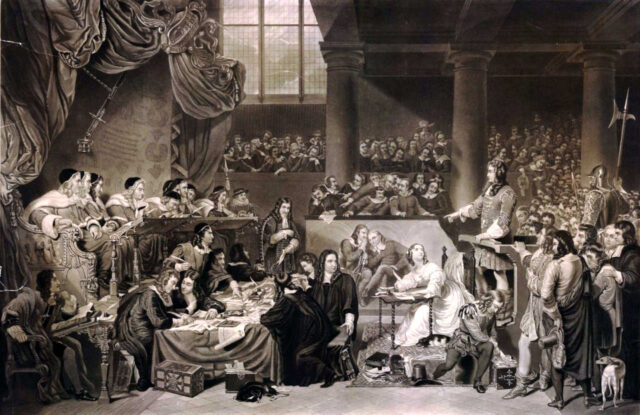 The Trial of William Lord Russell at the Old Bailey 1683
Print by James John Chant after George Hayter 1855
Image Source: The British Museum (CC BY-NC-SA 4.0)
Oddly, we have just done a piece on the subject of artists/engravers who produced works depicting our borough but didn’t live there, and now we have James John Chant, an engraver who didn’t seem to produce Epsom and Ewell ‘pictures’ but who lived in Epsom, in Ashley Road, from at least 1878 until some point in the 1890s. He then retired to Parkstone, Dorset (an area within Poole).
James John Chant (often referred to as J J Chant for engraving purposes) was born in Lambeth in about 1819, son of another James and his wife Ann. James Senior was an upholsterer, but even in the 1841 census Junior was described as an artist. In subsequent censuses his occupation was ‘historical engraver’.
Confession time. I have no idea who Mrs Chant was, other than that her name was Ellen and she was born somewhere around 1825 in either Chichester or Colchester (I think that one or other of the census enumerators might have misheard). I don’t know when and where they were married and I can’t tell you what happened to her, since she disappeared after the 1871 census, although James John still described himself as married in 1881. There were probably four children, but I only know anything about two of them, who were in Epsom with their father. Fortunately, this is not intended to be a ‘family tree’ type of article (I have to say that under the circumstances!)
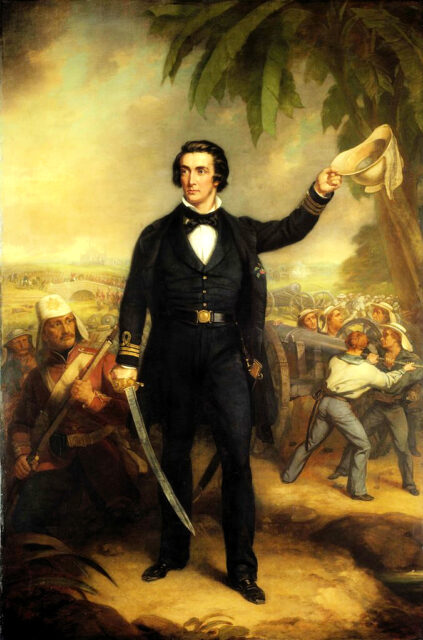 The original painting of Captain Sir William Peel, by John Lucas
Image Source : National Maritime Museum, Greenwich, London” (CC-BY-NC-SA-3.0)
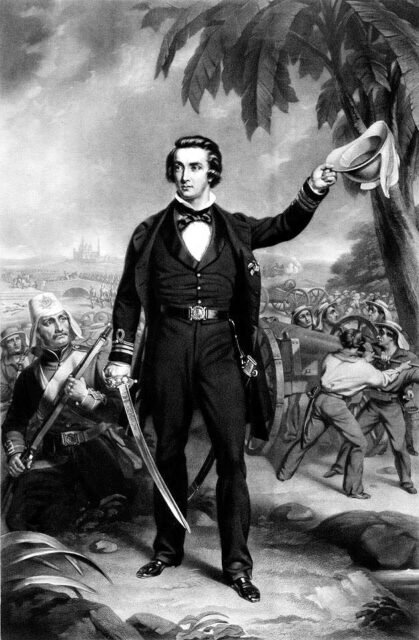 Captain Sir William Peel, by James John Chant after John Lucas
Mezzotint and stipple engraving
Image source: National Army Museum
Incidentally, before moving to Epsom (via Leatherhead), the Chants lived in Islington, which was, even then, a very confusing place geographically. Their former abode is currently in London N7 and I decline to speculate on the precise name of the area. The point is that their address was 36 Hilldrop Crescent, a road that assumed notoriety when, in 1910, Dr Crippen murdered his wife and buried her (without head or limbs) in the cellar of Number 39.
James tackled a wide range of subject-matter, including what we might describe as ‘chocolate box’ material that was popular in the Victorian and Edwardian eras.
 ‘Which do you like?’
Print by James John Chant after George Augustus Holmes, 1877
Image Source: The British Museum (CC BY-NC-SA 4.0)
And here’s something different again.
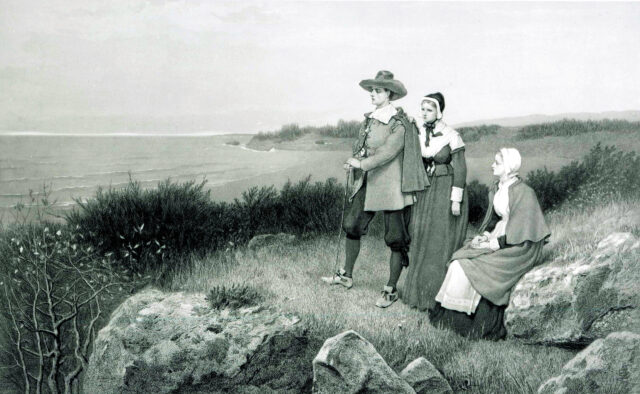 New English pilgrims waiting for the relief ship
Artist’s working proof by James John Chant after George Henry Boughton, 1874
Image Source: The British Museum (CC BY-NC-SA 4.0)
James died in Poole district in 1902, aged 83.
Jessie Chant
Jessie was born in Pimlico in 1851 and was still at home in Ashley Road at the 1881 census, aged 29 with no occupation listed. However, in 1886 she married Thomas Henry Maudslay, a widowed engineer: he had been born in Lambeth in about 1830. Jessie moved to his home at Knight’s Hill, Norwood and two daughters, Florence and Ida, were born in 1887 and c.1890 respectively. Thomas died in March 1892, leaving an estate which would be worth about £4 million in today’s money.
Then, in 1894 Jessie wed widower Henry Price Miles (born 1854 Monmouthshire), who was described as a merchant of Funchal, Madeira on the marriage certificate. If you’re thinking Madeira = fortified wine, you would be right. The Miles brand still exists today, but is now part of the Madeira Wine Company, which is controlled by the Blandy family. Henry was also involved in brewing and soft drinks.
I shall just throw in an old photo of Funchal (with an ulterior motive, which I will come to shortly).
 Red Hot Pokers and the Bay of Funchal by Sarah Angelina Acland, Autochrome, circa 1910
Image source: Museum of the History of Science, Oxford, via Wikimedia Commons
I imagine that Henry Miles spent a lot of time in Madeira and travelling on business; he wasn’t at home in either the 1901 or 1911 England censuses, by which time Jessie and her daughters were living in Dorset. Henry died at a Bayswater hotel (presumably on a trip to or from Madeira) in1929 and Jessie, then of the Grand Hotel, Bournemouth, died in 1931.
Florence Chant
Florence is the reason I showed you the old photo of the Bay of Funchal just now. You may have noticed that the photographer was a woman – Sarah Angelina Acland. Female photographers were pretty unusual in the Victorian and Edwardian eras and it’s only in more recent times that women became very prominent in the field. I conducted an experiment on myself – admittedly my memory is not what it was – and could only come up with one of each in total – Julia Margaret Cameron (1815-79) and Annie Leibovitz (born 1949). By comparison, I can think of many prominent male photographers, such as Eugѐne Atget, Ansel Adams, Robert Doisneau, Cecil Beaton, Don McCullin, David Bailey etc etc.
Florence Chant described herself as an artist from at least the 1891 census, when she was 33 years old, and in the 1901 edition, by which time she and her father had moved to Parkstone, she was an artist and photographer ‘on her own account’. I can’t find many examples of her work, but she did take studio portraits of Alfred Russel Wallace OM FRS, a renowned naturalist, explorer, anthropologist etc, who was right up there with Charles Darwin.
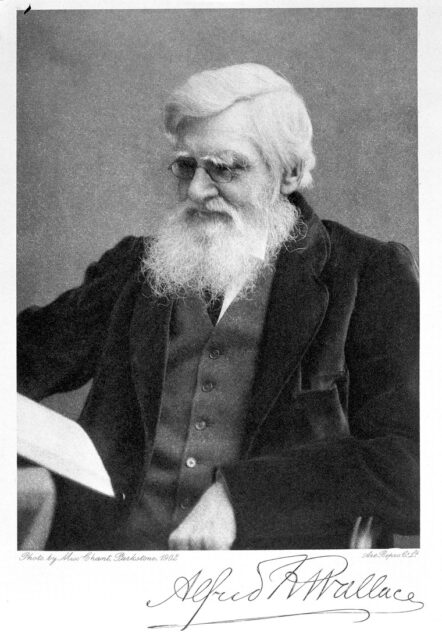 Alfred Russel Wallace
Photo by Miss Chant, Parkstone, 1902
Image source: Wellcome Collection (CC BY 4.0)
It’s difficult to read, but the writing directly beneath the portrait says ‘Photo by Miss Chant, Parkstone, 1902’. Florence took a number of photos of Mr Wallace, but the one above is probably the best. It looks to me as if she was very much a local photographer for Poole and environs – Mr Wallace lived in Broadstone, another suburb of Poole -, and she knew the Wallace family.
I have seen a cabinet portrait on the internet, which is of three children surnamed Hill c.1890: this suggests that Florence had set up a studio as soon as she moved to Parkstone. However, when commercial purveyors of downloads of old photographs, which are often out of copyright anyway, date such things, they are not always entirely accurate.
Florence and her father had been accompanied to Parkstone by a servant, one Sarah Ann Julia Ruberry, born 1870 Epsom, and by 1911 Sarah had graduated to being Florence’s live-in ‘assistant photographer’. It seems that, at some point, the ladies moved to Newey Selant, Cornwall (which I misspelt in the search engine, thus getting pages of building and plumbing supplies – and even when I spelt it as shown on the probate record I still got similar – let’s just say they had gone to Cornwall). Florence didn’t leave all that much in terms of effects when she died in 1930, but Sarah seems to have been in sole control of them.
Sarah had a flirtation with Farnham for a few years after Florence died, but by 1939 she had set up home in Weston- super-Mare and was ‘of private means’. She died in Weston in 1968 at the grand old age of 97.
Note: Obviously, I am not putting Florence in the same photographic league as Julia Margaret Cameron or Sarah Angelina Acland, both of whom were innovators, but it was still fairly brave and unusual in Victorian/Edwardian times for women to be working photographers.
Linda Jackson 2021