
Artists and Engravers
If, like me, you are constantly looking up christenings, marriages and burials for St Martin’s, Epsom, you may well have noticed the charming pictures of the church which head up the pages. The one immediately below is from a drawing by Thomas Allom (engraved by M J Starling) and appears in Brayley’s History of Surrey 1841.
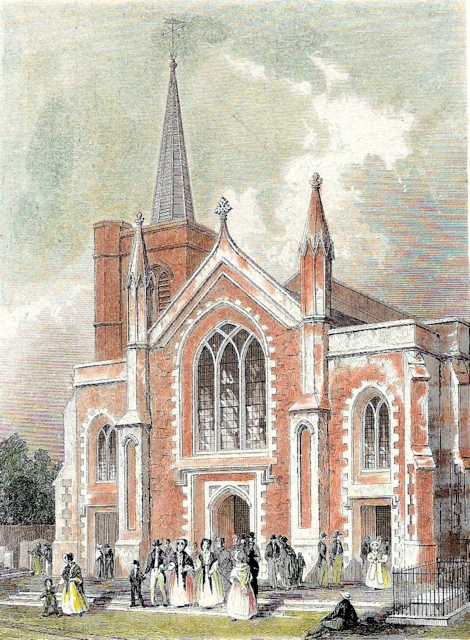 St Martin’s Church
Drawn by Thomas Allom, engraved by M. J. Starling, from Brayley’s History of Surrey 1841
Image courtesy of Epsom & Ewell Local And Family History Centre
And this next one is by John Nixon (engraved by Samuel Rawle).
 A view from the north east, dated 1807.
A hand-coloured copper engraving by J. Nixon, engraved by S. Rawle, and published by J. Asperne at the Bible
Image (1998.144-028) with thanks to Bourne Hall Museum
Engravers in the 18th and 19th centuries were often just as skilled as the person who made the original drawing, and sometimes they were even one and the same. I am not going to delve into the technicalities of engraving, which you can find easily enough on the internet, but let’s look at some of the people who depicted Epsom.
Thomas Allom (1804-72)
Extracts from Brayley’s Topographical History of Surrey are on this website and the text is liberally illustrated with Allom’s drawings, but the engraver was not always M J Starling (James Harfield Kernot, Thomas Abiel Prior and Henry Adlard also feature).
Allom was a phenomenon in that he came from humble beginnings – his father was a coachman, but Thomas Allom Senior had the foresight to apprentice him to an architect, after which Thomas studied at the Royal Academy School. Thomas spent several years in Hull, working with Henry Francis Lockwood, but then returned to London, combining his artistic and architectural activities. Notably, he collaborated with Sir Charles Barry on the rebuilding of the Houses of Parliament, which had largely been destroyed by fire in 1834.
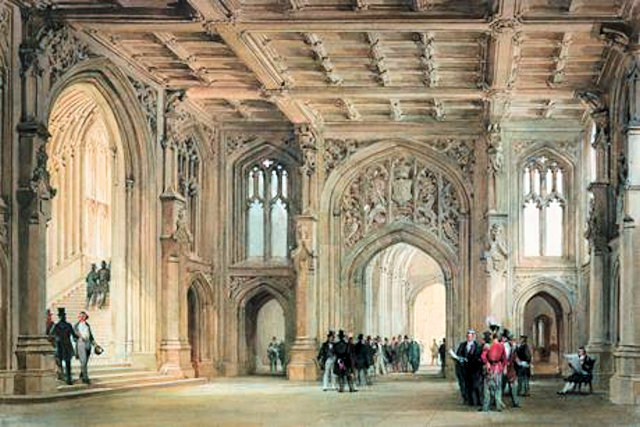
The Lower Waiting Hall looking towards Central Lobby
By Thomas Allom
M J (Matthew James) Starling (1805-1889)
Matthew was originally from Islington, son of Robert and Elizabeth Starling, and ended up in Sutton, Surrey by way of Hastings. The Starlings were rather ‘personages’ in Islington, but they came from a well-off Norfolk family.
John Colley Nixon (c.1755-1818)
Nixon was not a professional artist, but he dabbled profusely, both in landscape paintings and caricatures.
A member of the Nixon family did, however, make a highly significant contribution to the British art world, although not in the way you might think. The Reverend Robert Nixon, of Foots Cray in Kent, brother of John, was also an amateur artist and used the barbering services of one William Turner in Covent Garden. Mr Turner would exhibit some of his then teenaged son’s artworks in the shop and his temporarily captive customer was impressed, introducing the boy to John Francis Rigaud RA and his son, Stephen Francis Dutilh Rigaud. J M W Turner became, arguably, the greatest British painter of his day.
Once I had started this piece with St Martin’s, I strayed to other images shown on the website, which produced some interesting characters. The rest of this article is a pot pourri of some, but by no means all, of the artists/engravers who depicted our local area, together with other examples of their work.
Jodocus Hondius (otherwise Joost de Hondt)

A portrait of the Flemish/Dutch cartographer and engraver Jodocus Hondius
Image Source Wikipedia
Jodocus Hondius was responsible for most of the engravings in John Speed’s ‘The Theatre of the Empire of Great Britaine’, published in 1610. Hondius appears on this site with his engraving of Nonsuch Palace, although the original artist is unknown.
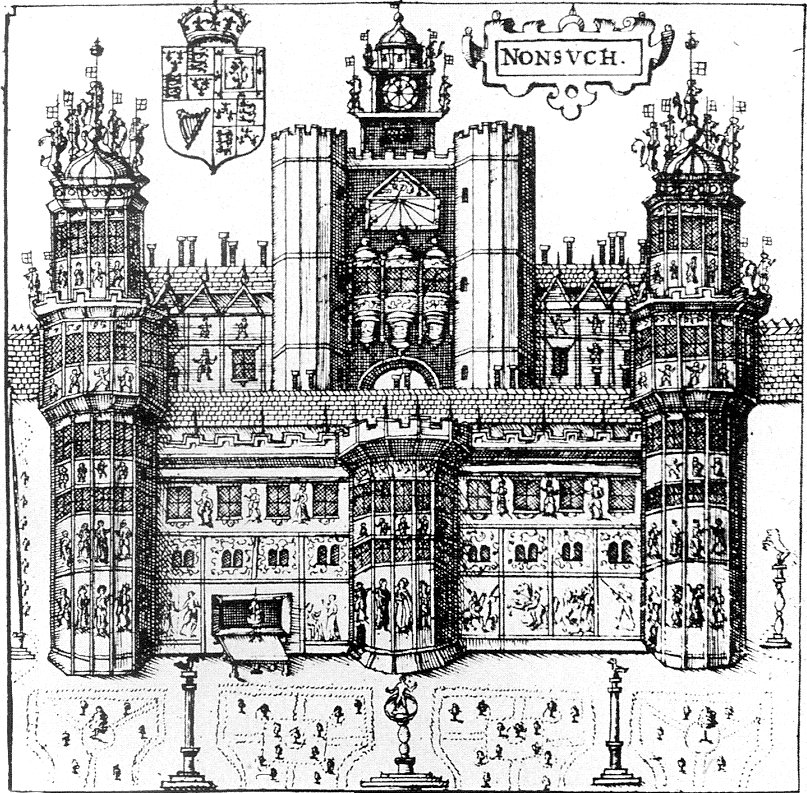
Bird’s-eye view of the south front of Nonsuch Palace.
Image Source Wikipedia
Hondius was born in 1563 in Flanders and was an engraver and cartographer. He also made instruments and globes.
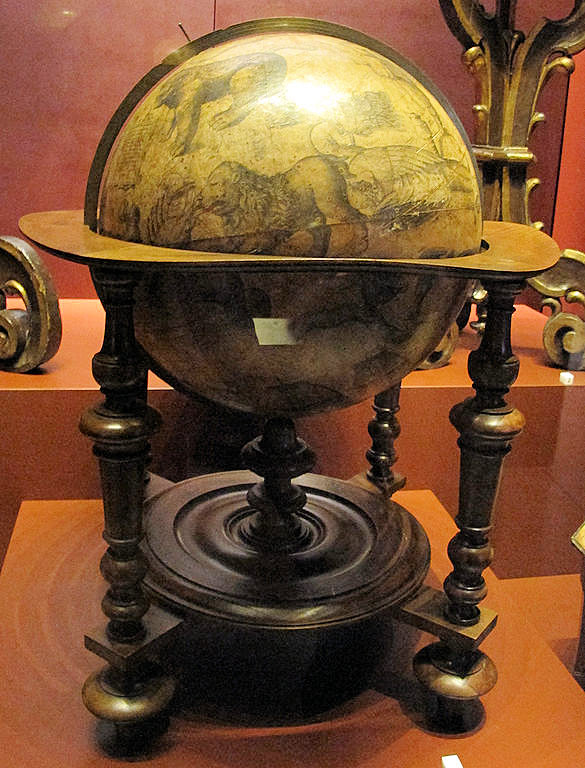
A Hondius globe in the Museo Galileo, Firenze, photographed by Sailko
Photo by Sailko (CC BY-SA 3.0) via Wikimedia Commons
A Hondius globe appears in a painting by someone very famous – Johannes Vermeer.
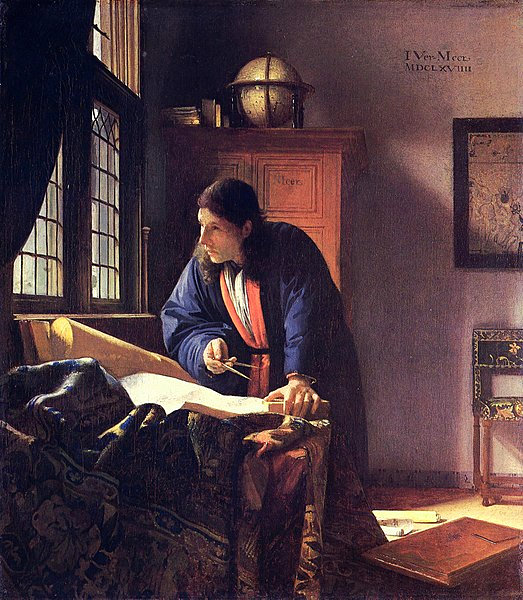 The Geographer by Vermeer, 1669
Image source: Wikimedia Commons
Hondius moved to London to escape from religious difficulties in Flanders but later went to Amsterdam, where he died in 1612.
Henry (or Hendrick) Hulsbergh
Henry was from Amsterdam, but by 1709 he had moved to London; he usually engraved large architectural pieces. One of his works was an architectural drawing of Richard Rooth’s house, which appears on this website.
The engraving below appeared in ‘Vitruvius Britannicus’, a three volume work by Scottish architect Colen Campbell, published between 1715 and 1725. Old books such as these are really useful when the building no longer exists in its original form or has been demolished/destroyed.
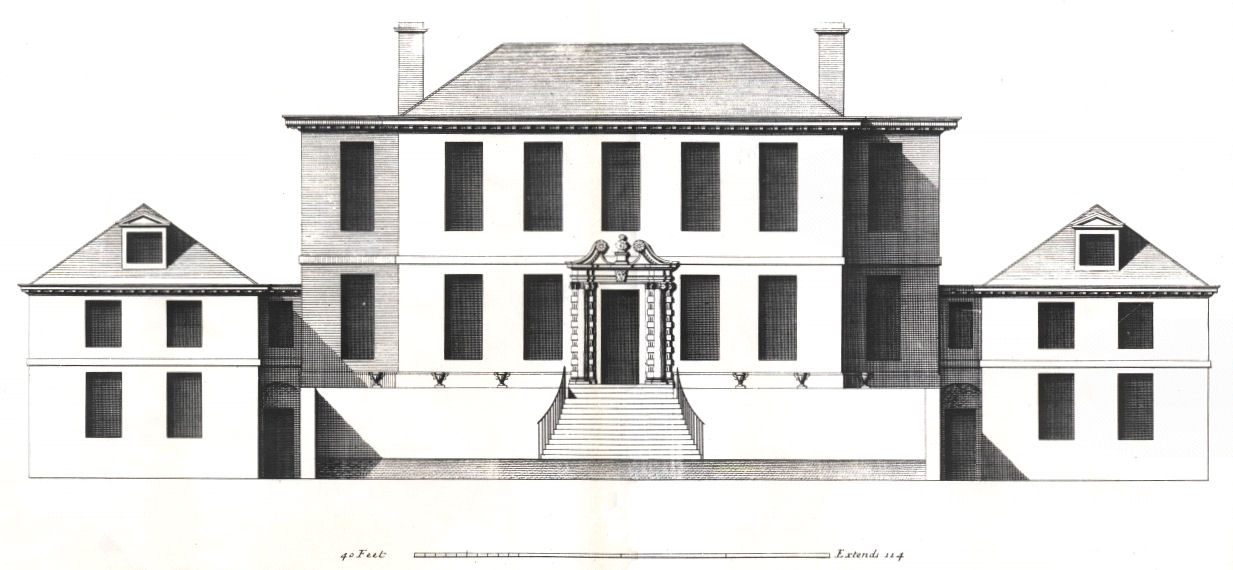 Mr Rooth’s house from Vitruvius Britannicus
Henry also engraved portraits and this next image, dated 1709, is of Aaron Hill, a playwright, poet and sometime manager of the Theatre Royal, Drury Lane.
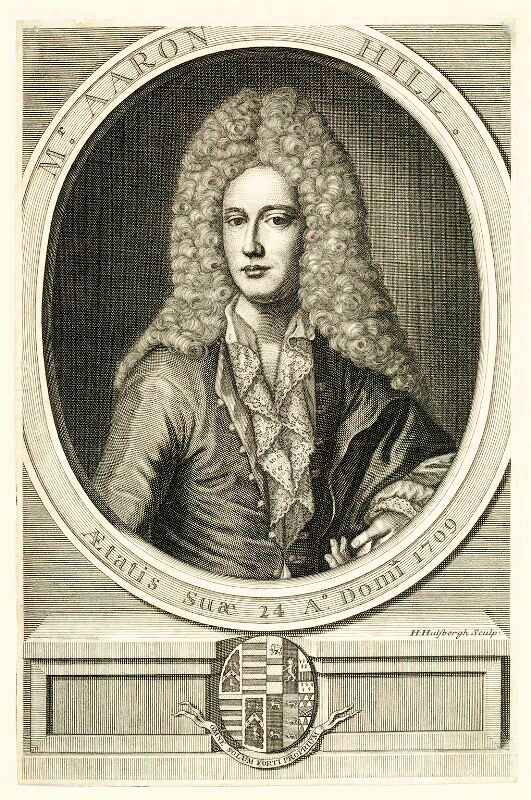 Aaron Hill
by Henry Hulsbergh (Hulsberg) line engraving, 1709
NPG D35830
And here is a Hulsbergh engraving of one of Campbell’s buildings – Burlington House in Piccadilly.
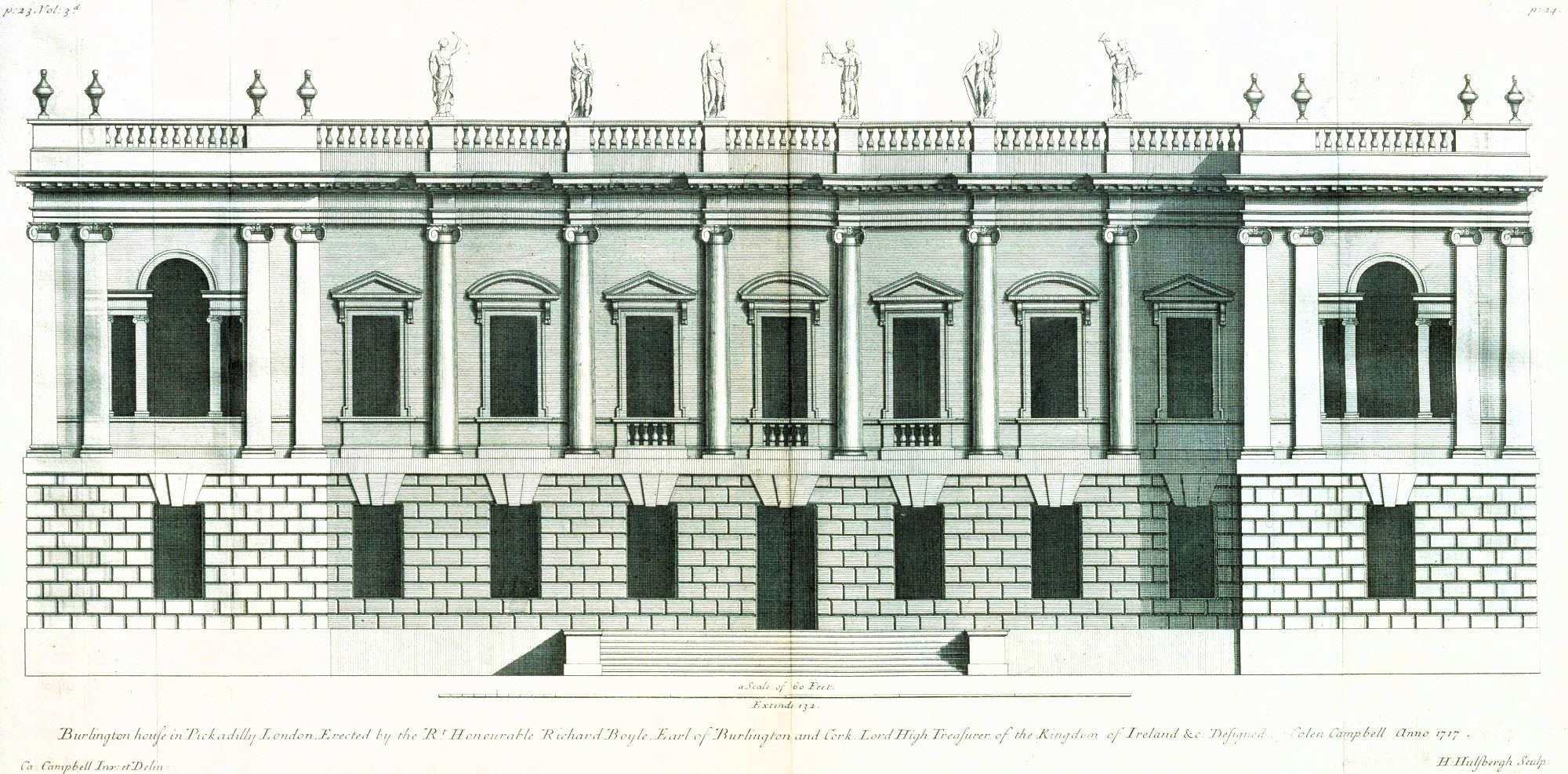
Burlington House in Pickadilly (sic), London [elevation of south front].
Image source Royal Academy (CC BY-NC-ND 3.0)
This building hasn’t changed that much in architectural style and is home to the Royal Academy and other learned organisations. It has, however, had a storey added since the engraving was done and now looks like this.
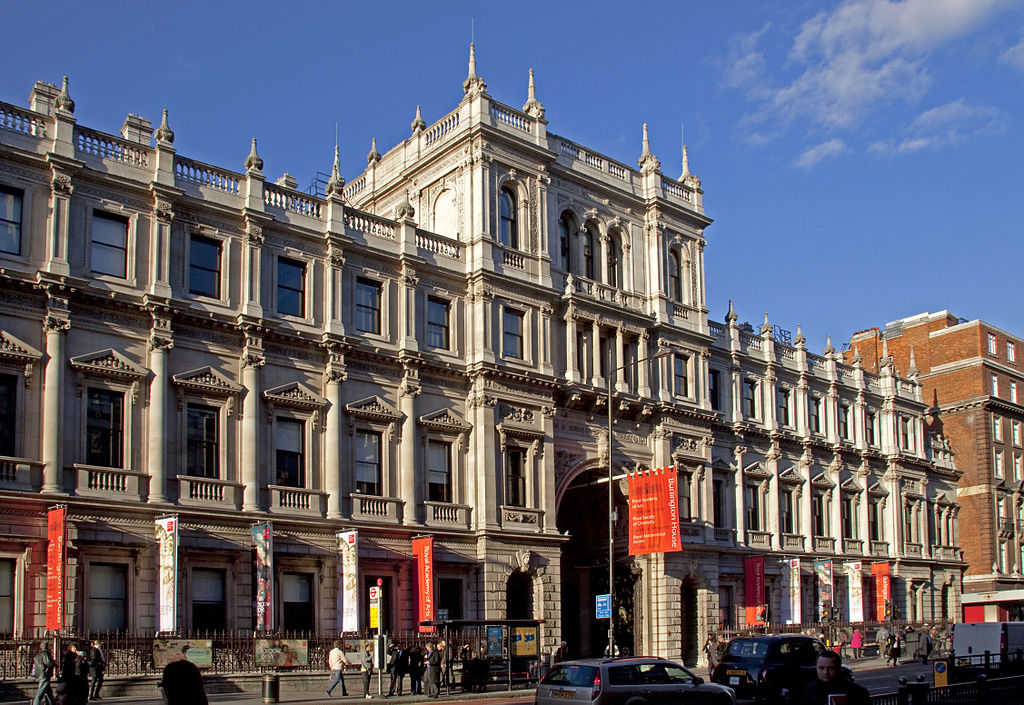 Burlington House in 2010
Photo by Tony Hisgett (CC BY 2.0)
Image source: Wikimedia Commons
Henry was collaborating with the architect Nicholas Hawskmoor (in turn, a collaborator of Sir Christopher Wren) on a project to chronicle Wren’s public works. Having started on the engravings, Henry suffered a paralytic fit, which completely incapacitated him. He lingered on for two years or so and died in 1729.
One of his last works, for the Wren project, was this engraving of St Paul’s Cathedral.
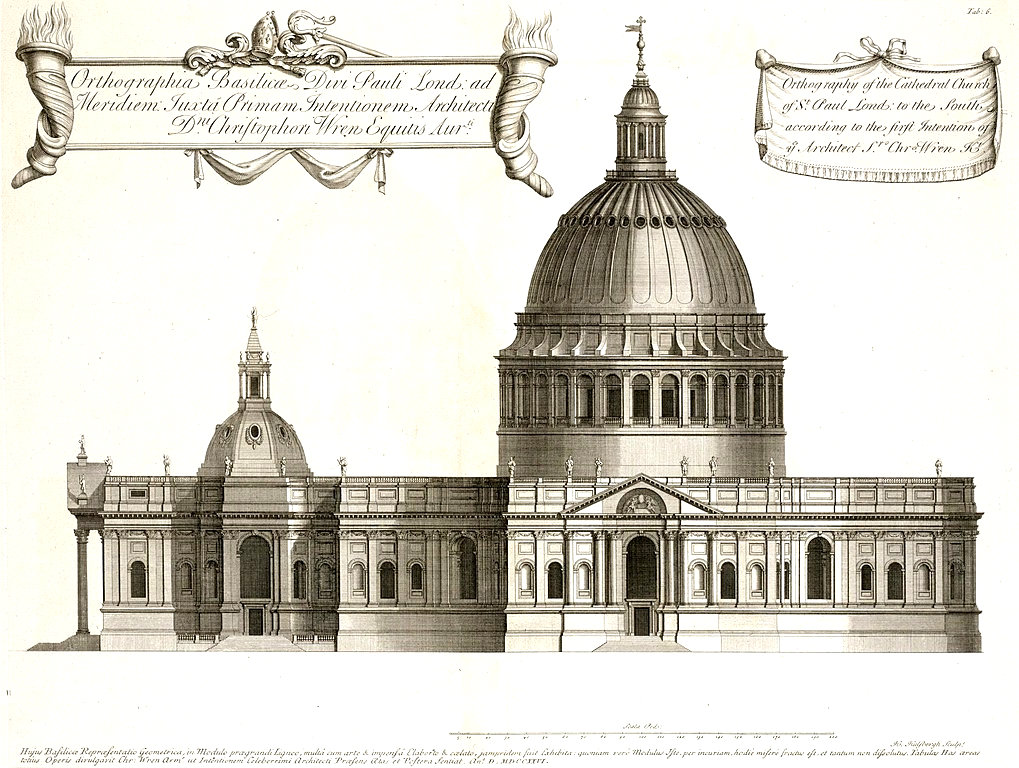 South elevation of Christopher Wren’s Great Model of St. Paul’s Cathedral
Source Royal Academy via Wikipedia
Edward Radclyffe
I’ve often thought that it’s all very well to do a monochrome engraving (not that I could), but how much harder it must be to produce one that is then printed in colour. The sort of thing that Henry Hulsbergh produced is – I hesitate to use this word – simple, such as a draughtsman might do, but, when it comes to engraving someone’s coloured landscape, that’s an entirely different matter. We have already talked about Thomas Allom, and Radclyffe collaborated with him on occasion.
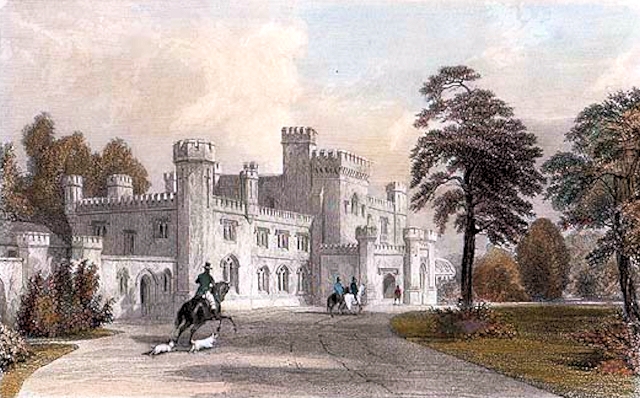 Kingswood Warren
This is an image which appears in Brayley’s History of Surrey: it’s drawn by Allom and engraved by Radclyffe. It does show rather more ‘art’ than, say, a Hulsbergh engraving, as you would expect when Allom made the original drawing. Here’s another of their collaborations, which better shows the complexity of making a coloured print.
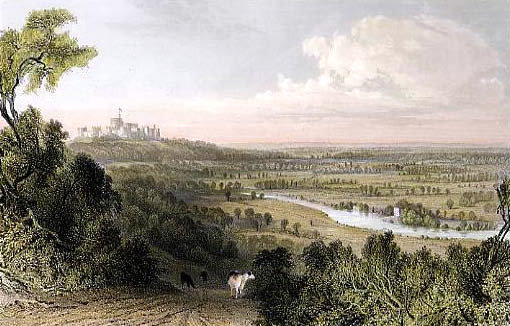 View from Coopers Hill with Runnymede and Windsor Castle, 1842
Image source: Wikimedia Commons
That view from Coopers Hill was something of a favourite with artists and engravers.
Edward Radclyffe was born in Birmingham in 1809, son of another engraver, William Radclyffe (more of Dad in a moment). Edward was something of a teenage prodigy, winning medals, and hot-footed to London as soon as he left his teens. He was a real talent and is best known for illustrations he produced for Thomas Roscoe’s ’The London & Birmingham Railway’.
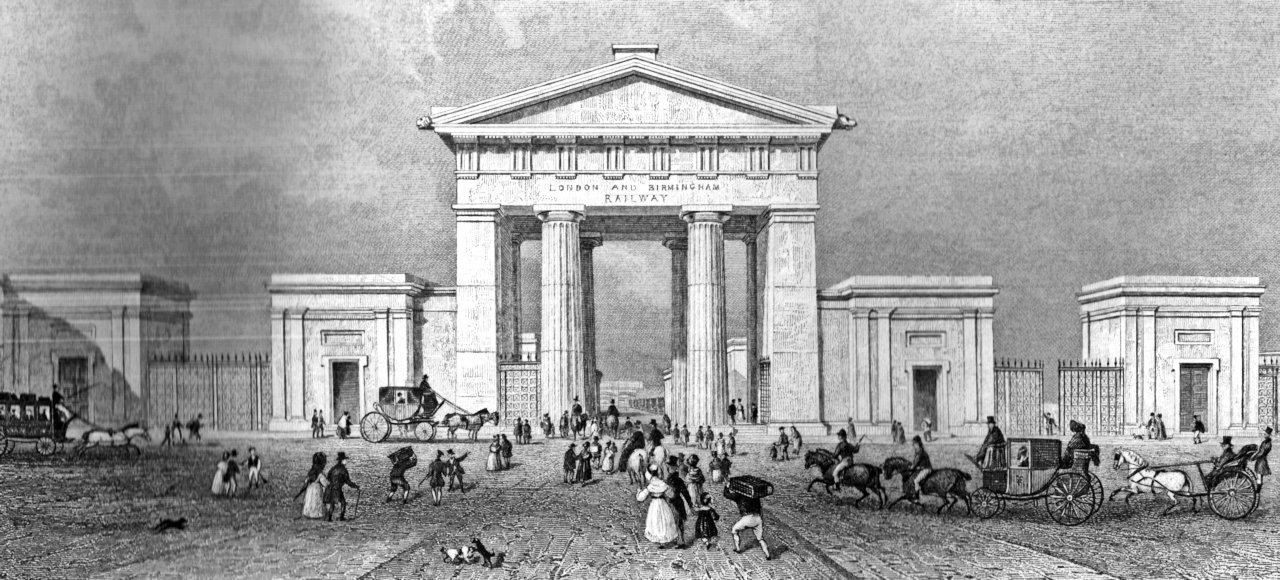 Entrance to Euston Station, 1838, engraved by Edward Radclyffe
Image source: Wikimedia Commons
Edward also engraved charts for the Admiralty and was working on a ‘Liber Studorium’ (a book of prints), but had barely started the engravings when he died, in 1863. The idea had been based on a book by J M W Turner, who tends to pop up fairly often in this article, but he was one of Britain’s finest ever artists, without question.
Edward’s father, William Radclyffe (1783-1855), was also a talented engraver and, along with his great friend David Cox, a major landscape painter, taught his son the art.
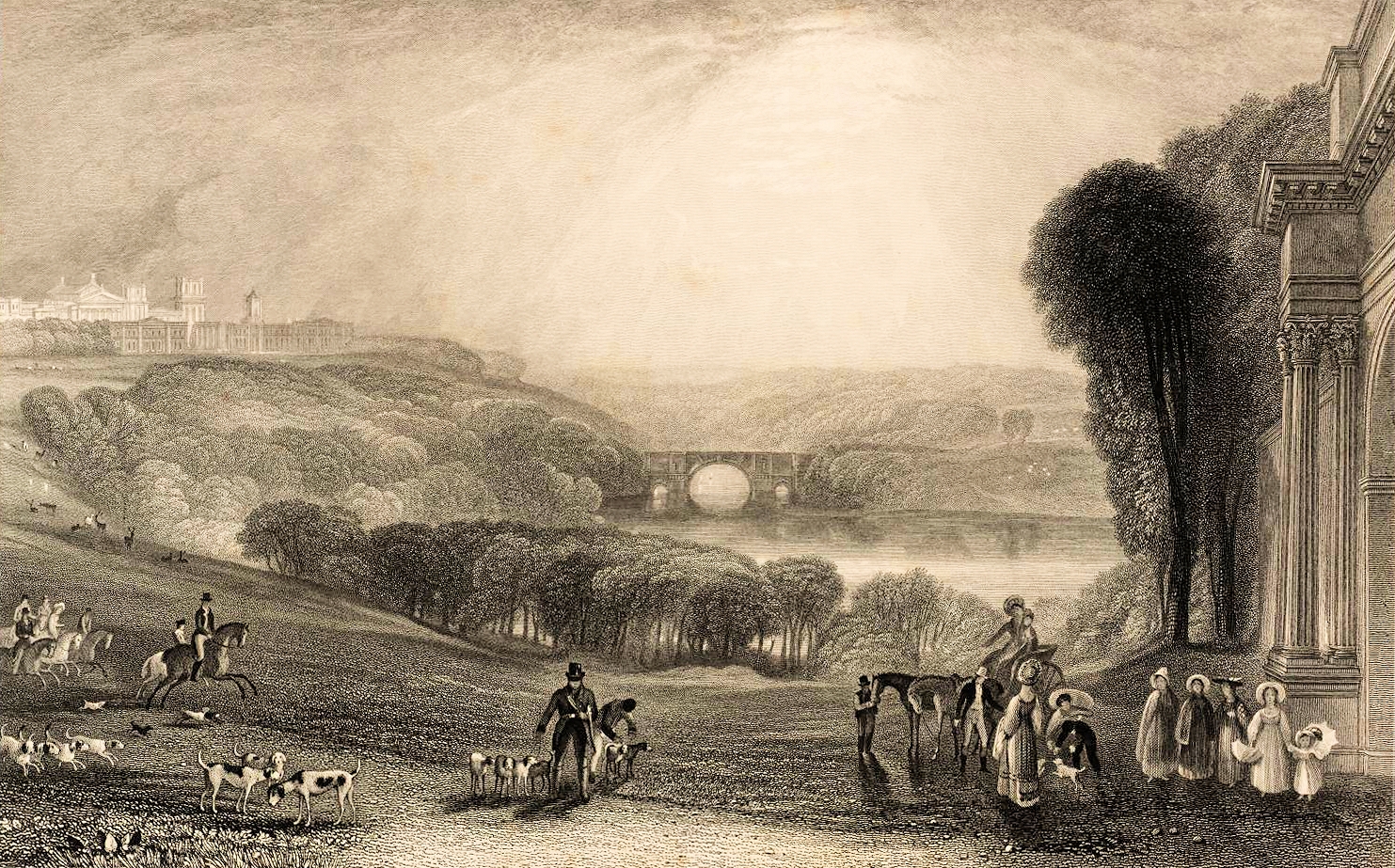 Engraving of Blenheim, Oxfordshire, by William Radclyffe
after Joseph William Mallord Turner, 1833
Image source: Tate Gallery Creative Commons CC-BY-NC-ND (3.0 Unported)
John Frederick Herring Senior
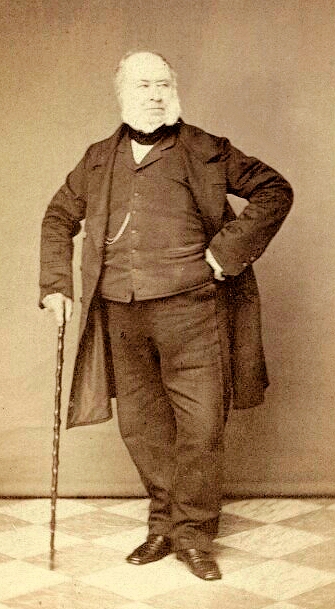 John Frederick Herring Senior,
albumen carte-de-visite, 1860s
Photograph by F Cooke
Image source NPG Ax14887
There are at least two Herring paintings on this website – for example, there is one in the article on Down Hall, which is by John Frederick Herring Senior and depicts Frederick, the 1829 Derby winner. He also painted Sir Gilbert Heathcote’s Amato, the 1838 winner. JFH Senior was a noted painter of horses and other animals – some rated him as highly as George Stubbs, who is generally reckoned to be the best British horse painter. It’s curious that so many racehorse portraits of the 18th and 19th centuries seem very elongated and out of proportion, as in this one below, which was painted by JFH Senior and engraved by Thomas Sutherland (more of him later).
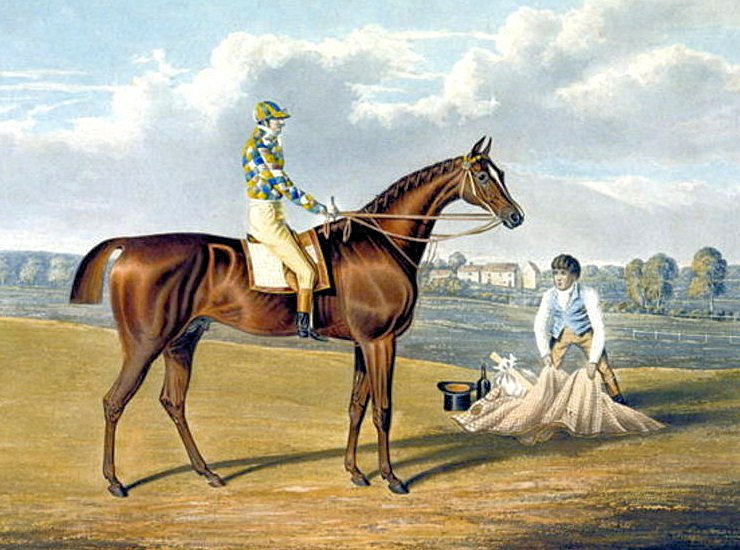 The Racehorse Barefoot c.1833
Image source Wikimedia Commons
I have serious doubts that racehorses really looked like that, but, as long ago as c.1762, Stubbs painted one that didn’t appear so oddly formed, so I suspect that there was a general style in vogue for most such paintings. The more realistic Stubbs painting referred to is extremely famous and resides in the National Gallery: it’s a massive 292cm x 246.4cm (roughly life-sized) and just shows the horse in motion, nothing else.
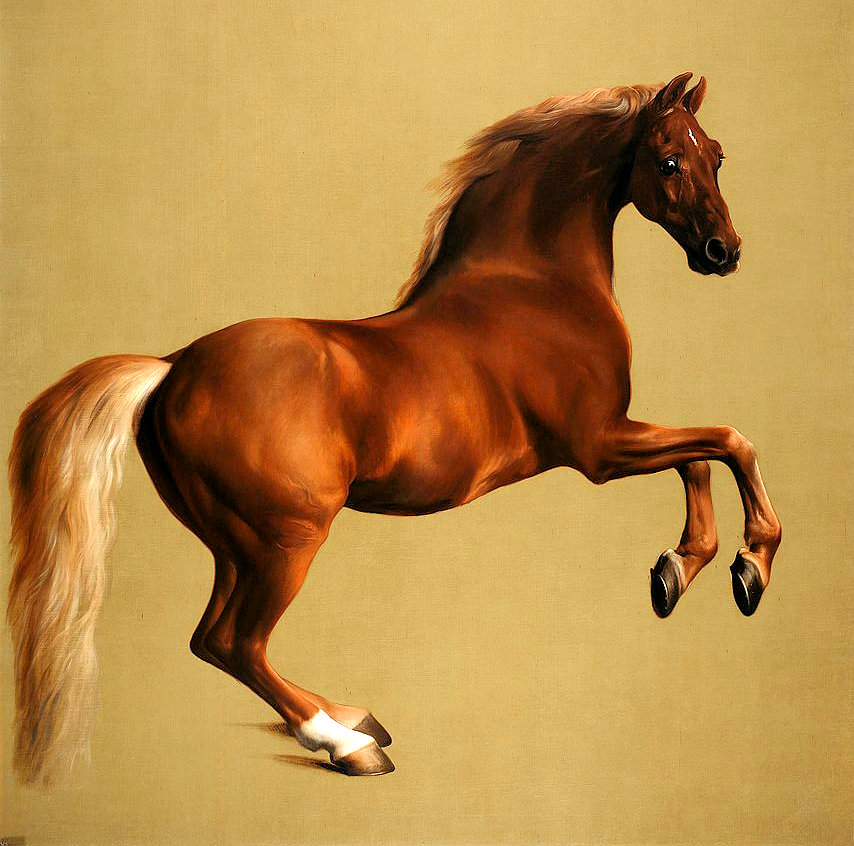 Whistlejacket c.1762 by George Stubbs
Image source: Wikipedia
So, let’s have something more realistic by JFH Senior. This next one is from 1845 and depicts two Arab horses: the painting was a birthday present to Queen Victoria from her mother, the Duchess of Kent, and is in the Royal Collection. The grey is Tajar, who belonged to Prince Albert but was often ridden by the Queen.
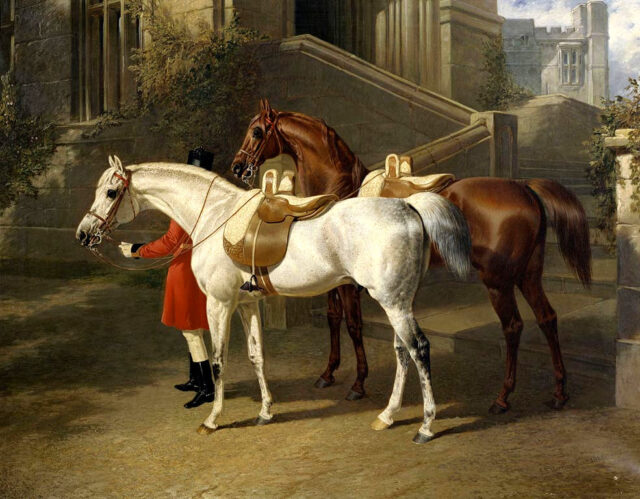 Tajar and Hammon by John Frederick Herring Senior, 1845
Image source: Royal Collection Trust RCIN 401368 ©
JFH Senior was a Londoner, born in 1795, who combined his twin loves of drawing and horses into a career as a painter of horses and other animals. He moved to Doncaster as a youth and obtained employment painting inn signs and insignia on coaches, then becoming a coach driver. In his spare time he painted horses; word got around and soon he was receiving commissions from racehorse owners. In 1830 he moved to Newmarket and then back to London. As ever, for so many artists then and now, money was a problem, but Senior was helped out by various people, including WT Copeland, who had taken over the Spode pottery and who commissioned designs from JFH Senior for dinner services and suchlike. Most of them seem to feature hunting scenes, but the items have endured and were still being produced more than a century later.
 Example of a Spode dinner plate with design by Herring Senior
Jeremy Harte, curator of Bourne Hall Museum, knows something about W T Copeland and Spode and gave an interview on the subject to a local newspaper in 2012, which elicited the useful nugget that JFH Senior employed a man called John Harris, whose depiction of the Epsom Grandstand was used on a large dinner service that was produced for a banquet there in 1847. Jeremy surmises that the items were taken away as souvenirs by the guests and the Museum does have one of the plates, donated by Mr C R Archer.
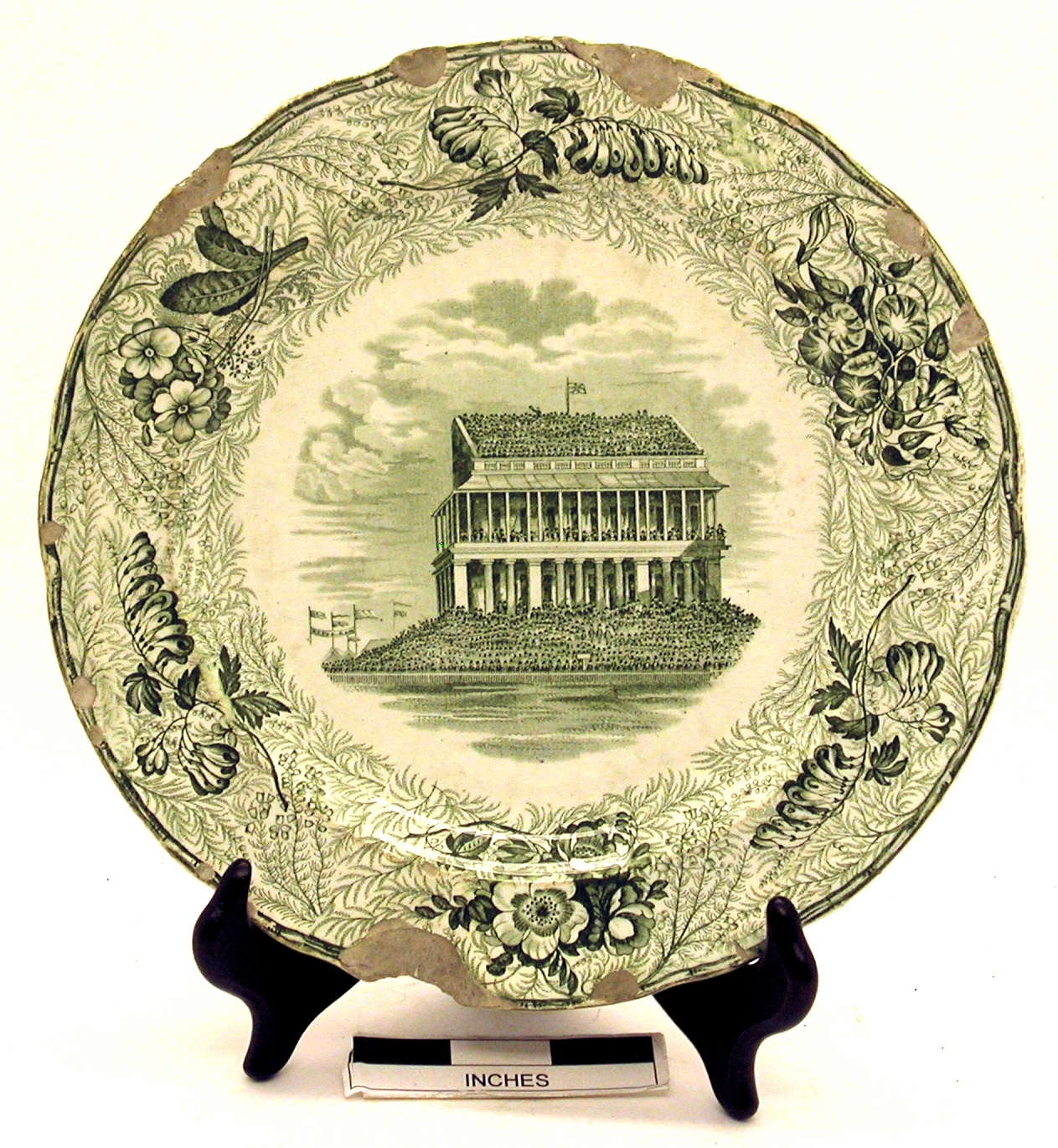 A Copeland & Garrett plate, with transfer-print of
Epsom Grandstand from a design by John Harris
Image courtesy of Bourne Hall Museum
After that digression into china, we return to JFH Senior’s paintings. His career received a boost in 1845, when he was appointed animal painter to the Duchess of Kent, and you have already seen his picture of Tajar and Hammon. Queen Victoria then became a patron. In 1853 he decided to stop painting horses and moved to Meopham Park, near Tonbridge, where he painted whatever took his fancy really, such as this next scene.
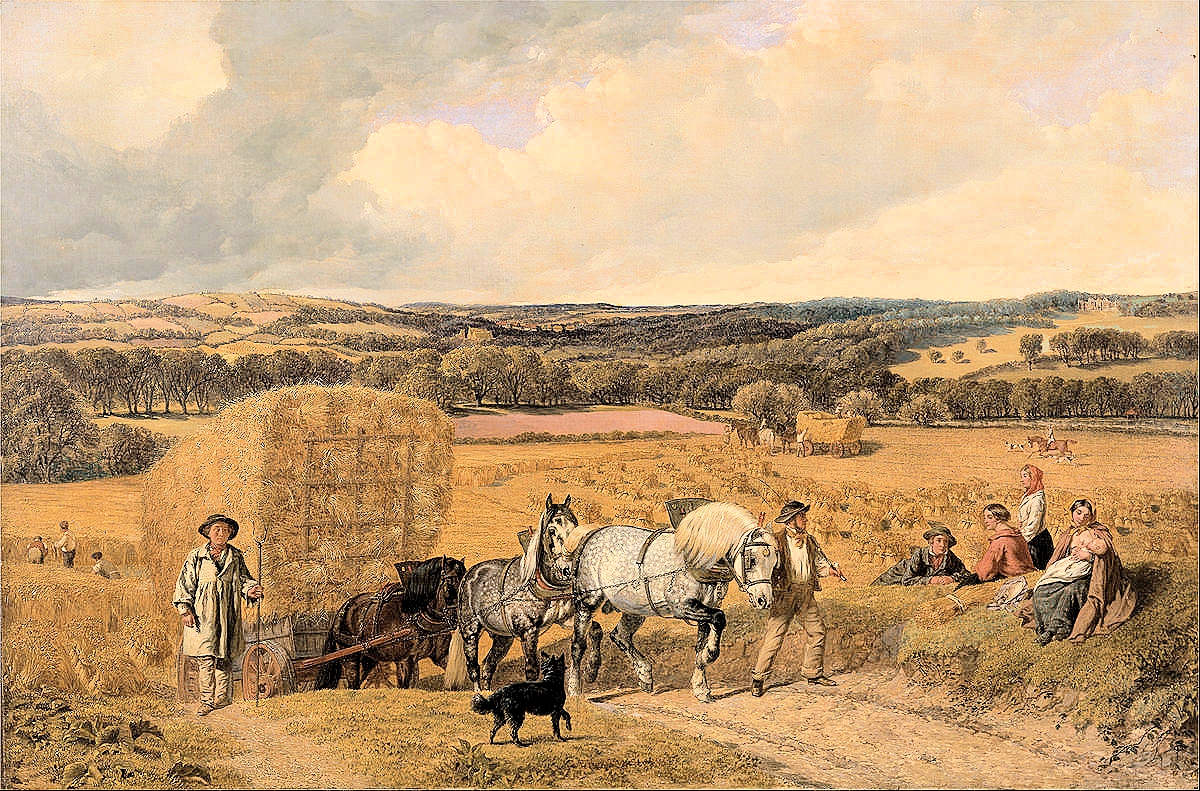 The Harvest, c.1857
Image source: Wikimedia Commons
JFH Senior died at Meopham in 1865 and was commemorated in the Illustrated London News with a drawn portrait (artist unknown).
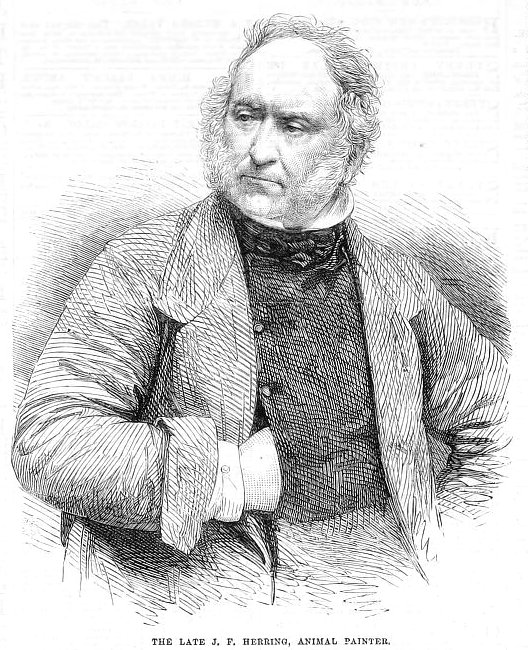 Portrait of John Frederick Herring Senior
from the Illustrated London News of 14 October 1865.
John Frederick Herring Junior
Junior’s birth year is often cited as 1815, but could be anywhere from then to 1820; he was born in Doncaster and it’s no surprise that he started drawing and painting horses from an early age. He too painted race winners in that elongated, out of proportion style I referred to earlier, but also other equine/animal subjects. Since I can’t find anything he did of our area, I will just show you an example of his work and then move on. JFH Junior died in 1907.
 Returning from the Hunt c.1855 by John Frederick Herring Junior
Image source: Yale Center for British Art
Two of Junior’s siblings, Charles and Benjamin, were also artists, and both painted in much the same genres as the other Herrings.
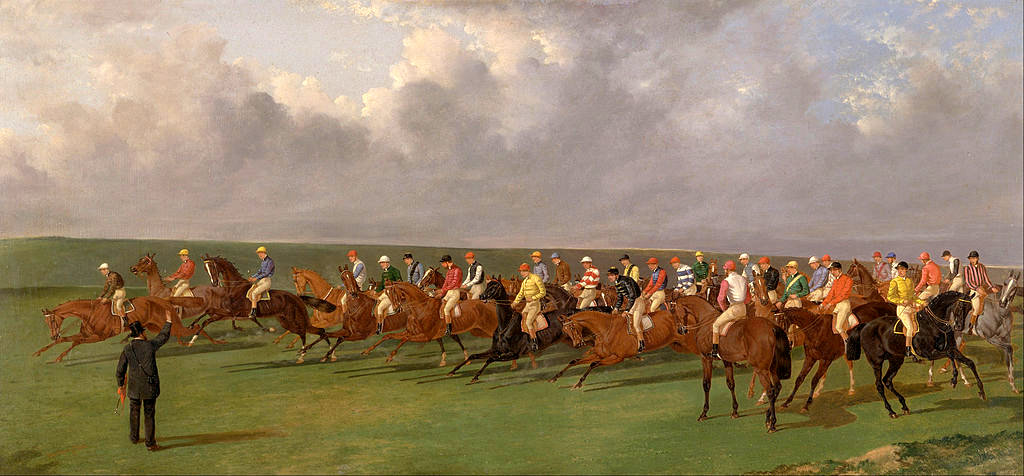 Silks and Satins of the Turf 1865 by Benjamin Herring
Image source: Yale Center of British Art
Henry Thomas Alken
Henry Thomas Alken was the son of artist Samuel Alken (1756-1815). Henry (1785 – 1851) was both painter and engraver, specialising in a similar sort of subject-matter to the equine painters we have been looking at.
 Henry Thomas Alken as Ben Tally O
Image source: Wikimedia Commons
Although Alken painted racing and hunting scenes, he was also a caricaturist. You will see in the picture below that there is a little white dog taking its life in its paws at the front of the field. Its fate is not recorded.
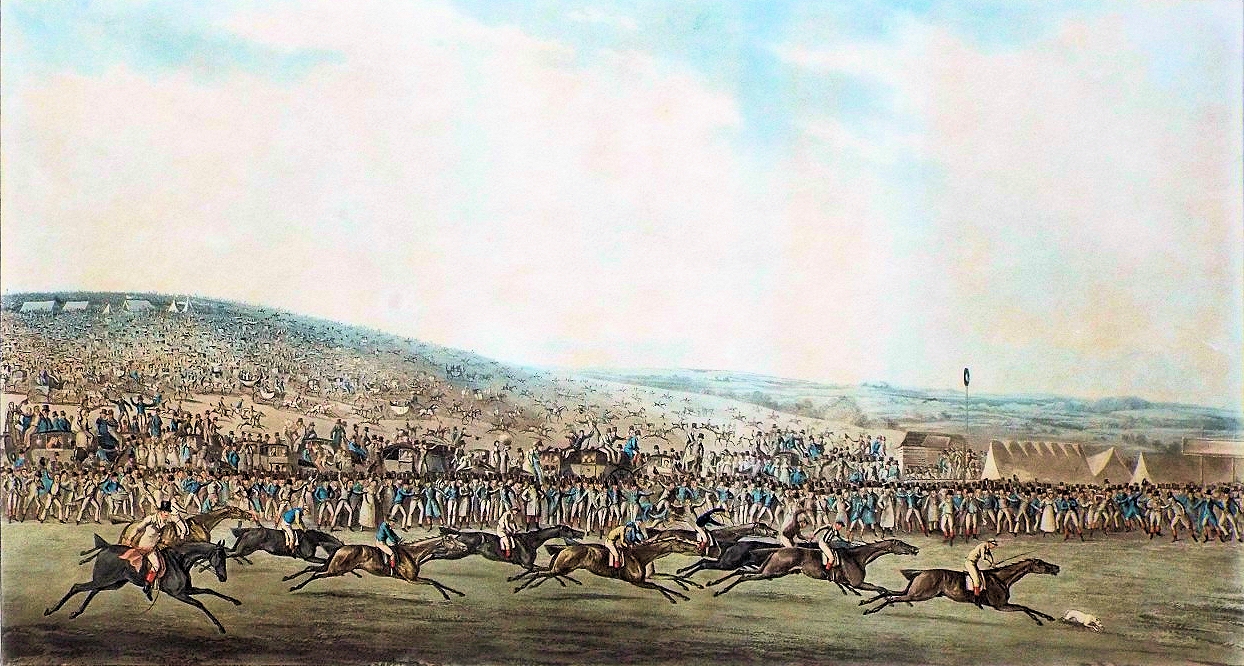 The 1818 Derby by Henry Thomas Alken, Engraved by Thomas Sutherland
I don’t know about you, but I was getting a little tired of elongated racehorses, so a touch of humour is welcome.
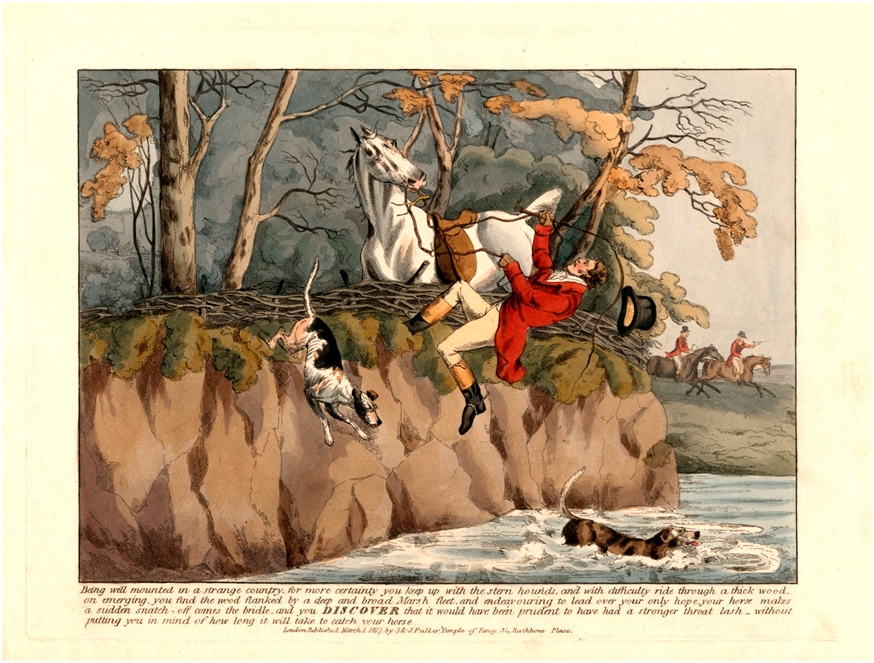 [Hunting Discoveries 1817] … Discover that it would have been prudent
to have had a stronger throat lash … by Henry Thomas Alken
Image source: Yale Center for British Art
Let’s have something completely different to finish up!
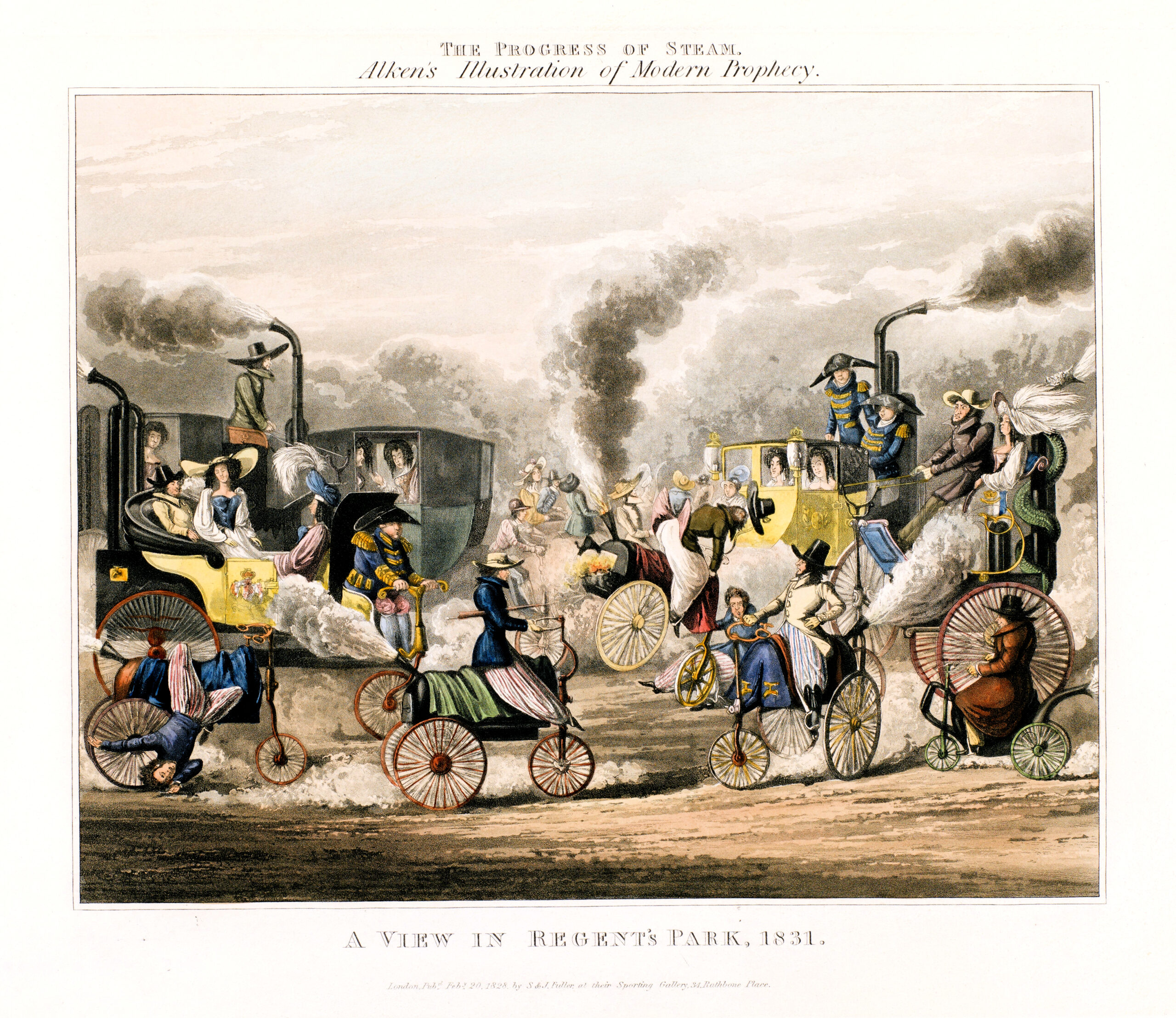 A view in Regent’s Park 1831 by Henry Thomas Alken
The Lewis Walpole Library, Yale University
That illustration was done in 1828, showing Henry’s impression of what steam-powered vehicles might look like in Regent’s Park. And we’ll have just one more of those.
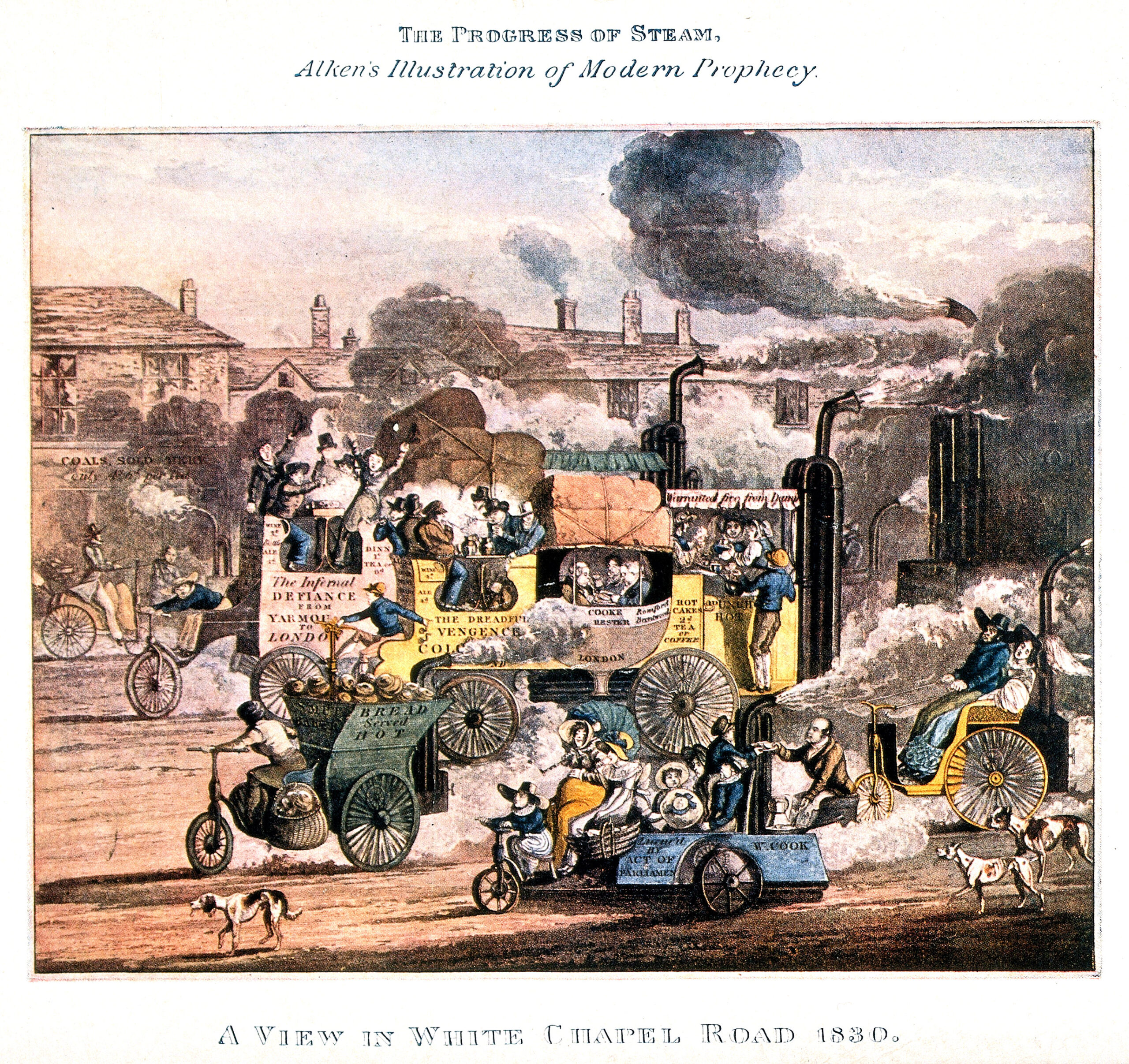 ‘The Progress of Steam – a view in Whitechapel Road’, 1830, by Henry Thomas Alken
Thomas Sutherland
Sutherland (1785 – possibly 1838) also did hunting scenes and was the engraver of JF Herring Senior’s painting of the horse Barefoot, which I showed you earlier. So far, I have avoided using the word aquatint because I didn’t want to get into the technicalities of etching, engraving and how a drawing or painting became a print. I’m not going to mention it now, except in captions, but this was an aspect of Sutherland’s work. We’re back to elongated horses, but not for long.
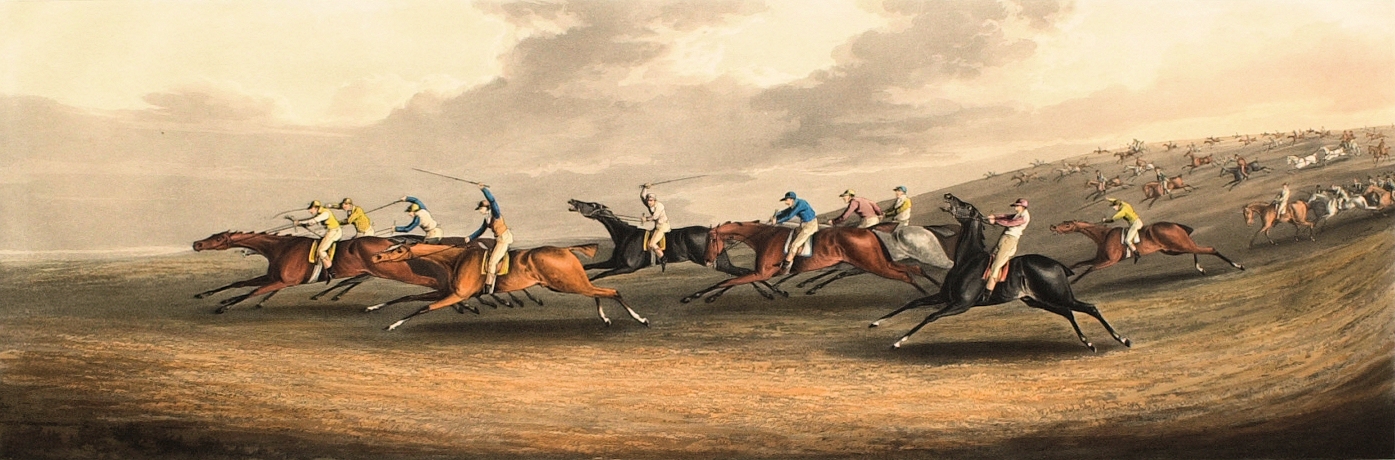 Epsom Running, aquatint on paper, 1818, by Thomas Sutherland
from a drawing/painting by Henry Thomas Alken
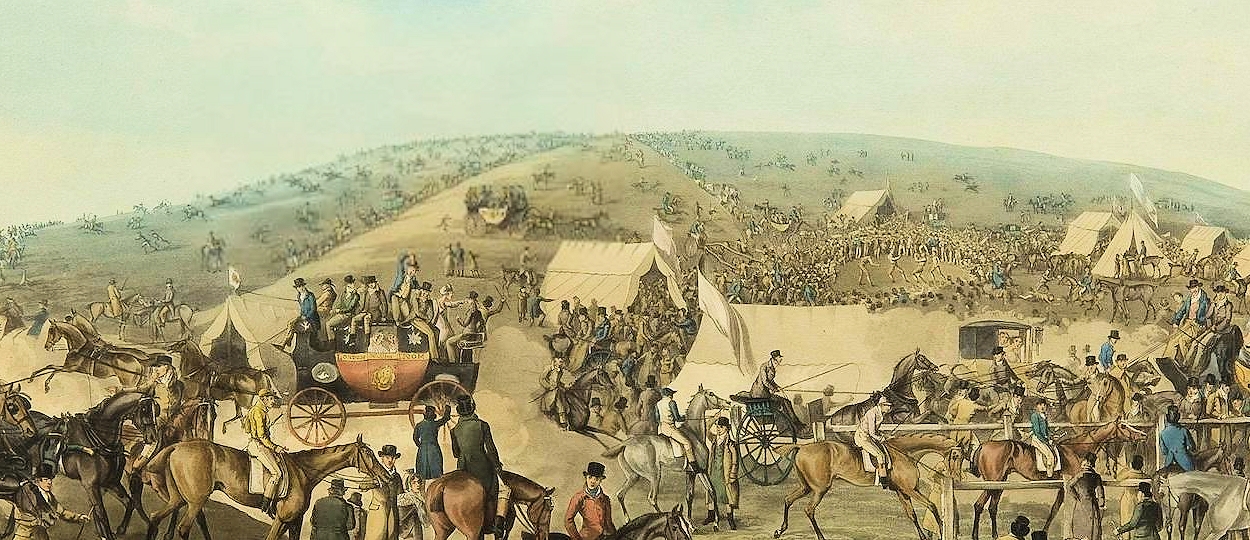 Epsom Races aquatint 1819, by Sutherland after Alken
Staying in Surrey, here are two rather nice views of Richmond.
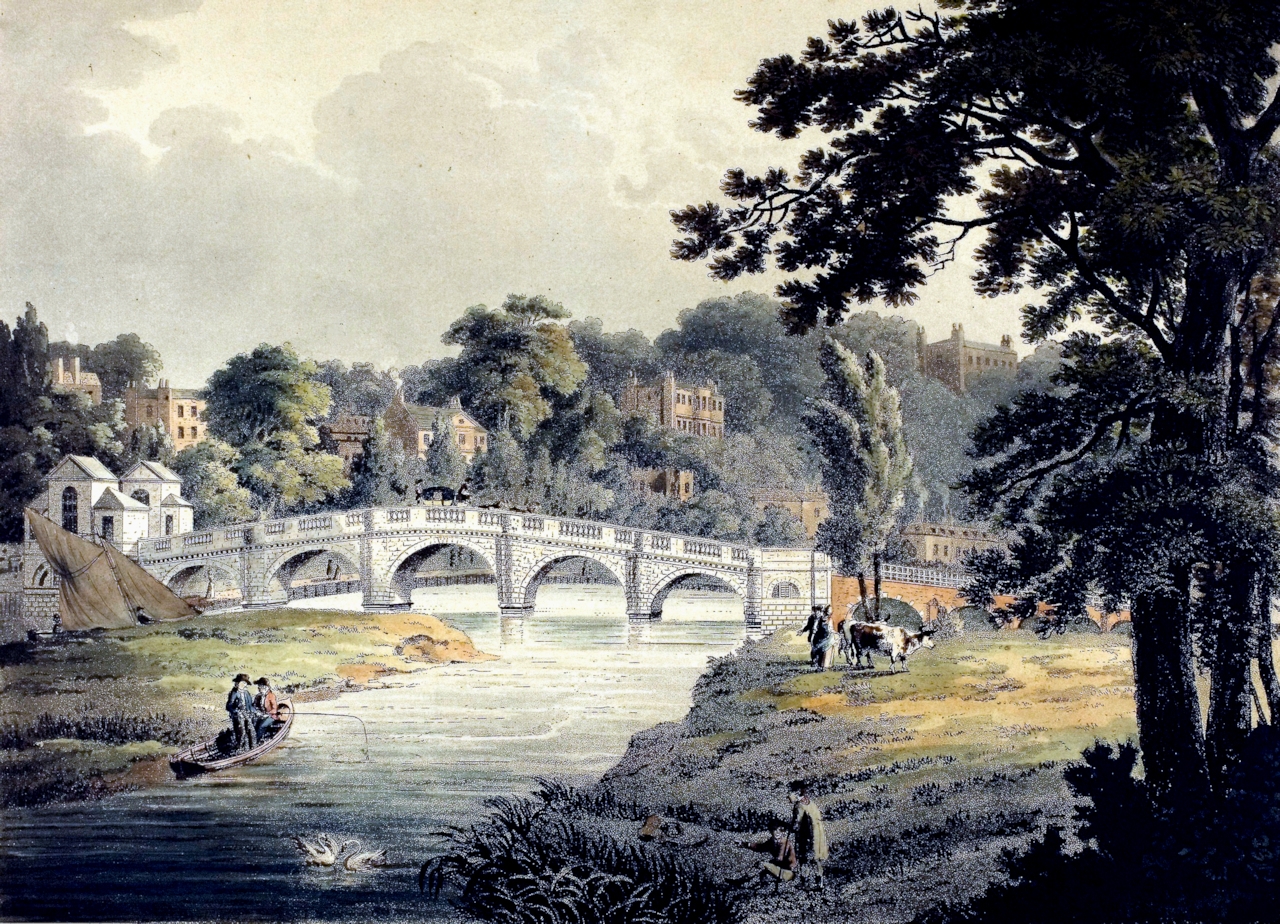 View of Richmond from the Bridge, aquatint heightened with watercolour,
1819, by Thomas Sutherland after John Gendall
Image source: Art Institute of Chicago
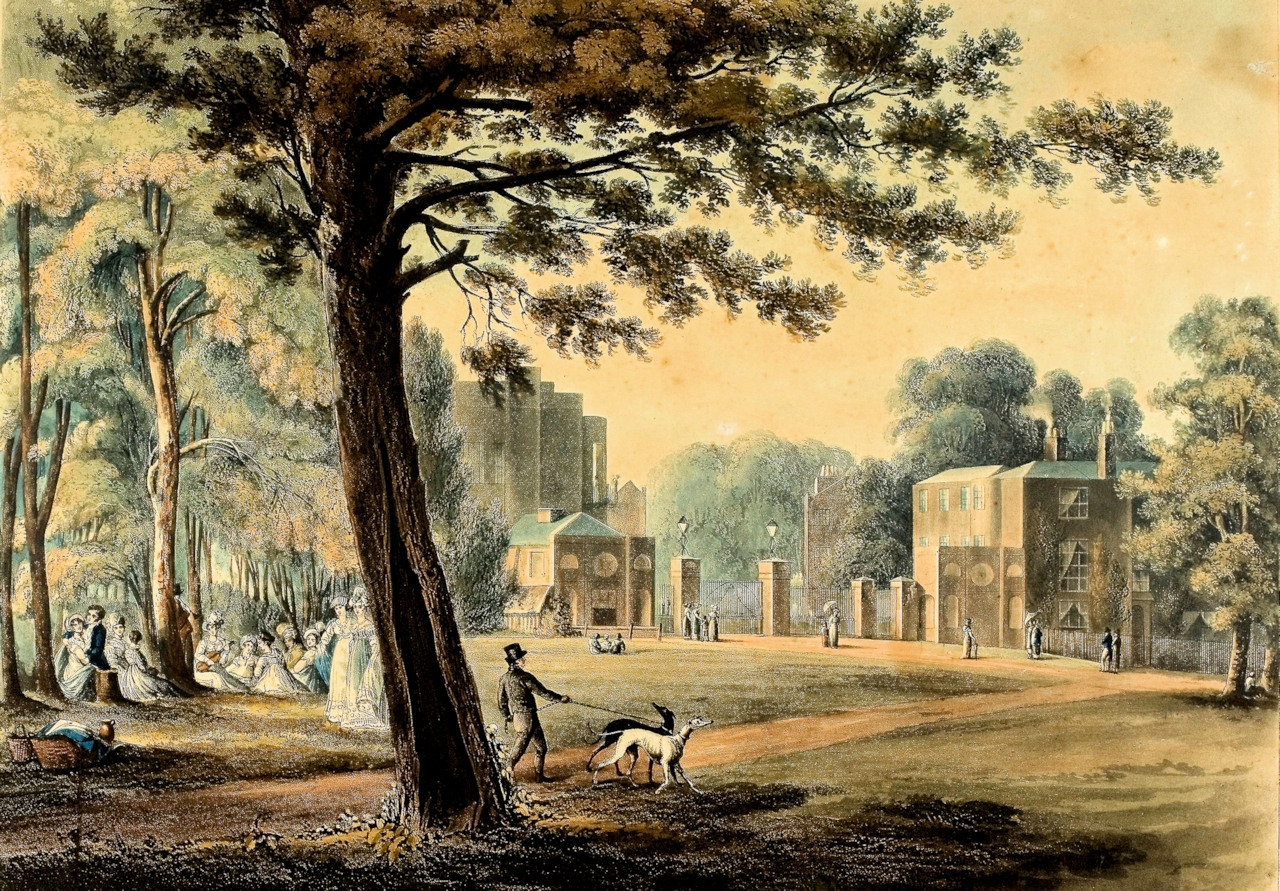 Richmond Park Entrance, aquatint heightened with watercolour, 1819,
by Thomas Sutherland after John Gendall
Image source: Art Institute of Chicago
I think we’ll end with something really exotic.
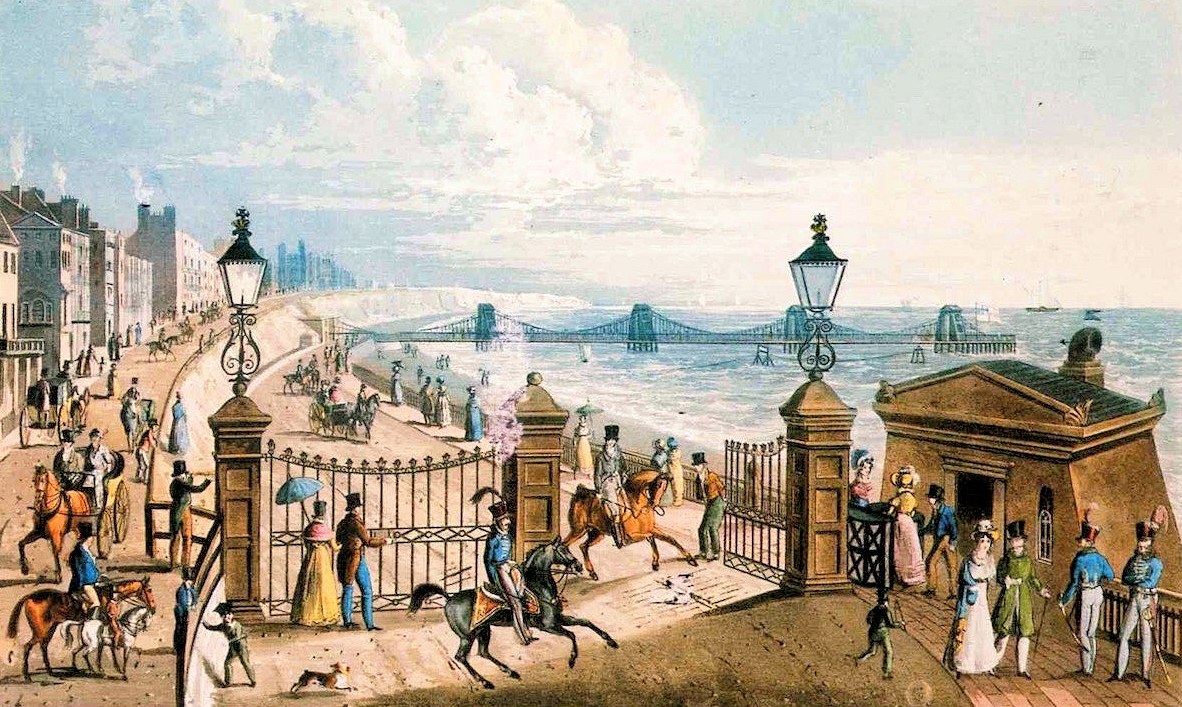 Brighton Chain Pier
Aquatint engraving by Thomas Sutherland, 1824, after Joseph Cordwell
Digital Image by the Society of Brighton Print Collectors, (CC BY-NC 4.0)
Note: The Chain Pier went down in the big storm of 1896, but before that it had been painted by the likes of John Constable and Turner (yes, him again).
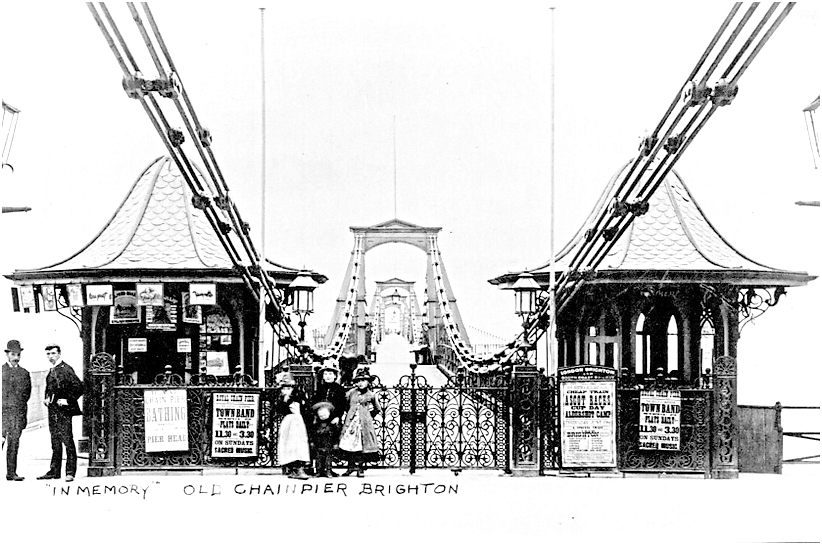 Postcard view (not by Constable or Turner) of the Chain Pier before it went down in the 1896 storm
Image courtesy the Linda Jackson Collection
Linda Jackson 2021