
The Occupants of Ewell Grove
 Ewell Grove House c1908
Image courtesy of Bourne Hall Museum
Our article on Ewell Grove traces the history of the residence from its medieval roots through to the demolition in 1937 of its Georgian re-incarnation. This companion article sets out what we know about its many occupants.
Contents
Thomas Provys (about 1400) & the Horde family (about 1550)
Thomas Hunt (resident from the 1750s to 1785)
John Pollard (resident from about 1790 to 1806)
Thomas Reid Bt and descendants (resident from 1806 to 1878)
Sir David Treharne Evans (resident from 1878 to 1907)
Cuthbert Wilkinson (resident between about 1907 to 1914)
WW1 & the Garsons (resident from about 1915 to the 1930s)
Thomas Provys (about 1400) & the Horde family (about 1550)
The Register or Memorial of Ewell from 1408 records that the property was owned by a Thomas Provys.
By the time of the Ewell Rental of 1549, an early house on the Ewell Grove was held by Allen Horde (of the Horde family) who in his 1555 will left the property to Elizabeth Horde of Fitznells (presumed be his widowed daughter in law) as noted in the 1577 Survey of Ewell.
Thomas Hunt (resident from the 1750s to 1785)
We have drawn a blank for the next 200 years but, in the 1750s, the Tudor house came into the possession of Thomas Hunt, junior. He was the eldest son of Thomas of Stourbridge (High Sheriff of Worcestershire in 1725) who had died in 1727. Thomas, the younger, went up to Oxford matriculating, aged 18, on 30 March 1737. He was still at Worcester College when, on 5 April 1743 he married Susanna Carter at Halesowen. They had arrived in Ewell in time for Thomas to be nominated an additional Trustee under the Turnpike Act, 28 Geo.II (1755) and he became established as a Merchant trading from Old Jewry, London.
Thomas died in 1785, leaving among other things “Two acres Hatch Furlong in Common Fields, adjoining Hunt’s garden and lately fenced by a hedge”. A key part of his 8-page Will dated 7 June 1784 and proved on 8 March 1785 (PROB 11/1127) made the following provision for his widow:
£200; coaches and horses; jewellery; a £300 annuity (added to her marriage settlement) to be paid quarterly and levied upon all unsettled saleable property excepting her dwelling-house; and residuary estate (including what lies within Warwickshire) with power of re-entry if the annuity’s payment fall thirty days behindhand; all other lands and the dwelling were consigned to the executors, who could let the widow reside there although she would have to give them notice if she wanted to leave within six months of her husband’s death, being compensated with £40 p.a. if she declined to live there – whenever she ceased to reside, the house to be sold for the benefit of any children whom the testator and wife might have.
Notwithstanding the will’s provisions, the widowed Susannah obviously chose not to stay in Ewell, moving away to Walcot, near Bath in Somerset, where she died about the end of 1798: her Will was proved 24 January 1797 (PROB 11/1284). The couple had had no children which is why, on 1 November 1786, Thomas Hunt’s trustees sold the two acres of copyhold land with, it may be assumed, Hunt’s freehold estate to John Pollard Esq, of Mitcham.
John Pollard (resident from about 1790 to 1806)
The building of Ewell Grove illustrated at the head of this article was commissioned by John Pollard, who had married Mary Yates at St Sepulchre, Holborn, on 26 April 1760). Between the commissioning of the house and its completion, Mary died on 7 October 1788. The widowed John and family appear to have moved into the new property by about 1790. As to family, we know of three daughters – Catherine, another Mary and Ann. The move, however, would not have included second daughter Mary (born 4 August 1767, baptised 31 August 1767 at St Sepulchre, London) who, on 26 May 1787, had married Thomas Seddon. He was a member of the family of furniture manufacturers in London House, Aldersgate, sufficiently famous to have an entry in the Oxford Dictionary of National Biography.
In his Brief History of Ewell, Cloudesley Willis John Pollard is mentioned as “a gentleman known as ‘fine Pollard’ ” with his brother (understood to be William Pollard) “to be a rough customer known as ‘coarse Pollard’ ”.
John Pollard was a partner with Joseph Sales in a firm of Tobacco and Snuff Manufacturers – Sales Pollard & Co of Aldersgate Street, London – that had been established during 1750. Described as one of the oldest houses in England in the Tobacco Trade, it established a reputation for fine Rappee and Scotch Snuff, also for Saffron Cut Tobacco. The initials of the firm were adopted as the name of a very popular snuff, “thereby proving the high repute of the house as snuff makers”. Much later, however, “SP” became the subject of a trade mark dispute.
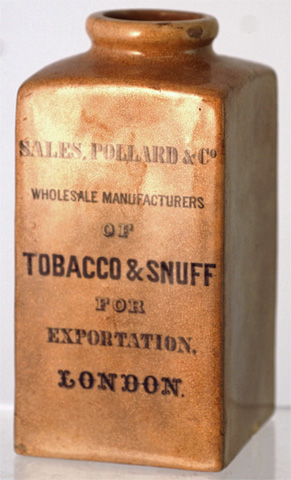
A Sales & Pollard glazed stoneware snuff jar (about 15cm tall.)
Image with thanks to The Saleroom, copyright acknowledged.
In 1790 – about the time the family moved to Ewell – John resigned from his position as chairman of Sales and Pollard. It is not know whether this had any connection with the firm’s being mentioned in a Parliamentary debate about Tobacco Tax as having paid a third of the whole duties on tobacco collected for a number of years the past. In any event, John was a wealthy man: between 1795 and 1801, he advanced more than £20,000 on loan to his son in law’s furniture firm, Seddons of London House, Aldersgate Street.
On 22 August 1801, daughter Catherine married – in Ewell – George [later Admiral] Wilson of Redgrave. This was some 12 years after the death of her mother, Mary, in 1788. As reported in Manning and Bray’s History and Antiquities of Surrey (1814):
“Against the East Wall of the Bray Chapel, on a white marble tablet was an inscription: –
Sacred to the memory of Mrs. POLLARD, wife of Mr. JOHN POLLARD Tobacconist, of Southwark, who died the 7th of October, 1788, aged 52 years, deservedly beloved and sincerely lamented’”.
The “Bray Chapel” was an addition to Ewell’s ancient church of St Mary erected by Richard Bray in 1529, and becoming his burial-place in 1559. The widowed John (who sold Ewell Grove in 1806 and moved away) died on 20 January 1817, at Bedford Row, London. (His will, dated 10 March 1810, was proved 11 February 1817 [PROB 11/1589].) The marble tablet in memory of his wife was replaced with new mural monument, to which was later added the death of their daughter, Ann, in 1823. When St Mary’s was rebuilt in 1847-48, the memorial was moved to the new church, where (as below) it may be seen today.
 The memorial to Mary Pollard
Image with thanks to Bourne Hall Museum
Sir Thomas Reid and descendants (resident from 1806 to 1878)
The purchaser of Ewell Grove in 1806 is understood to have been Thomas Reid. Certainly Henry, his second son (born 28 August 1793, christened St Stephen’s Coleman Street, London, 18 November 1793), died there in 1810 “after a lingering illness”. The story of Thomas – who, in September 1823, was created the 1st Baronet Reid of Ewell Grove, Surrey and Graystone Park, Dumfries – begins our article about The Reids of Ewell Grove.
As noted in that article, the family’s fortunes declined and, in 1878, the 4th (and last) Baronet, Sir Henry Valentine Rae Reid, sold Ewell Grove.
Sir David Treharne Evans (resident from 1878 to 1907)
 A carte-de-visite of Sir David Evans of Ewell Grove
Image courtesy of Bourne Hall Museum
The purchaser in 1878 was David Treharne Evans. He was born in Llantrisant, Glamorgan on 21 April 1949, the second child of “Rate Collector” Thomas and Anne (née Traherne) Evans. David’s uncle, Richard Evans, had gone into business as a manufacturer of buttons and other garment trimmings. This was a most successful business: the City of London directory for 1865 lists Robert Evans & Co with offices at 24, 25 & 74 Watling Street and factories at 197 Upper Thames Street & 13 Garlick Hill. David followed his uncle into the business and in the mid 1860s spent some time in France with Robert (who had never married and retired to St Etienne) learning the ropes.
The 1871 Census finds David back in Llantrisant – as a “Trimming manufacturer” with his now-widowed mother. He was obviously doing well: the previous year, he had been admitted as a local Freeman. However, he may already have been based in London: in 1874, he became an alderman of the City of London for the ward of Castle Baynard, as a result of which (as a “Trimmings Manufacturer of 24 Watling Street”). he was given the Freedom of City of London on 13 June 1874. In 1875, he offered himself to the livery for the honourable office of Sheriff of London and Middlesex, a post he held for the next two years.
On 18 December 1875, the 26 year old David married 19 year old Emily Deborah Boakes in her parish church of St Mary’s, Lewisham. The Register entry describes him as a “Warehouseman” and his residence as Perry Hill (presumably the one between Dulwich and Beckenham rather than the Perry Hill to the north of Guildford). The couple made their home in Ewell a few years before purchasing Ewell Grove in 1878: their first child, Richard Evan David Evans, was baptised at St Mary’s, Ewell on 10 June 1876. Nine more children followed, all born in Ewell – the last in September 1888.
Writing in 1943, the late Cloudesley Willis noted that, during Sir David’s time, the Surrey Stag Hounds met at Ewell Grove. We recently came across a couple of contemporaneous photographs of the Surrey Stag Hounds (although not at Ewell Grove), as below.
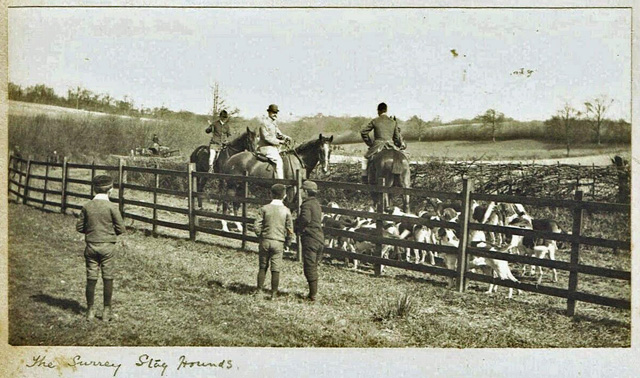
The Surrey Stag Hounds, circa 1900.
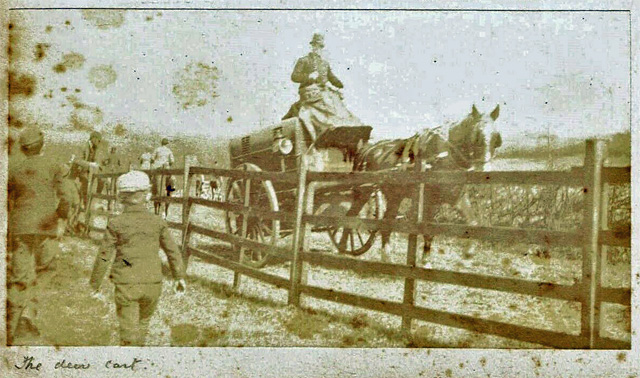
The “deer cart”, used to deliver an animal for the hounds to chase.
In 1891, David became the Lord Mayor of London and received the usual Knighthood.
The 1901 Census records the parents at Ewell Grove (Sir David listed as a “Warehouseman”) together with their three youngest children and all supported by four domestic servants. Emily died on 1 June 1903 aged only 46. The widowed David died – at Ewell Grove – on 14 August 1907, aged 58 and is buried in the churchyard of St Mary’s Ewell.
Cuthbert Wilkinson (resident between about 1907 to 1914)
The next resident of Ewell Grove was Ewell Grove was “master printer and newspaper proprietor” Cuthbert Wilkinson and members of his family.
Cuthbert had been born in Nottingham on 11 May 1854, the first child of printer John Chissell and Caroline Wilkinson. He was baptised in St Paul’s, Nottingham on 14 June as “John Chissell Cuthbert” but, certainly in later life, was always known as “Cuthbert” and we follow suit here.
During the 1860s, the family moved south. The 1871 Census records the parents and their now 5 children living at 5 Addington Square, Camberwell. 16 year old Cuthbert is listed as a “Grocer’s assistant”. In 1876, he married Rosa Cromwell and the 1881 Census records them living at 11 Oakfield Road, Penge with two young children. Cuthbert is now listed as a “Grocer”. Living with them were Cuthbert’s younger brother Henry (a “Grocer’s assistant”) and an unrelated 15 year old “Grocer’s apprentice”. The household was supported by a domestic servant.
Things were not, however, going as well as all that might suggest. As recorded on page 1052 of the London Gazette of 7 March 1882, the Surrey County Court, held in Croydon, had on 3 March 1882, declared him (“trading under the style of Wilkinson Brothers, Grocer and Oilman”) bankrupt. He quickly bounced back by succeeding his father (who had died in 1874) as a newspaper proprietor. The 1891 Census records the 36 year old Cuthbert (a “Printer, Publisher & Newspaper Proprietor”), 41 year old Rosa and their now complete family of six children living at “Florian”, Sydenham Avenue, Lewisham. They were supported by two live-in nurses and two domestic servants. The parents and their four youngest children (plus three domestic servants) were still at that address at the time of the 1901 Census.
It is not clear from the readily available records exactly when the Wilkinsons arrived in Ewell Grove. It was clearly after Sir David Evan’s death in 1907 – but Cuthbert arrived in time to be listed as a private resident there (together with a London address at 66 Holland Park) in the 1909 Kelley’s Directory entry for Ewell.
The 1911 Census records the 56 year old Cuthbert (as a “master printer and newspaper proprietor”), 61 year old Rosa and the three youngest of their six children living at the “15 room” Ewell Grove supported by three domestic servants. No occupation is recorded for either Rosa or 22 year old daughter, Maud. Both the sons (23 year old Edwin and 25 year old Edgar) are listed as “Journalist”.
Alongside his business dealings, Cuthbert was active in public affairs, local government and politics. He had been a member of the Common Council of the Corporation of London for Faringdon Without and was made a Freeman of the City of London. Most Freemen were members of the historic Livery Companies, but Cuthbert was not. Together with others in the same position, he helped found the Guild of Freemen and, in 1909, was elected by his peers as the Guild’s first Master. From 1913 until his death sat as a Municipal Reform Party member of the London County Council representing Camberwell.
Camberwell, was, of course, his family’s location on moving to London in the 1860s and, in the early days of WW1, he and the family moved back to that part of the world. Cuthbert’s last appearance in the Kelly’s Directory for Ewell was in the 1915 edition, likely to have been prepared in late 1914. When he died on 20 June 1918, it was at his 1901 Lewisham address.
WW1 & the Garsons (resident from about 1915 to the 1930s)
It seems Ewell Grove was taken over during WW1 for use as a home for wounded Belgian soldiers. Among those this (and other war hospitals in the area) brought to Ewell was a Dr Garson. His earlier years are relevant to our story here.
John George Garson was born on 23 July 1854 in Birsay, Orkney – the first of 6 children born to Presbyterian minister, the Revd John Garson, and Elizabeth (née Main). By the time of the 1871 Census he was a 16 year old “Scholar” lodging in Edinburgh, where he later attended the University and qualified as a medical doctor (LRCS 1875 & MD 1878).
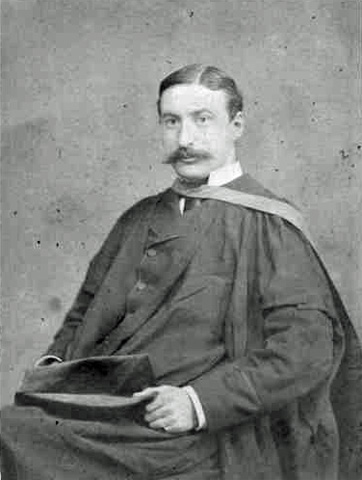
John Garson in what must be his graduation photograph.
Image with thanks to the Gregory family.
The 1881 Census records John as a lodger at 12 Princes Street, near London’s Oxford Circus, and lists him as a “Comparative Anatomist”. He became widely recognised as an authority on anthropology, a long-serving and prominent council member of Royal Anthropological Institute, publishing in their journal, and attached to the anthropological section of the British Association, editing and revising their new edition of Notes and Queries on Anthropology (1892).
On 18 April 1888, John married Florence Mary Sheridan at the church of St Matthias, Earls Court. They were both aged 33. The Register entry lists John as a “Doctor of Medicine”. No occupation is listed for his bride, the daughter of John Sheridan, listed as a “Gentleman”. (He owned an insurance/assurance business in the City of London and all his children lived lives of relative leisure – doing the Grand Tour, travelling to Australia and North America etc.)
The 1891 Census records the recently married John and Florence (who never had any children) as visiting her brother, Fordyce, (listed as a “Barrister”) at 1 Templeton Place, Kensington. The 1901 Census records the couple at home at 42 St John’s Wood Road, Marylebone, with John now listed as a “Physician”. Living with them were two young nephews, and the four were supported by two domestic servants.
In what seems a surprise change of direction, the 1911 Census records the couple as the apparent owners of the “Moorcote (perhaps – see later – a mis-transcription of “Glencote”) Private Sanatorium” in Eversley, Hampshire. The 56 year old John is listed as “Physician Superintendent (Employer)”. As usual, no occupation is listed for Florence. The resident employees were a Secretary to the Sanatorium, a Hospital Nurse and two domestic servants. Also resident was just one “Patient”, 29 year old George Tyler, a Lieutenant in the Royal Garrison Artillery.
The “Great War” began in mid-1914. It was not, as had been forecast, “over by Christmas” and, in 1915, the 60 year old John joined the Royal Army Medical Corps as a Lieutenant. Promoted to Captain in 1916, the records show his assignment as “prisoners of war and neurological hospitals, Epsom”.
At his point, we need to turn to the story of Margaret Isabella Scotson. She was born on 25 July 1879 in Haughton Le Skerne, County Durham, the third child of well-to-do “Builder” George Scotson and his wife, Mary. She was still in Durham by the time of the 1891 Census, a 21 year old living with her now-widowed mother and older sister – all listed as “Living on Own Means”. It is something of a surprise to find that Margaret’s next appearance in the readily available records is in 1900 London, when, on 10 November at the church of St Thomas Portman Square, this now 31 year old married 38 year old “Doctor of Medicine” William George Holloway. The Register records her address as “The Gower Hotel, Gower Street” and his as the nearby 11 Somerset Street.
The couple set up home in 7 Hertford Street Court, Mayfair. The 1901 Census records them there (with William listed as a “Surgeon, own account” working from home) supported by two domestic servants. Also there on Census night were visitors General Malcolm Nicholson and his wife Adela. Sadly, William died aged only 43 in 1904. The 1911 Census records the widowed and childless Margaret visiting apparently unrelated friends at 33 Dundonald Road, Willesden.
Was it because of her late husband’s medical connections that the widowed Margaret found her way to Ewell Grove during WW1? In any event, that is where these two apparently unrelated strands come together. On 29 November 1918, John Garson’s wife of 31 years, Florence, died – according to the later Probate record – at Ewell Grove (and the death was registered in the Epsom District). The Probate record also noted that she was “of” Glencote, Eversley – perhaps the “Moorcote” of the 1911 Census address.
Just over a year later, on 18 December 1919, John Garson and Margaret Holloway (née Scotson) – both widowed – married at St Mary’s, Ewell. The Register records the now 65 year old John as a “Captain RAMC” resident at “The War Hospital Ewell” and the 50 year old Margaret (for whom no “rank or profession” is noted) as resident in Ewell Grove.
Postwar to the 1930s
The newly married John and Margaret Garson stayed on at Ewell Grove. The occasional Kelly’s Directories between 1922 and 1930 record Dr John Garson as a “Private Resident” at that address.
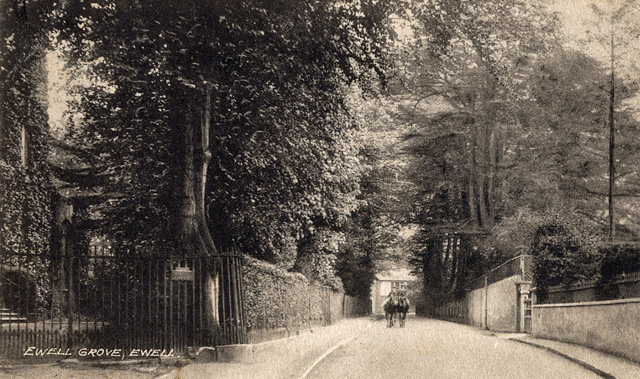
A c.1920 postcard view south along Cheam Road as the Garsons would have known it.
(The ivy-clad Ewell Grove is on the far left.)
Image with thanks to Bourne Hall Museum.
John Garson died at Ewell Grove on 31 May 1932, aged 77. He left the now twice-widowed Margaret as executor of an estate valued at £1,641.
The 1936 Kelly’s Directory contains an entry for the “Ewell Grove Nursing Home, Cheam Road, Lady Superintendent: Mrs Garson”. It is currently not clear if this had been the Garson’s side-line since WW1: there is no mention in previous Kelly’s directories.
Margaret herself died at Ewell Grove on 30 July 1936, aged 77. She left an estate valued at £2,940.
Ewell Grove and its site was acquired for development by the builders, Messrs Wates, Ltd. The house was demolished in 1937. Nowadays, the mansion’s footprint is covered by Nos 11-17 Cheam Road and most of its grounds are now taken up by housing on Portway and Portway Crescent.
Brian Bouchard & Roger Morgan © 2021
(expanded from the “people” elements of Brian’s
original 2012 – and now expanded – article on Ewell Grove.)