
PETULA CLARK CBE
(born in Ewell, 1932)

Petula Clark in 2017.
Copyright acknowledged.
This WW2 child singing prodigy – and subsequently very long standing international star of stage, screen, recording studio and concert hall – was born in Ewell and spent her early years in and around the Borough.
Petula’s father was Leslie Norman Clark, born in Chichester on 8 March 1909. The 1911 Census records him as the second child of Sydney (a “Clerk at Dyers and Cleaners Works”) and Ellen Clark living at 18 St Martin’s Street. Chichester. Her mother was Doris May (née Phillips), born on 9 April 1907 in Mountain Ash, Llanwonno, South Wales (about halfway between Pontypridd and Merthyr Tydfil). The 1911 Census records her as the youngest of six children (three of whom had died in infancy) living with their parents, William John (a “Colliery Blacksmith above ground”) and Sarah Phillips at 29 Eva Street, Mountain Ash.
It is reported that Leslie had aspirations to go on the stage but, firmly steered away from that by his parents, instead became a mental nurse. Doris also became a mental nurse, and it seems that the couple first met in the early 1930s when both were working at Long Grove Hospital, one of the Epsom “cluster” of mental hospitals. On 23 May 1932, when Leslie was 23 and Doris 25, they married at St Barnabas, Epsom – where the Register notes their places of residence as “Long Grove Hospital”.
The couple set up home at 63 Heatherside Road, Ewell. Petula, their first child, was born on 15 November 1932, and was baptised as “Petula Ellen” at St Mary’s, Ewell on 26 February 1933. A second child, Barbara, was born on Q2 1936 and also registered in the Epsom District.
The family then moved to Chessington, where the September 1939 Register records the parents living at “Don Tor”, Salmons Road. 30 year old Leslie is listed as “Male Nurse (RMPA) [Royal Medico-Psychological Association, see footnote]” – with the subsequent annotation that he was also “ARP [Air Raid Protection] Inspector Part Time”. 32 year old Doris is listed with the conventional “Unpaid Domestic Duties”. The nearly 8 year old Petula and 3½ year old Barbara are doubtless behind the two currently closed records at the address.
Her father had introduced this already gifted singer to the theatre in 1938 when he took her to see Flora Robson in a London play. Petula later recalled that, after the performance, “I made up my mind then and there I was going to be an actress.” However, her first public performances were as a singer, performing with an orchestra in the entrance hall of Bentall’s in Kingston upon Thames for a tin of toffee and a gold wristwatch.
Petula’s real breakthrough came in 1942. The 9 year old was attending a BBC broadcast with her father. The broadcast was delayed by an air raid during which she responded to the producer’s request for someone to perform to the jittery audience. Her singing was enthusiastically received, and she repeated her performance for the broadcast audience. This launched a series of some 500 appearances in programmes designed to entertain the troops. In addition to radio work, Petula frequently toured the United Kingdom with fellow child performer Julie Andrews. She was nicknamed the “Singing Sweetheart” and was also known as “Britain’s Shirley Temple”. She was adopted as a mascot by the British Army, with her photo stuck on many tanks as they went into battle.

The 10 year old Petula Clark at the BBC, 21 November 1942.
Photographer unknown © National Portrait Gallery.
Used here with permission under a Creative Commons Licence
While performing at London’s Royal Albert Hall in 1944, the 12 year old Petula was spotted by film director Maurice Elvey, who cast her in his war drama “Medal for the General”. Many more films followed, including three popular Huggett family comedies. She also worked with Alec Guinness in his 1952 film, “The Card”.
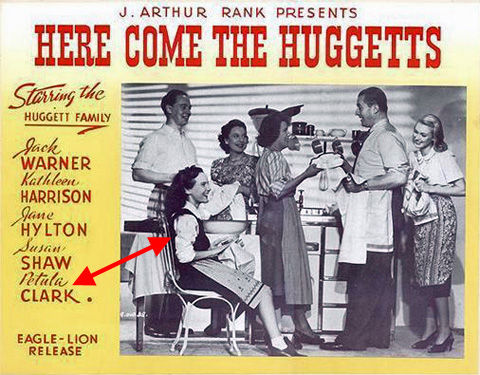
Poster for the 1948 film, “Here Come the Huggets”.
Copyright acknowledged.
Petula first appeared on television in the 1946 BBC variety show, Cabaret Cartoons. This led to her being signed to host her own afternoon series, titled simply Petula Clark. Pet’s Parlour followed in 1949 – she was still only 17. Alongside this, she was developing her recording career, enjoying considerable success though the 1950s, not least through Polygon Records (subsequently part of Pye Records) co-founded by her father.
A speculative 1957 concert at the Paris Olympia was received with acclaim. On the back of that, Petula signed with Vogue records, where she met her longtime publicist, collaborator and future husband, Claude Wolff. (They married in 1961 and had three children.) As well as continuing work in the UK, she developed a thriving career in mainland European, singing and recording in French, German, Italian and Spanish.
The 1964 international smash hit “Down Town” was a step change in Petula’s recording career and enabled her to establish a significant presence in the US. That year also saw her add another strand to her career by beginning to compose scores for a number of French films.
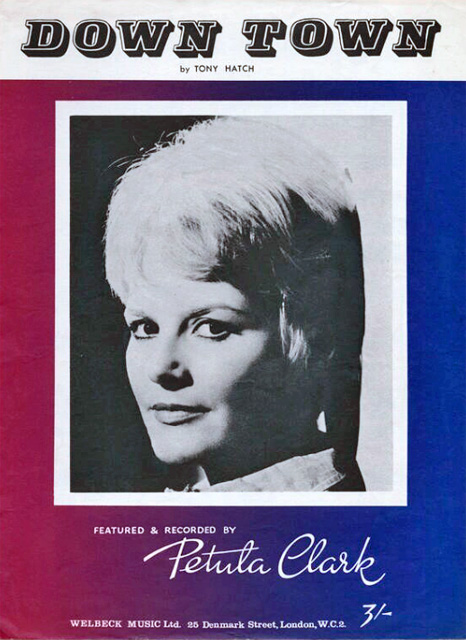
Cover of the sheet music for the 1964 hit “Down Town”.
From the writer’s collection.
After something of a lull, Petula’s film career revived in the late 1960s, particularly with starring roles in “Finian’s Rainbow” (for which she was nominated for a Golden Globe Award) and “Goodbye Mr Chips“.
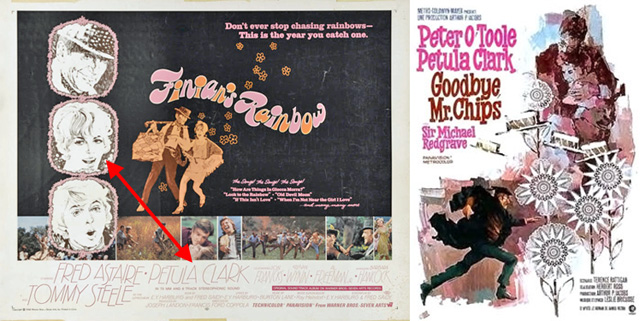
Posters for “Finian’s Rainbow” (1968) and “Goodbye Mr Chips” (1969).
Copyrights acknowledged.
Alongside recording and film work, Petula established a significant place in musical theatre, perhaps most notably as Norma Desmond in Lloyd-Webber’s “Sunset Boulevard”. (With over 2,500 performances, she has played the role more often than anyone else.)
In the 1998 New Years Honours, she was awarded the CBE for “services to entertainment”. At the investiture on 22 July 1998, the Queen is reported to have remarked that that she “had given so much pleasure over the years“. In 2018, Petula – Britains “biggest selling female singer” (she has sold nearly 70 million records) – was awarded a star (in the “recording” category) on the Hollywood “Walk of Fame”.

Part of the Hollywood “Walk of Fame”.
Photograph by Yuri Hasegawa, with thanks to www.discoverlosangeles.com
Petula’s remarkable career has spanned eight decades. As recently as 2019, she appeared in the London revival of the “Mary Poppins” stage musical.

Petula as the Bird Woman in the 2019 London production of “Mary Poppins”.
Copyright acknowledged.
Roger Morgan © 2020
Footnote
The RPMA (Royal Medico-Psychological Association) mentioned in Petula’s father’s entry in the 1939 Register oversaw what, in more modern terms, would be called “learning disability nurse training”. In 1951, the General Nursing Council of England and Wales assumed sole responsibility for such training.
The RPMA was set up in 1841 as the Association of Medical Officers of Asylums and Hospitals for the Insane. It changed its name in 1865 to the Medico-Psychological Association, receiving “Royal” status in 1926. In 1971, the RPMA was renamed the Royal College of Psychiatrists.