
PROFESSOR LAWRENCE STONE
From Lower Court Road to Princeton

Professor Lawrence Stone
Source not known
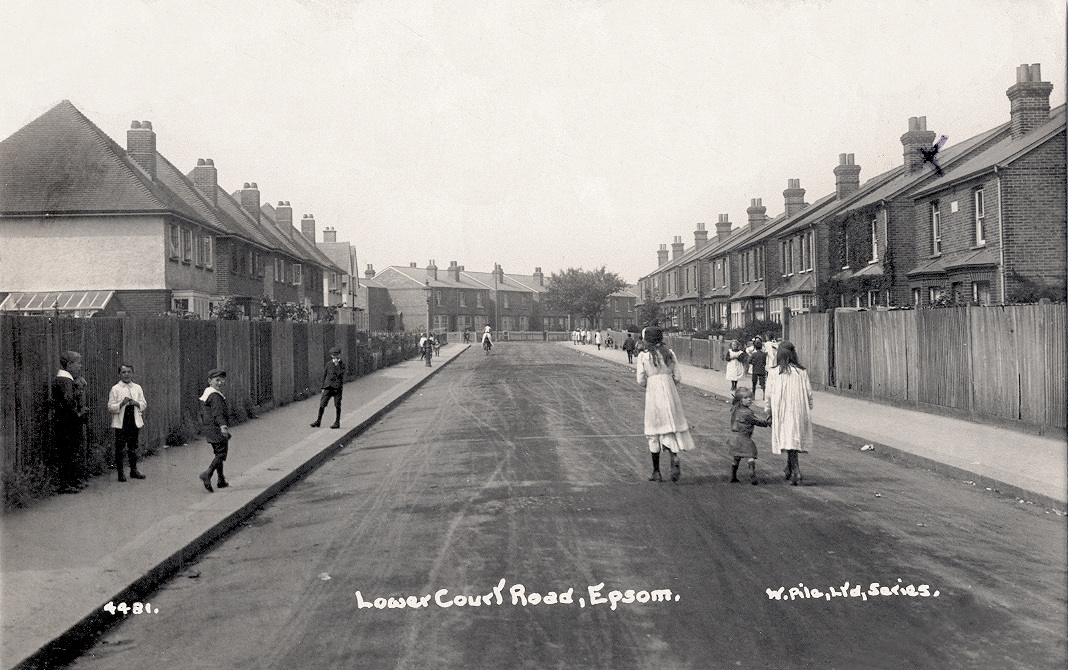
Lower Court Road, Epsom
Image courtesy of Bourne Hall Museum

Rainbow over Princeton Chapel
Photograph by Schizoform, via Flickr (CC BY 2.0)
Introduction
Lawrence Stone was suggested to me as a possible subject for an article. Having done some preliminary research, I feared that much of his work would be too dull/complex for what is intended to be an informative but easy-to-read website. However, he was born in Epsom and spent his early years in the town, so he deserves a page.
Family background
Lawrence’s parents were Lawrence Frederick and Mabel Julia Annie (née Read), both from Berkshire. Lawrence senior was a commercial artist in advertising, but he didn’t stick around for that long after his son’s birth on 4 December 1919 and apparently left the family home when Lawrence junior was a schoolboy. The family home was 3, Lower Court Road, Epsom. In the 1934 electoral register both Lawrence senior and Mabel were listed at an address in Leatherhead, but it’s doubtful that they both lived there. We know that Lawrence senior married someone else in 1938 and, still an artist, he was living in London with this new wife in the 1939 Register, Mabel being a housekeeper and matron at Godstowe Girls’ School in High Wycombe. We also know that Mabel died in 1978, and her erstwhile partner/husband (I can’t find any marriage record for the couple) died in the late 1950s or early 1960s. Having dealt with that, we’ll move on to Lawrence junior.
Education
Lawrence was a preparatory pupil at Downsend School, Leatherhead and went on to Charterhouse (obviously there was money in the family somewhere), where he was not keen on the study of classics. Then, Robert Birley was appointed headmaster and coached him in history, with a view to obtaining a history scholarship to Oxford. Birley was known for his interest in especially able pupils and often gave them personal tuition.
Lawrence duly got his scholarship and went up to Christ Church, Oxford in 1938, having spent a period at the Sorbonne in Paris beforehand. It seems that one must have a specialist subject within the curriculum and his was the Crusades, which would become a favourite subject later on. However, there was about to be a ‘here and now’ war and in 1940 he joined the Royal Naval Volunteer Reserve, serving as a lieutenant on destroyers. In the midst of all that he married, in 1943, Jeanne Cecilia Fawtier, who was the daughter of Professor Robert Fawtier, a French specialist in mediaeval history.
After leaving the Navy, Lawrence returned to Oxford to continue his studies and obtained a first in 1946; he then landed a research studentship to study politics, finance and corruption in the Elizabethan state, which must be when he acquired the material for a book he later wrote on the Elizabethan shipping magnate, financier and spymaster, Sir Horatio Palavacino. Subsequently he became a fellow of Wadham College, Oxford.
Work and diversification
In 1946 Nikolaus Pevsner had commissioned a book from Lawrence, persuaded by Thomas Kendrick, with whom Lawrence had spent a couple of pre-war summer vacations on Anglo-Saxon sculpture expeditions. His role was in the photographic team, but nevertheless Pevsner took a punt and in 1955 Lawrence produced ‘Sculpture in Britain: the Middle Ages’. (Not being a historian, I would have put the Middle Ages towards the end of the long period it actually covered, which was roughly from the fall of the Roman Empire to the 15th Century.)
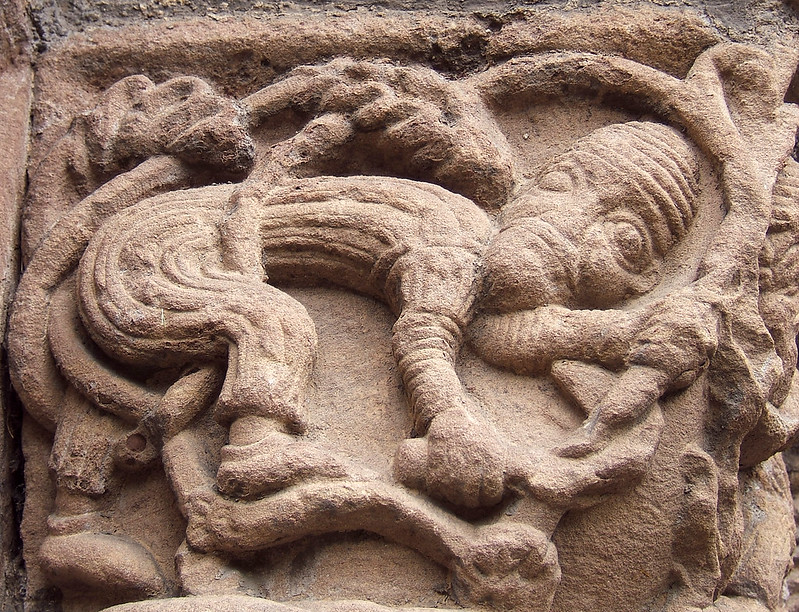
Medieval Man With Sickle Sculpture
Photograph by Cross Duck, via Flickr (CC BY-NC-ND 2.0)
It seems to be quite normal for academics to argue over conclusions drawn from historical facts and Stone and his contemporaries were no exception. When Stone published an article claiming that the Elizabethan aristocracy had been on the brink of financial ruin, the eminent historian Hugh Trevor-Roper took issue with him. Trevor-Roper said that Stone hadn’t understood the source documents and there ensued a public and acrimonious dispute, which also involved another leading historian, the socialist R H Tawney, who had been Stone’s mentor. In a nutshell, Trevor-Roper was right and Stone was determined to repair his reputation.
The result was ‘Crisis of the Aristocracy’ in 1965: this was on the same theme as the controversial article, but he qualified his previous arguments and backed them up with stacks of evidence.
Princeton
Another Epsom man, Ellis Kirkham Waterhouse, had spent time at Princeton many years before: it was and is a revered university, not just in the United States but worldwide. Stone had something in common with Waterhouse – frustration at the rigidity of venerable institutions and the infighting – and the former was becoming increasingly fed up with the inflexibility of the Oxford history syllabus. In 1960-61 he spent a period at the Institute of Advanced Studies (IAS) at Princeton and must have seen his way forward at that point.
The IAS School of Historical Studies was formed in 1949 as an amalgamation of the School of Economics and Politics and the School of Humanistic Studies. As its website says: ‘It bears no resemblance to a traditional academic history department, but rather supports all learning for which historical methods are appropriate.’ Additionally, it does not have a set view on any subject and encourages cross-fertilisation of ideas.
One of the most renowned affiliates of the IAS was Albert Einstein, so it’s appropriate that the street on which the Institute is located is called Einstein Drive.
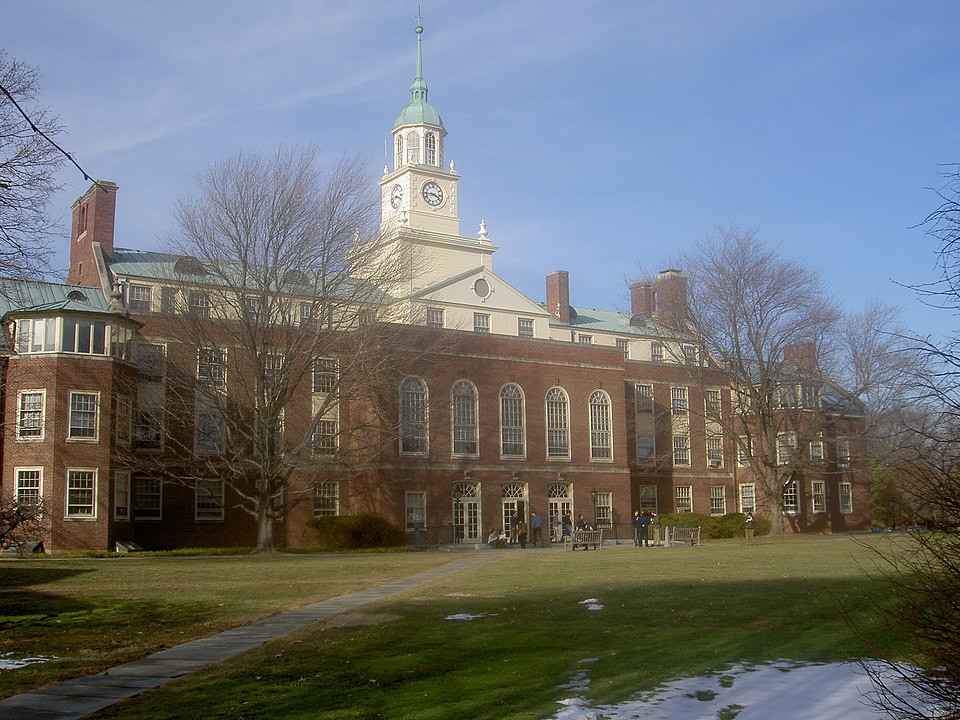
Institute of Advanced Studies, Princeton, New Jersey
Image source: Wikimedia Commons
In 1963 Lawrence was offered the Dodge professorship at Princeton and he accepted eagerly. From then on it was onwards and upwards and, because of a huge donation to the History Department, he was able to establish the Shelby Cullom Davis Center; he became its first Director in 1968. If you look at the website of the Davis Center, it has a wide-ranging and forward-looking approach to history and the role of Lawrence Stone is recognised by the Visiting Stone Fellowship and the Stone Prizes. Although Stone was challenging and combative and not always right, as he had been in England, his reputation and that of the Princeton History Department grew considerably.
He continued to publish provocative works, which dealt with topics such as the development of marriage and divorce over time. Apparently, his graduate students at Prince nicknamed him ‘Lorenzo il Magnifico’ (after Lorenzo de’ Medici, also known as Lorenzo the Magnificent).
On a personal note, there’s a lot to be said for a teacher with plenty of character and an innovative approach, as opposed to a dull as ditch water academic. It doesn’t necessarily mean you pass the exam, but at least you’re stimulated and entertained on the journey.
Decline
Work and an energetic lifestyle took their toll on Lawrence and he suffered a heart attack in 1973, but even then he called for reference documents and paper so that he could work from hospital. His wife, Jeanne, was very supportive, although they often disagreed on a range of matters. He retired from his Princeton appointments in 1990 but was still around in the History Department. He died from a cardiac arrest on 16 June 1999, followed by Jeanne in 2001. There were two children.
Linda Jackson 2020
Main Sources
- Oxford Dictionary of National Biography
- Various Wikipedia articles