
Empire Day
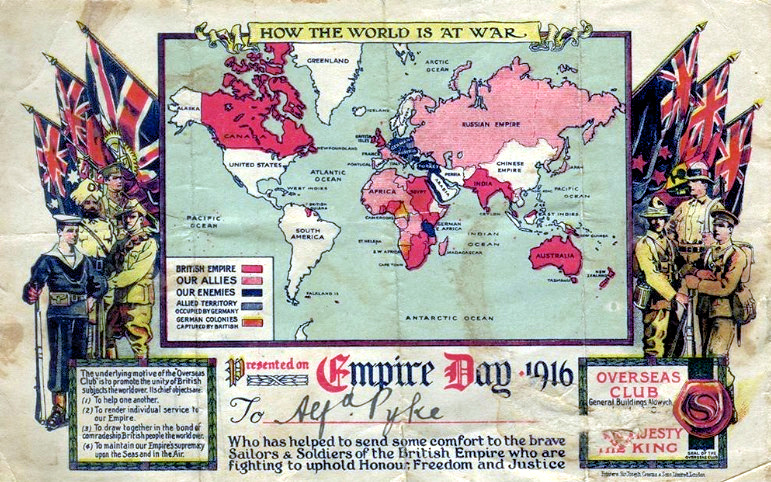
A WW1 certificate for children who “sent some comfort to the the brave Sailors & Soldiers of the British Empire”.
Image courtesy of Jon Pyke ©2019
After the death of Queen Victoria on 22 January 1901, her birthday, 24 May, was celebrated from 24 May 1902 as Empire Day but only officially recognised as an annual event in 1916. The concept was to encourage unity amongst the people of the Commonwealth; to have common ideals of freedom, justice, and tolerance. Empire Day became a major event, involving, among other things, school parades and the BBC.
The idea of a day that would “remind children that they formed part of the British Empire, and that they might think with others in lands across the sea, what it meant to be sons and daughters of such a glorious Empire”; and which apprised them that “The strength of the Empire depended upon them, and they must never forget it” was conceived earlier, in 1897.
Interest in Empire Day declined and in 1958 it became known as British Commonwealth Day, later just Commonwealth Day. In 1966 the date was altered to 10th June (the official birthday of the HM Queen Elizabeth II).
The British Film Institute have a video clip of London school children celebrating Empire Day in 1916.