
Local men who died during the Third Battle of Ypres
31 July to 10 November 1917
Also known as the Battle of Passchendaele.
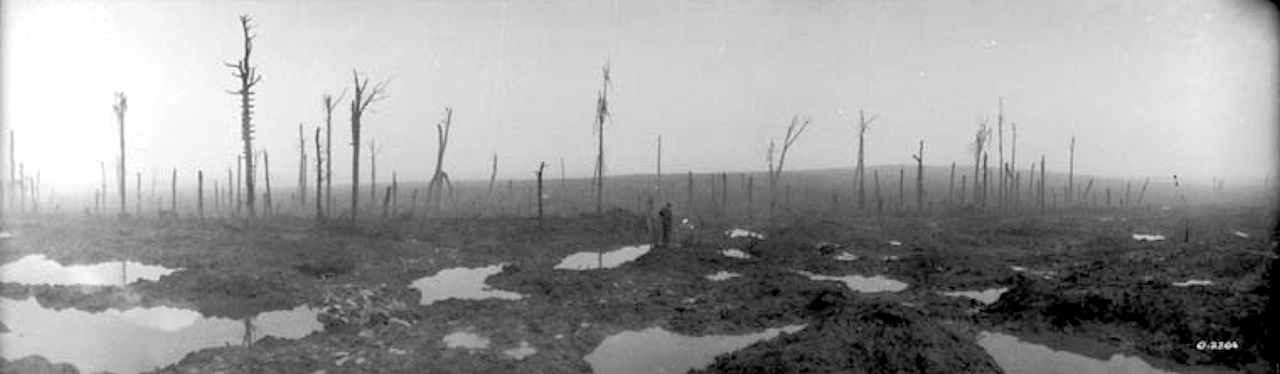
“Passchendaele, now a field of mud.” November, 1917.
Image Source Libraries and Archives Canada
Background
Ypres occupied a strategic position during the First World War because it stood in the path of Germany’s planned sweep across the rest of Belgium and into France from the north (the Schlieffen Plan). The neutrality of Belgium was guaranteed by Britain; Germany’s invasion of Belgium brought the British Empire into the war. The German army surrounded the city on three sides, bombarding it throughout much of the war. To counterattack, British, French, and allied forces made costly advances from the Ypres Salient into the German lines on the surrounding hills.
In the First Battle of Ypres (19 October to 22 November 1914), the Allies captured the town from the Germans. The Germans had used tear gas at the Battle of Bolimov on 3 January 1915. Their use of poison gas for the first time on 22 April 1915 marked the beginning of the Second Battle of Ypres, which continued until 25 May 1915. They captured high ground east of the town. The first gas attack occurred against Canadian, British, and French soldiers, including both metropolitan French soldiers as well as Senegalese and Algerian tirailleurs (light infantry) from French Africa. The gas used was chlorine. Mustard gas, also called Yperite from the name of this town, was also used for the first time near Ypres, in the autumn of 1917.
Of the battles, the largest, best-known, and most costly in human suffering was the Third Battle of Ypres (31 July to 10 November 1917, also known as the Battle of Passchendaele), in which the British, Canadian, ANZAC, and French forces recaptured the Passchendaele Ridge east of the city at a terrible cost of lives. After months of fighting, this battle resulted in nearly half a million casualties to all sides, and only a few miles of ground won by Allied forces. During the course of the war the town was all but obliterated by the artillery fire.
English-speaking soldiers in that war often referred to Ieper/Ypres by the deliberate mispronunciation Wipers. British soldiers even published a wartime newspaper called the Wipers Times. The same style of deliberate mispronunciation was applied to other Flemish place names in the Ypres area for the benefit of British troops, such as Whyteshaete becoming White Sheet and Ploegsteert becoming Plug Street.
Ypres was one of the sites that hosted an unofficial Christmas Truce in 1914 between German and British soldiers.
During World War Two, the British Expeditionary Force (B.E.F.) would fight the Germans in a delaying action at the Ypres-Comines Canal, one of the actions that allowed the Allied retreat to Dunkirk.
Text source: Wikipedia
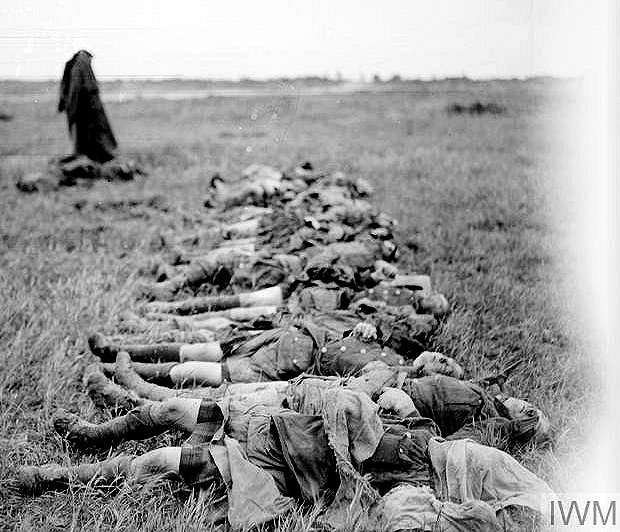
Dead soldiers of one of the Highlanders regiments awaiting burial, August 1917.
© IWM (Q 7814)
Local casualties of the “Battle of Passchendaele”
| Click on a surname to read about the individual | ||||||||
| Surname | Name | Rank | Number | Age | Date | Theatre | Where Commemorated | Unit |
| Ayling | William | Pte | 1967 | 26 | 1917-09-22 | Ypres 3 | Tyne Cot | RF 32 124B 41D |
| Benger | William Joseph MM | Sgt | 88288 | 22 | 1917-10-17 | Ypres 3 | Arras Mem | RFC 20 Sqd |
| Bennett | Arthur Ernest | L/Cpl | 22667 | 36 | 1917-08-05 | Ypres 3 | Menin Gate | ES 12 |
| Bowler | Henry John | Pte | 534416 | 32 | 1917-10-30 | Ypres 3 | Tyne Cot P152 | LR2/6 |
| Brook | Frederick Charles | Pte | 40872 | 36 | 1917-08-16 | Ypres 3 | Tyne Cot | RDub F 8 48B 16D |
| Budd | George Henry Warner | Pte | 27279 | 41 | 1917-08-22 | Ypres 3 | Tyne Cot | PASLI 6 43B 14D |
| Channell | Walter Henry | Sgt | 57173 | 34 | 1917-08-06 | Ypres 3 | Estaires Com Cem Ex | MGC 173 |
| Choney | Albert Walter MM | Sgt | S/505 | 28 | 1917-10-26 | Ypres 3 | Tyne Cot | WS 02 |
| Coller | Thomas George | Pte | G/40024 | 21 | 1917-09-21 | Ypres 3 | Ypres Reservoir | WS 11 |
| Deane | Arthur Francis | 2/Lt | 27 | 1917-08-16 | Ypres 3 | Bedford House Enc. No 4 IV G 3 | MGC 167 | |
| Dulake | David Henry | Pte | 242015 | 19 | 1917-09-04 | Ypres 3 | Tyne Cot | Gloucester 2/5 |
| Dunn | William Walter | Rfl | S/5282 | 28 | 1917-08-16 | Ypres 3 | Tyne Cot | RB 2 |
| Gabriel | Stewart Arkcoll | Gnr | 139088 | 39 | 1917-08-21 | Ypres 3 | Dozinghem | RGA 76 Seige Bty |
| Gaunt | George | Pte | 46653 | 36 | 1917-10-23 | Ypres 3 | Ypres Reservoir | Leics 11 6D Pion |
| Harris | Walter Stuart | Pte | 67823 | 19 | 1917-09-24 | Ypres 3 | Tyne Cot | MGC (Inf) 233 Coy |
| Harrison | Charles Hibbert | Lt | 1917-07-31 | Ypres 3 | Talana Farm | RFA | ||
| Johnson | Ernest Ralph | Sgt | R/277 | 24 | 1917-10-15 | Ypres 3 | Lijssenthoek | KRRC 7 |
| Macfarland | George Adams | Capt | 44 | 1917-10-17 | Ypres 3 | East Finchley Cem | RAMC | |
| Marson | John | Rfl | B/200764 | 28 | 1917-10-12 | Ypres 3 | Poelcapelle | RB 1 Formerly ASC |
| Moorcroft | Frederick John | AM 1st Cl | 13076 | 20 | 1917-08-03 | Ypres 3 | Maple Leaf | RFC 42 Squadron |
| Norrington | Raymond | Rfl | 551657 | 20 | 1917-08-16 | Ypres 3 | Menin Gate | LR 1/16 |
| Palmer | Thomas | L/Cpl | G/75082 | 35 | 1917-10-09 | Ypres 3 | Cement House | Middx 16 |
| Payne | Ernest Victor | Gnr | 27708 | 25 | 1917-09-12 | Ypres 3 | Artillery Wood | RGA 152 Siege Battery |
| Penfold | George | Gnr | 67048 | 34 | 1917-08-04 | Ypres 3 | Belgian Battery Corner | RGA 122 Heavy Bty |
| Rounce | Ernest Robert | Gnr | 36564 | 20 | 1917-08-23 | Ypres 3 | Hospital Farm | RFA C Bty 786 Bde |
| Shrubb | Oliver John | Pte | 40281 | 19 | 1917-08-03 | Ypres 3 | Dozinghem | SWB 10 |
| Smith | Leonard Cecil | Sgt | 231250 | 21 | 1917-10-26 | Ypres 3 | Tyne Cot Mem | LR 2/2 |
| Smith | Percy Robert | Pte | 50984 | 19 | 1917-07-31 | Ypres 3 | Menin Gate | Manchester 18 |
| Steward | Arthur Amyot | Lt | 35 | 1917-10-06 | Ypres 3 | Dunhallow ADS Cemetery | RFC 11 Balloon Company | |
| Stredwick | Ernest Henry | Pte | 2190 | 30 | 1917-10-12 | Ypres 3 | Tyne Cot Mem | ES 8 |
| Taylor | Harry | Gnr | 10589 | 29 | 1917-10-05 | Ypres 3 | Vlamertinghe New | Aus RFA |
| Tresize | Oliver | Pte | 4573 | 22 | 1917-11-05 | Ypres 3 | Lijssenthoek | Aus 03 |
| Turner | Harcourt Charles | Lt | 32 | 1917-08-23 | Ypres 3 | Tyne Cot | DCLI 6 | |
| Warr | Thomas E | 2/Lt | 20 | 1917-10-14 | Ypres 3 | Boulogne East | Dorset 6 50B 17D | |
| Wheeler | Ernest John | Pte | 15368 | 29 | 1917-10-06 | Ypres 3 | Tyne Cot Mem | Devon 9 |
| Whelan | Stephen Ewart | Pte | 6279 | 30 | 1917-07-31 | Ypres 3 | Menin Gate | Northants 7 |
| White | Arthur | Pte | 295303 | 22 | 1917-10-26 | Ypres 3 | SW649 York Pl Mil Hosp Brighton | LR 4 |
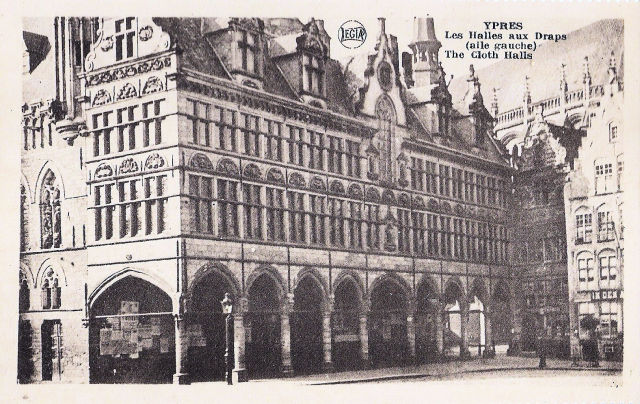

Postcard views of Ypres’ Cloth Halls before and after the war.
Images courtesy of Eileen Hunter
Between 1933 and 1967, Ypres’ “Cloth Halls” were meticulously reconstructed to their pre-WW1 condition. At 125 metres (410 ft) in breadth, with a 70 metres (230 ft)-high belfry tower, the building recalls the importance and wealth of the medieval trade city – and now houses the “In Flanders Fields” museum.