
THE CIRCUS COMES TO TOWN
 Extract from Barnums Greatest Show on Earth Poster
Introduction
Once upon a time, going to the circus was a big treat. I remember being taken to the Bertram Mills circus at London Olympia one Christmas. I suppose I would have been around eight at the time and remember nothing much about it, except gazing up in trepidation at the trapeze performers far above me, and I’m almost sure it featured Coco the Clown, (Nicolai Poliakoff OBE) who was the most famous clown in Britain for many years. The Mills show was a classy operation as such things go. I don’t think I ever saw a circus again – probably because we got a television set, which was something of a death knell for the big top.
Imagine the excitement then, well over a hundred years ago, when there was no television and a travelling circus came to town.
Sangers Circus
We have written and photographic evidence of Sangers Circus coming to Epsom & Ewell, but before we get to that here’s a great picture of people lining the streets of Beverley, Yorkshire in 1901 as the animals lumbered into town.
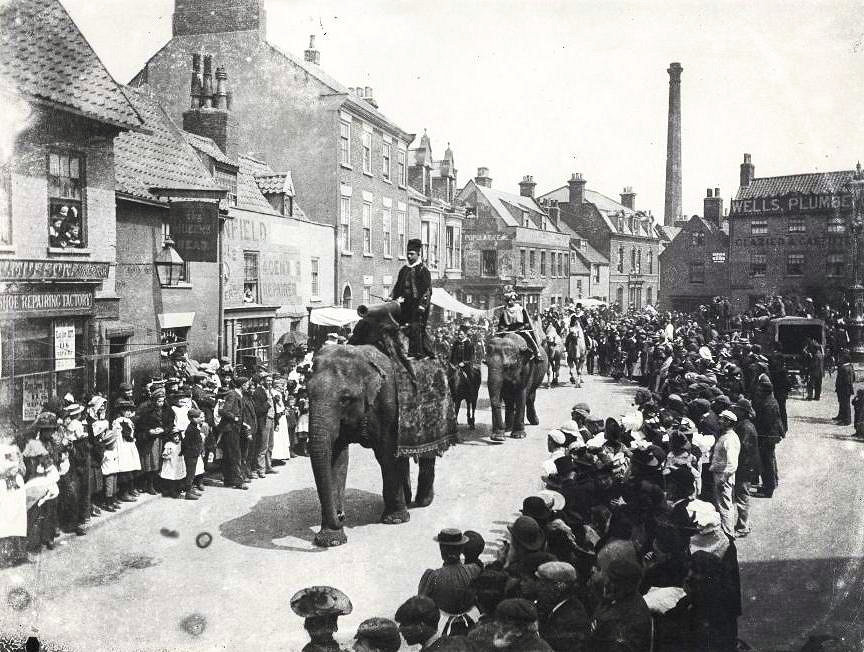 Sanger’s Circus, Wednesday Market, Beverley 1901
Source: East Riding Archive ref DDPD-2-1-32 via flickr
In one of our articles on Pound Lane School the following entry was quoted from the Girls’ School Log Book for 19 September 1907.
‘Owing to a visit of Sangers’ Circus, School opened at 1.30 and Registers closed at 3.30. This, it was thought, would prevent children staying away to attend the afternoon performance at 3.45 pm.’
And this is from the Boys’ School Log Book for the same day.
‘19 Sept 1907- the attendance this week so far has been very good indeed. This afternoon the attendance dropped from 227 to 184, owing to the presence of a circus in the town. To minimise the effects of this, school was held from 1.30 to 3.30’
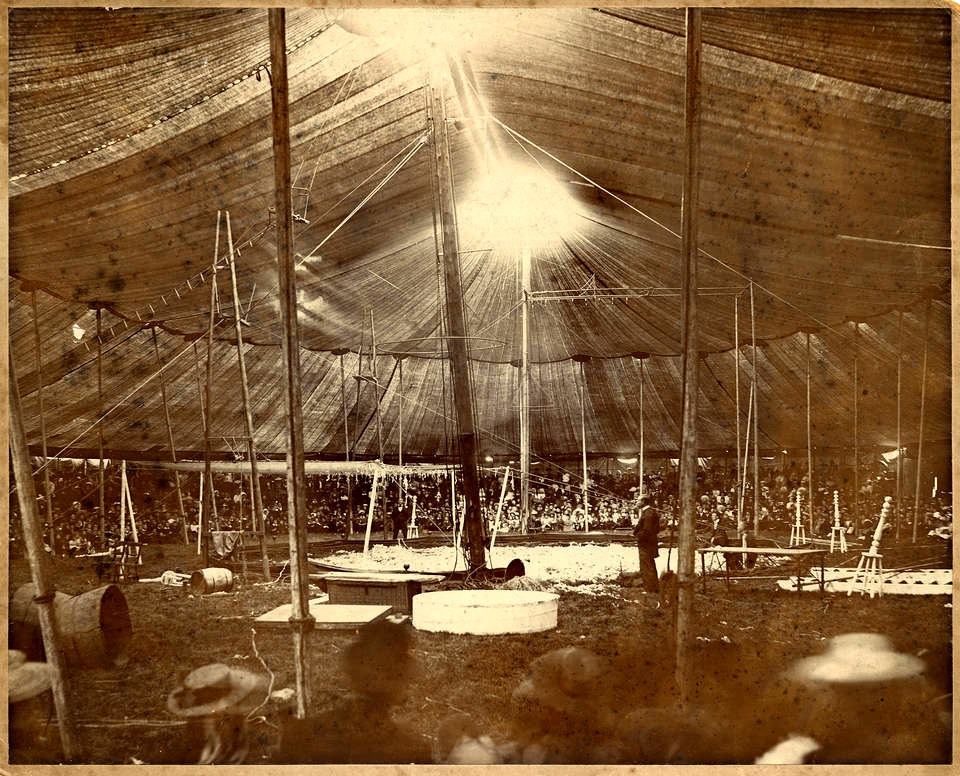 Interior of the tent at Sanger’s Circus (late 19th century)
Photograph by A.M. Bliss & Co., , Britain. Museum no. S.114-2018.
© Victoria and Albert Museum, London
We also have the charming Reminiscences of George W Challis to verify the facts.
‘Another exciting day was when a circus came to Epsom; Lord George Sangers was no doubt the best. It was held in a field just behind the boys’ school in East Street. Crowds used to flock into the town at midday to watch the procession parading in the High Street. I can only guess at the number of horses, but I do remember there were 2 huge coaches each drawn by 40 horses – Lord George Sanger riding in a very old stage coach at the rear, of course. School was out of the question in the afternoon so we would not miss this treat.
I did not think at this time that I should ever perform in a circus but I did in the year 1900 and this is how it came about. Epsom East Street Football Club, being the only club in town, received a letter from the agent of Sangers Circus asking if one of its players would take part in a football competition against one of their elephants when they visited the town. I jokingly said you can send my name in, which the secretary did. Soon my name was billed all over the town in foot high letters. I did not bargain for this and I was subjected to a good deal of leg pulling and incidentally, when my young lady heard what I had done, she was very much put out. Anyhow I would not back out of my agreement and when the great night arrived I was accompanied by all of our club members.
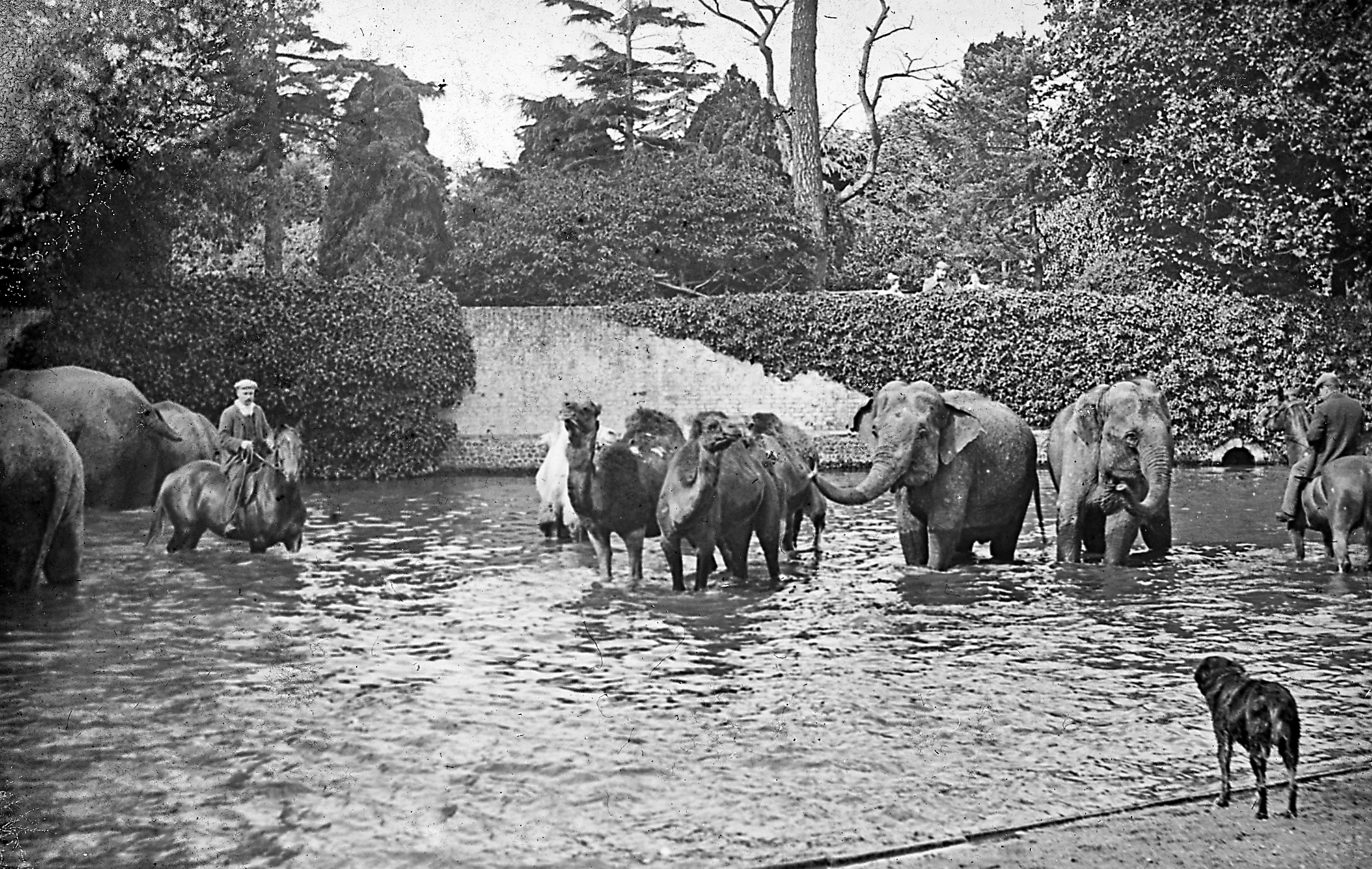 Elephants and camels in the Chessington Road Horse Pond c1900
Image courtesy of Epsom & Ewell Local And Family History Centre
Just previous to my turn, a football match was played between the clowns and elephants. It was a rough and tumble game and the elephants picked up clowns, shook and trod on them. Imagine my feelings when I went into the ring after this. The Ringmaster then made his announcement mentioning my name as being willing to play against the elephant. We were to have 5 kicks at each other’s goal. The elephant won the toss and kicked first, and could he kick – the goal was about 2 feet high. He knocked my goal down with one go and with another kick the ball caught me square in the middle, the top of the ball caught my nose making me see stars. Now came my turn – the goals were not very big and the big fellow kept rolling about and there did not seem much room to get a ball through. However, I did manage to get one past him as he rolled onto one side. The Ringmaster then announced the elephant had not been beaten for 2 years and presented me with a silver cup.’
Note: The footballing elephants were actually the brainchild of ‘Lord’ John Sanger (neither George nor John Sanger was a real lord). The two men were brothers but John broke away from George and established his own travelling circus. John died in 1889 and his son, also John, carried on in the business. There are many tales of deceased circus elephants having been buried in various UK locations and several reported instances of serious issues. For example, in 1905 one of the animals became uncontrollable and was shot dead by a yeoman in Bakewell.
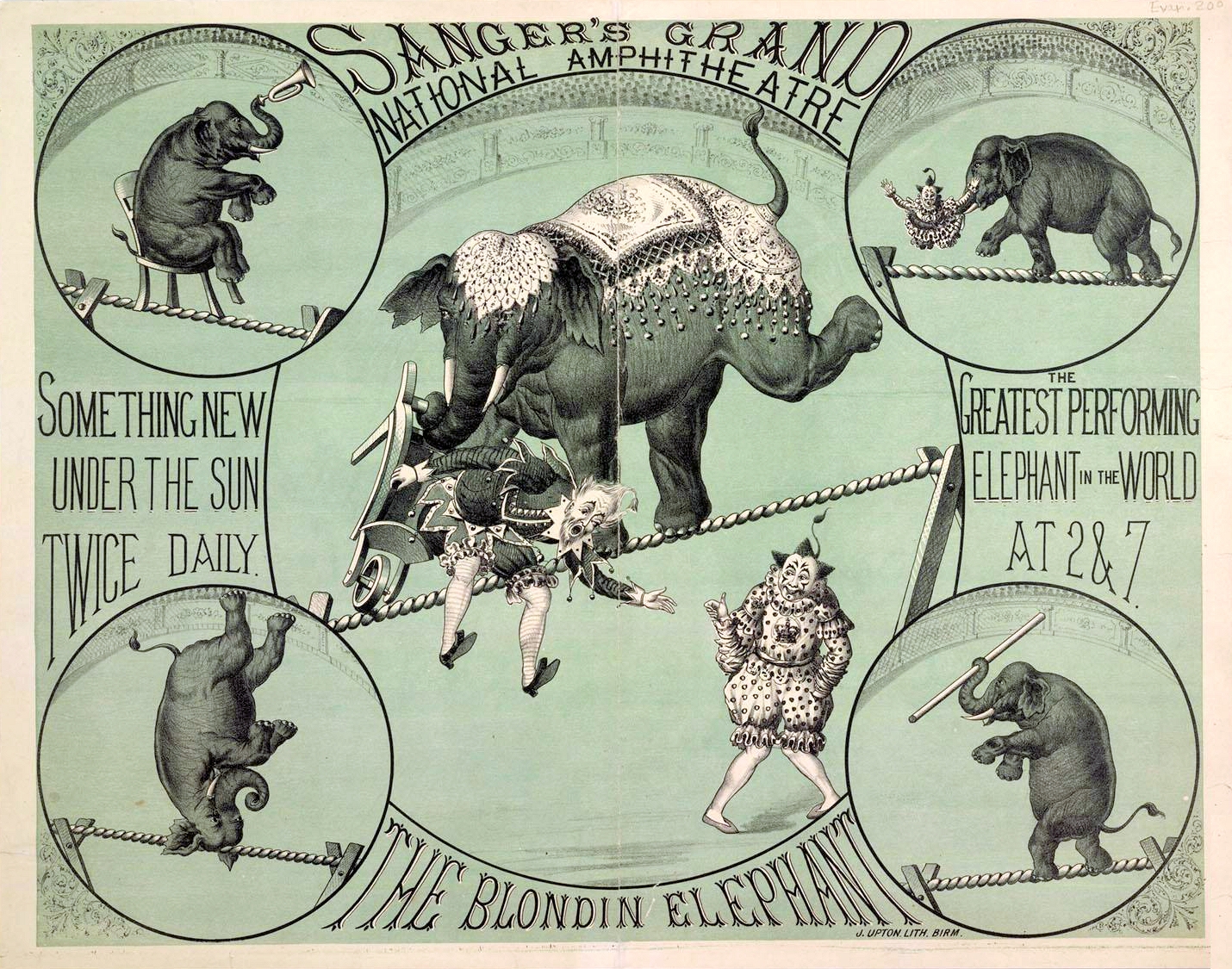 Poster advertising performing elephants at George Sanger’s Grand
National Amphitheatre c.1881 Image source: British Library (public domain)
Developments
The use of wild animals in circuses has now been outlawed, but the practice was already dwindling a long time ago. Just the logistics of moving a travelling circus containing wild animals must have become increasingly challenging as areas became more built-up and motor traffic increased. The Chipperfield family, for example, diversified into safari parks, both in the UK and overseas. It’s remarkable that this circus dynasty began in 1684 when a James Chipperfield showed his performing animals at the Thames Frost Fair. That winter the Thames was frozen solid, allegedly to a depth of about 1 foot, for two months. Here’s a painting of the Fair of 1683/1684, although, offhand, I can’t see any performing animals.
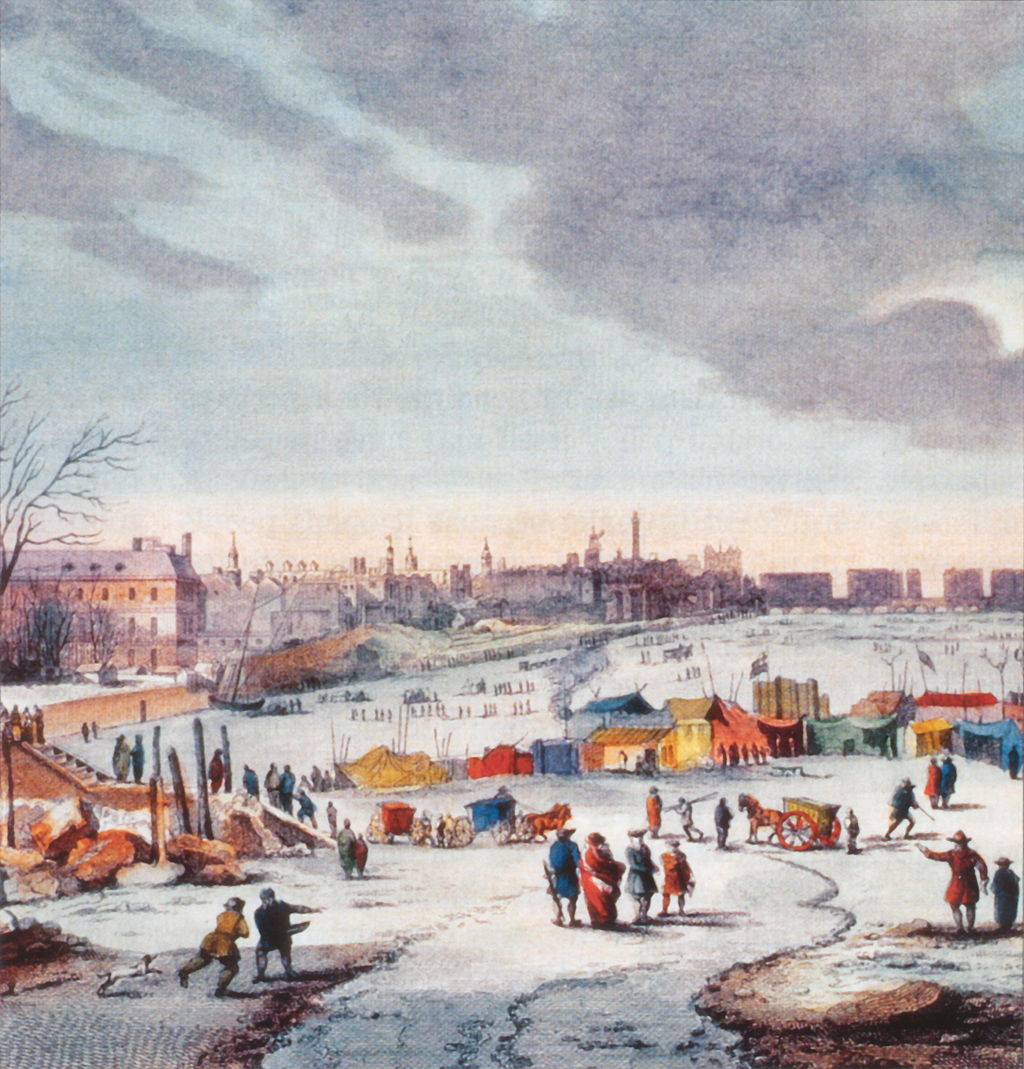 Frost Fair on the River Thames, near the Temple Stairs, 1683/4, by Thomas Wyke
Image source: Wikipedia
The most recent incarnation of the Chipperfield enterprise is the Charles Chipperfield circus, which seems to be still in operation, and it also hires out equipment/marquees for weddings/events or will put on a performance to your requirements.
You can tell from the Chipperfield story that circus entertainment has had to adapt to survive and many of the household name businesses haven’t survived. Gerry Cottle, now deceased, was another well-known name in the business and, as well as having his own circuses, he presented the Moscow and Chinese State Circuses in Britain. Latterly he owned and ran the Wookey Hole Caves and co-founded The Circus of Horrors, which is not what you might call traditional family entertainment, but it is something different in the circus genre (think ‘Rocky Horror Show’ with a lot of knobs on).
The show ‘Bacchanal’, presented by The Circus of Horrors, Madrid, September 2021
Here are some photographs from the Bourne Hall Museum collection (dates not known).
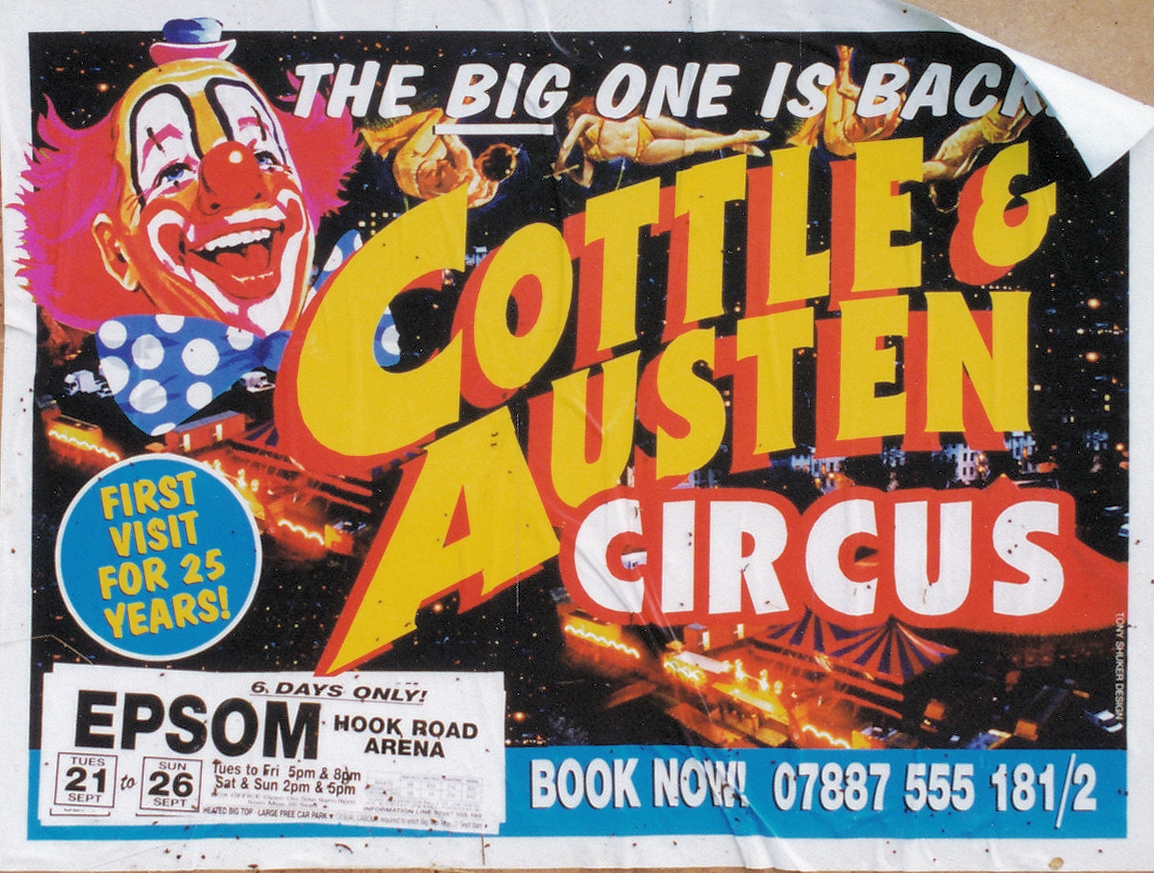 Poster advertising the Cottle & Austen circus at Epsom’s Hook Road arena
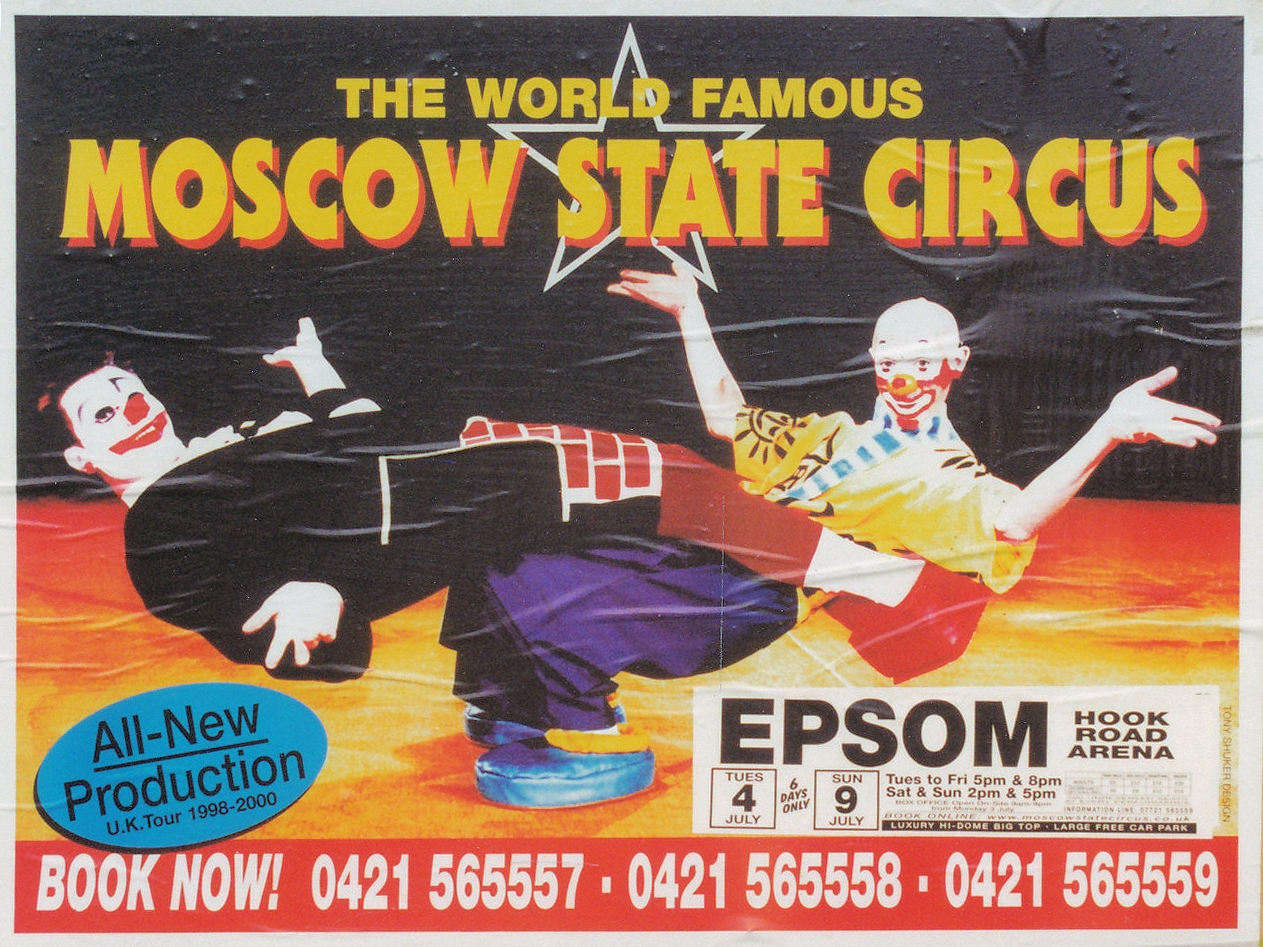 Poster advertising the Moscow State Circus at Hook Road arena
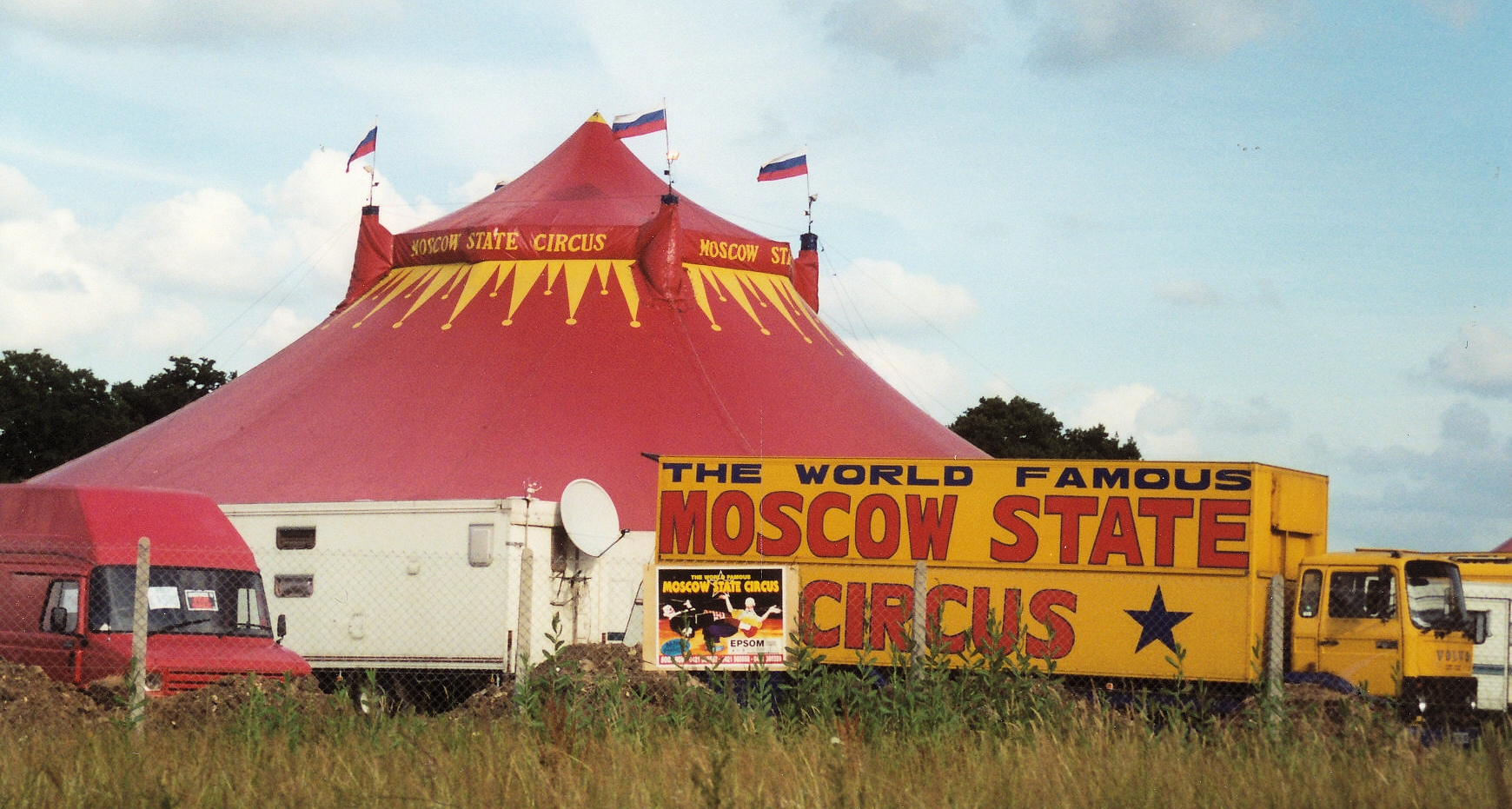 The Moscow State Circus at Hook Road arena
The circus has changed markedly, and is now often a big theatrical extravaganza incorporating circus and dancing skills. I suppose the paying punters would be reluctant these days to turn out for Coco the Clown and routine acrobats, exciting though they may have been back in the day, but the disappearance of wild animal acts is a major plus for animalkind. However, there are still some traditional-style shows, such as the Blackpool Tower Circus, and, if that doesn’t float your boat, there are big spectaculars around, Cirque du Soleil probably being the most famous and popular of these.
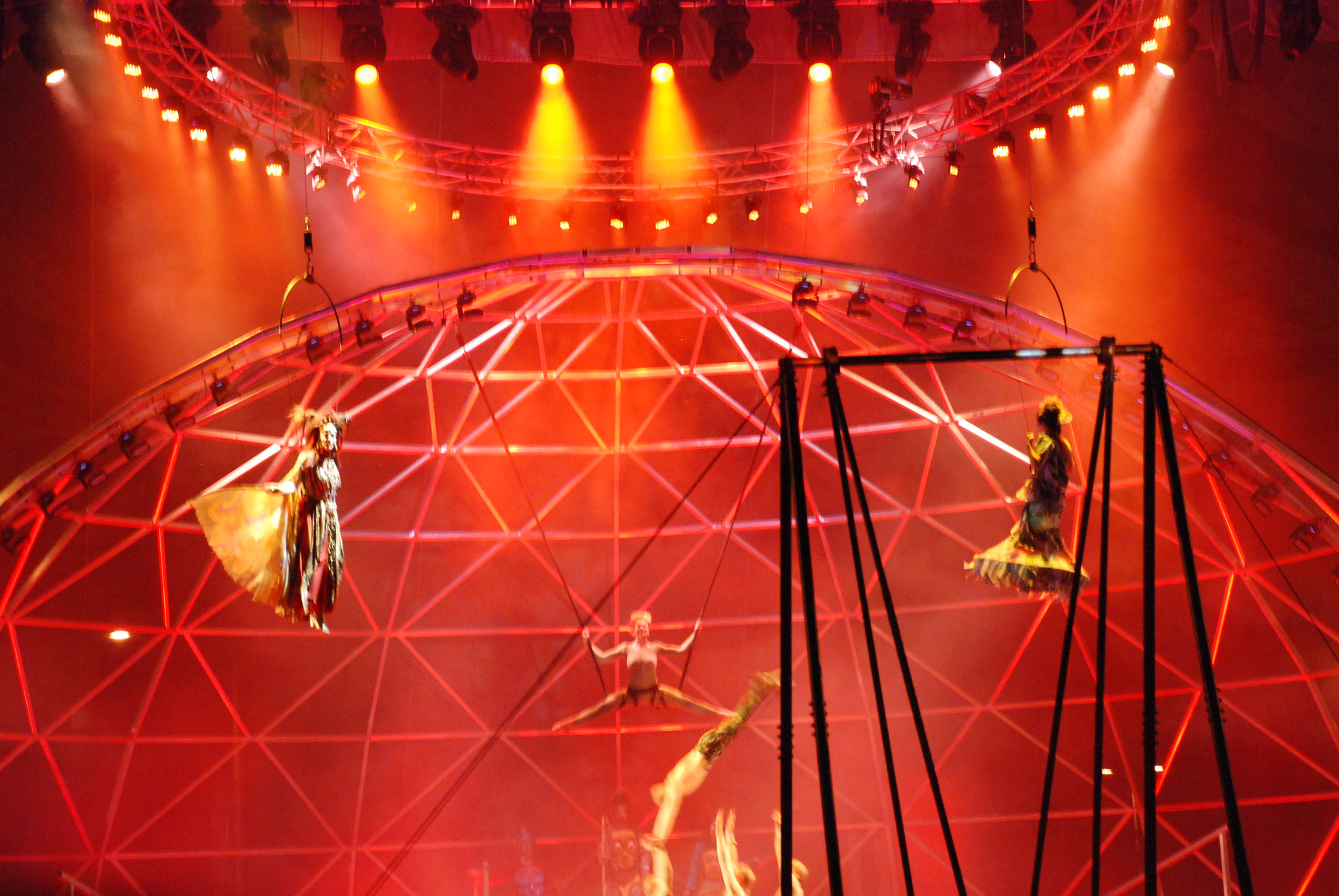 Cirque du Soleil, 2009
Photo by Erwin L’HER via flickr
Dress rehearsal for the Cirque du Soleil show
‘Amaluna’ at the Trafford Centre, Manchester, 2016
Linda Jackson April 2022