
THE DOUBLE RAILWAY FATALITY.
 Detail from the headstone of The Williams Family in Epsom Cemetery
Image courtesy of Clive Gilbert © 2022
While walking in Epsom Cemetery our Great War researcher Clive Gilbert noticed the above inscription on grave A244A and was intrigued enough to research the incident. Clive found this newspaper report in The West Surrey Times of 28 September 1905:
Danger of Crossing the Line.—-Jury’s Recommendation.
The inquest on Capt. John Randall, of the 28th (Indian) Light Cavalry, and William Williams, postman, of Epsom, was held by Mr. Gilbert White, the deputy coroner, at the Railway Inn, Epsom, on Friday. Mr. W. Dorset was foreman of the jury; Mr. F. St. Lawrence appeared for the L.B. and S.C. Railway Co., and Mr. Forrest represented the Post Office.
Colonel William Lowndes Randall, 6, Egertom Mansions, S.W., identified the body of Capt. Randall as that of his son. He was residing at The Chalet, Epsom, and was 36 years of age. He was a captain in the Indian Army and was home on leave. — Mrs. Elizabeth Williams, 30, Victoria Place, Epsom, said deceased William Williams was her son. He was a postman, and was 22 years of age.
Harry Holbrook, of New Cross, engine driver, said on Wednesday he was driving the 10.25 a.m. express train from London Bridge to Portsmouth Harbour. The train came into Epsom at 10.55, two minutes late. The signals were all off, and the line was clear as the train approached the station. When he got in sight of the station—about 30 yards away—he saw two men standing on the ballast at the edge of the down platform. Williams was putting a bag over his shoulders, and both were moving across the line. He had sounded the whistle on approaching the station, and when he saw the men he whistled again and applied the brake. A train was standing at the up platform, and that impeded his view. After he applied the brake he saw no more of the men, and he was not certain that the engine had knocked them down until the train stopped at the end of the platform. He then examined the engine, and found the left leading bogey wheel splashed with blood. On the right side of the engine the lamp was battered and the bull’s eye knocked down, and the steam sand pipe underneath broken. He did not go back. The train was going from 25 to 30 miles per hour.
By the Coroner: The train ran daily, and Williams should have known that it was due.—By a juror: Williams and Capt. Randall were standing still on the line when he first saw them. They were facing down the platform, and Williams was lifting a bag on to his back.
Ernest Andrews, fireman of the express train said he only saw Capt. Randall standing on the line. He was taking something off the platform.
Thomas Bines, 2, Railway Cottages, East Street, Epsom, signalman, at the town signal box, said as the up train was approaching the station he saw Capt. Randall and Williams standing on the edge of the down platform. He saw them both jump on to the line together. The express had just passed the box, and almost as soon as they commenced to move off the ballast the engine struck them. It looked as if they were waiting for the up-train to pull up so that they could cross the line. He went to his window and shouted out to the stationmaster that two men had been run over. He heard the express sound its whistle twice.
John Symonds, of Sutton, point oiler, said he was at the station at the time of the accident. He saw Capt. Randall rest his portmanteau on the down platform and jump on to the ballast. He did not see the postman. He afterwards helped to pick him up. Death must have been instantaneous. They were both lying in the four-foot way.
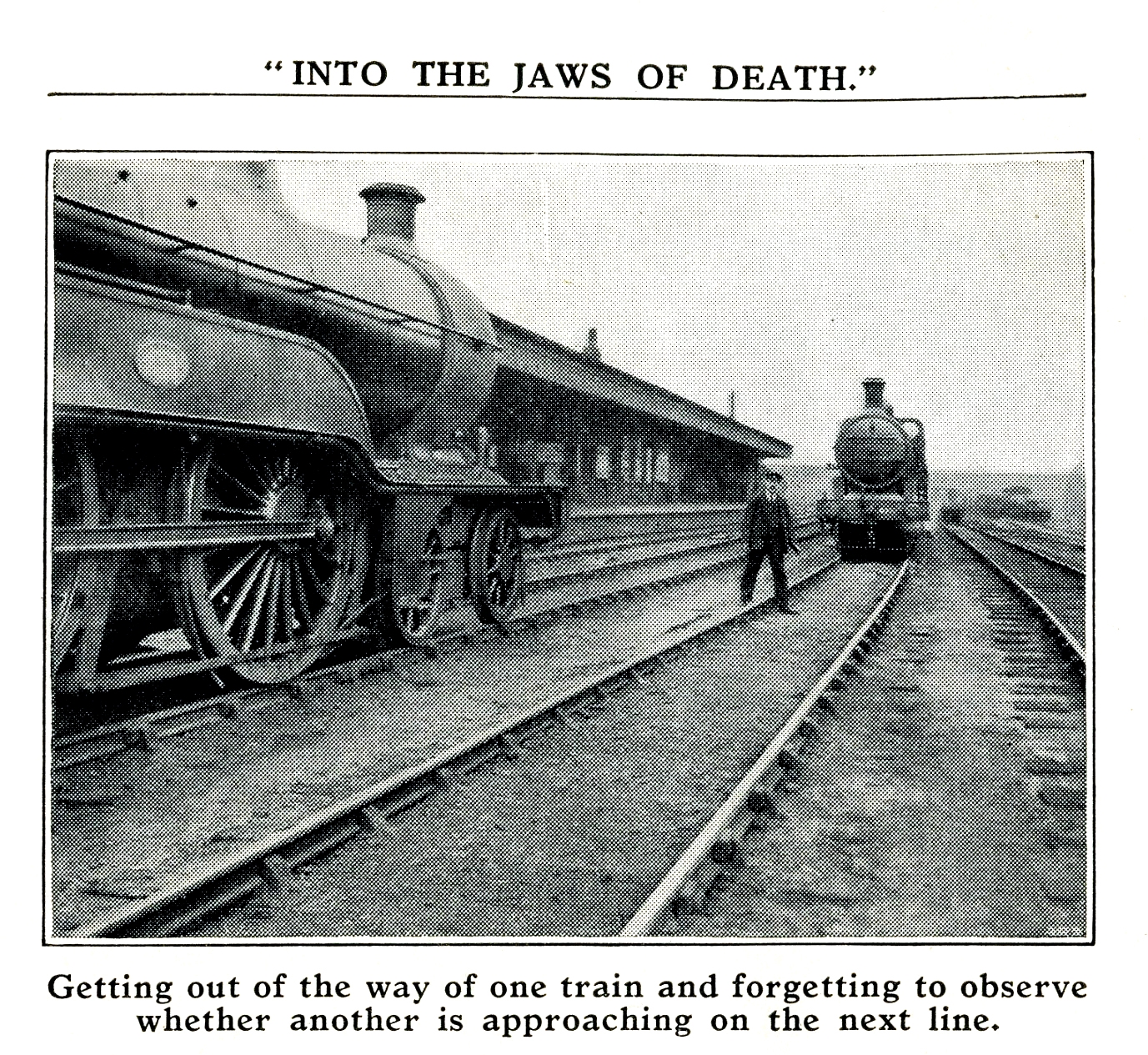 Cutting from a 1913 safety guide.
Image courtesy of Railway Work, Life & Death project
An Awful Sight.
George Read, of Epsom, said he was sitting on the seat on the platform. He saw the two men standing on the platform just as the express came in, and he saw nothing of them. Their intention was evidently to cross the line, and when they were struck they were facing the up platform. The postman had the bag over his left shoulder. —-By Mr. St. Lawrence: There was a subway leading from one platform to another. There were several notices about to warn passengers not to cross the line. He should say they had time to catch the train going through the subway.
Frederick Huckshaw, paper boy, said Capt. Randall bought a paper from him just as the up train was running in. He then stood on the edge of the platform and had plenty of time to have gone down the subway.
Harry Peerless, stationmaster at Epsom, said as soon as soon as Bines called out he went on to the line. He found the body of Capt. Randall a little distance away. He was lying with his head under him, and his neck was broken. Twenty-five yards further on he found half of the body of Williams and the other half was lying immediately under the wall of the down platform, 10 yards further on. People were in the habit of crossing the line, but the officials did all they could to check them. He often got insulted for telling passengers to use the subway. Williams was always most careful in crossing the line. The men would have had time to go down the subway, as the up train had two minutes wait for time.—By Mr. St. Lawrence: Postman had the run of a station pretty much the same as a porter. Williams would know the up train would wait two minutes.
The Foreman said the construction of the up platform offered an inducement for passengers to cross the line.—Mr. Peerless said the slope was so constructed in order that they could roll milk churns down.—P.C. Page said he removed the bodies to the mortuary. Capt. Randall was lying in the four-foot way, about 15 yards west from the crossing. Williams’ head and shoulders lay between the platform and the rail 26 yards away, and the remaining part of his body was another 25 to 30 yards farther on in the four-foot way.
The jury returned a verdict of death from misadventure, and considered no blame or negligence was attributable to any of the railway officials. They also expressed the opinion that some penalty should be enforced to prevent persons crossing the line in future.—Mr. St. Lawrence said the company already possessed that power, and were continually prosecuting people for crossing the line. He wished to express the deep sympathy of the directors at the sad occurrence.
The funeral of Mr. William Williams took place on Monday afternoon at he cemetery. Hundreds of people were present at the cemetery, and lined the route, thus testifying to the respect in which the deceased was held, and the intensity of the sorrowful feeling evoked by the terribly sad accident. About 100 postmen walked behind the hearse, and the coffin was carried by four of the deceased comrades—Messrs. T. Humphrey, W. Dumbrill, J. Cowland and F.J. Payne. All the postmen from the local district, which includes Epsom, Ashtead, Banstead, Tadworth and Walton-on-the Hill were present, and postmen from Leatherhead, Sutton and Carshalton also attended. In addition there were representatives of the Liberal Club, Epsom Football Club and Epsom Harriers, and a number of railway officials. The Rev. W.A. Haslem conducted the service which was of a most impressive character. The floral tributes included handsome wreaths from the Epsom branch of the Postmen’s Federation, the Sutton Post Office staff, the Banstead Post Office staff, the Epsom Football Club and the Epsom Liberal Club.
The funeral of the late Captain Randall took place at Golder’s Green Crematorium, Hampstead, on Saturday.
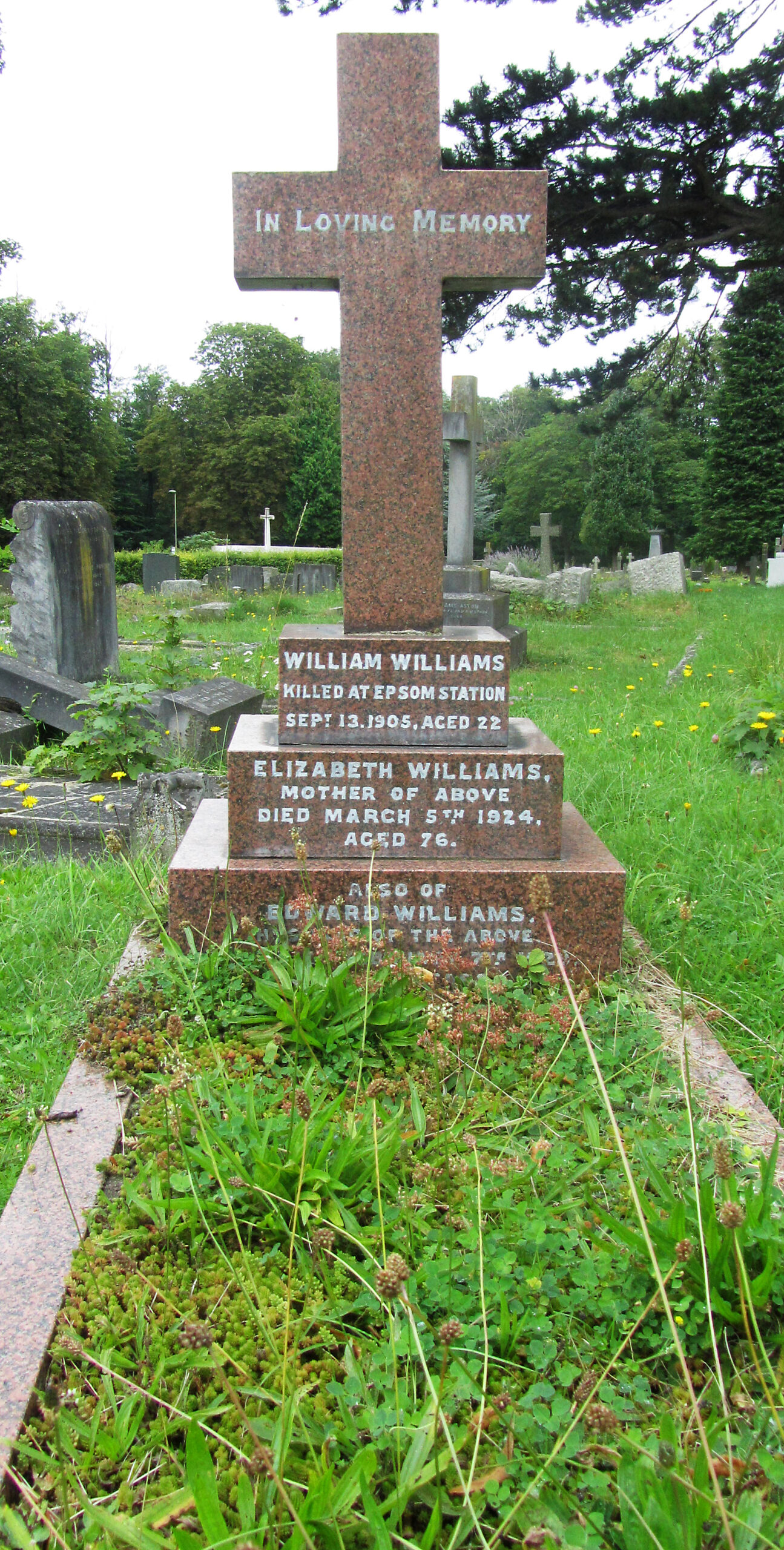 The Williams Family Grave (A244A) in Epsom Cemetery.
The plot was purchased by Edward Williams,
a builder of 30 Victoria Place, Epsom.
Image courtesy of Clive Gilbert © 2022
Researched by Clive Gilbert 2022
You may also be interested in our railway accidents page and in our other Railway pages